
Tombstone Tuesday: America Waldo Bogle
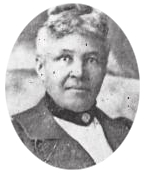 While researching this past weekend’s Surname Saturday article on the Waldo surname, I came across today’s subject. Her story is interesting and a bit intriguing, especially in regards to her parentage.
 America Waldo was born on June 2, 1844 in Missouri. For years it was purported that Daniel Waldo was America’s father. However, it appears that couldn’t be true because Daniel and his family left for Oregon in 1843. His single brother Joseph, however, remained in Missouri (later going to Oregon in 1846). It seems more plausible that America was the child of Joseph Waldo and an unnamed slave. Also of note is the fact that the 1840 census indicates that Daniel did not possess slaves at that time, although his two brothers did.

 This article is no longer available for free at this site. It was re-written and enhanced, complete with footnotes and sources and has been published in the January-February 2019 issue of Digging History Magazine. Should you prefer to purchase the article only, contact me for more information.
I invite you to check out Digging History Magazine. Since January 2018 new articles are published in a digital magazine (PDF) available by individual issue purchase or subscription (with three options). Most issues run between 70-85 pages, filled with articles of interest to history-lovers and genealogists — it’s all history, right? 🙂 No ads — just carefully-researched, well-written stories, complete with footnotes and sources.
Want to know more or try out a free issue? That’s easy if you have a minute or two. Here are the options (choose one):
- Scroll up to the upper right-hand corner of this page, provide your email to subscribe to the blog and a free issue will soon be on its way to your inbox.
- A free article index of issues is available in the magazine store, providing a brief synopsis of every article published in 2018. Note: You will have to create an account to obtain the free index (don’t worry — it’s easy!).
- Contact me directly and request either a free issue and/or the free article index. Happy to provide!
Thanks for stopping by!
Surname Saturday: Waldo
There are two theories as to the origins of the Waldo surname. One source believes the surname is Low German, the name having first been seen there in the thirteenth century along the Franconian-Bavarian border. It is believed that the name is one of the oldest in Germany and also belongs to some of the wealthiest landowners of that time. The family’s ancestral castle was named Waldau. Spelling variations for this surname of Germanic origins include Waldau, Waldauer, Waldov, Waldow, Zumwalt and others.
The second theory points to a baptismal name which meant “son of Walter” and derived from the Old Norman name “Valporfr”. Early records list someone (without surname) in the Domesday Book of 1086 as “Walteif.” Later Adam Walthef was recorded in Yorkshire in 1219 and Thomas de Walthe was recorded in Sussex in the next century. Spelling variations include Walthew, Waldie, Walde, Watthey, Waddy, Wealthy and Wilthew.
Peter Waldo
One of the early historic figures bearing this surname was Peter Waldo, a merchant who later became a minister in Lyon (France). The Christian sect he founded, the “Waldensians”, adhered to a strict interpretation of scriptures as well as advocating voluntary poverty.
Another minister made his mark on American history after living to be one of only six remaining Revolutionary War veterans to be interviewed and photographed for a history book published in 1864, entitled The Last Men of the Revolution.
Daniel Waldo
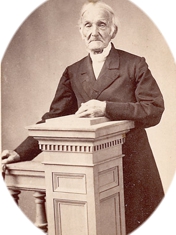 Daniel Waldo was born on September 10, 1762 in Windham, Connecticut to parents Zacheus and Tabitha (Kingsbury) Waldo. He was the ninth of thirteen children. His great-great grandfather, Deacon Cornelius Waldo, was one of the earliest Waldos to arrive in America, landing at Ipswich, Massachusetts in 1654. Daniel’s great-grandmother was an Adams with direct ties to the family of Presidents John and John Quincy Adams.
In 1778, at the age of sixteen, Daniel joined the Continental Army. The following year he was taken prisoner by the Tories in Horseneck, Connecticut. He was later taken to New York along with other members of him company. There they were imprisoned in Sugar House, a sugar refinery, but released in a prisoner exchange two months later.
Around the age of twenty Daniel became a Christian and decided to devote his life to ministry. He enrolled at Yale University and graduated in 1788 with an M.A. in theology. He was licensed to preach the following year on October 13, 1789 and on May 24, 1792 was ordained. He married Nancy Hanchett and together they had five children. However, in 1805 she became insane but lived until 1855. Daniel would later remark, “I lived fifty years with a crazy wife.”
He continued serving as both a minster and missionary and in 1856, at the age of ninety-four, was appointed as Chaplain of the House of Representatives. During his tenure he officiated at the funeral of Preston Brooks who famously assaulted fellow representative Charles Sumner on the House floor over the issue of whether Kansas would be admitted as slave or free state (click here to read an article addressing the controversy). During his tenure with Congress, Daniel Waldo spent a lot of time reading, and was heard to say of congressional proceedings that he didn’t wish to hear “the quarrels in the House.”
Although he believed that the Union Army would prevail in the Civil War and he deemed President Lincoln an honest man, though not decisive enough, “he thought that the leaders of the rebellion should be dealt with in such a manner that no one would dare, in the future, to repeat the experiment.” In his closing years, Daniel lived with his eldest son while still serving as the House Chaplain. After falling down a flight of stairs, Daniel Waldo died on July 30, 1864, just a few weeks short of his 102nd birthday.
Another minister, Elias Hillard, had earlier set out to locate the last six surviving veterans of the Revolutionary War, all of them over the age of one hundred. The nation was still fighting the Civil War, but Hillard was determined to interview the six veterans and photograph them. At the time, Hillard remarked, “our own are the last eyes that will look on men who looked on Washington; our ears the last that will hear the living voices of those who heard his words.” Daniel Waldo was one of the six remaining veterans, although he never met or saw George Washington in person.
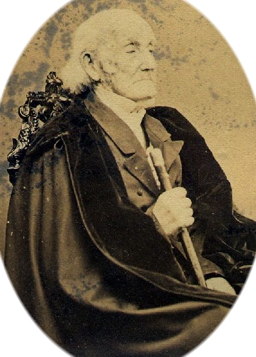 Hillard wrote of Daniel’s philosophy of life, perhaps his secret to longevity:
In his personal habits, Mr. Waldo was very careful and regular. His standing advice was to “eat little.” He drank tea and coffee. The control of the temper he deemed one of the most important conditions of health, declaring that a fit of passion does more to break down the constitution than a fever. His mental vigor he retained wonderfully to the last. His memory was excellent, differing from that of most aged people, in that he retained current events with the same clearness as the earlier incidents of his history.
To close his sketch of Daniel Waldo, Elias Hillard quoted a friend of Daniel’s:
Mr. Waldo possessed naturally a clear, sound, well balanced mind, with little of the metaphysical or the imaginative. He was a great reader, eagerly devouring every work of interest that came within his reach. His spirit was eminently kind and genial, and this, united with his keen wit and large stores of general knowledge, made him a most agreeable companion.
He was one of the most contented of mortals. Though he experienced many severe afflictions, and had always from an early period of his ministry one of the heaviest burdens of domestic sorrow resting upon him, his calm confidence in God never forsook him, nor was he ever heard to utter a murmuring word. As a preacher, he was luminous, direct, and eminently practical; his manner was simple and earnest, and well fitted to command attention. At the close of a life of more than a hundred years, there is no passage in his history which those who loved him would wish to have erased.
Did you enjoy this article? Yes? Check out Digging History Magazine. Since January 2018 new articles are published in a digital magazine (PDF) available by individual issue purchase or subscription (with three options). Most issues run between 70-85 pages, filled with articles of interest to history-lovers and genealogists — it’s all history, right? 🙂 No ads — just carefully-researched, well-written stories, complete with footnotes and sources.
Want to know more or try out a free issue? You can download either (or both) of the January-February 2019 and March-April 2019 issues here: https://digging-history.com/free-samples/
Thanks for stopping by!
Feisty Females: Mercy Otis Warren
 Tomorrow marks the 226th anniversary of the United States Constitution’s ratification when New Hampshire became the ninth state to approve. In honor of that occasion, today’s “feisty female” is a woman whose writings no doubt helped shape that historic document. Her activism both before and during the Revolutionary War served to rally the cause for liberty from British tyranny.
Mercy Otis was born on September 14, 1728 in West Barnstable (Cape Cod) to parents James and Mary (neè Allyne) Otis. Her father was an industrious and prosperous merchant, attorney and judge who fared well enough to send his sons to Harvard. While education was neither encouraged nor mandated in that day for girls, Mercy managed to receive an informal education, by accompanying her brothers who were tutored by their uncle Reverend Jonathan Russell. She was allowed to study side-by-side with her brothers all subjects except Latin and Greek.
In many ways the path that Mercy chose was an unusual one for a young woman of that day. Her education broadened her horizons beyond that of the normally expected role of wife and mother (she didn’t marry until her mid-twenties). She possessed a quick-wit and enjoyed freewheeling political discussions with her father and brothers.
In 1754 she married James Warren and moved to Plymouth. James and Mercy had five sons: James (1757), Winslow (1759), Charles (1762), Henry (1764) and George (1766). While embracing a traditional role of wife and mother, Mercy continued to further her education as an avid reader of literature.
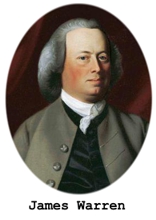 James Warren became involved in politics after being elected to the Massachusetts House of Representatives, later serving as the Speaker of the House and President of the Massachusetts Provincial Congress. Mercy supported her husband throughout his political career, becoming more active in civic and political affairs as acts of British tyranny increased. Their home was a meeting place for those of like-minded beliefs to gather and debate. At some point the Warrens made the acquaintance of John and Abigail Adams, and thereafter Mercy corresponded regularly with them. Although Mercy was sixteen years older than Abigail, the two became close friends and confidants.
When Mercy began writing and publishing around 1772, she did so anonymously. She wrote plays and published propaganda-type articles in the newspapers – her husband referred to her as a “scribbler.” The colonists were establishing de facto “shadow governments” called “Committees of Correspondence.” In November of 1772 the Massachusetts Committee of Correspondence was formed in the Warren’s home by Samuel Adams and Joseph Warren. Years later Mercy wrote that these committees were so effective that “no single step contributed so much to cement the union of the colonies.”
The only play she wrote under her own name was The Group, a satire about what would happen if the King took away Massachusetts’ charter of rights. Mercy wasn’t the only member of her family to engage in political activism. Her brother James adamantly opposed British policies and coined the phrase “taxation without representation is tyranny.”
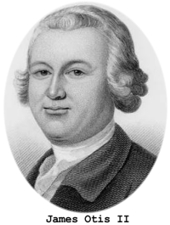 His activism put him in danger – he was attacked and severely beaten in a Boston coffee house in 1769. He never recovered from the brain injuries, slowly slipping into insanity. While under the care of his sister Mercy in 1775, and after hearing of the Battles of Lexington and Concord, he ran away and joined the militia to fight in the Battle of Bunker Hill. After the war, he moved to Andover and died in 1783 after being struck by lightning.
James Warren was appointed as a Major General in 1776 and also served as the Paymaster General of the Continental Army from 1776 to 1781. In his absence, Mercy was in charge of family affairs back in Plymouth, where she continued to write in support of the revolution. After the war, however, Mercy and James Warren fell out of favor with their friends John and Samuel Adams. As the new government was being formed following the war, Mercy argued against the federalists in favor of self-rule.
In 1788 she published a pamphlet entitled Observations on the New Constitution which expressed her strong anti-federalist (opposed to a central government) beliefs. Although unsuccessful in preventing the ratification of the Constitution, some historians believe the pamphlet may have influenced the later inclusion of the Bill of Rights which were adopted in 1789.
In 1805 Mercy published a three-volume book entitled History of the Rise, Progress and Termination of the American Revolution. Her work is set apart as one of the most knowledgeable and comprehensive histories written about the Revolutionary War, and the only written by a woman. The book was prefaced by her still-strong patriotic sentiments: “every domestic enjoyment depends on the unimpaired possession of civil and religious liberty.” The book further widened the schism in her relationship with John Adams, resulting in heated correspondence going back and forth until 1812. Adams believed he had been slighted and passed it off with a remark aimed at his antagonist: “history is not the Providence of Ladies.”
After returning from the war, James Warren, having fallen out of favor with leaders who were forming the new government, was prevented from holding office again. He died on November 28, 1808. On October 19, 1814, Mercy Otis Warren died at the age of eighty-six. She is buried at Burial Hill in Plymouth. Her activism in support of liberty earned her a place in the National Women’s Hall of Fame, as well as a World War II liberty ship named in her honor, the SS Mercy Warren.
Did you enjoy this article? Yes? Check out Digging History Magazine. Since January 2018 new articles are published in a digital magazine (PDF) available by individual issue purchase or subscription (with three options). Most issues run between 70-85 pages, filled with articles of interest to history-lovers and genealogists — it’s all history, right? 🙂 No ads — just carefully-researched, well-written stories, complete with footnotes and sources.
Want to know more or try out a free issue? You can download either (or both) of the January-February 2019 and March-April 2019 issues here: https://digging-history.com/free-samples/
Thanks for stopping by!
Ghost Town Wednesday: Maiden, Montana
 In 1880 five prospectors, “Skookum Joe” Anderson, c.c. Snow, Eugene Ervin, Pony McPartland, and David Jones, discovered gold in the Judith Mountains near Lewiston, Montana. There are at least two theories as to how the mining town they founded got its name. One story says that one of the early prospectors was named Maden and put up a sign calling the location “Camp Maden” – and later an “i” was added to make it Maiden. Another theory is that the town was named after a friend’s daughter who was referred to as “Little Maiden.”
Speaking of naming, here are some of the names attached to mines in the area: Tom Thumb, War Eagle, Sun Dance, Yankee Blade, Little Rhoda, Jessie Trim, Maginnis, Collar, Kentucky, Maggie C. Weeden, Pilgrim, Hailstorm, Lone Star, Sucker State, Spotted Horse, Bamboo Chief, Crow Girl, Niagra, Treasure Box, Wolverine and many others. Unique names with equally unique histories I’m sure.
The Spotted Horse mine was by far the most productive mine, operating from 1881 until 1902 it yielded in excess of five million dollars in gold, with the largest yields coming during the early years when high-grade ore was being extracted. The Maginnis mine was opened in 1880 and worked at various intervals until 1899, and finally closed in 1909. Over the years Maginnis produced almost two million dollars in gold.
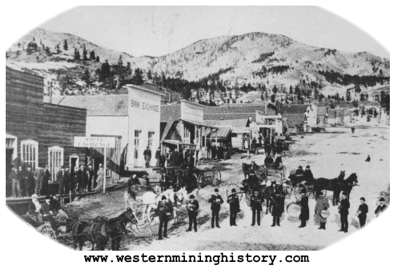 The town site was established in 1881, although neither platted nor surveyed. Instead lots were designated by selecting one and building a fence around it. News spread quickly and soon the town was booming. By 1882 there were several businesses, including saloons, clothing stores, general merchandise and dry-goods stores, a blacksmith, barbers, one law and one doctor’s office, hotel and restaurant. Obviously, cash was flowing from the influx of both independent prospectors and capitalists.
After capitalists began to enter the mining district, existing mines began to be extensively worked and mills were built to process the ore. Investors poured thousands of dollars into the Collar Company Mine to ascertain the possible yields. Unexpectedly, the mine closed in late 1883 after only a nine-day run. As it turned out, the collapse of the Collar Company was due to corporate mismanagement. The value of the mine had been overestimated and when expenses were more than expected, investors balked.
The failure of the mine was devastating to the town, since the company was basically bankrupt. That meant that employees wouldn’t be paid until a sale could be arranged. Another threat to the town’s prosperity had occurred earlier in 1883 when nearby Fort Maginnis (the town was situated within the fort’s reservation) posted an order requiring all residents to vacate Maiden. Protests were lodged and the army decided to instead reduce the size of the reservation to exclude Maiden and the surrounding mines.
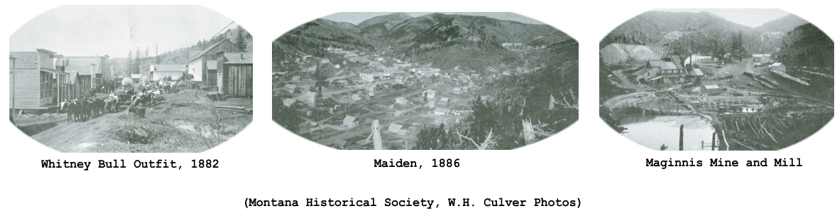
In June of 1884 investors formed the Maginnis Company. With new infusions of investment cash, mining picked back up and miners were put back to work, a boon to the town of Maiden. Not only was commerce booming but culturally the town had a brass and coronet band, as well as an amateur baseball team. Maiden would also become a stop for two stage routes.
In 1885 the new county of Fergus was created and Maiden vied for the honor of being the county seat, up against the cattle town of Lewiston. The rivalry brought boasts from both sides, but in the end Lewiston won the seat in 1886, with mining taking a back seat to the cattle and sheep industries. Even with the appearance of prosperity, the town of Maiden would continue to struggle as the realities of mining in a remote location began to sink in.
There were water shortages which forced the company to build a reservoir. Another complication was the remoteness of the area. Freight delivery was expensive with steeply-graded trails which were best traveled during the dry season. Over the next several years, the fortunes and misfortunes of mining operations would vacillate – some years better than others. After a time the higher-grade ore played out and with marginal qualities of ore being extracted in the mid-1890’s, the population began to dwindle.
In 1896 there were less than two hundred residents and many of the mines had closed. By the early 1900’s, towns like Lewiston prospered and grew while the mining towns were languishing. In 1905, a fire destroyed most of Maiden. With no interest in rebuilding, Maiden became a ghost town.
Did you enjoy this article? Yes? Check out Digging History Magazine. Since January 2018 new articles are published in a digital magazine (PDF) available by individual issue purchase or subscription (with three options). Most issues run between 70-85 pages, filled with articles of interest to history-lovers and genealogists — it’s all history, right? 🙂 No ads — just carefully-researched, well-written stories, complete with footnotes and sources.
Want to know more or try out a free issue? You can download either (or both) of the January-February 2019 and March-April 2019 issues here: https://digging-history.com/free-samples/
Thanks for stopping by!
Mining History Monday: Vermilion Lake Gold Rush
 During the nineteenth century thousands of people headed west to find their fortunes, but in 1865 gold was discovered in an unexpected place – in northern Minnesota, just south of the Canadian border. The discovery was more or less accidental since the original survey commissioned by Minnesota Governor Stephen Miller was meant to locate iron ore deposits.
In 1864 Miller sent Augustus Hanchett to the Lake Vermilion area of northern Minnesota “for the purpose of determining the existence, character and extent of the iron depots in that vicinity.” Hanchett began his survey in late September and soon confirmed the existence of deposits, but had little time to fully determine the quantities before winter set in.
The following year Governor Miller asked the legislature to fund a complete survey led by Henry Eames. Eames and his surveyors departed from Duluth in the spring and began to extensively survey Hanchett’s findings. Eames did indeed find iron ore and confirmed its presence but didn’t forward samples to the governor. Instead, Eames and his brother brought home samples containing quartz and then forwarded them to New York City for a chemical analysis. To ensure he would be the first to know the results of the analysis Eames ordered them sent to his attention. Not surprisingly, after receiving favorable results, Eames was eager to stake his claim.
Eames then forwarded samples of iron ore and quartz to the governor who ordered his own analysis. The findings were promising – the proportion of gold per ton was $25.63 and silver at $4.42 per ton. Governor Miller, like Eames, wanted the results telegraphed directly to him so that he would have personal knowledge before the general public. Thus, at least a week before the results were made public in the newspapers, he had already positioned himself to profit from the Lake Vermilion discovery.
In an article written for the Minnesota Humanities Commission, The Vermilion Lake Gold Rush, 1865-1866, Dana Miller observed that, of course, today such behavior would be unethical and illegal. However, the “gilded age” had begun, the period of time from 1865 to 1901 which was so-coined by Mark Twain. As Miller pointed out, these were perfectly acceptable practices and even thought to be “good business sense.”
The discovery of gold in those days caused waves of excitement no matter where it had been found. Before long newspapers across the country were reporting the news:
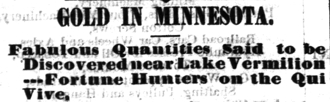
Even though the original estimates were less than thirty dollars per ton, speculations were already circulating as to the potential of fifty to sixty dollars per ton (without any apparent data to back it up). Daily news stories drove fortune hunters to Lake Vermilion, this despite the fact that the process of extracting the gold would be more difficult than that found in the West – some of the fortune-seekers even came from as far away as California. While there were plenty of individual miners, there were a number of small groups and corporations who wanted to invest time and money at Lake Vermilion.
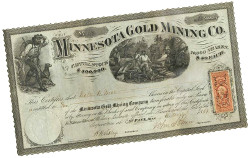 One company of twenty-five men each contributed $150 and formed the “Mutual Protection Gold Miner’s Company” (later adding twelve more partners). Thomas McLean Newson was the company’s president and founder. The “Mutuals” (as they called themselves) planned to travel to Vermilion to search for gold, but they also had plans to live there and “civilize” the place. Many of them were Civil War veterans who had muster pay to fund their venture. Newson, who served as a Major in the war, ran operations much like the military with an ordered chain of command.
One wonders now if these men really knew what they were getting into, for they departed on December 26, 1865, in the dead of winter. The group encountered dense forests with only a wilderness trail, deep snow drifts and temperatures well below zero. But the Mutuals, especially Newson, were so sure they would be successful that they pressed on and arrived on March 6, 1866. Newson summed up their journey for the St. Paul Pioneer:
The work of cutting a road was one of greater magnitude than the reader will imagine. Nearly the whole force of the Mutuals were engaged in it, and day after day from dawn to dark, slashed away at the big trees in their road, scarcely any of them less than a foot thick. Of course slow progress was made, and many discouragements met with, but they pressed on perseveringly and undaunted, and finally reached the end of their route safe and sound . . . No accidents happened to any of them on the entire trip; and every man was tougher, fitter and heavier than he had ever been before.
While waiting for the spring thaw, the Mutuals began planning their town. By April, Winston City had about three hundred men, two stores, several houses, a city hall which doubled as the company’s headquarters, and several saloons. The Mutuals weren’t the first to arrive, and their presence and persistence in quickly establishing their city was met with some opposition. One of their opponents referred to Newson as “Generalissimo High Cochilorun Chief”.
Gold discoveries often brought out the worst in people, however, and it became necessary to set rules of conduct. As the weather changed and became more spring-like, the winter snows melted, which in turn brought muddy, swampy conditions and mosquitoes. Those conditions also made it especially difficult for supplies to be transported to the area.
By summer there were as many as five hundred men in the area and miners were working all around the area. It appears, though, that the work proved to be more difficult than most imagined. A full day’s sweat and toil may only have yielded precious few inches toward their goal. Even with less than encouraging results, the Mutuals continued to issue optimistic reports. However, as winter approached the realities of facing a harsh winter in such a remote location without tangible results caused many of the Mutuals to abandon the project and return home.
When the next spring arrived, some prospectors returned, although not in the numbers seen in 1866. It wasn’t even news any longer as newspapers had very little to say about the Vermilion “gold rush.” By 1868, what “rush” there had been was over.
Afterwards, critics claimed there never was any gold at Lake Vermilion, although Henry Eames had been so sure that gold did indeed exist there. Since early on he sought to profit from the government-funded survey, perhaps greed was part of the problem. After all, the original purpose of the survey had been to approximate the iron ore potential of the area, not the discovery of gold or other precious minerals. Their hopes and desires for fortune were likely influenced by the wildly successful gold rushes out West. However, prospecting gold in California with a pan down by the river was infinitely less physical work than what miners encountered at Vermilion.
Later, iron ore would indeed be discovered, as it turned out, by miners on their way to find gold.
Did you enjoy this article? Yes? Check out Digging History Magazine. Since January 2018 new articles are published in a digital magazine (PDF) available by individual issue purchase or subscription (with three options). Most issues run between 70-85 pages, filled with articles of interest to history-lovers and genealogists — it’s all history, right? 🙂 No ads — just carefully-researched, well-written stories, complete with footnotes and sources.
Want to know more or try out a free issue? You can download either (or both) of the January-February 2019 and March-April 2019 issues here: https://digging-history.com/free-samples/
Thanks for stopping by!
Surname Saturday: Keep
Like many surnames of Early or Middle English origin, the spelling of the Keep surname evolved over time. These names were recorded, beginning in the fourteenth century:
Walter Kep (1230)
John Kepe (1290)
William atte Kep (1290)
Thomas ate Kepe (1327)
Robert de Keepe (1332)
William Keppe (1583)
Henry de Keepe (1611)
Mary Keep (1681)
One family historian discovered that during the eleventh century (before William the Conqueror’s invasion), the name was spelled “Cheppe”.
It is possible the name was either residential or occupational. If residential it might describe a person who lived at a castle (de Keep), or if occupational it may refer to someone who was a jailer. In Middle English the word “keep” derived from the verb “keepen,” meaning to hold or defend.
Keep family historians believe that John Keep of Longmeadow, Massachusetts was the progenitor of all Keeps in America, although the date of his arrival is unknown. With the advent of DNA testing, a link has been established to link John Keep with an early ancestor, Walter Kep (1230), he of the East Midland Keeps (Bedfordshire, Northamptonshire and Birmingham).
John Keep
The birth date of John Keep, as well as his arrival in New England, is unknown. The Great Migration of those fleeing religious persecution began in 1620 and continued through the early 1640’s. If John was indeed one of the early immigrants, wherever he landed he would have been faced with the dangers and challenges which all Pilgrims encountered, of which there are extensive historical records.
What is known is that at some point, perhaps in 1660 or just before, John moved inland to the town of Springfield. On February 18, 1660 it was recorded in town records: “John Keepe desiring entertaynmt in this Towne as an Inhabitant his desires were granted by the Select men ye day above said.” Springfield was a closed settlement and at that meeting John had been granted residence.
Less than a month later on March 13, John was granted five acres of meadow land, and over the ensuing years records indicate he acquired more. It is also evident from town records, that John Keep was a prominent citizen and held various offices in his community. On February 11, 1666 it was noted:
There was choise made of veuars of fences for the severall ffields. John Keepe and Samuel bliss veiwers for the long medo and the Home Lotts as far as the meeting house.
A fence viewer had authority to administer fence laws and would have inspected new fence and helped to settle disputes such as livestock trespassing on a neighbor’s land. He later was appointed to the office of surveyor and court records indicate he served as a juror at various times. Thus, he was obviously a prominent member of the town and considered to have good judgment.
On December 31, 1663, John married Sarah Leonard and to their marriage were born:
Sarah (1666)
Elizabeth (1668, died in 1675)
Samuel (1670)
Hannah (1673)
Jabez (1675, killed by Indians in 1676)
In 1676 youngest son Jabez, along with John and Sarah, met their untimely deaths. After Massasoit had died and his successor son Wamsutta also died, Philip became the leader of the Pokanokets. While his father had gotten along reasonably well with the colonists, Philip had a distrust and hatred of the colonists (his brother Wamsutta had died in their custody). In June of 1675 King Philip’s War began with an attack on the Plymouth colony of Swansea, killing ten colonists.
In October Springfield was attacked and several houses and barns were burned, but Longmeadow was spared. The English retaliated on December 19 by attacking an Indian winter camp where several hundred Indian women, children and elderly were burned to death. The dangers were so great during the winter of 1675-1676 that residents of Longmeadow did not venture into Springfield to church. But, on Sunday, March 26, 1676 sixteen men on horseback intended to take their families, escorted by Captain Nixon, to church for the baptism of Jabez. It was a fateful decision, as recorded in the History of Hadley:
On Sunday, the 26th of March, some of the people of Longmeadow, men and women, with children, ventured to ride to Springfield to attend public worship, in company with several Colony troopers. There were 16 or 18 men in all, but some had women behind them, and some had children in their arms, and when they were near Pecowsic Brooks 7 or 8 Indians in the bushes fired upon the hindmost and killed a man and a maid, wounded others, and took two women with their babes, and retired into a swamp. Six are said to have been slain or mortally wounded. John Keep, his wife Sarah, and his infant son Jabez are three of them. (The names of the others are not in the Spring Field records.) Those forward rode some distance towards Springfield, set down the women and maids, and then returned, but could not find the two women and children.” A letter from Major Savage [to the Governor’s Council] dated at Hadley, 28 Mar 1676, states “On the 26th inst. we had advice from Springfield that 8 Indians assaulted 16 to 18 men besides women and children as they were going to meeting from a public place they call Longmeadow, and killed a man and a maid, wounded 2 men and carried away captive 2 women and 2 children. In the night I sent 16 horse in pursuit of them, who met with some that were sent from Springfield, and overtook the Indians with the captives, who as soon as they saw the English, killed the 2 children and sorely wounded the women in the heads with their hatchets and so ran away into the swamp where they could not follow them. The scouts brought back both the women and the children. One of the women remained still senseless by reason of her wounds and the other is very sensible and rational.
John, Sarah and Jabez were all killed and buried in Springfield. Their only remaining son, Samuel, would carry on the Keep family name. The Nutting family of Groton suffered a similar fate at the hands of Indians in 1676 as well (see this Surname Saturday article). The Nutting and Keep families would intermarry later.
Dr. Nathan Cooley Keep
This descendant of John Keep was born in Longmeadow on December 23, 1800. At the age of fifteen Nathan went to Newark, New Jersey to apprentice as a jeweler. He returned to Longmeadow and after becoming interested in dentistry, moved to Boston to attend Harvard Medical School, graduating in 1827.
During his forty-year dentistry practice, Nathan invented several dental tools and is credited with the development of porcelain teeth. He was also a practicing physician and in 1847 was the first doctor to use anesthesia during childbirth, administering it to Henry Wadsworth Longfellow’s wife Fanny.
In 1850 he participated in the Parkman murder trial in Boston. In November of 1849 Dr. George Parkman, he of one of the most prominent Boston families, vanished. A week after his disappearance a janitor found body parts hidden in the laboratory of chemistry professor John Webster.
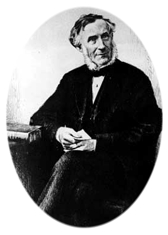 Nathan was Parkman’s dentist and was able to identify the “mineral teeth” found to be those of his patient. His emotional testimony was recorded by the New York Globe:
I was in New York at the time of Dr. Parkman’s disappearance, and received a letter stating that his artificial teeth had been found in the furnace of Prof. Webster’s laboratory. I soon afterward returned to Boston, and the teeth were brought to me, and I at once recognized them as the teeth which I had made for Dr. Parkman…. [Here the voice of Dr. Keep was frequently interrupted by sobs, and he was finally obliged to wait for some time, until his emotions would allow him to proceed.]… I was satisfied that the right upper teeth which were put into my hands by Dr. Lewis, were Dr. P’s. There could be no mistake about them.
With those words, the fate of mild-mannered professor John Webster was sealed. Webster was convicted and publicly hanged in Boston’s Leverett Square on August 30, 1850. With Nathan Keep’s testimony, the field of forensic dentistry had been introduced.
Did you enjoy this article? Yes? Check out Digging History Magazine. Since January 2018 new articles are published in a digital magazine (PDF) available by individual issue purchase or subscription (with three options). Most issues run between 70-85 pages, filled with articles of interest to history-lovers and genealogists — it’s all history, right? 🙂 No ads — just carefully-researched, well-written stories, complete with footnotes and sources.
Want to know more or try out a free issue? You can download either (or both) of the January-February 2019 and March-April 2019 issues here: https://digging-history.com/free-samples/
Thanks for stopping by!
Ghost Towns of the Mother Road: Valentine, Arizona
 The area around what became known as Valentine, Arizona was established in 1898 when President William McKinley set aside land for an Indian School. By the way, if you missed Monday’s article about “Henry P. Ewing, The Blind Miner,” check it out here. Henry was the first superintendent of the Indian School.
The location was first named Truxton for some landmarks (named after a local family), but in 1910 the town name was officially changed to Valentine in honor of Robert G. Valentine, Commissioner of Indian Affairs. After the Indian School was built, a separate school for Anglo children was built, referred to as “The Red Schoolhouse.”
This article has been updated and published in the June 2018 issue of Digging History Magazine. Other articles in this issue include: “On a Whim and a Bet: America’s First Coast-to-Coast Road Trip”, “Victorian Pastimes: Girdling the Globe”, “Victorian Fashion: Bicycles, Bloomers and Suffrage”, and more. Preview the issue here or purchase here.
I invite you to check out Digging History Magazine. Since January 2018 new articles are published in a digital magazine (PDF) available by individual issue purchase or subscription (with three options). Most issues run between 70-85 pages, filled with articles of interest to history-lovers and genealogists — it’s all history, right? 🙂 No ads — just carefully-researched, well-written stories, complete with footnotes and sources.
Want to know more or try out a free issue? You can download either (or both) of the January-February 2019 and March-April 2019 issues here: https://digging-history.com/free-samples/
Thanks for stopping by!
Henry P. Ewing, The Blind Miner
 While researching possible topics for today’s article, I was thinking perhaps mining history and then ran across a link to a story about a blind miner in Mohave County, Arizona. Hmm … that sounds interesting, so I researched a bit further. Just the story about Henry Ewing as a blind miner is fascinating enough, but I thought there must be more to his story, and indeed there is. But, first the story of Henry P. Ewing, the blind miner.
The astonishing tale of a blind miner in Mohave County began to show up in the local newspaper in 1906 after Henry had a few mishaps. In his book Arizona, Prehistoric, Aboriginal, Pioneer, Modern: The Nation’s Youngest Commonwealth Within a Land of Ancient Culture, Volume 2, James McClintock had a short paragraph about Henry:
A Blind Miner and His Work
Mohave County has given the world many instances of rare courage in its pioneer days, but nothing finer than the tale how a blind miner, Henry Ewing, unaided sunk a shaft on his Nixie mine, near Vivian, not far from the present camp of Oatman. It was in 1904, after Ewing, a gentleman of culture, had lost his eyesight. Despite the warning of friends, he
This article is no longer available for free at this site. It was re-written and enhanced (5-page article), complete with footnotes and sources and has been published in the June 2018 issue of Digging History Magazine. Should you prefer to purchase the article only, contact me for more information.
Did you enjoy this article? Yes? Check out Digging History Magazine. Since January 2018 new articles are published in a digital magazine (PDF) available by individual issue purchase or subscription (with three options). Most issues run between 70-85 pages, filled with articles of interest to history-lovers and genealogists — it’s all history, right? 🙂 No ads — just carefully-researched, well-written stories, complete with footnotes and sources.
Want to know more or try out a free issue? That’s easy if you have a minute or two. Here are the options (choose one):
- Scroll up to the upper right-hand corner of this page, provide your email to subscribe to the blog and a free issue will soon be on its way to your inbox.
- A free article index of issues is available in the magazine store, providing a brief synopsis of every article published in 2018. Note: You will have to create an account to obtain the free index (don’t worry — it’s easy!).
- Contact me directly and request either a free issue and/or the free article index. Happy to provide!
Thanks for stopping by!
Surname Saturday: Frisbie
Today’s surname is easy to identify as to its origins. After the Norman Conquest in 1066 the name appeared as a locational name. The family lived in Leicestershire in a town called “Frisby” (no longer in existence). There is a village in Leicestershire today called “Frisby on the Wreake”, however.
According to one source, there are several towns in England called “Frisby” and all derive from “frisir,” an Old Norman word which meant someone from Frisia or Friesland. The earliest instance of this surname appeared in the Domesday Book of 1086 as “Frisebi” (without surname). In 1198, another “Frisebi,” again without surname, lived in Leicestershire. For the Yorkshire Poll Tax of 1379, the name “Robertus de Frysby” was recorded and William de Frisseby was the rector of Filby, County York in 1412.
Spelling variations include: Frisbie, Frisby, Frisbee, Frisebie, Frisebye, Friseby and others. At the time of the Revolutionary War there were as many as fifteen spelling variations of this surname.
Richard Frisbie
Records and family histories appear to indicate that Richard Frisbie immigrated to Virginia from England in 1620. It is believed that Richard was born in 1591 in St. James, Clerkenwell, London, England. Most family genealogists believe that Richard married Margaret Emerson on November 30, 1618. In 1619 their first child Mary was born and christened on November 7 in St. James. It seems a bit uncertain as to when their next child, Edward, was born. Some say he was born in 1620 in England and others believe he was born in Virginia in 1621 after Richard and Margaret immigrated there.
What is known is that Richard departed in February of 1620 on board the Jonathan which carried two hundred passengers. The ship reached Jamestown on May 27, traveling fourteen weeks, losing twenty-five passengers and four crew members. One of the casualties appears to have been young Mary (or perhaps she died soon after arrival).
Some family historians speculate that perhaps Richard came over as a half-share tenant of the Virginia Company of London. If so, the terms would have included the Company paying the cost of his passage. In exchange he would have agreed to work for them for a certain number of years and during that time would receive half of what he produced. The crop he raised was likely tobacco.
Seven years was a common term for an indenture agreement at that time. That would have meant he was bound to the Company until 1627. However, in 1624 the Virginia Company’s charter was withdrawn by King James and placed directly under royal commission. Some speculate that his indenture agreement may have been voided as a result because Richard returned to London in 1625. At this time it appears that he and Margaret had at least two children, Edward and Ann.
Apparently their timing for returning to England was not good as there was a plague epidemic which would sicken Ann. She was buried in August of 1625. Another son, Richard, was born in 1626 and died in 1629. In 1628 twins Zechariah and Henry were born and both died in 1629 (although not the same date). Peter was born in 1630, George in 1633 (died in infancy) and Jane in 1634. It is believed that the family left to return to America in 1635 (Peter, however, was left behind in England for some reason).
There don’t seem to be any more records of Richard, Margaret or Jane. Some speculate they died soon after returning to Virginia or possibly died at sea, leaving fourteen year-old Edward as the family’s sole survivor. Therefore, Edward Frisbie is considered the progenitor of all Frisbies born in America.
Edward Frisbie
Family historians record that Edward, after being banished from the Virginia Colony for his Puritan beliefs, removed to the New Haven Colony in 1644, settling in Branford, Connecticut. Edward married Hannah Rose (or Hannah Rose Culpepper) in Branford in 1649. Eleven children were born to their marriage, including a set of twins:
John – 1650
Edward – 1652
Samuel – 1654
Benoni – 1656
Abigail – 1657
Jonathan – 1659
Josiah – 1661
Caleb – 1666
Hannah – 1669
Silence – 1672
Ebenezer – 1672
All their children lived to adulthood and died in Branford. Some historians have speculated that Edward had more than one wife, but others indicate that Hannah lived until 1690. He was apparently a wealthy landowner since in his will there are references to several tracts of land in Branford. His estate was inventoried on May 26, 1690 – his surname signed as “Frisbye”.
Many of Edward’s Connecticut descendants served in the Revolutionary War. As noted above there were several spelling variations, including: Frisby, Frissbee, Fruisbie, Frisbee, Fresbee, Fresbie, Frisbe, Frisbea, Frisbees, Frisbies and Frisbey.
William Russell and Joseph P. Frisbie
No article about the Frisbie family would be complete without the story of how the round disk known as the “Frisbee” came to be. Historians trace it back to 1871 when William Russell Frisbie moved to Bridgeport from Branford, Connecticut (he, obviously a descendant of Edward). His father Russell operated a grist mill in Bridgeport and William took a job managing the local branch of the Olds Baking Company.
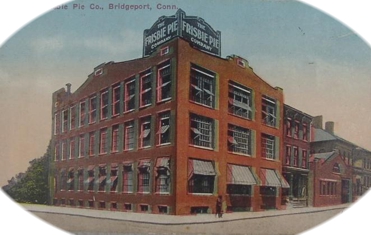 William later purchased the bakery and changed the name to “Frisbie Pie Company”. Upon his death in 1903, his son Joseph took over management of the company. Under Joseph’s leadership the company grew from six routes to two hundred fifty, opening stores in Hartford, Poughkeepsie, New York and Providence, Rhode Island. In his book What’s in a Name?, Philip Dodd describes Joseph’s inventions and management practices:
The family house became the site of a factory with baking rooms, delivery bays and new machinery, much of it invented by Joseph P., who preferred to custom-design and build his own equipment: a pie rimmer using the principle of the potter’s wheel, meat tenderers, a cruster that could process eighty pies a minute. Since there was no electricity for the bakery, he had a power plant constructed in the basement.
He had high standards of cleanliness and hygiene, a trait learned from his father. The deliverymen in their fleet of trucks and the factory staff wore snappy uniforms, the salesmen crisp jackets with bow ties and peaked caps. They had good wares to sell, up to thirty varieties of individual and family-size pies, delivered hot to a network of grocery stores.
Production levels steadily increased and by 1940 the bakery was churning out two hundred thousand pies a day, employing almost eight hundred workers. Joseph had a heart attack in the 1930’s and in 1941 he passed away at the age of sixty-three. His widow Marion ran the business for several years until it was sold in 1958.

One historian believes that the company’s truck drivers were the first to toss Frisbie Pie tins on the loading docks when they had down time. The tins were engraved with “Frisbie’s Pies” and had six small holes, centered in a star pattern, so that the tin would “hum” as it flew. It is believed that the “sport” of Frisbie migrated to several Eastern colleges, perhaps first at Yale. Students would shout “Frisbie!” to warn of the incoming pie tin – a new sport called “Frisbie-ing” had been invented.

Sometime in the mid-1940’s two men, Walter “Fred” Morrison and Warren Franscioni, saw possibilities in marketing a plastic flying disk. Their first version was called “The Flyin’ Saucer” and wildly popular cartoon character Lil’ Abner was used to sell it. After their efforts failed, Morrison launched his own version in 1955, calling it the “Pluto Platter Flying Saucer.”

That version caught the eye of executives at Wham-O and, as the old saying goes, the rest is history. Wham-O changed the spelling and on January 13, 1957 the Frisbee was introduced to the world. Since 1957 over two hundred million Frisbees have been sold – all attributable to a Bridgeport, Connecticut pie company run by the Frisbie family which could, of course, be traced all the way back to immigrant Edward Frisbie.
Did you enjoy this article? Yes? Check out Digging History Magazine. Since January 2018 new articles are published in a digital magazine (PDF) available by individual issue purchase or subscription (with three options). Most issues run between 70-85 pages, filled with articles of interest to history-lovers and genealogists — it’s all history, right? 🙂 No ads — just carefully-researched, well-written stories, complete with footnotes and sources.
Want to know more or try out a free issue? You can download either (or both) of the January-February 2019 and March-April 2019 issues here: https://digging-history.com/free-samples/
Thanks for stopping by!
Feisty Females: Bessie Coleman
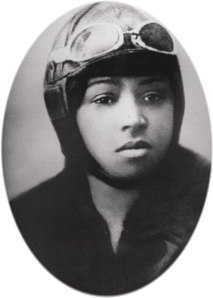 Elizabeth “Bessie” Coleman was born on January 26, 1892 to parents George and Susan Coleman, she being the tenth of their thirteen children. George Coleman was part African American and part Cherokee, a sharecropper in Atlanta, Texas which had been settled by former Georgia residents. While there were opportunities to make money in the local industries (railroads, oil, lumber), the Coleman family struggled. George moved his family to Waxahachie in 1894, hoping to do better for himself and his family.
George purchased a quarter-acre plot of land and built a small three-room house in the black section of Waxahachie. By all accounts, Bessie’s early childhood was a happy one. She began school at the age of six and walked four miles each day to the all-black school where she excelled, especially in math.
In 1901, George Coleman left his family and headed to Indian Territory (Oklahoma) to pursue better opportunities, citing racial barriers too difficult to overcome in Texas. Susan, however, refused to accompany him and was left with four girls under the age of nine after her older sons also left home. Susan obtained employment as a cook and housekeeper. The family she worked for allowed her to live in her own home and also provided clothing for the girls.
Their routine, however, was disrupted every year when the Coleman family participated in the cotton harvest. Bessie continued to excel in school and when she had completed the eighth grade (probably all the primary education available to her at the time), she saved her money and entered the Colored Agricultural and Normal University in Langston, Oklahoma in 1910. Her money was exhausted after one term and she returned to Waxahachie where she worked as a laundress. By 1915 Bessie Coleman wanted more out of life so she headed to Chicago where her brother Walter lived.
She found work as a manicurist in the White Sox Barbershop and Susan and her remaining children joined her in 1918. Her brothers came home after World War I with war stories, including those of French female pilots. In 1919 the worst race riot in history took place in Chicago and Bessie would soon conclude she wanted something more out of life. Her ambition was to become a pilot like the French women her brothers boasted about.
At the age of twenty-seven she began pursuing a career in aviation, but first she had to find someone willing to train her. However, for a black woman those opportunities just didn’t exist in America at that time. Still determined to pursue her dream of becoming a pilot she obtained funding and a passport and headed to France in November of 1920.

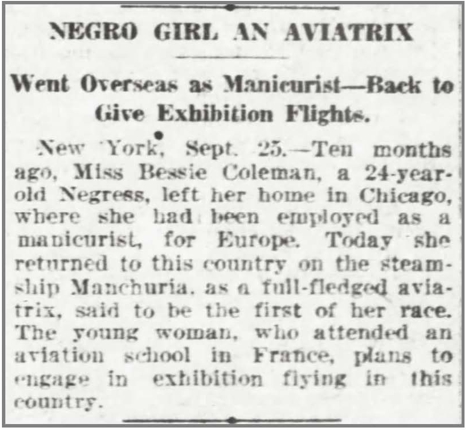
The course, taught at Ecole d’Aviation des Freres Caudon, was normally ten months in length – Bessie completed it in seven. On June 15, 1921 Bessie Coleman received her pilot’s license from the Federation Aeronautique Internationale. She was the first black person, male or female, ever to do so and the only woman of the sixty-two candidates that year eligible for licensing.
Upon her return to America in September she received widespread press coverage:
At that time in history flight exhibitions were a popular form of entertainment in the United States. Lacking skills to perform as a stunt pilot at those shows, Bessie returned to France for more training. She returned to the States in August of 1922, and on September 3 she was billed as “the world’s greatest woman flier” at an event held at Curtiss Field in New York City. Six weeks later she returned to Chicago to enthrall a crowd at the Checkerboard Airdome (now Midway Airport).
She continued to work as a stunt flier, but still had ambition to do more. Briefly she considered a movie career and traveled to California to earn money to purchase a plane of her own. She crashed the plane on February 22, 1923 and returned to Chicago to pursue her ultimate goal of opening her own flight school. It would take awhile to accomplish since along the way she had to overcome the barriers of both race and gender.
Back in Texas she began appearing in towns big and small across the state to give lectures and perform exhibitions. One stipulation she always insisted upon for her exhibitions – everyone, regardless of race, was to be admitted without being segregated. She was able to make a down payment on another plane and then continued lecturing in Georgia and Florida. Still planning to open a flight school, she also opened a beauty shop in Orlando to earn more money to put towards the flight school. Because she was still making payments on her plane, she borrowed planes and continued to perform exhibitions, even occasionally parachuting.
By spring of 1926 she had finally made the final payment on her plane and arranged to have it flown to Jacksonville, Florida where she would be performing on May 1. On April 30, Bessie and her mechanic took the plane up for a test flight. The mechanic was piloting and suddenly lost control of the plane. Bessie, who was not wearing her seat belt, was thrown from the open cockpit, plummeting two thousand feet to her death. The plane crashed and burned, killing the mechanic as well. It was later discovered that a wrench had accidentally slid into the gearbox, jamming it.
Bessie Coleman died on April 30, 1926 at the age of thirty-four. Her body was returned to Chicago for burial and several thousand mourners paid their respects. She would later have buildings and streets named in her honor. In 1995 the United States Postal Service honored her with a commemorative stamp. The accompanying resolution stated, “Bessie Coleman continues to inspire untold thousands even millions of young persons with her sense of adventure, her positive attitude, and her determination to succeed.”
Earlier this year I wrote an article about “Feisty Female” Cornelia Clark Fort, another pioneering aviator. If you haven’t yet read that article, check it out here. Also, Fannie Flagg’s latest book is a great read and loosely based on Cornelia’s story.
Did you enjoy this article? Yes? Check out Digging History Magazine. Since January 2018 new articles are published in a digital magazine (PDF) available by individual issue purchase or subscription (with three options). Most issues run between 70-85 pages, filled with articles of interest to history-lovers and genealogists — it’s all history, right? 🙂 No ads — just carefully-researched, well-written stories, complete with footnotes and sources.
Want to know more or try out a free issue? You can download either (or both) of the January-February 2019 and March-April 2019 issues here: https://digging-history.com/free-samples/
Thanks for stopping by!