
Far-Out Friday: The Great Airship Hoax
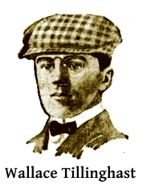 Orville and Wilbur Wright had made headlines six years earlier at Kitty Hawk, North Carolina with their “flying machine.” However, from mid December of 1909 to late January 1910, newspapers across the country perpetrated, and later renounced, a farcical tale which came to be called The Great Airship Hoax.

 This article has been removed from the web site but will be updated, complete with footnotes and sources and featured in an upcoming issue of Digging History Magazine. History is full of all kinds of hoaxes, schemes and frauds and the upcoming issue will highlight many of them which occurred during the Victorian Era (“O, Victoria, You’ve Been Duped!”). If you’re a genealogist, there are genealogical fraud instances which merit caution. These were featured in an article entitled, “Don’t Be Duped: Genealogical Fraud”, and published in the February 2018 issue of Digging History Magazine. The issue also includes a list of surnames which might be “suspect”.
I invite you to check out Digging History Magazine. Since January 2018 new articles are published in a digital magazine (PDF) available by individual issue purchase or subscription (with three options). Most issues run between 70-85 pages, filled with articles of interest to history-lovers and genealogists — it’s all history, right? 🙂 No ads, just carefully-researched stories, complete with footnotes and sources.
Want to know more or try out a free issue? That’s easy if you have a minute or two. Here are the options (choose one):
- Scroll up to the upper right-hand corner of this page, provide your email to subscribe to the blog and a free issue will soon be on its way to your inbox.
- A free article index of issues is available in the magazine store, providing a brief synopsis of every article published in 2018. Note: You will have to create an account to obtain the free index (don’t worry — it’s easy!).
- Contact me directly and request either a free issue and/or the free article index. Happy to provide!
Thanks for stopping by!
Ghost Town Wednesday: Brilliant, New Mexico
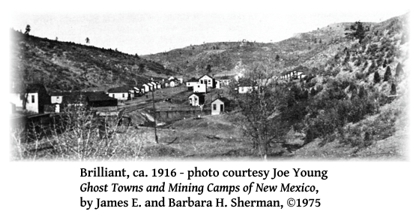 Unfortunately, there is probably little left to see, if any, of this once-bustling coal mining town in northern New Mexico. You could perhaps view the location of the old town site if you shell out $450 per night to stay in media mogul Ted Turner’s hunting preserve. The sites that were once the towns of Gardiner, Brilliant, Blossburg and Swastika (see my article about Swastika here) are all part of the Vermejo Park Ranch. Most of the existing structures are said to have been bulldozed, although one might occasionally see an old coke oven here and there.
 This article is no longer available for free at this site. It was re-written and enhanced with sources as part of an article entitled “Bullets, Barons, Boom and Bust: The Ghost Towns and Storied History of Colfax County”, published in the July-August 2020 issue of Digging History Magazine. Should you prefer to purchase the article only, contact me for more information.
I invite you to check out Digging History Magazine. Since January 2018 new articles are published in a digital magazine (PDF) available by individual issue purchase or subscription (with three options). Most issues run between 70-85 pages, filled with articles of interest to history-lovers and genealogists — it’s all history, right? ???? No ads — just carefully-researched, well-written stories, complete with footnotes and sources.
Want to know more or try out a free issue? You can download either (or both) of the January-February 2019 and March-April 2019 issues here: https://digging-history.com/free-samples/
Thanks for stopping by!
Tombstone Tuesday: The Ellison Family of Sumter County, South Carolina
 This family lived in Sumter County, South Carolina, and as the largest slaveholders in the state, were avid supporters of the Confederate cause. The patriarch of the family, William Holmes “April” Ellison, Jr. was a successful entrepreneur and readily offered the labor of his sixty-three slaves to the Confederate Army. Born into slavery, William had been freed on June 8, 1816 at the age of twenty-six by his master (and possibly his father) William Ellison.
It is believed that April Ellison was born in April of 1790, this due to the fact that often children born to slave parents were given the month of their birth as their name. Around the age of ten, April was apprenticed to William McCreight, and learned to build and repair cotton gins. He continued to work in McCreight’s shop until 1816 (even though his apprenticeship had ended after six years) and worked as a blacksmith, machinist and carpenter. During that time, April also learned how to read, write and do basic math and bookkeeping.
This article is no longer available for free at this site. It was re-written and enhanced, complete with footnotes and sources and has been published in the January-February 2019 issue of Digging History Magazine. Should you prefer to purchase the article only, contact me for more information.
I invite you to check out Digging History Magazine. Since January 2018 new articles are published in a digital magazine (PDF) available by individual issue purchase or subscription (with three options). Most issues run between 70-85 pages, filled with articles of interest to history-lovers and genealogists — it’s all history, right? 🙂 No ads — just carefully-researched, well-written stories, complete with footnotes and sources.
Want to know more or try out a free issue? You can download either (or both) of the January-February 2019 and March-April 2019 issues here: https://digging-history.com/free-samples/
Thanks for stopping by!
Surname Saturday: Tillinghast
Tillinghast is an English locational surname meaning “one who came from Tillinghurst”, according to the 4Crests web site, and a place where auctions were held. While most family heraldry came into wide use during the Middle Ages, it appears that the Tillinghast family crest depicted above, might have been a sort of “hybrid” crest with the “Tilling” and “Hurst” families.
One family historian believes that the Tillinghast crest has never been confirmed by family researchers. Those crests that have been in circulation for years and purported to be the actual family crest, don’t appear to have been officially registered in England. Thus, the origin of the crest depicted above is cast in doubt.
According to House of Names, the name was first found in Norfolk where a family seat was held as Lords of the Manor. Following the Battle of Hastings in 1066, William, the Duke of Normandy, granted land to his “victorious Barons.” Barons, Bishops and Lords passed down land to their descendants who were known as “under-tenants”.
The Norman system of assigning surnames identified the under-tenant with his land holdings to distinguish them from the senior (barons, bishops, lords) members of the family. House of Names believes that those who descended from the original under-tenants of Didlington or Dillington bear this surname.
Spelling variations include: Dillington, Dilinton, Dillenton, Dillonton, Dyllington, Dillyngton, Tillington, Tilington and many more. The Tillinghast Surname DNA Project, focusing on descendants of Pardon Tillinghast who was the “gateway ancestor” and progenitor of all American Tillinghasts, focuses on even more possible connections to other surnames.
Besides those names listed above as spelling variations, the DNA project includes a wider range of possible surnames tied to the Tillinghast name: Fillinghad, Fillinghart, Fillinghast, Tealinghurst, Lillengast, Thillinghast, Tickleass, Tiddlehurst, Tillinghass, Tillingrass, Tinklehurst, Tittinghurst, Tollinghost, Tillinghost, Willington and several more.
The goal of this particular DNA projects is to prove that participants are descendants of Reverend Pardon Tillinghast, who came to America in 1643 and settled in Providence, Rhode Island in 1645. His descendants include notable figures in American history like Julia Ward Howe, author of the Battle Hymn of the Republic and Stephen A. Douglas, the man who debated Abraham Lincoln in 1858 and later lost to him in the 1860 presidential election.
Did you enjoy this article? Yes? Check out Digging History Magazine. Since January 2018 new articles are published in a digital magazine (PDF) available by individual issue purchase or subscription (with three options). Most issues run between 70-85 pages, filled with articles of interest to history-lovers and genealogists — it’s all history, right? 🙂 No ads — just carefully-researched, well-written stories, complete with footnotes and sources.
Want to know more or try out a free issue? You can download either (or both) of the January-February 2019 and March-April 2019 issues here: https://digging-history.com/free-samples/
Thanks for stopping by!
Feisty Females: Phillis Wheatley
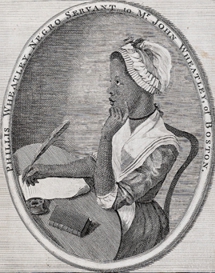 Today’s “Feisty Female” came to America as a slave, and during her all-too-brief life, made history by becoming the first African American woman to have her own book of poetry published. Most scholars believe she was born in Senegal around 1753.
In 1761 the young girl was sold into slavery and placed on a North American-bound ship named Phillis. She was said to have been a frail female child whose health the ship’s captain believed so precariously close to death that he wished to sell her quickly to gain a profit before she died.
She was purchased by the Wheatley family of Boston as a personal servant to Susanna, the wife of John Wheatley. According to the Poetry Foundation, Phillis Wheatley, named after the ship that brought her to America, was “pampered” in the Wheatley household, although not entirely excused from domestic duties.
Eighteen year-old Mary Wheatley and her brother Nathaniel helped educated her, and within sixteen months Phillis could read passages from the Bible. At the age of twelve she began studying Latin and English literature and studied the works of noted poets like Alexander Pope, John Milton, Homer and Ovid. The family recognized how gifted she was and, of course, a slave receiving such a liberal education was unheard of at the time.
Her first poem, entitled An Elegiac Poem, on the Death of that Celebrated Divine, and Eminent Servant of Jesus Christ, the Reverend and Learned George Whitefield, was published in 1770. Many scholars once believed that poem to have been her first published work, but in 1969 another poem, On Messrs. Hussey and Coffin, was discovered to have been published in 1767.
By the age of eighteen, Phillis had written twenty-eight poems and Susanna helped her place advertisements for subscribers in the Boston newspapers in early 1772. They found, however, that colonists would not support the work of an African. In May of 1771 Nathaniel had accompanied Phillis to London because Susanna thought she might find better opportunities to have her work published there.
While in England she met with the Lord Mayor of London and other prominent members of British society, and found an enthusiastic supporter in Selina Hastings, the Countess of Huntington. The Countess wrote a letter of introduction to bookseller Archibald Bell who helped her publish her first book of poems entitled Poems on Various Subjects, Religious and Moral.
Another reason for the journey to London in 1771 was Phillis’ health. According to the Poetry Foundation she suffered from a chronic asthmatic condition. As she was on her way back to America, the first edition of her poetry book was being circulated. It was the first book of poetry ever published by a Negro slave.
More than a third of her poems were about the deaths of prominent people, her friends or sometimes strangers. She was a regular correspondent with George Washington and had met Benjamin Franklin while in London. Other admirers of her work included John Hancock and Dr. Benjamin Rush, signers of the Declaration of Independence.
In 1774, three months before Susanna Wheatley died on March 3, Phillis Wheatley was manumitted. The British, who had abolished slavery, had been disapproving of the Wheatleys keeping her as a slave, although she was never really exposed to the harsh life most slaves experienced.
John Wheatley and his daughter Mary both died in 1778 and the only family she had ever really known had slipped away. On April 1, 1778 Phillis married John Peters, a free black who called himself “Dr. Peters”. He was apparently an ambitious entrepreneur, purported to have practiced law, operated a grocery store, worked as a baker and barber and had at one time applied for a license to run a bar.
Peters wore a wig, sported a cane and played the part of gentleman. To Boston society, however, this was viewed as evidence of a “shiftless” and arrogant black man. During and following the Revolutionary War it was particularly difficult for free blacks to compete with whites for jobs. After moving to Wilmington, John struggled financially and Phillis took work as a charwoman while he tried to fend off creditors and find work.
After the couple returned to Boston, they lived in a rundown section of the city where Phillis again struggled with her health. Her closest friends hadn’t been pleased with her decision to marry John Peters in the first place, and now the first African American woman to have a published book of poetry was living in poverty.
Even during those years of financial and physical challenges, Phillis Wheatley continued to write and publish her poems. During the fall of 1779, in an attempt to raise funds for her family, she ran advertisements for subscribers to a new work she had dedicated to Benjamin Franklin. Again, however, her work was rejected by Americans.
Phillis Wheatley’s life ended on December 5, 1784, alone and uncared for, since John, deeply in debt, had been jailed. The couple had children, but none survived to adulthood. Three and-a-half hours following her death, Phillis Wheatley’s last surviving child died and was buried with her.
Scholars believe that she wrote one hundred and forty-five poems. Ironically, the first American edition of Poems on Various Subjects wasn’t published until two years following her death. As the title of her first volume implies, she wrote on a variety of subjects, but historians have long puzzled over why she, an African slave, never wrote much about slavery.
Some believe that slavery was a conundrum of sorts for her, for it was what brought her to America. Yet, after being purchased by the Wheatley family and educated, that same institution led her to Christianity. That sentiment is noted in her most well-known poem, On Being Brought from Africa to America:
‘Twas mercy brought me from my pagan land,
Taught my beknighted soul to understand
That there’s a God, that there’s a Savior too:
Once I redemption neither sought nor knew.
Some view our sable race with scornful eye,
“Their color is a diabolic dye.”
Remember Christians; Negroes, black as Cain,
May be refin’d, and join th’ angelic train.
Recently, scholars have discovered other poems and letters which prove that she did in fact associate with eighteenth century abolitionists. The more scholars today study her work, the more convinced they are that Phillis Wheatley despised the institution of slavery. While a patriot and a strong advocate for America’s independence, she dared to chide fellow patriots in a poem eulogizing General David Wooster:
But how presumptuous shall we hope to find
Divine acceptance with the Almighty mind
While yet o deed ungenerous they disgrace
And hold in bondage Afric: blameless race
Let virtue reign and then accord our prayers
Be victory ours and generous freedom theirs.
Clearly, Phillis Wheatley held strong opinions regarding slavery and had no fear of possibly offending even revered patriots. Feisty Female, indeed!
Did you enjoy this article? Yes? Check out Digging History Magazine. Since January 2018 new articles are published in a digital magazine (PDF) available by individual issue purchase or subscription (with three options). Most issues run between 70-85 pages, filled with articles of interest to history-lovers and genealogists — it’s all history, right? 🙂 No ads — just carefully-researched, well-written stories, complete with footnotes and sources.
Want to know more or try out a free issue? You can download either (or both) of the January-February 2019 and March-April 2019 issues here: https://digging-history.com/free-samples/
Thanks for stopping by!
Tombstone Tuesday: The Christian Bibles of Greene County, Tennessee
I ran across this unique surname while researching ancestors in Pulaski County, Kentucky. If you regularly read Tombstone Tuesday articles, you’ll know that I’ve written a few of late highlighting some residents of that county, who as far as I know are not related to me – but you never know. That also led me to another interesting surname which I will be writing about soon – Outhouse – so stay tuned for that one.
I found four men buried in Greene County, Tennessee with the name “Christian Bible” and it appears that they were all descended from Johann Adam Bible, the immigrant who arrived in Philadelphia on a ship named Sandwich on November 30, 1750. As I wrote in Saturday’s surname article (read it here), it is believed that Johann was part of the great Palatine migration to America in the mid-eighteenth century. Briefly, here are his descendants’ stories.
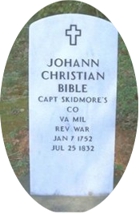
Christian Bible (1752-1832)
Christian Bible was born on January 7, 1752 in Montgomery County, Pennsylvania to parents Johann Adam and Maria Eva Margaretha (Muller) Bible. It’s possible his full name was Johann Christian Bible, since some family researches refer to him that way, and a tombstone erected in his honor displays his full name and honors his service in the Revolutionary War.
According to family historians, Christian first married Catherine Vollman (or Folman) in 1775 and following her death in 1787 or 1788, he married Margareth Speagle. As noted in his will, his children were: John, George, Adam, Lewis, Jacob, Abraham, Isaac, Christian, Elizabeth, Catherine, Sarah, and Mary.
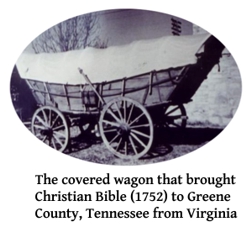
At the time of his death on October 22, 1833, it appears all of his children, except Christian who had pre-deceased him, and his second wife Margaretha were all still living and beneficiaries of his estate. To his sons he bequeathed tracts of land and each of his daughters, except Mary, would receive fifty pounds a year after his death. The daughters of his son Christian were to receive five dollars each.
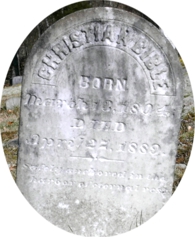
Christian Bible was born on March 13, 1804 in Greene County, Tennessee to parents John and Elizabeth (Pickle) Bible, and was the grandson of Christian Bible (1752-1832). On November 2, 1826, Christian married Mary Bower “according to the rules of the Lutheran Church”. In 1850 the following were enumerated as his children: Reuben, David, Lucretia, Levina, Martha and Thomas.
It appears that this Christian Bible probably didn’t serve during the Civil War, but possibly listed as a Southern Loyalist as recorded by the Southern Claims Commission following the war. That is interesting, because it appears yet another Christian Bible of Greene County, Tennessee was a Union soldier (his story follows this one).
Mary passed away on June 8, 1869 and in 1880 he was married to Elizabeth. Christian died on April 27, 1889 and is buried in the Gum Springs Cemetery in Greene County.
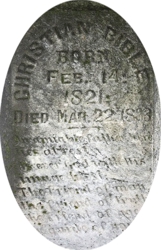
Christian Bible was born on February 14, 1821 in Greene County, the son of Adam and Elizabeth (Neas or Nehs) Bible, and grandson of Christian Bible (1752). On February 6, 1842 he married Louisa Marie Tucker and to their marriage were born the following children: Mary Elizabeth, Noah Luther, Martha Ellen, Lydia Ann, Louisa Jane Laura, Surena Emily and Nathan Hankins. All their children lived to adulthood except Louisa who died at the age of five in 1859.
This Christian Bible has an interesting history in regards to his Civil War service. Records indicate that Christian joined the Union Army (as opposed to his 1804 cousin also named Christian who was a Southern loyalist) on January 30, 1863 at Greeneville, Tennessee. He joined as a private and was mustered in on June 15, 1863, a member of Company F, 4th Regiment East Tennessee Infantry.
Family historians have discovered some interesting stories about Christian, including the fact he actively recruited men of Greene County and helped them get to the Union lines. It appears this may have occurred before his own enlistment in 1863, as according to the family records, the Confederates discovered what he was doing, forcing Christian to leave his home and join the Union Army. In a piece called “Christian’s Escapades”, family historians continued:
Somewhere near McMinnville he and most of his regiment were captured by Confederates and after being “robbed and stripped of belongings by the Rebels” were sent to Loudon, Tennessee. For there Christian took the train to Bulls Gap. Christian rejoined his reorganized regiment in December of 1863, but because of recurring sickness was unable to be an effective element of the unit.
Furthermore, military records indicate that on May 30, 1864 Christian deserted but returned to duty on September 13, 1864. He was mustered out of the military in Nashville on August 2, 1865, and on January 17, 1873, the charges of desertion were expunged from his military records. He later donated land on which the Mount Pleasant Methodist Church still stands today. Louisa died on March 30, 1890 and three years later Christian died on March 22, 1893.
And now for the last Christian Bible of Greene County, Tennessee!
Christian W. Bible (1847-1911)
Christian W. Bible was born on June 7, 1847 in Greene County, the son of Philip Henry and Barbara Ann Smith Bible, the grandson of Adam Bible and the great-grandson of Christian Bible (1752). Following his service during the Civil War in the 3rd Regiment of the Tennessee Volunteer Mounted Infantry (Union), he married Mary Carter on October 30, 1870.
In 1880 two children, James and Foie (sons), were enumerated. Following Mary’s death in 1885, Christian remarried Martha Elizabeth Brown in 1888. To their marriage were born at least four children: Lula, Flora, Carrie and Serena. Christian W. Bible died on January 31, 1911 and was buried in the Shiloh Cumberland Presbyterian Church Cemetery.
That’s a lot of “Christian Bibles” in Greene County, Tennessee (and a challenge to research!). I’m sure there were even more Christian Bibles born during that time (and since) – one family historian noted that at least one remained behind in Virginia rather than migrate with other Bible family members to Tennessee. It was an obviously well-regarded family name, and a quick survey of the Bible family name in Greene County at Find-A-Grave reveals that this family played an important role in the county’s history.
Did you enjoy this article? Yes? Check out Digging History Magazine. Since January 2018 new articles are published in a digital magazine (PDF) available by individual issue purchase or subscription (with three options). Most issues run between 70-85 pages, filled with articles of interest to history-lovers and genealogists — it’s all history, right? 🙂 No ads — just carefully-researched, well-written stories, complete with footnotes and sources.
Want to know more or try out a free issue? You can download either (or both) of the January-February 2019 and March-April 2019 issues here: https://digging-history.com/free-samples/
Thanks for stopping by!
Surname Saturday: Bible
Bible
This unique surname has origins in both Germany and England, according to various sources:
House of Names: This German surname is derived from the Latin verb “bibere”, which means “to drink” (as in “imbibe”). According to this source the original bearer of the name was a member of the von Hahn family, but due to his fondness of drinking, changed his name to Bibow. The family like that name, and when establishing the family coat of arms, used a rooster sitting upon a green cushion because von Hahn sat on a green cushion. Probably established in the late fourteenth century, in was used by a man named Eggerd von Bibave whose seal was a rooster sitting on a cushion. The name was originally seen in Mecklenburg, situated in northern Germany, and those bearing the surname would have been part of the “backbone of early development of Europe” and its feudal society. Spelling various include: Bible, Bibbow, Bibo, Bibbo, Biboe, Bibboe, Bibble and others.
4Crests.com: This source cites a baptismal name which meant “son of Bibbe or Isabel” which also be spelled Bibb, Bibby, Bibbi, or Bibbey. In the fourteenth century records show a family named Bibby, descended from Richard Bibby of the thirteenth century, who was the son of a woman named “Bibbi”. Other records show someone in Oxford in 1200, without surname, named “Bibele”.
Ancestry.com: Of English origins, the female personal name Bibel, considered a nickname of Bibb. Also possibly a spelling variation of the German name Biebl or Biebel.
The New Dictionary of American Family Names considers it to be an English nickname of Isabel, or a descendant of little Bibb.
According to family historians, an early immigrant by the name of Johann Adam Hans Biebel arrived on a ship named “Sandwich” on November 30, 1750. He had sailed from Rotterdam, Holland and landed in Philadelphia with his family.
Johann was believed to have been part of the great Palatine immigration to America in the mid-eighteenth century. Upon arriving in America, Johann changed his name from Biebel to Bible and later served in the Revolutionary War as a patriot.
Did you enjoy this article? Yes? Check out Digging History Magazine. Since January 2018 new articles are published in a digital magazine (PDF) available by individual issue purchase or subscription (with three options). Most issues run between 70-85 pages, filled with articles of interest to history-lovers and genealogists — it’s all history, right? 🙂 No ads — just carefully-researched, well-written stories, complete with footnotes and sources.
Want to know more or try out a free issue? You can download either (or both) of the January-February 2019 and March-April 2019 issues here: https://digging-history.com/free-samples/
Thanks for stopping by!
Wild West Wednesday: The Ruby Murders
 In 1914 the Ruby Mercantile was sold by Julias Andrews to Philip Clarke, who moved his family to Ruby and built a bigger store up on a hill.
The Clarke family soon discovered the dangers of living in Ruby with its proximity to the Mexican border and the presence of bandits in the area. According to Legends of America, store owner Philip Clarke and his wife kept guns in every room of their home and store. Clarke later moved his wife and children to a nearby town while he continued to operate the mercantile.
By 1920 Clarke had purchased substantial acreage and cattle in the area and sold his store to John and Alexander Fraser. The Fraser brothers were warned about Mexican bandits – to be forewarned was to be forearmed. They may not have heeded Clarke’s warning, however, because on February 27, 1920 both were found shot inside their store. Alexander had been shot dead in the back and head and John, still alive with a shot to his left eye, died five hours later.
This article is no longer available for free at this site. It was re-written and enhanced (entitled “Mining and Murder”) with sources and has been published in the March 2018 issue of Digging History Magazine. Should you prefer to purchase the article only, contact me for more information.
I invite you to check out Digging History Magazine. Since January 2018 new articles are published in a digital magazine (PDF) available by individual issue purchase or subscription (with three options). Most issues run between 70-85 pages, filled with articles of interest to history-lovers and genealogists — it’s all history, right? 🙂 No ads — just carefully-researched, well-written stories, complete with footnotes and sources.
Want to know more or try out a free issue? You can download either (or both) of the January-February 2019 and March-April 2019 issues here: https://digging-history.com/free-samples/
Thanks for stopping by!
Tombstone Tuesday: Remember Elijah Soper
Remember Elijah Soper was born on May 4, 1794 in Milton, Chittenden County, Vermont to parents Mordecai and Naomi (Owen) Soper. According to The New Soper Compendium by Earl Soper, Mordecai’s place of birth is disputed – some believe he was born in England while others believe he was born in Connecticut in 1746.
Mordecai married Naomi on April 4, 1770 in Salisbury, Connecticut. His residence was recorded later as “Nine Partners” in Dutchess County, New York, where Mordecai and Naomi lived a short time before settling in Poultney, Vermont in 1771. He served in the Revolutionary War and returned to Poultney then later moved to Milton. There he took the Freedman’s Oath on May 3, 1787 and raised his large family. Remember was the ninth child of thirteen.
Remember served in the War of 1812 as a Captain, and according to the Portrait and Biographical Album of Champaign County, Illinois (PBACC), was present at the battle of Plattsburg, “being in one of the volunteer corps, he was the means of saving the regular troops from defeat. His coolness and bravery inspired his men with courage to rush upon the enemy and put them to flight.”
His service was lauded in PBACC, stating that during the battle of Plattsburg “the movements of the volunteer troops commanded by Capt. Soper were so regular and precise that the British mistook them for reinforcements from the regular service, and withdrew from their position, abandoning the attack of the fort.” Captain Remember Elijah Soper, “although at the front with his men, escaped without a wound.”
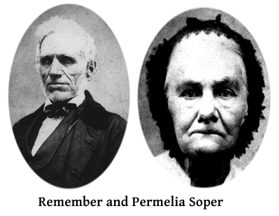
Remember received a pension and a bounty of one hundred sixty acres of land. He returned home to Vermont and married Permelia McNall in 1819. Their first child Harriet died at the age of one month in 1820, followed by Adeline (1821), Julia; Amasa (1826-1827); Orange Phelps (1828); Eveline (1830); Rachel (1833); and Milton Hubble (1836).
An “R.E. Soper” was enumerated in Franklin County, Vermont in 1840 and in 1847 the family had migrated to Benton, Lake County, Illinois. The county was just south of Wisconsin’s border and near the shoreline of Lake Michigan. His son Orange married Jerusha Abels in Michigan, but returned to Vermont around 1863 with Remember and Permelia.
Jerusha died in 1865 and Orange married Laura Harrington in 1867, then returned to Illinois in 1868. His brother Milton had accompanied the family back to Vermont in 1863, but like Orange moved back to Illinois in 1868. Their daughters married and one migrated west to Wisconsin. Orange migrated the farthest west to South Dakota where he died in Watertown (date unknown).
A little more history on the brothers was found in the Portrait and Biographical Album of Champaign County, Illinois. Milton was remembered as a “gentleman of education and refined tastes who has made the most of his opportunities in life.” He was a highly respected member of the Harwood Township farming community. At the age of sixteen he had entered Waukegan Academy and then attended Lawrence University in Appleton, Wisconsin. Thereafter he matriculated at the University of Michigan, graduated with honors and returned home to find Remember in ill health.
Milton had been hired to superintend the public schools in Memphis, Tennessee, but cancelled his plans and returned to Vermont with Remember and Permelia. The timing was fortuitous since the Civil War was still being fought in that part of the South. Even though Milton had desired at one time to pursue the field of medicine, or perhaps a military career, he put aside those dreams and accompanied his parents home to Vermont.
Instead, he purchased a farm in Franklin County and worked with his father for four years. He and Orange made plans to establish a sheep ranch in southwest Missouri and began the search for land. Apparently it was a little too far south for their tastes: “They looked over the country and found a suitable location, but also found that an ultra Yankee had very little to encourage him in settling there.” Perhaps the deep-seated wounds of war were yet too fresh.
Milton instead returned to Illinois, first purchasing over five hundred acres of speculative land from the Illinois Central Railroad Company. After selling the majority of it he established his own “beautiful farm of 240 acres, with a handsome modern residence, a good barn and all other buildings necessary for the shelter of stock and the storage of grain.” The farm was one of the finest and Milton one of the most esteemed members of the community.
After returning to Vermont in 1863 due to ill health, Remember spent the remainder of his life there. He passed away on November 4, 1872 in Fairfax, Franklin County. Permelia passed away on May 1, 1878. Both are buried in the Miltonboro Cemetery in Chittenden County.
What caught my attention about this story was the name “Remember Elijah” where did that come from? I had seen a list of the children of Mordecai and Naomi and noticed they had a son named Elijah born in 1773 and then in 1794 Remember Elijah was born. Why two sons named Elijah? According to family historians, the first Elijah drowned when his canoe overturned in the Lamoille River. To remember Elijah, they named their next son “Remember Elijah”.
Did you enjoy this article? Yes? Check out Digging History Magazine. Since January 2018 new articles are published in a digital magazine (PDF) available by individual issue purchase or subscription (with three options). Most issues run between 70-85 pages, filled with articles of interest to history-lovers and genealogists — it’s all history, right? 🙂 No ads — just carefully-researched, well-written stories, complete with footnotes and sources.
Want to know more or try out a free issue? You can download either (or both) of the January-February 2019 and March-April 2019 issues here: https://digging-history.com/free-samples/
Thanks for stopping by!
Surname Saturday: Blackwell
Blackwell
Sources agree that the Blackwell surname was a locational name, a place in the counties of Derbyshire, Durham and Worcestshire. It was an ancient surname, traced back to Olde English and Anglo-Saxon orgins.
The name was recorded in the Saxon Cartularium of Durham in 964 as “Blacwaelle”, according to the Internet Surname Database. An instance of the name was also recorded in Derbyshire as “Blacheuuelle” in the 1086 Domesday Book.
This locational name meant “black stream”, stemming from the Olde English word “blaec” which meant “dark-colored”, likely referring to the color of the water. The name may have also referred to someone who lived next to a “black stream”.
The spelling variations of this surname are varied and numerous, including Blackwell, Blackwall, Blackwill, Blakewell, Blakewill, Blaikewall, Blakwill, Blackville, Plackwell, Plakewell, Plackville, Blatswill and more.
Yesterday, I wrote about the early life of Elizabeth Blackwell, America’s first female medical school graduate. Following is the conclusion of her amazing story. If you missed Part I, you can read it here.
Elizabeth Blackwell: Medical School and Beyond
“With an immense sigh of relief and aspiration of profound gratitude to Providence”, Elizabeth Blackwell accepted Geneva Medical College’s invitation to enroll. Within days she was on her way to western New York. Upon her arrival she was interviewed by the dean of the college and assigned as student No. 130 in the medical department.
Although the medical program was short in comparison to today’s requirements, the task ahead was nonetheless daunting. One of the professors read her letter of introduction from Dr. Warrington, the Quaker who had advised her to give up, and then Elizabeth entered the lecture hall.
She later surmised the professor was reminding his students that a lady would grace their presence. Apparently it wasn’t uncommon in that day for students to make all sorts of crude remarks and jokes aimed at their professors. As the story goes, Elizabeth’s presence in the classroom made it more likely that her male counterparts would behave themselves.
While gradually being accepted by the faculty and her fellow students, the townspeople, specifically the women folk, weren’t as approving. In her autobiography, Pioneer Work in Opening the Medical Profession to Women, Elizabeth remarked:
Very slowly I perceived that a doctor’s wife at the table avoided any communication with me, and that as I walked backwards and forwards to college the ladies stopped to stare at me, as at a curious animal. I afterwards found that I had so shocked Geneva propriety that the theory was fully established either that I was a bad woman, whose designs would gradually become evident, or that, being insane, an outbreak of insanity would soon be apparent.
Still, however, she discovered that she was barred from certain lectures or demonstrations which were deemed too delicate for woman’s sensibilities – the reproductive anatomy lecture would not be appropriate for a lady. Elizabeth disagreed, argued her case and won the support of her fellow students.
Following her first term Elizabeth began searching for a hospital or institution where she could conduct her summer studies in practical medicine. She returned to Philadelphia and decided to study at the Blockley Almshouse. Her first assignment took her to the third floor, the women’s syphilitic department, “the most unruly part of the institution.”
The director thought her presence might have a positive effect on the “very disorderly inmates.” Instead, she was thought of as a curiosity. She made the acquaintance of the resident matron whose appearance belied her gruff mannerisms in dealing with patients; Elizabeth referred to her as Mrs. Beelzebub. She was, however, enraptured with the head physician, Dr. Benedict, whose patient and kind ministrations to his terminally ill patients touched Elizabeth.
The Irish potato famine brought scores of immigrants, many who had been afflicted with famine fever while making their way across the seas. Blockley was overwhelmed with the epidemic, but proved a valuable lesson for Elizabeth — she used her experiences and observations of that summer to later write her graduate thesis on typhus.
Elizabeth returned to school following her summer practicum and renewed her determination to complete her course of study. By this time she was more at ease and confident in her own capabilities, and even though she could have concurrently pursued a social life, she chose not to do so. In her words, “I lived in my room and my college, and the outside world made little impression on me.”
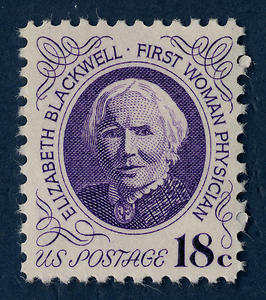
By mid-January of 1849 she was preparing to sit for her exams. On January 19 she wrote that she had passed her final examinations with flying colors, first in her class. Perhaps realizing they were about to witness a momentous event in history, her fellow students greeted her with applause. In four days she would become the first women in U.S. history to receive a medical degree.
With thankfulness to God on her mind, Elizabeth entered the Presbyterian church where the graduation ceremony was held on January 23. After all other students had received their degrees, Elizabeth was called to the platform. After receiving her diploma from the school’s president, she addressed him, “Sir, I thank you; it shall be the effort of my life, with the help of the Most High, to shed honour on my diploma.”
Keenly aware of her momentous accomplishment, Elizabeth knew that it was only the first step. She returned to Philadelphia for a short time, intending to continue her medical studies. Instead, at the invitation of a cousin, she traveled abroad in April and studied in Paris and London. Her colleagues and advisers had encouraged her specifically to consider studying in Paris where opportunities for women were more readily available. In June her post-graduate work continued as she accepted a position in Paris at its maternity hospital, La Maternité.
She began working in the field of obstetrics and had planned to become a surgeon. However, in November of 1849 while treating a baby’s eye infection, she contracted what was most likely gonorrhea (which was probably passed to the baby as it passed through the birth canal) and lost sight in her left eye. She would never become a surgeon.
After completing her term of study at La Maternité, and now blind in one eye, Elizabeth traveled around Europe for a time. Her studies at St. Bartholomew’s in London, however, presented a challenge as she noted in journal entries and letters to her family. One professor in charge of Midwifery and the Diseases of Women and Children had basically written her off, politely informing her of his disapproval of women in medicine.
While in London, one of her more pleasant experiences was a social one, making the acquaintance of Miss Florence Nightingale (although they later had a falling out). By May of 1851 it was time to consider whether it would be more profitable for her to remain in England or return to America. Encouraged by attempts in Philadelphia and Boston to found schools for women to pursue medical careers, Elizabeth finally departed England in July of 1851.
Elizabeth chose to begin her formal practice in New York, but the first seven years were “uphill work”. As a solo practitioner, with a largely empty waiting room, she began to feel isolated and in 1853 established a dispensary among the New York’s poor, near Tompkins Square in Manhattan.
In 1857 the dispensary expanded into the New York Infirmary for Women and Children. The third woman in U.S. history to receive a medical degree, her sister Emily, joined the practice. Emily’s presence lifted her spirits, her “working powers more than doubled.” While Elizabeth focused on the practice of obstetrics and gynecology, Emily handled the surgical practice.
Still, the hospital caused a stir because it was one thing for a woman to receive a medical degree, but yet another to found a hospital and purport to train other women in the practice of medicine. They had been warned that no one would lease them a facility, and they would be looked upon with suspicion purely because they were female doctors. The critics believed that without male doctors at such a facility there was no way the women could control the situation should some incident or accident occur.
Elizabeth and Emily plowed ahead, determined that their hospital would be staffed entirely by women. Perhaps to assuage the public’s doubts, the board of physicians which oversaw their operations was entirely male, all supporters of the Blackwell sisters and their enterprise.
Elizabeth traveled throughout Europe and immersed herself in social reform, specifically in areas concerning women’s rights, health issues, medical education for women and more. She traveled back and forth to London several times in the 1860’s and 1870’s, and in 1874 helped establish the London School of Medicine for Women.
She and Emily had experienced a rift in their relationship, disagreeing over the management of the hospital and medical college. In 1869 she left America behind, having become somewhat disenchanted with the women’s medical movement there, and returned to England. She worked for a time at the London School of Medicine for Women but was gradually pushed aside as a physician. In 1877 she left the active practice of medicine and continued to push for social reforms.
Like her five sisters, Elizabeth never married. She simply had no use for, nor the time to pursue a marriage relationship. She had always possessed a strong personality and could be quite critical in her views of others.
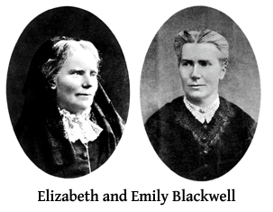 Her memoirs were published in 1895, and Elizabeth remained a professor of gynecology until 1907 when she fell down a flight of stairs. The accident left her not only physically challenged, but mentally disabled as well. On May 31, 1910 she suffered a stroke at her home in Sussex and died at the age of eighty-nine.
Her sister Emily died four months later in Maine on September 7 at the age of eighty-three. Their pioneering work had paved the way for wider acceptance of women in medicine. In 1915 the American Medical Association admitted its first female members.
Want to know more or try out a free issue? You can download either (or both) of the January-February 2019 and March-April 2019 issues here: https://digging-history.com/free-samples/
Thanks for stopping by!