
Far-Out Friday: Honeymoon In The Corn Field
 Their May-December marriage made headlines in early June of 1946, right along with worries over sky-rocketing milk prices (up one cent per quart!) and possible meat and bread shortages. One newspaper article noted that mothers were thinking about feeding their children cake instead of bread that night (let them eat cake!). However, for Mattie Large and her teenage husband, their marriage wasn’t such a big deal to them in the hills of eastern Kentucky near Louisa. It did raise eyebrows around the country though.

 Did you enjoy this article snippet? Yes? Check out Digging History Magazine. This article has been updated and is available in the July-August 2021 issue of the magazine.
Since January 2018 new articles are published in a digital magazine (PDF) available by individual issue purchase or subscription (with three options). Most issues run between 70-90 pages, filled with articles of interest to history-lovers and genealogists — it’s all history, right? 🙂 No ads, just carefully-researched, well-written stories, complete with footnotes and sources.
Want to know more or try out a free issue? Samples available here: https://digging-history.com/free-samples/
Thanks for stopping by!
Wild Weather Wednesday: Yet Another 1913 Historic Storm
 From beginning to end, the year 1913 was a meteorologically-challenging year. Earlier this year, “Wild Weather Wednesday” articles covered two 1913 historic weather events: The Great Flood of 1913 (Part One and Part Two) and The White Hurricane. On July 10, 1913 the highest temperature ever recorded in the United States occurred in Death Valley – 134 degrees.
That year would end with an historic blizzard which buried the eastern slope of Colorado in early December. As the Daily Journal of San Miguel County reported on December 1, snow was “general throughout Colorado”, but the eastern slope would take the brunt of the storm. Days later the Steamboat Pilot reported their part of the state had entirely escaped the storm.

This article is no longer available for free at this site. It was re-written and enhanced, complete with footnotes and sources and has been published in the February 2018 issue of Digging History Magazine. Should you prefer to purchase the article only, contact me for more information.
I invite you to check out Digging History Magazine. Since January 2018 new articles are published in a digital magazine (PDF) available by individual issue purchase or subscription (with three options). Most issues run between 70-85 pages, filled with articles of interest to history-lovers and genealogists — it’s all history, right? 🙂 No ads — just carefully-researched, well-written stories, complete with footnotes and sources.
Want to know more or try out a free issue? You can download either (or both) of the January-February 2019 and March-April 2019 issues here: https://digging-history.com/free-samples/
Thanks for stopping by!
Tombstone Tuesday: Mattie Grace Grob Large (1892-1992)
 Some Tombstone Tuesday articles just beg to be written because the subject lived such a long and purposeful life. Today’s article is one of those.
Mattie Grace Grob was born on January 16, 1892 in Leavenworth, Kansas to parents Mathias and Martha (Kuellmer) Grob. Mathias was born in Germany in 1849 and immigrated with his parents to Ohio when he was four years old. Martha was the daughter of German immigrants and was born in Ohio in 1854. Mathias and Martha married on November 4, 1879 and to their marriage were born nine children, six of them living to adulthood, although their oldest child Elizabeth died at the age of thirty-six.
Mathias and Martha migrated to Kansas in 1883, where Mathias engaged in farming. His obituary noted that he was a self-made man, well-informed and a prosperous land owner. Early in adulthood he had become a Christian and loved to attend church. He was a generous person who diligently studied the Bible, able to hold forth on perplexing issues. In reading about Mattie’s life, it’s obvious her parents and their faith provided a great example to follow.
Mattie married Leo Seth Large on July 28, 1914. According to family historians, Leo’s father wasn’t around much during his childhood. His mother struggled to support her own children as well as those from James Large’s first marriage. In 1916 his mother disappeared and Leo and Mattie took care of some of the younger children. Perhaps this is why they had only two children of their own: Helen Kathryn (1916) and Leo Harvel (1918).
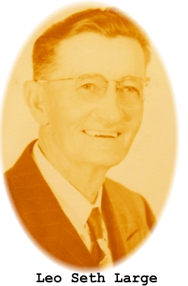 Leo was a truck farmer in Leavenworth County, Kansas, well known and respected by the community. After his retirement from farming, Leo and Mattie lived in DeSoto (Johnson County), Kansas. Mattie was a telephone operator for the city of DeSoto for several years. She was an active member of the local Methodist Church, volunteering her time to prepare meals for church dinners. She was also an expert gardener and a seamstress.
Leo died in 1962 of lung cancer and was buried in the DeSoto Cemetery. All through her life it appears Mattie Grace kept busy. I found several accounts of people who posted remembrances at Find-A-Grave. Mattie made such an impression on them and their memories are still vivid.
Like her father, she was a generous person, one friend remembering “you never left her house empty handed, whether it was a magazine, jar of jelly or a plant from her flower bed.” Her children, six grandchildren and eleven great-grandchildren adored her.
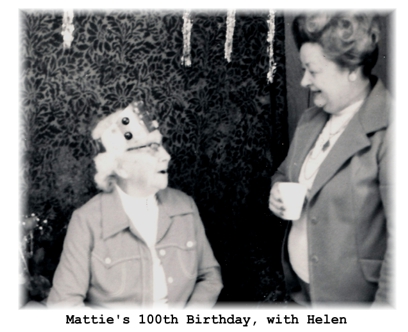 Mattie Grace Grob Large had a long and purposeful life. She celebrated her one hundredth birthday in early 1992 and was residing in a Topeka nursing home. She passed away a couple of months shy of her one hundred and first on November 8, 1992. Some of the stories I write make me wish I’d known the person. Mattie is one of those people and I hope you enjoyed her story.
I was actually researching another husband and wife, Abraham and Sarah Large, when I came across Mattie’s story. In this holiday season of giving and goodwill, it seemed appropriate to tell Mattie’s heartwarming story instead. I ran across another Mattie Large while researching Mattie Grace. I’ll tell her story on Far-Out Friday – a true story you just can’t make up!
Did you enjoy this article? Yes? Check out Digging History Magazine. Since January 2018 new articles are published in a digital magazine (PDF) available by individual issue purchase or subscription (with three options). Most issues run between 70-85 pages, filled with articles of interest to history-lovers and genealogists — it’s all history, right? 🙂 No ads — just carefully-researched, well-written stories, complete with footnotes and sources.
Want to know more or try out a free issue? You can download either (or both) of the January-February 2019 and March-April 2019 issues here: https://digging-history.com/free-samples/
Thanks for stopping by!
Surname Saturday: Butter (and a little apple history)
Butter
Today’s surname is also a common word and another one which presents a research challenge, but with an interesting historical twist – the story of an apple. According to immigration passenger lists, people with the Butter surname, or some variation thereof, came from Ireland, England, Scotland and Germany. 1920 census records indicated a substantial number of the Butter family in Texas, as well as New York, Pennsylvania, Michigan and Tennessee.
The theories as to its origins are as follows:
Forbears: This web site notes that the surname Butter (or some variation of it, and there are many) is the 33,215th most common in the world. The highest incidences of the name today occur, surprisingly, in Nigeria, Germany and the Netherlands, with the United States ranked fourth. According to Forbears, the surname is a nickname: “the butur”; “Buture, the bittern”; “Botor, a bustard” (Source: Dictionary of English and Welsh Surnames). In 1273 the name John le Butur of Cambridgeshire was listed on the Hundred Rolls, as well as John Botere of Huntingsdonshire. In 1581 Richard Butter was on the rolls of the University of Oxford.
Internet Surname Database: This web site concurs with Forbears in regards to a nickname origin and elaborates a bit more. The nickname would be for someone having a certain vocal characteristic the call of a bittern, a wading bird in the heron family. Both the Middle English word “botor” and the Old French word “butor” both mean bittern. Another observation is an Old English word “butere” which meant “butter” and referred to an occupational name for a dairyman or someone who sold butter or ran a buttery.
House of Names: In Scotland the name was first seen among the Pictish clans and the family lived in Perth and Fife counties. One village was named “Buttergask” or “Buttercask” in the Ardoch parish.
ScotClans: Butter was the name of an old family in Perthshire. The name Adam Butir was recorded in 1331 and William Butyr and Patrick Butirr are found in 1360 records.
4Crests: The surname was as official name, meaning “at the buttery” or one who kept butter, or a store for liquor. Richard of the Bottery was mentioned in a 1399 record. John Butterey married Elizabeth Burnell in 1531, and a daughter of John Buttereye was baptized in 1669 in London.
Variations of this name include: Butter, Butters, Butterlaw, Butterwick, Butterworth, Butterton, Buttar, Buttars, Butere, Putter, Buttry, Batter, and many, many more.
When did the Butter (or Butters) family make its way to America? According to The Genealogical Registry of the Butters Family, published in 1896, the name first appeared following the arrival of Scottish prisoners, referring to them as “romantic young followers of Charles II” who had been captured at Dunbar and Worcester by Cromwell and sent to the colonies as indentured servants.
Tradition holds that in the early days of the Massachusetts Bay Colony, three Butter brothers came from Scotland: John, Isaac and William Butter. One was said to have gone off somewhere and never heard from again, and another was captured by Indians, and upon his escape returned to Scotland. The records for John and Isaac were so sparse that the nineteenth century family genealogists concluded that William Butter, who settled in Woburn, Massachusetts was likely the progenitor of their family in America.
The Butters Apple
According to the family history cited above, the area where William settled and many of his descendants remained for over two hundred years was an area known as “Butters Row District”, situated in a new town near Woburn called Wilmington. A map included in the Butter history book lists the following people who lived in the era continuously from 1665 to 1895:
William Butters
James Butters
Abiel Butters
Samuel Butters
John Butters
Lorenzo Butters
Walter Butters
Oliver Butters
Simeon Butters
In the same district was a school called the Butters Row School. In the middle of all of these Butters family members and their properties is a landmark simply called “Apple Tree.” Why would a map like this include a prominently marked “Apple Tree”. This particular apple tree was planted by William Butters (1711-1784) who was the grandson of William Butter, the immigrant. The tree had been transplanted from a neighboring farm in Wilmington.
The tree was situated near William’s house and as the tree grew it attracted a large number of birds, namely woodpeckers. The apple was first called the “Woodpecker” or “Pecker”, but also known as the “Butters Apple”. The tree flourished and produced fruit for a number of years before Deacon Samuel Thompson discovered it while surveying the Middlesex Canal.
Thompson mentioned his discovery to canal engineer Loammi Baldwin, who was so impressed with the apple that he visited the Butters farm and obtained his own cuttings for transplantation near his home in Woburn. He gave cuttings to friends and later the apple variety was named after him.
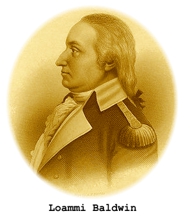 Baldwin, a Revolutionary War veteran who crossed the Delaware with Washington, was a scientist and civil engineer, who also happened to be (appropriately) the second cousin of Johnny Appleseed. Baldwin apples were a hearty and flavorful variety used for making pies and hard apple cider. The bright-colored fruit is a winter apple and easily shipped. Harvested in October, they can be stored for several months.
 The Baldwin became the most popular apple grown in New England. In 1833 the New American Orchardist noted that “no apple in the vicinity of Boston is so popular as this, at the present day.” By the mid-nineteenth century the apple was seen in other states like New York and Pennsylvania.
 In 1895 the Rumford Historical Society erected a monument to the Baldwin apple near its original location in Wilmington. The inscription reads:
This monument marks the site of the first Baldwin Apple Tree found growing wild near here. It fell in the gale of 1815. The apple first known as the Butters, Woodpecker or Pecker apple was named after Col. Loammi Baldwin of Woburn. Erected in 1895 by the Rumford Historical Association.
The popularity of the Baldwin declined in the early twentieth century, however, with the introduction of the Jonathan variety. In 1934 a devastatingly cold winter in the northeast destroyed several orchards across New England. Though not as popular today, it’s still considered a good cider apple.
Did you enjoy this article? Yes? Check out Digging History Magazine. Since January 2018 new articles are published in a digital magazine (PDF) available by individual issue purchase or subscription (with three options). Most issues run between 70-85 pages, filled with articles of interest to history-lovers and genealogists — it’s all history, right? 🙂 No ads — just carefully-researched, well-written stories, complete with footnotes and sources.
Want to know more or try out a free issue? You can download either (or both) of the January-February 2019 and March-April 2019 issues here: https://digging-history.com/free-samples/
Thanks for stopping by!
Feisty Females: Harriet Quimby
 Her life, though short, was full of many accomplishments. Harriet Quimby was born on May 11, 1875 in Arcadia, Michigan to parents William and Usrula Quimby. The Quimbys had several children, but only Harriet and her older sister Kittie survived to adulthood. Historians note that her father was an unsuccessful farmer who left the Midwest in the early 1900’s and headed West.
This article is no longer available on the web site. It will, however, be rewritten (complete with footnotes and sources) and included in a future issue of Digging History Magazine.
I invite you to check out Digging History Magazine. Since January 2018 new articles are published in a digital magazine (PDF) available by individual issue purchase or subscription (with three options). Most issues run between 70-85 pages, filled with articles of interest to history-lovers and genealogists — it’s all history, right? 🙂 No ads — just carefully-researched, well-written stories, complete with footnotes and sources.
Want to know more or try out a free issue? You can download either (or both) of the January-February 2019 and March-April 2019 issues here: https://digging-history.com/free-samples/
Thanks for stopping by!
Ghost Town Wednesday: Silverbell, Arizona
 There were actually two towns in Arizona with the same name, one “Silverbell” and one “Silver Bell”, situated about four miles apart. Both were mining towns, but “Silverbell” has the most colorful history.
According to the Arizona State Museum, the first time any mining operations were recorded in the area was in the early 1870’s when Charles O. Brown from Tucson began prospecting. Throughout the 1870’s Brown and his partners staked several claims, opened mines and built a smelter. At the time Arizona was still a territory, and it would be several years before that part of the west was tamed enough to become a full-fledged state. In that era without strong territorial authority, mining districts were established.
Miners elected a leader and recorder and committees set boundaries and enforced rules. Brown’s operations fizzled and in 1890 two English companies came to the so-called Silver Bell Mining District, but their tenure was short-lived and there was little to show for the investment.
At the turn of the century, new mining interests bought up a substantial number of claims in the district. By 1901 there was enough activity in the area to warrant the establishment of a public school, with an enrollment of seventy-five students the first year. The two communities, Pelton and Atlas Camp, although small in numbers, were enumerated for the 1900 census.
Claims were sold in 1903 to the Imperial Copper Company, and soon afterwards the town of Silverbell was established. By 1905 the population of Silverbell had reached around one thousand. In 1904 a post office was opened. Silverbell, like many towns throughout the west, including a company store and the company’s offices. The town also had a school, saloons, a Chinese bakery, barber, doctor, justice of the peace and a deputy sheriff.
Silverbell continued to expand and other businesses, including a company-owned hotel were added. There were some challenges for Silverbell, however. Good drinking water was hard to come by and had to be brought in by wagon or train. The water, stored in tanks, was piped to the town’s residents.
Another challenge for the town was its penchant for violence. Despite the presence of a lawman, the area was plagued with murders and other acts of lawlessness. Before Deputy Sheriff Joe McEven arrived three murders had already occurred. James and Barbara Sherman, authors of Ghost Towns of Arizona, wrote that Silverbell was known as the “hell-hole of Arizona.”
The lawlessness and drinking water issues bring up an interesting observation I made while researching the town’s cemetery at Find-A-Grave. At the web site there are eighty-five interments listed, and someone has taken the time to find and post each and every person’s death record. The cemetery has several young children buried there, some who died of enteritis, which I’m guessing might have been due to the lack of potable water.
There were a few people who died of illnesses such as typhoid fever, dysentery and tuberculosis. There were miners who died in mine accidents and there were some who were killed by violence. The majority of those buried (at least those listed at Find-A-Grave who probably had grave markers) in the Silverbell cemetery were originally from Mexico it appears, although the Arizona State Museum said other ethnic groups such as Papago, Chinese and Japanese made their home in Silverbell.
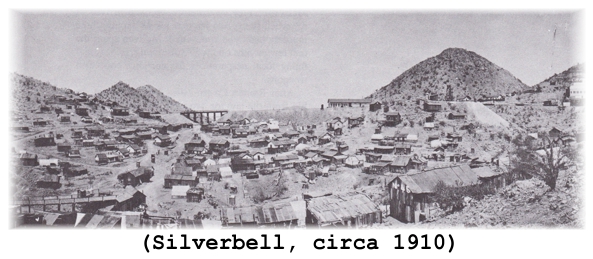 In 1910 the population of Silverbell was 1,118 persons living in 327 households. There were grocers, butchers, restaurant owners, musicians, teachers, carpenters, and more – and of course, as seen in most mining towns, prostitutes. The company operated a hospital and in 1910 there was also a movie house. The town’s fortunes changed the following year, however.
By 1911 many businesses began to depart when Imperial overextended itself and declared bankruptcy. Its holdings were leased to American Smelting & Refining Company (ASARCO) and by 1919 ASARCO had acquired all of the assets of Imperial, including the railroad and smelter. The post office had closed in 1911 but was reopened in 1916.
The population of Silverbell temporarily rebounded after ASARCO assumed ownership, but by 1920 the price of copper fell and ASARCO turned their attention to other mining operations. Between 1920 and 1930 about five hundred people populated Silverbell, but by 1930 all copper mining had been shut down. In 1931 there were only about forty-five people and the post office closed for the last time in 1934. By 1954, Silverbell was totally abandoned.
ASARCO, although abandoning mining operations in Silverbell, continued to work other mines in the area. In 1954, just four miles southeast of Silverbell, they established the town of “Silver Bell”. Mining operations at the new site actually seemed to have faired better until 1984 when copper prices again plummeted. The availability of potable water and a viable sewage system again added to the challenges. Houses fell into disrepair and in the late 1980’s only a few homes and company buildings remained.
ASARCO purchased an old mine near the original Silverbell town site in 1989. It was noted in 2007, however, that the town is now abandoned with only a few company buildings, mine shafts and some junked vehicles remaining.
Did you enjoy this article? Yes? Check out Digging History Magazine. Since January 2018 new articles are published in a digital magazine (PDF) available by individual issue purchase or subscription (with three options). Most issues run between 70-85 pages, filled with articles of interest to history-lovers and genealogists — it’s all history, right? 🙂 No ads — just carefully-researched, well-written stories, complete with footnotes and sources.
Want to know more or try out a free issue? You can download either (or both) of the January-February 2019 and March-April 2019 issues here: https://digging-history.com/free-samples/
Thanks for stopping by!
Tombstone Tuesday: Greenup Raney
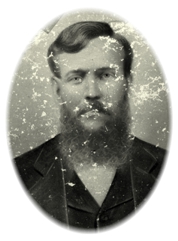 Greenup Raney was born on August 7, 1846, according to an entry at Find-A-Grave (and his grave stone), although he could have been born anywhere from 1847 to 1849, based on various records. It appears from an 1860 census record that his mother was named Celia and he had a brother James who had been born around 1852. Greenup was eleven in 1860 on the 21st day of July.
Greenup’s father, however, is a mystery . . . and I’m not the only one scratching their head on this one. I came across several posts asking for information on Greenup’s father. For now, that remains a mystery.
Just as mysterious is what happened to Celia. After the 1860 census when she was enumerated as the head-of-household with two sons, she disappeared. She was a thirty eight year-old day laborer in 1860. Her name doesn’t appear in the 1870 census records, but a reference to her apparent demise is referenced on Greenup’s marriage record.
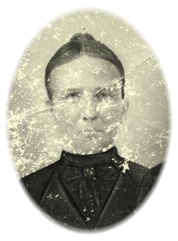 Greenup married Martha Ann Pointer on October 17, 1867 in Pulaski County, Kentucky. The record notes that Greenup did not know his father’s birth place, so it might be that his birth father and Celia perhaps never married. On that day, Greenup was nineteen years old which would indicate a birth year of 1848 (the 1900 census recorded August 1847). Martha Ann was a bit older, twenty-two at the time of their marriage. As to the whereabouts of either of Greenup’s parents, the remarks at the bottom of the record tell us that “groom has neither father, mother or guardian living.”
There is a record indicating that a Greenup Raney enlisted in Company B of Kentucky Hall’s Gap Infantry Battalion on April 16, 1865 in Stanford, Lincoln County, Kentucky. General Robert E. Lee had surrendered to General Ulysses S. Grant exactly a week earlier in Virginia.
Greenup’s service was short-lived, mustered out on July 27, 1865. Although his military service was brief, he applied for a pension on July 26, 1890. I suppose it’s also possible this might have been Greenup’s father and he was named after him, but records for anyone named Greenup Raney seem to all point to today’s subject.
No Civil War battles had been waged in southern Lincoln County, however the residents remained vigilant. Thus, this unit was formed to scout the area and protect it. In a book chronicling the history of Lincoln County, it was noted that the area had always been a perfect place to raise children. Most folks were farmers and there was an abundance of woods, filled with trees, plants and small animals. “The community was filled with good, decent, Christian people raising children and sharing the problems of each household.”
The children born to Greenup and Martha’s marriage were:
William Gaither (1868)
Emmaline (1869)
James Francis (1875)
Mary Elizabeth (1876)
Parlee Pearl (1879)
John (1882)
Mattie Bell (1885)
It appears the entire family remained in Pulaski County, the children also marrying spouses from the area and raising the grandchildren of Greenup and Martha there. Greenup, who went by the shortened name “Green” was a farmer. In 1900 four of their children remained in the home (Emmaline, Parlee, John and Mattie). Emmaline married later that year. By 1910, their nest was empty.
Greenup passed away on September 12, 1912 and was buried in Goforth Cemetery in Pulaski County. The grave stone appears to have been “homemade” and the date of his birth is listed as August 7 ,1846. In 1930 Martha Ann was living with her daughter Emmaline and her family, and this appears to be the last record available for her.
Lots of “Green” in Pulaski County
While researching this article, I came across a lot of males named “Green” in Pulaski County. It seems to have been a popular name. I found one other Greenup (Jones), but maybe like Greenup Raney he went by just “Green”. Not sure where the name came from but there is a Greenup County in northern Kentucky.
The most interesting “Green” name, however, was Green B. Rash (the “B” may be as in “Berry” – I’ve seen some other Kentucky men named Green Berry or Littleberry). It seems that Green Rash served with some of my kin (a Stogsdill cousin or uncle) during the Civil War – their names are listed on the 1890 Veterans Schedule in the same company.
In my research I came across more names from my own family. William G. Raney’s second marriage was witnessed by two people named Sears and Stogsdill (surnames both in my line). So, who knows – as thick as folks in that part of the world were, I might be related somehow to some of these Green fellows.
Did you enjoy this article? Yes? Check out Digging History Magazine. Since January 2018 new articles are published in a digital magazine (PDF) available by individual issue purchase or subscription (with three options). Most issues run between 70-85 pages, filled with articles of interest to history-lovers and genealogists — it’s all history, right? 🙂 No ads — just carefully-researched, well-written stories, complete with footnotes and sources.
Want to know more or try out a free issue? You can download either (or both) of the January-February 2019 and March-April 2019 issues here: https://digging-history.com/free-samples/
Thanks for stopping by!
Surname Saturday: Marple
Marple is most commonly known as an English surname and most sources agree that it was a locational name referring someone who lived near a maple tree grove. There are some mild disagreements about the specific location where the name emanated from. For instance, this article later highlights a Marple (or Marpole) from Wales.
House of Names refers to the Marple family of Cheshire who lived at the manor of Marple, while other sources believe it originated from Yorkshire. Specifically, the Internet Surname Database argues that the town of Marples in Cheshire is not linked to the Marple surname (but I suppose might be linked to the Marples surname, a spelling variation).
There were early occurrences of the name in Cheshire in the thirteenth century. According to 4Crests, the name is an Old English word, “merpel” and the earliest records show “Merphull” and “Merpel” being used in Cheshire, both without surnames.
In the fourteenth century, Thomas de Mapples was listed on the Yorkshire tax roll of 1379. Still, it’s certainly possible that the Marple (or Marples) surname originated from the town in Cheshire. The first spelling of the village was recorded in 1248 as “Merpel”. Of course, there are many spelling variations, including: Marple, Marples, Marble, Marbles, Merple, Merpel, Merble, Merbles, Marpole and more.
One of the first (if not the first) Marple to come to America was David Marple who settled in Pennsylvania.
David Marple
The records for David Marple and his family are a bit sketchy, although I found one source with some interesting deductions as to his history. It appears that he was Welsh, or at least half-Welsh, probably born in Radonshire to parents Thomas and Rebecca (Jones) Marple (or Marpole because Rebecca Marpole is seen in Pennsylvania records later).
David and his wife Jane (Morgan??) were married before coming to Pennsylvania in the early eighteenth century. A group of Welsh Baptists had arrived in 1687:
By the good Providence of God, there came certaine persons out of Radonshire, in Wales, over into the Province of Pennsylvania, and settled in the township of Dublin, in the County of Philadelphia.
As was the case with so many people of faith in seventeenth century England, religious persecution compelled them to make the journey across the Atlantic. Parliament had passed a religious tolerance act in 1689, but by the end of the century the Church of England was again pressuring other faiths to conform.
In 1701 Thomas Griffith, Baptist minister, brought several other individuals with him from South Wales, although the list doesn’t include David and Jane Marple. It may be that they arrived between 1701 and 1703 because records show that Rebecca Marpole was added to the Pennepek (Pennepack) church around that time, perhaps after first attending a church in Newcastle, Delaware. Pennepack church records also indicated that David and Jane had been baptized in Wales (date unknown because entry was torn away).
One family researcher implies that Jane might have been related to Thomas Griffith somehow, she having a half-brother named Benjamin Griffith. Their research also includes a theory that possibly David and Jane were second cousins.
According to Pennsylvania and New Jersey church records, David died in Lower Dublin, Philadelphia, Pennsylvania at the age of seventy-five. He was a member of the Lower Dublin Baptist Church according to the same church record.
Many family researchers believe he is buried at the Old Pennepack Baptist Church (also known as the Lower Dublin Baptist Church). Someone has placed a grave stone there, but the church’s record of burials listed on their web site believes it’s possible the David Marple buried there is another David Marple (there appears to have been several descendants with the same name). The Old Pennepack Baptist Church has a long and storied history, founded in 1688, but where he is buried may be a mystery.
It appears that David’s descendants began to migrate away from Pennsylvania to Virginia and then to what became West Virginia. In case you missed it, this week’s Tombstone Tuesday article was about Albinus Reger Marple, who I believe is one of David’s descendants. You can read that article here.
Did you enjoy this article? Yes? Check out Digging History Magazine. Since January 2018 new articles are published in a digital magazine (PDF) available by individual issue purchase or subscription (with three options). Most issues run between 70-85 pages, filled with articles of interest to history-lovers and genealogists — it’s all history, right? 🙂 No ads — just carefully-researched, well-written stories, complete with footnotes and sources.
Want to know more or try out a free issue? You can download either (or both) of the January-February 2019 and March-April 2019 issues here: https://digging-history.com/free-samples/
Thanks for stopping by!
Wild West Wednesday: Jackson Lee “Diamondfield Jack” Davis
 No one seems to have a definitive history of Jackson Lee “Diamondfield Jack” Davis’ early life. Even the date and place of his birth appears to be a mystery. A cursory internet search will yield results spanning the years between 1864 and 1879 as his purported birth year. His place of birth is uncertain, but the name “Jackson Lee” would suggest Southern roots like perhaps Virginia or West Virginia.
Most historians consider him a gunslinger, famous for wearing his rifle slung across his back and carrying pistols, as many as three, either holstered or in his coat pocket and a Bowie knife strapped to his leg – he was armed to the teeth at all times. He made a name for himself in the mining camps of the west and later as an “enforcer” of sorts, working for cattlemen who were constantly battling for grassland with the sheep ranchers, a familiar saga of the 1800’s West (see more about the bloody Graham-Tewksbury feud in Arizona here).
Some have written about Davis as if he was an all-out hired gun, his only mission in life to shoot and kill sheep herders. If that was indeed true, then it’s easy to see how he was mistakenly accused and convicted of killing two sheep herders in 1896. That miscarriage of justice would become the most remarkable and memorable of his storied life.
How did he come by the nickname “Diamondfield Jack”? In the summer of 1892 Davis worked in a Silver City, Idaho silver mine. Not long afterwards, Idaho had a diamond rush and he later claimed to have discovered a diamond mine. He was known to have been a big talker, regularly embellishing his stories. After taking a job with the Sparks-Harrell Cattle Ranch and bragging about his adventures as a diamond miner, someone gave him the nickname “Diamondfield Jack” and it stuck.
In 1895 Davis was hired by James E. Bower, general superintendent of the ranch, ostensibly to bully and intimidate sheep herders in the area who were thought to be intruders on the cattlemen’s grassland. His reputation for carrying all those weapons was no doubt meant to intimidate and from time to time he included threats to kill someone.
In fact, he did carry out one of those threats by wounding Bill Tolman in the shoulder. Davis left the area for awhile until things cooled off, drifting into Nevada to avoid an warrant for his arrest for attempted murder. In late January of 1896 he ventured back into southern Idaho, later testifying that he was on his way back to turn himself into the sheriff for Tolman’s shooting.
Along the way he joined up with Fred Gleason, another cowboy employed by the Sparks-Harrell Ranch. Together they seemed to have meandered along, not in any real hurry, looking for horses. On the evening of February 2 the two were riding after dark near a sheep camp. Davis stopped and fired off a few rounds in the direction of the camp and then the two men continued on their way back to the Brown Ranch where they were staying.
The following day Davis and Gleason hung around the ranch and shoed their horses. The following morning they decided to leave and head up the river to the Middle Stack Ranch. They continued to meander their way through, again, in no particular hurry. On February 6 they met with James Bower at the H.D. Ranch and Bower rode with them to Wells, Nevada. Witnesses later testified that Davis and Gleason remained there for several days – drinking and talking too much.
Meanwhile, the bodies of sheep herders Daniel Cummings and John Wilson had been found, a grisly discovery made by a sheepherder named Ted Severe at Deep Creek. The crime scene was littered with .44 caliber bullets shot from a .45 caliber gun. It was known that Davis had a reputation for using .44 caliber bullets when he couldn’t find the exact caliber for his weapons of choice. Thus, he became the prime suspect in the murders.
Another cowboy with the Sparks-Harrell operation later testified that Davis had decided to leave the country and head south – his friend Gleason was drunk all the time and threatening to kill sheep herders in Deep Creek. Until he was arrested in March of 1897 in Yuma, Arizona for his alleged crime, no one knew of his whereabouts. Because Davis and Gleason had been in the area of the killings and Davis had the reputation of bullying and intimidation, the locals just assumed Davis was guilty.
Adding to the assumption of his guilt, Davis was arrested while jailed in the Yuma Arizona Territorial Prison. Gleason had been found in Deer Lodge, Montana. By mid-March the two were brought to Albion, Idaho to stand trial. The sheep herders and their supporters, including the Wool Growers Association, mounted an all-out effort to see them convicted. Davis and Gleason, however, had the cattlemen on their side. John Sparks and Andrew Harrell, former employers, put up most of the funds for their defense.
Davis and Gleason had the best defense lawyers money could buy and testimony and evidence was carefully and methodically presented. The prosecutors were also well-qualified and able to establish that the two men had at least been in the area of the crime on that day. When it came time to decide Davis’ fate, the jury took only two hours to find him guilty of first degree murder. He was sentenced to hang on June 4, 1897. Gleason’s trial, however, had a different result – he was acquitted.
The next five years of Jack Davis’ life turned out to be most harrowing. Appeals were mounted by his attorneys and several times his execution was stayed. At one point he was transferred to the Idaho State Penitentiary, only be to returned to the Cassia County Jail where he had first been imprisoned during and following his trial.
Following another series of appeals, another execution date was set for July 3, 1901. This must have been frustrating for Davis and his attorneys, for you see two other men, James Bower and Jeff Gray had finally confessed to the killings, claiming self-defense. Davis received a short reprieve from the Board of Pardons with a new date of execution scheduled for July 17. His attorneys had been unable to convince the Board of his total innocence, even with the knowledge of Bower and Gray’s confession.
Three hours before his scheduled execution on the 17th, his sentence was changed to life imprisonment – no exoneration yet, but Davis would be allowed to live out his life in the Idaho State Penitentiary. After another round of legal wrangling and appeals, Jackson Lee “Diamondfield Jack” Davis was finally pardoned by Idaho Governor Frank Hunt on December 17, 1902.
His case had been covered by newspapers all around the country. When released, Davis unsurprisingly left Idaho and moved to Nevada. He kept his name and reputation in the papers over the ensuing decades, striking it rich in the mining camps of Nevada. He later wrangled with the Industrial Workers of the World and continued to carry four guns with him at all times. When asked why he did that, Davis replied, “Well, if I ever get into a mix-up and don’t have my guns and got killed, I’d never forgive myself as long as I lived.”
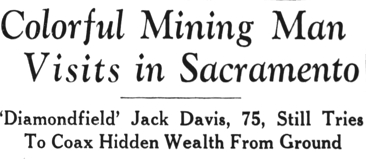
By the late 1930’s Davis, then in his seventies, was still seeking more fortune. He made his way to Las Vegas and for several years afterwards alternated between residences in Los Angeles and Las Vegas. The man who seemed to have nine lives (or more), finally met his end not in a spectacular fashion befitting his gunslinger image, but in an accident with a taxi cab after stepping off a curb in Las Vegas on December 28, 1948.
While on the way to the hospital, he told a friend that he intended to live to the age of one hundred. Jack Davis lingered for a few days but passed away on the morning of January 2, 1949. One obituary printed in a Salt Lake City newspaper was full of misstatements about his life, and was probably picked up by other papers across the country.
But, that was the story of his life apparently, largely misunderstood and misreported. As Max Black pointed out in his book entitled Diamondfield, the irony of the incorrect obituary was perhaps fitting, for Davis himself was known to be an exaggerator of the truth.
Diamondfield Jack was definitely a “Wild West” character and a part of Idaho folklore and history. A National Forest campground is named in his honor, as well as a restaurant in Twin Falls, Idaho.
If you’re interested in learning more details about Diamondfield Jack and his legal entanglements and woes, followed by his successful business career, Max Black’s book was written to finally tell the truth about what really happened. The book is available on Amazon for $3.99, and if you have Kindle Unlimited, it is free to borrow.
Did you enjoy this article? Yes? Check out Digging History Magazine. Since January 2018 new articles are published in a digital magazine (PDF) available by individual issue purchase or subscription (with three options). Most issues run between 70-85 pages, filled with articles of interest to history-lovers and genealogists — it’s all history, right? 🙂 No ads — just carefully-researched, well-written stories, complete with footnotes and sources.
Want to know more or try out a free issue? You can download either (or both) of the January-February 2019 and March-April 2019 issues here: https://digging-history.com/free-samples/
Thanks for stopping by!
Tombstone Tuesday: Albinus Reger Marple
 Albinus Reger Marple was born on January 27, 1834 in Lewis County, Virginia to parents John Weaver and Ruth (Reger) Marple. It’s possible that his first name was a family name, evidenced by a record of someone named Albanus Marple in Pennsylvania. Most family researchers believe that Albinus’ grandfather John Abram Marple was the son of Enoch Marple, Sr. of Philadelphia, who later migrated to Virginia. His middle name, of course, was his mother’s maiden name.
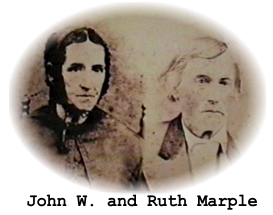 Research revealed more than one spelling of his name, but it is spelled “Albinus” on his grave stone, with alternate spellings on various records of Albinos, Albinas and Albenus. Albinus married Mary Jane Post, daughter of Daniel and Mary Post on February 1, 1855 in Upshur County, Virginia (eventually West Virginia). The children (rather unusually named) born to their marriage were:
Mandema “Dem” (1856)
Louvernia “Vernie” (ca. 1859)
Seleucus “Luke” Eumenis (1860)
Nevada “Vadie” (1866)
Achilles Landolus “Dolus” (1872)
In 1860 Albinus and his family were enumerated in Buckhannon (Upshur County). At that time Upshur County was still part of Virginia. However, when Virginia voted to secede from the Union in April of 1861, the delegates west of the Allegheny Mountains opposed the move.
On May 15, 1861 the anti-secessionists of western Virginia convened their own convention in Wheeling and began to make plans for their own state in support of the Union. On June 20, 1863 Congress granted statehood to West Virginia.
However, during the Civil War, the state was considered a border state like Delaware, Maryland, Kentucky and Missouri. Apparently, Albinus and his brother Addison were sympathetic to the Confederate cause, at least at the war’s beginning. Both deserted the Rebel Army shortly after enlistment and both surrendered to private citizen Joseph Strager, as noted in an article entitled Men In Gray: Confederate Soldiers of Central West Virginia by Ralph P. Bennett.
On October 19, 1863, the brothers took an oath of allegiance to the Union and were sent north. According to Bennett, it was common for the Union to send former Confederate soldiers north of the Ohio River. Bennett further described the predicament Albinus and Addison, much like other former Confederate soldiers, faced:
The Marple brothers like many others wished to serve the cause of the Confederacy, yet their loyalty was in conflict with their awareness of the sufferings and privations of their families who lived behind enemy lines. A letter in the 31st Virginia Infantry by John M. Ashcraft, from the wife of Private William W. Stockwell to her soldier husband states , having hard time out of provisions, no crops, will come to you, meat [sic] me at Staunton. Many soldiers requested detached duty to spy on Union activities and hopefully recruit soldiers but often their primary motivation was to visit home and family. By 1864 the declining fortunes of the Confederacy caused morale to plummet and desertions increased markedly.
Albinus and his brother survived the war and returned to Upshur County to farm. A short biography of Albinus was included in The History of Upshur County, West Virginia, published in 1907. At that time he owned three hundred and eighty acres of fertile land along Hackers Creek. Albinus and Mary Jane were members of the Westfall Chapel Methodist Protestant Church.
Albinus died on September 9, 1908 and a few months later on January 20, 1909 Mary Jane passed away. Both are buried in the McVaney Cemetery in Upshur County.
Did you enjoy this article? Yes? Check out Digging History Magazine. Since January 2018 new articles are published in a digital magazine (PDF) available by individual issue purchase or subscription (with three options). Most issues run between 70-85 pages, filled with articles of interest to history-lovers and genealogists — it’s all history, right? 🙂 No ads — just carefully-researched, well-written stories, complete with footnotes and sources.
Want to know more or try out a free issue? You can download either (or both) of the January-February 2019 and March-April 2019 issues here: https://digging-history.com/free-samples/
Thanks for stopping by!