Wild West Wednesday: Buckshot Roberts and the Gun Battle at Blazer’s Mill
 This gun battle at Blazer’s Mill, located on the Rio Tularosa, is considered part of the Lincoln County War of 1878. The most famous participant of that war was, of course, William H. Bonney, a.k.a. “Billy the Kid.” Billy and his fellow posse members called themselves the “Regulators” and were led by Dick Brewer. Their “opponents” were the Murphy-Dolan faction who aligned themselves with Lincoln County Sheriff William Brady.
The Regulators were more or less the “extra-legal” force for the Tunstall-McSween faction who supported the town constable Dick Brewer (the Regulators’ leader). Tensions between the two factions had been brewing for awhile but erupted into a full-scale county war early in 1878. On February 18, John Tunstall was murdered, which precipitated the organization of Brewer’s posse.
Sheriff Brady was later killed on April 1. These two events set the stage for the gun battle at Blazer’s Mill. Andrew L. “Buckshot” Roberts would be drawn into the war whether he wanted it or not because the Regulators thought he might have been involved in Tunstall’s murder.
 The history of Andrew Roberts is, at best, sketchy. Many stories and theories abound as to his origins. Some believe he was from Texas, others believe he was born farther east. His grave stone has a marker indicating he fought as a Confederate in the Civil War. Another theory has him joining the Texas Rangers after the war and fighting Indians – yet another story has him later doing battle against the Texas Rangers. Some historians suggest that he was once a buffalo hunter and rode with William F. “Buffalo Bill” Cody.
Whatever his true history, along the way he earned the moniker of “Buckshot” after he was shot up so bad his right arm was crippled. After that he wasn’t able to lift a rifle to his shoulder – he shot strictly from the hip. At some point, perhaps wanting to settle down with a more peaceful existence, he bought a little ranch near Ruidoso. While he officially took no sides in the Lincoln County Wars, it was generally believed that he aligned himself with the Dolan-Murphy faction.
Noted author and western historian Emerson Hough wrote about Roberts in his book The Story of the Outlaw: A Study of the Western Desperado:
When the Lincoln County War broke out, he was recognized as a friend of Major Murphy, one of the local faction leaders; but when the fighting men curtly told him it was about time for him to choose his side, he as curtly replied that he intended to take neither side; that he had seen fighting enough in his time, and would fight no man’s battle for him. This for the time and place was treason, and punishable with death. Roberts’ friends told him that Billy the Kid and Dick Brewer intended to kill him, and advised him to leave the country.
Roberts decided to do just that as he sold his property and prepared to leave. Again there are various theories as to why Roberts rode into Blazer’s Mill on April 4 (just three days after Sheriff Brady had been murdered). Hough mentions three theories or rumors: that he went to meet a friend who had been badly wounded; he went to confront Major Godfroy who he’d had a disagreement with; or he was headed there to kill none other than Billy the Kid. Hough thought it more likely he was there to visit his friend.
Yet another story, which might be the most plausible of all, was that he was there checking to see if payment for his land sale had arrived in the mail. Again, whatever the actual facts, it appears he unknowingly rode in to find the Regulators were also there. One member of the Regulators, Frank Coe, asked Roberts to give up his weapons, which Roberts refused to do. Meanwhile the rest of the Regulators had retreated behind a house.
One eyewitness said that suddenly the rest of the gang came from behind the house and began firing at Roberts. Rather than retreat inside the house, Roberts began firing on the Regulators (twelve or thirteen men). Roberts shot Jack Middleton (although not mortally wounded), shot off George Coe’s finger, grazed another one or two and almost got off a shot at Billy the Kid, but instead his gun misfired.
Charlie Bowdre came around the house next and Roberts fired at him, striking his belt and cutting it off. Bowdre almost simultaneously fired at Roberts and wounded him – although later other Regulators would claim they actually shot Roberts. Roberts now retreated back into the house. Having run out of ammunition for his own rifle, he picked up another rifle and pulled a mattress to the floor and laid upon it near the open window at the front of the house.
By this time, everyone had retreated, but Dick Brewer decided to take matters into his own hands. He approached the house by crossing the river over a foot bridge. When he found a strategic spot from which to take aim (about 125 yards west of the house), he fired into the house. While his shot did nothing but scatter bits of adobe, it gave Roberts a bead on where his target was hiding.
Even though Brewer’s eyes were barely visible above the pile of logs where he was hiding, Roberts, himself severely wounded, fired and struck Dick Brewer in the eye – blowing off the top of his head. With Brewer laying dead, Billy the Kid became the de facto leader and ordered his men to retreat. It was apparent to them that their scrappy opponent would kill them all if he had the chance. Billy the Kid would remember the gun battle by remarking, “Yes sir, he licked our crowd to a finish.”
Buckshot Roberts did indeed hold his own against the Regulators, but on April 5 he died after attempts to save his life failed. Before he died he was so desperately in pain that two men had to hold him down. Eyewitness Johnny Patten claimed that he built a coffin in the shape of a big “V” so that both Roberts and Brewer could be buried side by side. “We just put them both in together,” said Patten, “and there they lie today grim grave-company.”
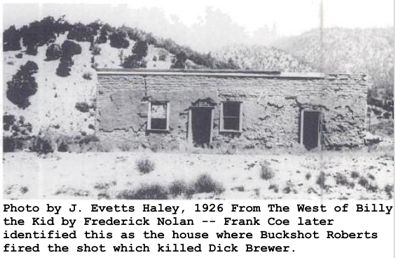
When Emerson Hough visited the battle site in 1905 he verified and measured the distances reported. It was indeed a 125-yard downhill shot made by Roberts which killed Dick Brewer. For someone with such great odds against him, not to mention his inability to lift a rifle to shoulder-level, Buckshot Roberts put up one heck of a fight. According to one source, it was later proven that he had nothing to do with Tunstall’s murder.
 Did you enjoy this article? Yes? Check out Digging History Magazine. Since January 2018 new articles are published in a digital magazine (PDF) available by individual issue purchase or subscription (with three options). Most issues run between 70-85 pages, filled with articles of interest to history-lovers and genealogists — it’s all history, right? 🙂 No ads — just carefully-researched, well-written stories, complete with footnotes and sources.
Want to know more or try out a free issue? You can download either (or both) of the January-February 2019 and March-April 2019 issues here: https://digging-history.com/free-samples/
Thanks for stopping by!
Mothers of Invention: Sarah Mather and Martha Coston (Also Making Civil War Naval History)
 The subjects of today’s article were not only “mothers of invention” but also made a bit of naval history as well, contributing to the Union’s cause during the Civil War.
Sarah Mather
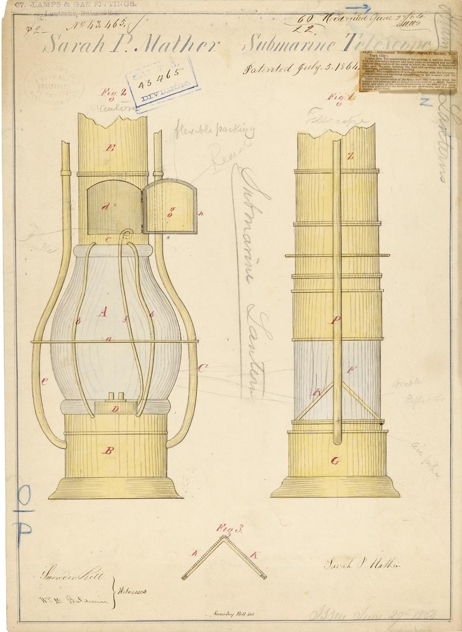
Unfortunately, for history’s sake, little is known about inventor Sarah Mather. One source believes her to have been married with at least one daughter. There don’t appear to be any records of other inventions by Sarah Mather (except an improvement on the first). However, her submarine telescope was an important naval innovation.
On April 16, 1845, Brooklynite Sarah Mather was granted a patent (US Patent No. 3995) for an invention she called a “submarine telescope” – an “Apparatus for Examining Objects Under the Surface of the Water”.
The nature of my invention consists in constructing a tube with a lamp attached to one end thereof so to be sunk in the water to illuminate objects therein, and a telescope to view said objects and make examinations under water. . . .
It will at once be obvious that the above named lamp and telescope can be used for various purposes, such as the examination of the hulls of vessels, to examine or discover objects under water, for fishing, blasting rocks to clear channels, for laying foundations or geological formations, the lamp being used for lighting the objects while inspected by the telescope.
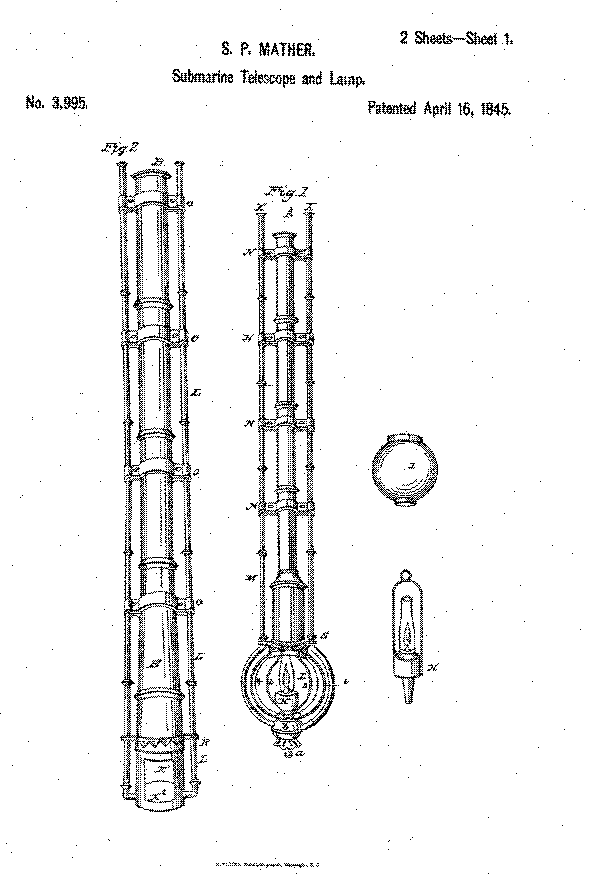

Primarily, her invention was used to examine a ship’s hull without having to remove it from the water. On July 5, 1864 she was awarded US Patent No. 43465 for an “Improvement in Submarine Telescopes”. With the beginnings of submarine warfare during the Civil War, her invention was also useful in detecting Confederate underwater activity.
Martha Jane Hunt was born in Baltimore, Maryland in 1826. After her mother was widowed, her family moved to Philadelphia sometime in the 1830’s. By the age of fourteen, Martha, in her own words, was “unusually tall and mature in appearance for my age.” She attended school and studied hard. One summer day she was attending a picnic in the park and met nineteen year-old inventor Benjamin Coston.
His prowess as a skillful inventor was well-known in Philadelphia. He had been working on a “submarine boat or torpedo” which could operate underwater up to eight hours without resurfacing. The air needed to survive underwater was a chemical process which he had also invented. She was obviously impressed with his skills as an inventor, not to mention his handsome features. In her autobiography, A Signal Success, she remarked, “to tell the truth, I was a little too much in awe of his genius to be quite at my ease with him.”
They began to spend a great deal of time together, he assisting with her school work, especially in mathematics, grammar and history. As long as he remained in the city she excelled, but during his absences her grades suffered. She began to depend on him and, needless to say, she was falling in love with Mr. Coston, and he with her. Her mother was shocked to hear from Benjamin that he was in love with her “baby girl”, but agreed to allow their marriage when Martha reached the age of eighteen.
Benjamin’s work had caught the attention of Admiral Charles Stewart, a.k.a. “Old Ironsides”. The admiral urged Benjamin to join the navy and arranged a meeting with the Secretary of the Navy. Benjamin received an appointment as master in the service of the Navy at the Washington Navy Yard. Realizing that they would be separated for an extended time, and having grown so fond of each other, they decided to elope.
With her sister (Nellie) and Nellie’s fiancé Tom Blair as witnesses:
We proceeded at once to the house of a minister, unworthy of the gospel he preached, and willing for the sake of an extra fee to ask no embarrassing questions and agree to make no revelations. . . . and in a few moments it was over, and I, a sixteen-year-old girl, a wife.
Because of Benjamin’s assignment to the Washington Navy Yard (instead of a two-year scientific expedition at sea), the young couple relocated to Washington, D.C. After four years of marriage they had two young sons. Benjamin’s worked in a pyrotechnic laboratory where he developed and tested rocketry for the government. Although his work was well received, Benjamin and the Navy were at odds in regards to promotions and credit for his work. He resigned and accepted a position as president of Boston Gas Company.
The family continued to grow after they moved to Boston. After the birth of their fourth son, Benjamin was called to Washington on business. As he was returning, he became seriously ill and three months later died. Martha returned to Philadelphia to live with her mother, but not long afterwards her baby son Edward became ill and died as well.
The tragedies continued as her mother also died a short time later. Martha, always close to her mother, was devastated, remarking “I had lost both my anchor and my pilot, and was at the mercy of unknown seas.” As she was dealing with multiple tragedies, the family’s finances had not been tended to properly and Martha realized that her source of income from Benjamin’s business was depleted. At twenty-one she was penniless with three small children.
One rainy afternoon in November she began going through some of Benjamin’s papers, some of which consisted of his notes for unfinished inventions and chemical experiments while working with pyrotechnics for the Navy. She came upon a large envelope which contained a detailed plan for signals which could be used at night much like signal flags were used during the day. Each signal was numbered and a certain fire color assigned to each one, corresponding to colors used by signal flags during the day.
She began corresponding with Navy officials, trying to find someone interested in the perfection of Benjamin’s plans. Some of her husband’s naval co-workers assisted her efforts to develop flares for testing. The tests, unfortunately, were utter failures. In the meantime, tragedy struck again when her second son became ill and died – just as her initial communication efforts were rebuffed. Still, the Secretary of the Navy encouraged her to continue.
Martha pursued the task, giving over the care of her two remaining sons to friends so she could dedicate herself full-time to the project. It would take years of working with chemists to perfect the flares, as well as find a manufacturer. The task was arduous, but they finally were successful in developing a pure white and vivid red light. A third color was needed, however.
In August of 1858 Martha was in New York City attending the celebration of the first transatlantic telegraph cable being laid. A fireworks display gave her the idea that a pyrotechnics company might be able to help her develop the third color. She inquired with several firms, requesting either a blue or green color. They worked together for several weeks and finally in February of 1859, a naval review board gave her a favorable report. On April 5, 1859, Martha Coston was granted US Patent No. 23,536 for a pyrotechnic night signal and code system. Benjamin, however, was listed as the inventor and she as the administratix.
For the next two years, the Navy tested the new system around the world with satisfying results. The perfection and successful testing couldn’t have come at a better time. After Fort Sumter, Congress passed a funding bill and Martha and her partner immediately began production of the Coston signal flare – they sold one million flare signals during the Civil War. The signals were, of course, important tools to issue orders before and during battles. For the Navy, however, it allowed them to identify whether an approaching vessel was friend or foe, since the Union exclusively used the signals.
So successful were the Coston signal flares, David Dixon Porter, a Mississippi River squadron commander, would later write:
at night the signals can be so plainly read that mistakes are impossible, and a commander-in-chief can keep up a conversation with one of his vessels distant several miles, and say what is required almost as well as if he were talking to the captain in his cabin. This was the case in the Mississippi and also in the North Atlantic Squadron during the war, where we read hundreds of these signals (nay, thousands), which were frequently kept going all night long.
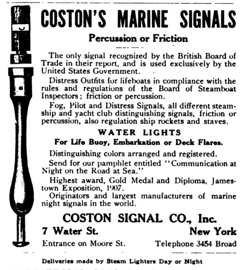 Martha continued to improve the device and in 1871 received a patent for a “Twist Ignition” device. Coston Signals were used on April 17, 1912, the fateful night when the Titanic sunk. Naval and Coast Guard services utilized the signals until marine radios came into usage in the 1930s.
Did you enjoy this article? Yes? Check out Digging History Magazine. Since January 2018 new articles are published in a digital magazine (PDF) available by individual issue purchase or subscription (with three options). Most issues run between 70-85 pages, filled with articles of interest to history-lovers and genealogists — it’s all history, right? 🙂 No ads — just carefully-researched, well-written stories, complete with footnotes and sources.
Want to know more or try out a free issue? You can download either (or both) of the January-February 2019 and March-April 2019 issues here: https://digging-history.com/free-samples/
Thanks for stopping by!
Surname Saturday: Nutting
The Nutting surname is Anglo-Saxon and derives from the Middle Ages English name of “Cnute” which became popular after a Dane by the name of “Cnut” became King of England in 1016. According to the Patronymica Britannica:
Ferguson derives this name and Nutt from Knut, or Canute, the Danish personal name; Knut was derived from a wen or tumour on his head. It is however worthy of remark, that the hazel, Anglo-Saxon hnut-beam, gave rise to several names of places, from some of which surnames have been derived, as Nutfleld, Nuthall, Nuthurst, Nutley, Nuthampstead. The names Nutter and Nuttman are also probably connected with this tree-signifying, perhaps, dealers in its fruit.
Another possibility as to origin is that the surname was derived from the Old English word “hnutu”, which meant brown. It could have been a nickname given to someone with a brown complexion since the English have an old saying “brown as a nut”. For instance, in A Study in Scarlet (Sherlock Holmes), one line reads: “Whatever have you been doing with yourself, Watson?” he asked in undisguised wonder, as we rattled through the crowded London streets. “You are as thin as a lath and as brown as a nut.”
A 1379 Yorkshire poll tax record lists a “Willelmus Nutyng”. Other spelling variations include Nutt, Nutter, Nudd, Nuttman, Knutt, to name a few. John Nutting immigrated from England as John Winthrop’s land steward and is considered the progenitor of all Nuttings in America – his story follows.
John Nutting
Some believe that John Nutting was born sometime between 1620 and 1625 to parents John and Elizabeth Rawlings Nutting. There is, however, a theory that he may have been a child in 1618 since a copyhold deed found among (John) Winthrop papers read: “John Nutton (Nutting) a lifelong tenant of one moiety of the lands of Groton Manor”. The grantee named was John Nutton, Senior. This would imply that there was a John Nutton (Nutting), Jr., and therefore that he had been born prior to 1618.
One source believes that John Nutting (Junior) immigrated in 1639, although it seems unclear as to when exactly he made the voyage across the Atlantic. Nevertheless, the first solid reference to his presence in the Massachusetts Colony was the record of his marriage to Sarah Eggleton on August 28, 1650 in the town of Woburn. Before their fifth wedding anniversary, three children were born:
John – 25 Aug 1651
James – 30 Jun 1653
Mary – 10 Jan 1655
The town of Chelmsford was incorporated in 1655 and the Nutting family decided to migrate westward. More children were added to their family:
Josiah – 10 Jun 1658 (died 10 Dec 1658)
Sarah – 07 Jan 1659 (died in infancy)
The pastor of their church in Chelmsford, Reverend John Fiske, kept a notebook and recorded the following about the Nutting family:
“Their Admission to the Church “29 of 4*, ‘56 (1656)”
“This day testim: was giuen touching Jo: Nutting & his wife, by Isa. Lernet, Sim: Thompson, and Abram Parker.”
“13 of 5, ‘56, …. there was joyned to the Church Jo: Nutting, after his Relation made, . . . assent given to the p’fession of faith & Cov’t of the Church.”
“It. Jo: Nuttin’s wife, hr Relation being repeated by the officer of the Church.”
“Three of Jo: Nutting’s Children baptized, – John, James, Mary. 3 of 6, ‘56.”
“(Date uncertain) Josiah Nutting, Br. Nutting’s child, baptized.”
“13 or 12, 59, Sarah Nutting, dau. of Br and sister Nutting, baptized.”
Around the time John and his family removed to Chelmsford, John Winthrop petitioned the Great and General Court for a new plantation at Petapawag which bordered Chelmsford. The Nutting family, being longtime friends of the Winthrops, began to consider yet another removal to the new settlement which would be called Groton, named after Groton Manor, England.
Perhaps surprisingly, the Nuttings and two other families who were considering the move to Groton were met with opposition from the Church. Nutting family historian Reverend John Keep Nutting wrote:
To us it would seem strange for a member about to remove from one town to another, to be expected to ask leave from the church. In those days it was quite different. Each new settlement was in reality, so far as all local interests were concerned, a small nation by itself. Its voting citizens were the members of the church – none others. And upon these the town rested for defence and for up-building. Solemn vows bound these to mutual defence and helpfulness. When therefore three leading families proposed to leave Chelmsford, it was no small matter.
On September 9, 1661 the following was recorded:
“On this day the three Bre: Ja: Parker, Ja: Fiske, Jo: Nutting, ppounded to the church: That they, haueing some thoughts and inclinations to a Remoue, desired to ppound it to the church, that (as they may see God to make a way for them) they may have the church’s loueing leaue so to doe, &their prayers for them, for a blessing of God vpo: their undertaking.”
The pastor . . . put it to vote, to see if . . . they should giue their grounds. . . .”
“Heerpo: scarce a man in the church but p’sently said, ‘The grounds The grounds!’”
The discussion (and controversy) continued for awhile apparently:
“After much Agitation, . . . ca: to this Result for answr. That the case was doubtful to us at present . . . (but if the brethren) shall in the meane time setle them in their pposed way . . . we shall leaue the matter with God.”
Following a vote on December 23, 1661, there are no more mentions of the three families until they are granted letters allowing them to join the Groton church. So, perhaps the removal took place either in late 1661 or early 1662. John Nutting had proposed that his move to Groton would allow him to settle near the meetinghouse there. On September 21, 1663 a vote was recorded wherein John Nutting was appointed the janitor of the meetinghouse:
Sep: 21:63 It is agreed by ye Towne with John Nuttin & voted that he the said John shall keepe cleane the meeting house this ye(ar) or cause it to be kept cleene & for his labors he is to h(ave) forrteen shillings.
John immersed himself in the civic affairs of his new hometown. In November of 1663 he was chosen as a selectman, the highest office in the town. He was subsequently re-elected to the same office in 1667 and 1669. In 1668 he took on the additional office of constable.
More children were born to John and Sarah after their move to Groton:
Sarah – 29 Mar 1663
Ebenezer – 23 Oct 1666
Jonathan – 17 Oct 1668
Deborah (not recorded)
Their home was said to have been large and secure enough to serve as a garrison in Groton, especially during King Philip’s War (1675-1678). King Philip was the name the English gave to Metacomet, the war chief of the Wampanoag Indians, he being the second son of Massasoit.
After the colonists arrived they made an alliance with Massasoit, and for the most part peace was maintained, although increasingly the English were making deeper incursions onto Indian lands. After Massasoit died, Metacomet ascended to leadership and began to realize that his land was slowly but surely being overtaken by colonists who wished to explore and live farther west than the original settlements. At the time, Groton was one of the most westward of settlements in the colony.
With stirrings of war the settlers began to prepare by fortifying five homes (John’s being one) which would serve as garrisons. Trouble began on March 2, 1676 when Indians pillaged deserted homes and took cattle and swine. On March 9, four settlers were attacked – one was killed, two escaped and one was taken prisoner (later escaping).
On March 13, approximately four hundred Indians made their way to Groton, led by a chief named Monoco or Monojo – the settlers called him “One-eyed John”. Early that morning, guards at John Nutting’s garrison saw two Indians “skulking about”. Those stationed at the garrison probably assumed there were no other Indians close by and decided to attack, but it turned out to be an ambush. John Nutting, a corporal, was one of the leaders.
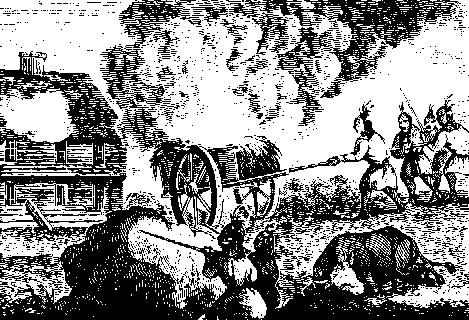 As the attack escalated, panic ensued and several fled, including some of the men. A second ambush was mounted by Monojo and his warriors. They took over the garrison and kept the battle going until nightfall. According to family historian John Keep Nutting:
Night put an end to active hostilities, but Monojo called up Captain Parker, reminding him that they were old neighbors, and held quite a conversation with him. He discussed the cause of the war and spoke of making peace. He naturally ridiculed the white man’s worship of God in the Meetinghouse, seeing that God had not helped them. He boasted that he had burnt Medfield and Lancaster, would now burn Groton, then “Chelmsford, Concord, Watertown, Cambridge, Charlestown, Roxbury, and Boston”, adding, “What me WILL that me DO!” The chronicler, however, is pleased to add to his account that not many months later this boaster was seen marching through the Boston streets which he had threatened to burn “with an halter about his neck, wherewith he was hanged at the town’s end”, in September of the same year.
John Nutting had been killed in the first attack. Historians presume that, as records indicate, the Indians cut off his head and “did set it vpon a pole, looking unto his own lande.” Apparently the rest of his family had safely escaped. John Nutting died defending his home, family and friends. Sarah’s name appeared a few months later in Woburn town records, referred to as “Widow Nutting”.
An apt summary of John Nutting’s life was penned by Reverend Nutting:
It is equally certain that he was truly a pious man. Among the things he coveted, was a home “nigh to the Meetinghouse”, so that he and his wife and his “smale childr:” might not miss the beloved “ordin:”. His humble position as sexton or janitor of the Meetinghouse, both at Chelmsford and at Groton, could not have been because he needed the trifling stipend, but rather because he felt it to be an honor to be “a door keeper in the house of the Lord.”
Did you enjoy this article? Yes? Check out Digging History Magazine. Since January 2018 new articles are published in a digital magazine (PDF) available by individual issue purchase or subscription (with three options). Most issues run between 70-85 pages, filled with articles of interest to history-lovers and genealogists — it’s all history, right? 🙂 No ads — just carefully-researched, well-written stories, complete with footnotes and sources.
Want to know more or try out a free issue? You can download either (or both) of the January-February 2019 and March-April 2019 issues here: https://digging-history.com/free-samples/
Thanks for stopping by!
Feuding’ and Fightin’ Friday: Spikes-Gholson Feud
 This family feud simmered quite awhile before it ended in the early 1900’s in eastern New Mexico, in an area now known as Quay County. The feud began in east Texas during the Civil War when the two patriarchs of the Spikes and Gholson families crossed paths, or should I say just “crossed.”
This article has been “snipped”. The article was updated, with extensive new research and sources, for the September-October 2020 issue of Digging History Magazine. It is included in the article entitled “Feuds, Fugitives and the Founding of Quay County”. This issue is Part II of a short series of articles dedicated to New Mexico history and how to find the best genealogical records. The September-October 2020 issue is available here: https://digging-history.com/store/?model_number=sepoct-20
Did you enjoy this article? Yes? Check out Digging History Magazine. Since January 2018 new articles are published in a digital magazine (PDF) available by individual issue purchase or subscription (with three options). Most issues run between 70-85 pages, filled with articles of interest to history-lovers and genealogists — it’s all history, right? 🙂 No ads — just carefully-researched, well-written stories, complete with footnotes and sources.
Want to know more or try out a free issue? You can download either (or both) of the January-February 2019 and March-April 2019 issues here: https://digging-history.com/free-samples/
Thanks for stopping by!
Ghost Town Wednesday: Eagle City, Idaho
 This ghost town in the Coeur d’Alenes of Idaho, although once a thriving gold mining town, might not be worthy of a mention, but for the fact that Wyatt Earp and Josephine “Sadie” Marcus arrived there in early 1884 for the Coeur d’Alene gold rush. Titus Blessing, subject of a Tombstone Tuesday article awhile back, was also there and possibly crossed paths with the Earps.
After leaving behind the OK Corral shootout in Tombstone and the Dodge City “war” in Kansas, Wyatt and Sadie headed to Idaho with Wyatt’s brother Jim, landing in Eagle City. Eagle City was the first mining camp to spring up in the area when gold was discovered by Andrew Pritchard in 1882. In early 1884, miners were arriving daily, many living in tents.
Wyatt and Sadie came to make their fortune as well, although not just as miners. They purchased a round circus tent – forty-five feet high and fifty feet in diameter – and opened a dance hall. Later they opened the White Elephant Saloon. Wyatt’s attempts at being a businessman always seemed to be thwarted by being drawn into some local controversy or conflict. Such was the case in Eagle City as well.
After A.J. Pritchard discovered gold, he began filing multiple claims in the area, his holdings being quite extensive. When the Earps came to Eagle City they formed their own mining company and decided to challenge Pritchard’s claims. The other partners in the company were Danny Ferguson, John Hardy, Jack Enright and Alfred Holman. Pritchard and the Earps found themselves in court frequently, arguing for miners’ rights and defending claim jumps. Pritchard won at least one suit where he claimed the Earps had jumped a claim.
Wyatt claimed four mines: the Consolidated Grizzly Bear, the Dividend, the Dead Scratch and the Golden Gate. His brother claimed the Jesse Jay. As if he wasn’t busy enough running the dance hall and saloon and mining, Wyatt took the job of deputy sheriff in Kootenai County. In late March, Wyatt would again be involved in a gunfight, although this time as peacemaker.
Wyatt’s partners (Ferguson, et al) were claiming to have legally purchased a lot in downtown Eagle City from Philip Wyman. Another gentleman, William Buzzard, claimed that he had purchased the lot from Sam Black whereon he built a cabin. Enright claimed the cabin was not located on the same lot he purchased. Nevertheless, Buzzard began hauling lumber to the site to begin construction of a hotel.
On March 29, Buzzard pointed a rifle at Enright and ordered him off his property. Enright left, but when he returned he was accompanied by Ferguson, Holman and William Payne who were, as they say, “armed to the teeth.” Bullets soon began flying, with two bullets hitting Buzzard’s hat and Enright narrowly missing a bullet in his face.
The Earp brothers stepped in, and as the report goes, took on the role of peacemakers:
with characteristic coolness, they stood where the bullets from both parties flew about them, joked with the participants upon their poor marksmanship, and although they pronounced the affair a fine picture, used their best endeavors to stop the shooting.
The Shoshone County sheriff ordered Buzzard to stop shooting, while Wyatt persuaded Enright and his friends to give up their guns. Later Buzzard and Enright had a smoke together and worked out their differences apparently. However, more than a decade later Buzzard would claim that Wyatt Earp was the instigator of the “lot-jumping claims” – again his reputation would be tainted.
A few months after Enright and Buzzard battled, Enright was involved in another gunfight, this time with the manager of the Eagle City Pioneer, Henry Bernard. Enright was shot by Bernard and died. Not long afterwards, the Earps sold out (at a loss) and left Eagle City. Presumably, the town of Eagle City began to fade away sometime later in 1884 or the following year since in 1885 the town of Murray, built just up the creek from Eagle City, became the county seat of Shoshone County.
Today not much remains of Eagle City except a few obscure graves. Murray’s population once numbered in the hundreds but today is home to mostly retirees and considered a “semi-ghost town.” The Sprag Pole Inn and Museum is said to be a “must-visit” for its exhibits highlighting the gold rush era and the history of the area.
Stay tuned for next week’s Tombstone Tuesday article highlighting three notable and/or infamous residents of Murray, Idaho.
Did you enjoy this article? Yes? Check out Digging History Magazine. Since January 2018 new articles are published in a digital magazine (PDF) available by individual issue purchase or subscription (with three options). Most issues run between 70-85 pages, filled with articles of interest to history-lovers and genealogists — it’s all history, right? 🙂 No ads — just carefully-researched, well-written stories, complete with footnotes and sources.
Want to know more or try out a free issue? You can download either (or both) of the January-February 2019 and March-April 2019 issues here: https://digging-history.com/free-samples/
Thanks for stopping by!
Tombstone Tuesday: John Wesley Spikes
 John Wesley Spikes was born in Alabama on September 29, 1841 to parents John Edward and Nancy (Colquehoune) Spikes. In 1843 his mother passed away and his father married Lucinda Carter on January 11, 1844. Lucinda was a widow with a young son, also named John, and she and John Edward had two children together before the family migrated west to Texas in 1846. They first settled along the Sabine River and later moved to Kaufman County, Texas in 1849.
According to Kaufman County history, John Edward was a farmer and slave owner with a different philosophy. He treated his slaves as family, provided for their welfare and allowed them to be buried next to his own family’s plot. He helped to establish and build a school in Kaufman, while his family and farm continued to grow and prosper.
This article has been “snipped”. The article was updated, with new research and sources, for the September-October 2020 issue of Digging History Magazine. It is included in the article entitled “Feuds, Fugitives and the Founding of Quay County”. This issue is Part II of a short series of articles dedicated to New Mexico history and how to find the best genealogical records. The September-October 2020 issue is available here: https://digging-history.com/store/?model_number=sepoct-20
Did you enjoy this article? Yes? Check out Digging History Magazine. Since January 2018 new articles are published in a digital magazine (PDF) available by individual issue purchase or subscription (with three options). Most issues run between 70-85 pages, filled with articles of interest to history-lovers and genealogists — it’s all history, right? 🙂 No ads — just carefully-researched, well-written stories, complete with footnotes and sources.
Want to know more or try out a free issue? You can download either (or both) of the January-February 2019 and March-April 2019 issues here: https://digging-history.com/free-samples/
Thanks for stopping by!
Ghost Town Wednesday: Kimberly, Utah
 Kimberly, Utah, located in the northwest part of Piute County, began to be settled in the 1890’s. In 1888 prospectors came to the Tushar Mountains to find a storied lost mine called “Trapper’s Pride.” It may not have been the mine they were searching for, but the men discovered two large veins of both gold and silver and founded the Gold Mountain Mining District in April of 1889.
The Annie Laurie Mine, named after Newton Hill’s daughters, was opened in 1891 and became one of the most productive in the mining district. Another prospector, William Snyder, developed the Bald Mountain Line. The town site he founded was first called Snyder City, later changed to Kimberly after an investor from Pennsylvania, Peter Kimberly, bought the Annie Laurie and other area mines. He combined all his holdings into the Annie Laurie Consolidated Mining Company and constructed a cyanidation plant to process the gold.
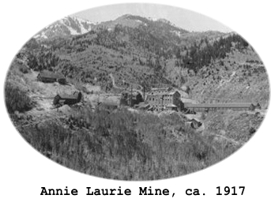 With the mill in place and the abundance of gold, silver and other precious metals, Kimberly began to boom. The town was divided into Lower Kimberly and Upper Kimberly, the lower part being the business district and the upper residential. In the book A History of Piute County by Linda King Newell (1999), Lower Kimberly is described:
Its main street twisted like a horseshoe around the contour of the canyon. Lower Kimberly had a post office, school, dance hall, doctor’s office, two or three general stores, several “specialty” shops, a slaughterhouse, three livery stables and as many saloons, two hotels, two barbershops, two boardinghouses, a dairy, and two newspapers, the Free Lance and the Nugget. The jail, one of the few brick structures in the town, stood toward the back of the small bench that provided a level area for some of the buildings. Inside were two iron cells, with only enough room on the front for the doors to open without hitting the wall. Those who supposedly knew said it was the strongest jail within a hundred miles.
A good jail was a good idea, since like many other mining booms town, it was a wild and woolly place. In 1900 the Gold Mountain School District was established and a school was built. Because of deep winter snows (the town was situated at approximately 9,000 feet), children attended school from April through November. Enrollment was at its highest in 1903 with 89 students.
The early 1900’s were the most productive for the area mines. After the cyanide mill was built in 1902, two hundred and fifty tons of ore could be processed in one day. Gold from the mines was shipped by stagecoach in bars measuring 6x10x10 inches and valued at over $20,000 each. The bars were stacked on the floor of the coach, between passengers’ feet, and of course, an armed guard always accompanied each shipment.
By 1902 the Annie Laurie alone employed three hundred miners, paid three dollars a day, and Kimberly’s population rose to five hundred. That year Peter Kimberly was said to have had an offer to sell out for five million dollars. By 1905 the mine was at its peak production level running three shifts, seven days a week.
Entertainment wasn’t lacking in Kimberly. The dance hall, built by the mining company, had one of the finest dance floors in the state. A young doctor, J.S. Steiner, established his medical practice by charging each family one dollar a year. If services were required, no additional fees were collected. There was constant traffic up and down the mountain roads carrying gold to the railroad at Sevier and supplies into Kimberly.
The town would begin its decline, however, in 1905 when Peter Kimberly died. The company was sold to a British company which lacked experience in managing mining operations. When the new owners instituted a scrip payment system, redeemable only at the company store, miners began to quit. The new company plunged into debt after building a new mill, followed by the Panic of 1907 which brought even more financial uncertainty.
In 1910 the Annie Laurie Consolidated Mining Company declared bankruptcy and with mine closure the demise of Kimberly soon followed. That year’s census enumerated only eight residents. The following year the company’s property, worth millions, sold at auction for a mere $49,000. Three men maintained the tunnels and buildings for a time for the new company, Sevier-Miller Coalition Company. In 1931, more workers were hired to remove a large block of ore. However, by 1938 the gold and silver were depleted and the mines were permanently closed. By 1942 most buildings had collapsed or were moved elsewhere.
One notable person born in Kimberly in 1905, Ivy Baker Priest, served as President Dwight Eisenhower’s Treasury Secretary from 1953 to 1961. She was the mother of Pat Priest, the actress who played Marilyn Munster on the television show The Munsters.
Did you enjoy this article? Yes? Check out Digging History Magazine. Since January 2018 new articles are published in a digital magazine (PDF) available by individual issue purchase or subscription (with three options). Most issues run between 70-85 pages, filled with articles of interest to history-lovers and genealogists — it’s all history, right? 🙂 No ads — just carefully-researched, well-written stories, complete with footnotes and sources.
Want to know more or try out a free issue? You can download either (or both) of the January-February 2019 and March-April 2019 issues here: https://digging-history.com/free-samples/
Thanks for stopping by!
Tombstone Tuesday: Horatio Nelson Jackson
 Horatio Nelson Jackson was born on March 25, 1872 in Toronto, Ontario, Canada to parents Reverend Samuel Nelson and Mary Ann (Parkyn) Jackson. Samuel was a minister who was also born in Canada (Brome), although according to census records Samuel’s father had been born in Massachusetts, thus it is possible that he could claim United States citizenship as well. Mary Ann was Canadian by birth and she and Samuel had seven children, the first two dying in infancy, followed by five sons who all lived to adulthood. Not long after she and Samuel married in 1866, Mary Ann completely lost her hearing and became an expert lip-reader in order to communicate.
According to 1900 census records, Horatio entered the United States in 1873. Whether or not he claimed dual citizenship by virtue of his father perhaps claiming dual citizenship, is not clear. In the 1920’s Horatio applied for passports as a sworn citizen of the United States (although his birthplace is noted in all records as Toronto). Nevertheless, after completing his public school education, Horatio entered the University of Vermont to study medicine at the age of eighteen (his father has also received his degree in medicine from the same institution in 1871).

This article was enhanced, with sources, and published in the June 2018 issue of Digging History Magazine. Preview the issue here or purchase here. I invitey you to check out Digging History Magazine. Since January 2018 new articles are published in a digital magazine (PDF) available by individual issue purchase or subscription (with three options). Most issues run between 70-85 pages, filled with articles of interest to history-lovers and genealogists — it’s all history, right? 🙂 No ads — just carefully-researched, well-written stories, complete with footnotes and sources.
Want to know more or try out a free issue? You can download either (or both) of the January-February 2019 and March-April 2019 issues here: https://digging-history.com/free-samples/
Thanks for stopping by!
Motoring History Monday: America’s First Coast-to-Coast Automobile Trip
In honor of the upcoming Memorial Day weekend when many Americans “hit the road” to officially begin summer, today’s article is about the first successful coast-to-coast American road trip.
On May 19, 1903, Horatio Nelson Jackson was in San Francisco on business. His primary residence was in Vermont where he had been a physician. Following a bout with tuberculosis he spent time in California and in May of 1903, having given up the practice of medicine three years earlier, was returning from Alaska were he had overseen some gold mine investments.
While at the University Club he overheard a group of men talking about the new horseless carriage – in their opinion it would never be able to make a cross-country trip. Horatio thought otherwise and boastfully wagered $50 claiming he could make the trip in less than three months. The wager must have seemed impetuous since Horatio did not own an automobile, and likely had very little, if any, experience driving one.
This article is no longer available for free at this site. It was re-written and enhanced, complete with footnotes and sources and has been published in the June 2018 issue of Digging History Magazine. Should you prefer to purchase the article only, contact me for more information.
I invite you to check out Digging History Magazine. Since January 2018 new articles are published in a digital magazine (PDF) available by individual issue purchase or subscription (with three options). Most issues run between 70-85 pages, filled with articles of interest to history-lovers and genealogists — it’s all history, right? 🙂 No ads — just carefully-researched, well-written stories, complete with footnotes and sources.
Want to know more or try out a free issue? You can download either (or both) of the January-February 2019 and March-April 2019 issues here: https://digging-history.com/free-samples/
Thanks for stopping by!
Surname Saturday: Gwinnett
The “Gwinnett” surname is of Welsh origin, first seen in Herefordshire where the family seat was held. The name derived from the Old Welsh nickname “Gwynn” for one who was fairly complected and had blonde hair. The area in Wales known as “Gwynnedd” was home to the family bearing this surname.
Spelling variations of this surname include: Gwinnett, Gwinet, Gwinett, Gwinnet and others. The subject of today’s article, Button Gwinnett, hailed from Gloucestshire. One family historian estimates that the Gwinnett family arrived in Gloucestshire around 1575, leaving the Gwynnedd area of North Wales.
Button Gwinnett
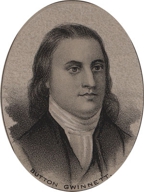 Button Gwinnett was born in Down Hatherly, Gloucestershire, England in about 1735 (at least that is when he was baptized), the son of Reverend Samuel and Anne (Emes) Gwinnett and the oldest of seven children. It is said that he acquired his unusual forename from his godmother Barbara Button. Young Button was educated in Gloucestershire and became a merchant. In 1757 he married Ann Bourne and by 1762 he and Ann decided to immigrate to America.
The Gwinnett family first landed in Charleston, South Carolina and then continued on to Savannah, Georgia to became a merchant. When his business failed, he sold his stock and purchased St. Catherine’s Island off the coast of Georgia and became a farmer. He turned to politics in 1767, serving as a justice of the peace and later in the Georgia Lower Assembly. After limited success as a planter, Button abandoned politics to concentrate on paying his debts, selling off most of his property, including St. Catherine’s.
It is said that Button had doubts about the colonies succeeding in breaking away from England. After leaving politics he was still active in his community and parish. After coming under the influence of Lyman Hall, Button Gwinnett became an emboldened radical. He was present at Peter Tondee’s tavern in Savannah on July 24, 1774 to debate the right of England to continue to pass laws which were burdensome to the colonists, referred to as “Intolerable Acts”. By 1775 his views had changed and he came out forcefully in favor of the rights of colonists to govern themselves.
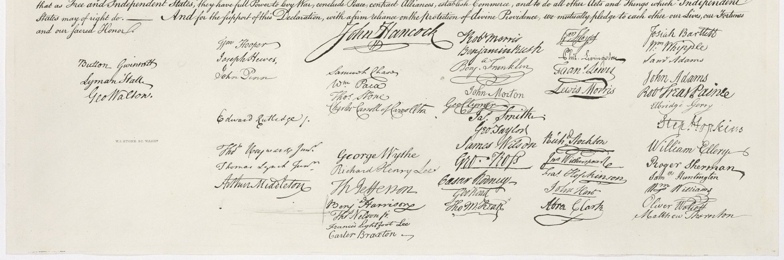
In early 1776 he was elected to Georgia’s general assembly in Savannah, which gave him a seat in the national Congress. He traveled to Philadelphia to join other delegates and on July 2, 1776 voted in favor of the Declaration of Independence before it was presented as a “fair copy” to Congress on July 4. On August 2, 1776 he signed his name to the revolutionary document, just above his mentor Lyman Hall:
While serving in the Continental Congress, the opportunity for Button to serve as a brigadier general in the 1st Regiment of the Continental Army arose. However, the position went to his political rival Lachlan McIntosh, embittering Gwinnett. He returned to Georgia and continued to serve in the legislature. In 1777 he assisted in drafting the Georgia state constitution.
In the background he continued to oppose McIntosh, and after Button became president of the Council of Safety, he went even further in his attempts to thwart his rival. To assert his own power Button undertook an attempted invasion of Florida, leading the troops himself. It was an ill-conceived plan and after its failure, Gwinnett was charged with malfeasance. He was cleared of the charges and then ran (unsuccessfully) for Governor.
McIntosh had publicly denounced Gwinnett, and to defend his honor Button challenged him to a duel. They dueled at the distance of only twelve feet and both were severely wounded. However, Button Gwinnett was the only one mortally wounded. He died on May 19, 1977 and was buried in Savannah’s Colonial Park Cemetery. Gwinnett County, Georgia is named after Button Gwinnett.
Today his signature is one of the most rare and sought after of all the signers of the Declaration of Independence. A letter with his signature sold at auction in New York in 1979 for $100,000. By 1983 its value had risen to $250,000.
Did you enjoy this article? Yes? Check out Digging History Magazine. Since January 2018 new articles are published in a digital magazine (PDF) available by individual issue purchase or subscription (with three options). Most issues run between 70-85 pages, filled with articles of interest to history-lovers and genealogists — it’s all history, right? 🙂 No ads — just carefully-researched, well-written stories, complete with footnotes and sources.
Want to know more or try out a free issue? You can download either (or both) of the January-February 2019 and March-April 2019 issues here: https://digging-history.com/free-samples/
Thanks for stopping by!