Tombstone Tuesday: Elizabeth Mosby Woodson Allison (1824-1924)
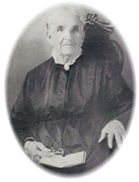 I can’t remember how I happened to stumble across the story of Elizabeth Mosby Woodson Allison – perhaps the tragic way she died caught my eye in a 1924 newspaper headline. By all accounts, she lived a full and long life, yet one of the most interesting aspects of Elizabeth’s life was her impressive family heritage.
Elizabeth Mosby Woodson was born on December 30, 1824 in Franklin County, Virginia to parents Benjamin and Martha “Patsey” LeSueur Woodson. According to History of Monroe and Shelby Counties, Missouri, Benjamin “was a prominent teacher in the south-western part of Virginia.” Thus, his children received a good education. The family had connections to the well-known Virginia families of Woodson, LeSueur, Bacon and Randolph.
The LeSueurs were of French origin and traced their heritage back to Eustace LeSueur, a great French painter born in 1617 and referred to as the French Raphael. Other prominent LeSueur family members included Thomas LeSueur, a famous mathematician, and Peter LeSueur a wood engraver. The family’s immigrant ancestor in America, a French Huguenot named David LeSueur, came with Lafayette “to assist the colonies in their struggle for independence.”
 The family’s most impressive heritage came through the Randolph family and connected Elizabeth, a first cousin twice removed, to the third President of the United States, Thomas Jefferson. Elizabeth’s grandmother Nancy Anna “Nannie” Woodson (who apparently married her cousin John Stephens Woodson) was the first cousin of Jefferson through his mother’s Randolph line.
That connection alone was impressive enough for the life-long member of the Daughters of the American Revolution, but through the Randolph line Elizabeth was also a direct descendant of Pocohantas through her son Thomas Rolfe. If there was a “royal lineage” in America, this might come close to qualifying as such.
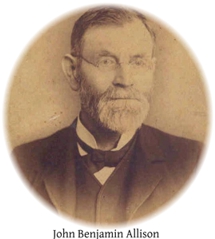
In 1840 Elizabeth and her family migrated to Monroe County, Missouri and were enumerated in Jackson for the 1840 census. In 1844 Benjamin purchased land to farm, but passed away in 1848 before Elizabeth married John Benjamin Allison on November 14, 1850. John was a farmer, and like his father-in-law Benjamin, a teacher.
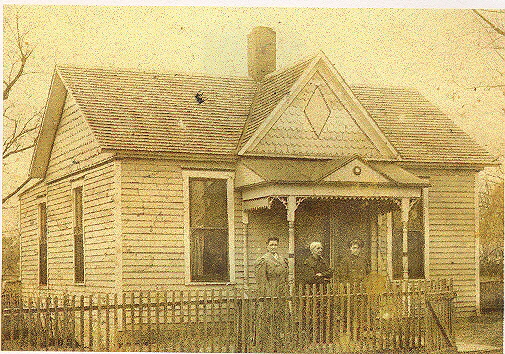 To their marriage were born nine children: George Wilkerson, Benjamin Alexander, Dorothy Ann (“Dollie”), Arabella Jane, Martha Elizabeth, John Stephen, Emma Jemima (John and Emma were twins), William Mosby and Mary Edith – all living to adulthood with the exception of Martha who died in 1861.
In August of 1861, residents of Monroe County were alerted to the news that the “Federals were coming”. Governor Claiborne Fox Jackson had refused Abraham Lincoln’s request to send Missourians to fight for the Union, calling it an illegal action. In 1861 approximately one-fourth of the county’s population was slaves, so during the Civil War Monroe County was generally on the side of the Confederacy, although there were likely to have been Union sympathizers as well.
From the tone of Chronicles of the Civil War in Monroe County by B.C.M. Farthing, in general the county’s sympathies were more aligned with the South. Where the Allisons and Woodsons placed their loyalties is unclear, although one newspaper account in 1923 indicated that Elizabeth had “interesting experiences connecting her with the Civil War.”
 According to accounts provided by family historians and in newspaper clippings, Elizabeth was a member of the Methodist Church who loved to sing hymns and recite poetry. After John passed away in 1904, she lived with her children at various times. In 1910 she was living with Mary and her family in Comanche County, Oklahoma; in 1920 Elizabeth was living with her daughter Arabella and her husband George Fischer in Dallas, Texas.
On the occasion of her ninety-eighth birthday, a Dallas newspaper reported that Elizabeth was at that time the oldest living descendant of Pocohantas. She was in good health:
Despite the worries and cares which she has undergone during her many years, Mrs. Allison is still active and reads without the aid of glasses. She also recites poems and sings songs which she learned in her schooldays.
After all Elizabeth had lived through during her lifetime, her life ended tragically, apparently the result of her habit of smoking a corn-cob pipe. On the evening of February 19, 1924 she accidentally set herself on fire while smoking in bed, and by the time her son-in-law George Fischer reached her most of the clothing on her body had been burned away. George suffered severe burns trying to rescue her.
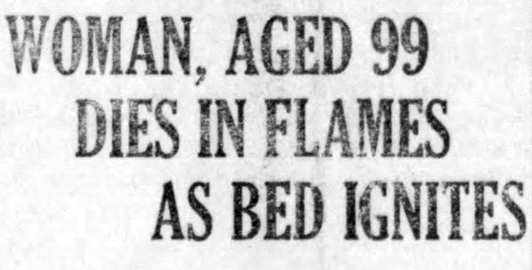
She was taken back to Missouri to be buried next to John in Audrain County. At the time of her death she was the oldest living descendant of Pocohantas, a fact included in accounts of her death in newspapers across the country.
 Did you enjoy this article? Yes? Check out Digging History Magazine. Since January 2018 new articles are published in a digital magazine (PDF) available by individual issue purchase or subscription (with three options). Most issues run between 70-85 pages, filled with articles of interest to history-lovers and genealogists — it’s all history, right? 🙂 No ads — just carefully-researched, well-written stories, complete with footnotes and sources.
Want to know more or try out a free issue? You can download either (or both) of the January-February 2019 and March-April 2019 issues here: https://digging-history.com/free-samples/
Thanks for stopping by!
Ghost Town Wednesday: Santa Fe, Kansas
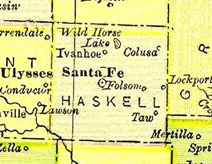 The town of Santa Fe, Kansas was officially platted on July 31, 1886 at 4:00 p.m. and named for the Santa Fe Trail which was situated about five miles north of town. It wasn’t long before several business sprang up – two grocery stores, a restaurant and hotel, a bakery, laundry and two lumber yards.
The town was first located in Finney County, but about nine months later on March 5, 1887, Haskell County was formed and named for Congressman Dudley C. Haskell. In July of 1887, Santa Fe, located at the geographic center of the county was chosen as the temporary county seat. On November 7 it became the permanent county seat.
The only transportation service for passengers, goods and mail at that time was the Lee and Reynolds stagecoach line. The railroads had not yet reached the area, and, as was the case with most county seats in that day, they hoped that one would see fit to build a railroad through the town. Even without the immediate prospect of a railway system being built, the town continued to grow.
On January 2, 1888, Santa Fe was incorporated as a third-class city (more than 350 but less than 2,000). In less than two years the town had already added three banks, a school, two churches, a flour mill, five newspapers and more. The first newspaper was the Santa Fe Trail and the longest running newspaper was the Santa Fe Monitor (1888-1918).
At least two railroad companies expressed some interest in building their rail line through the town. The Kansas, Texas & Southwestern Railroad conducted a survey and the Dodge City, Montezuma & Trinidad Railroad submitted a proposal asking the town to subsidize the construction (with a guaranteed completion date within thirty days).
The town, excited at the prospect of having a railway system, raised over ten thousand dollars in just a few hours. Their efforts were for naught, however, as both railroad companies declined to commit to a railway running through Santa Fe.
According to Ghost Towns of Kansas by Daniel Fitzgerald, the late 1880’s were marked by drought and crop failures. The 1890’s were said to have been good years as the town continued to grow and community activities and events were regularly held. However, the late 1890’s brought drought conditions even more severe than a decade or so earlier – somewhere between forty to sixty percent of the county’s residences were forced to leave.
Some decided to remain after renewed prospects of the Santa Fe Railroad building there surfaced. Eventually, the Santa Fe Railroad decided to route its line through Sublette, a few miles south of Santa Fe. In the early 1900’s the town began a slow decline, although efforts still continued to attract a rail line to Santa Fe. A last ditch effort in early 1913 to woo the Wichita Falls Railroad failed, setting the stage for another county seat election.
On February 5 there were two options on the ballot – Santa Fe and Sublette, newly thriving after the Santa Fe Railroad had agreed to build there. Sublette, however, failed to garner the necessary three-fifths vote and Santa Fe retained the seat. On April 11, the district court agreed and ruled in favor of Santa Fe.
However, attorneys for Sublette vowed to take their case to the Kansas State Supreme Court immediately following the district court’s decision. On June 7, 1913, the state supreme court ruled, instead, in favor of Sublette, essentially nullifying the three-fifths vote requirement. To this day, Sublette remains the seat of government in Haskell County.

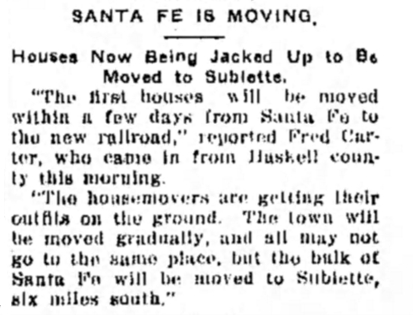
Over the next five years, Santa Fe residents continued to leave, some migrating to Sublette and others to Satanta. On July 25, 1918, the Santa Fe Monitor was closed as editor John Miller decided it was time to pack up and leave for Sublette. When the migration away from Santa Fe began, families and businesses moved, including physical buildings. On September 10, 1912, the Hutchinson News was reporting “Santa Fe Is Moving”:
One resident, Steve Cave, had already migrated to Sublette and by the end of December 1912 was counted among the enthusiastic “boosters” of Sublette:
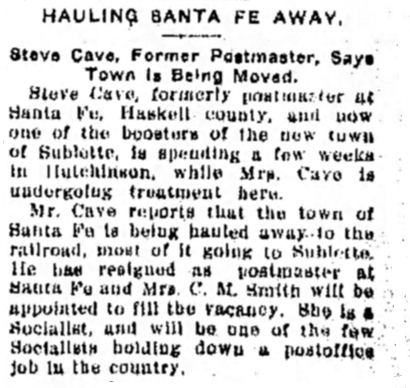
The little tidbit at the end of this article is interesting – after Mr. Cave resigned as postmaster of Santa Fe, Mrs. C.M. Smith, a Socialist, was appointed. The article notes that she is “one of the few Socialists holding down a postoffice job in the country.”
According to Daniel Fitzgerald, and as of the printing of his book in 1988, no buildings remained and the former town site had been converted to farm land.
Did you enjoy this article? Yes? Check out Digging History Magazine. Since January 2018 new articles are published in a digital magazine (PDF) available by individual issue purchase or subscription (with three options). Most issues run between 70-85 pages, filled with articles of interest to history-lovers and genealogists — it’s all history, right? 🙂 No ads — just carefully-researched, well-written stories, complete with footnotes and sources.
Want to know more or try out a free issue? You can download either (or both) of the January-February 2019 and March-April 2019 issues here: https://digging-history.com/free-samples/
Thanks for stopping by!
Tombstone Tuesday: Cemeteries in Odd Places
 In the early days of American history, it was common for families to set aside a small plot of land on their farm for the family cemetery. As time marched on, however, farm land gave way to more industrialization and large cities, or later what came to be called the “suburbs”. In some cases, no doubt, old cemeteries were moved elsewhere, but that wasn’t always the case.

This article was published in the October 2018 issue of Digging History Magazine. Preview the issue here or purchase here.
I invite you to check out Digging History Magazine. Since January 2018 new articles are published in a digital magazine (PDF) available by individual issue purchase or subscription (with three options). Most issues run between 70-85 pages, filled with articles of interest to history-lovers and genealogists — it’s all history, right? 🙂 No ads — just carefully-researched, well-written stories, complete with footnotes and sources.
Want to know more or try out a free issue? You can download either (or both) of the January-February 2019 and March-April 2019 issues here: https://digging-history.com/free-samples/
Thanks for stopping by!
Surname Saturday: Fulleylove
 Today’s surname, in honor of a day of love, is of English origin and dates back to medieval times. The Fulleylove surname gradually evolved from the early use of nicknames. Sometimes nicknames were reflective of physical characteristics, peculiarities, even mental and moral attributes, habits of dress or occupation.
It’s possible the nickname referred to an amorous person, or even a person of religious fervor and devotion. The derivation came, most likely, from the Middle English phrase “full of love” which developed out the Old English word “luf”. According to the Internet Surname Database, the name may have been a direct translation of a pre-existing French name, Pleynamur (or Old French “pleyn d’amour”) which means “full of love”.
Records show a William Fuloflove on the 1332 Subsidy Rolls of Cumberland. Reginald (or Roger) Full-of-Love resigned his church position at Tottingham, Norfolk in 1433 and Ralph Full-of-Love was the rector in West Lynn in 1462. In 1649 the wedding of John Fullilove and Anne Reve was recorded in London.
It is believed that one of the first records of the name occurred in 1327 when Henry Ffuloflove was on the Subsidy Rolls of Cambridgeshire. Spelling variations of this surname include: Fullalove, Fullerlove, Fulleylove, Fullylove, and Fullilove. Whether or not a family crest was ever established is unclear, and the name appears to be somewhat uncommon.
Find-A-Grave lists several with this surname in New Jersey, a few in Arizona, Texas, Michigan and various other places, including England and Canada. Browsing through historical newspapers yielded several results referring to John Fulleylove, a Victorian artist from Leicester, England. After being trained as an architect he became an architectural and landscape artist whose work was known and appreciated around the world.
Two historical newspaper items containing references to the Fulleylove surname caught my eye. I find it especially fascinating to read eighteenth, nineteenth and early twentieth century newspapers. The first item, an “almost obituary”, is from the March 30, 1850 edition of the New Orleans Times-Picayune:
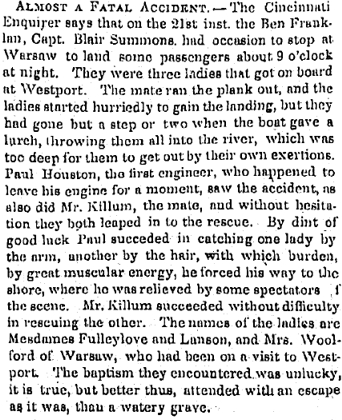
The other was a column entitled “Biblio-File” in the April 14, 1968 edition of the Independent Press-Telegram (Long Beach, California):
To end on a note of love, the amorous tendency is to be found in over a hundred forms among English surnames, starting with the Old English Leofman, and including Truelove and Dearlove, Prett(i)love, Sweeting, Sweetman, Dear, Dearing, Dearman and Darling, Loveman, Luffman and even Lemon. Not to mention Fullalove, Fullilove, Fulleylove, Spendlove, Spendlow and Spindlow, all “in the sense of pouring it out extravagantly.”
Did you enjoy this article? Yes? Check out Digging History Magazine. Since January 2018 new articles are published in a digital magazine (PDF) available by individual issue purchase or subscription (with three options). Most issues run between 70-85 pages, filled with articles of interest to history-lovers and genealogists — it’s all history, right? 🙂 No ads — just carefully-researched, well-written stories, complete with footnotes and sources.
Want to know more or try out a free issue? You can download either (or both) of the January-February 2019 and March-April 2019 issues here: https://digging-history.com/free-samples/
Thanks for stopping by!
Far-Out Friday: The Great Airship Hoax
 Orville and Wilbur Wright had made headlines six years earlier at Kitty Hawk, North Carolina with their “flying machine.” However, from mid December of 1909 to late January 1910, newspapers across the country perpetrated, and later renounced, a farcical tale which came to be called The Great Airship Hoax.
 This article has been removed from the web site but will be updated, complete with footnotes and sources and featured in an upcoming issue of Digging History Magazine. History is full of all kinds of hoaxes, schemes and frauds and the upcoming issue will highlight many of them which occurred during the Victorian Era (“O, Victoria, You’ve Been Duped!”). If you’re a genealogist, there are genealogical fraud instances which merit caution. These were featured in an article entitled, “Don’t Be Duped: Genealogical Fraud”, and published in the February 2018 issue of Digging History Magazine. The issue also includes a list of surnames which might be “suspect”.
I invite you to check out Digging History Magazine. Since January 2018 new articles are published in a digital magazine (PDF) available by individual issue purchase or subscription (with three options). Most issues run between 70-85 pages, filled with articles of interest to history-lovers and genealogists — it’s all history, right? 🙂 No ads, just carefully-researched stories, complete with footnotes and sources.
Want to know more or try out a free issue? That’s easy if you have a minute or two. Here are the options (choose one):
- Scroll up to the upper right-hand corner of this page, provide your email to subscribe to the blog and a free issue will soon be on its way to your inbox.
- A free article index of issues is available in the magazine store, providing a brief synopsis of every article published in 2018. Note: You will have to create an account to obtain the free index (don’t worry — it’s easy!).
- Contact me directly and request either a free issue and/or the free article index. Happy to provide!
Thanks for stopping by!
Ghost Town Wednesday: Brilliant, New Mexico
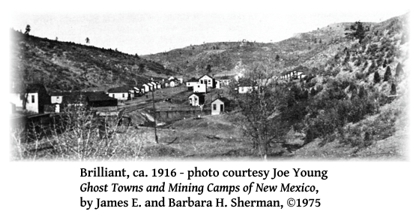 Unfortunately, there is probably little left to see, if any, of this once-bustling coal mining town in northern New Mexico. You could perhaps view the location of the old town site if you shell out $450 per night to stay in media mogul Ted Turner’s hunting preserve. The sites that were once the towns of Gardiner, Brilliant, Blossburg and Swastika (see my article about Swastika here) are all part of the Vermejo Park Ranch. Most of the existing structures are said to have been bulldozed, although one might occasionally see an old coke oven here and there.
This article is no longer available for free at this site. It was re-written and enhanced with sources as part of an article entitled “Bullets, Barons, Boom and Bust: The Ghost Towns and Storied History of Colfax County”, published in the July-August 2020 issue of Digging History Magazine. Should you prefer to purchase the article only, contact me for more information.
I invite you to check out Digging History Magazine. Since January 2018 new articles are published in a digital magazine (PDF) available by individual issue purchase or subscription (with three options). Most issues run between 70-85 pages, filled with articles of interest to history-lovers and genealogists — it’s all history, right? ???? No ads — just carefully-researched, well-written stories, complete with footnotes and sources.
Want to know more or try out a free issue? You can download either (or both) of the January-February 2019 and March-April 2019 issues here: https://digging-history.com/free-samples/
Thanks for stopping by!
Tombstone Tuesday: The Ellison Family of Sumter County, South Carolina
This family lived in Sumter County, South Carolina, and as the largest slaveholders in the state, were avid supporters of the Confederate cause. The patriarch of the family, William Holmes “April” Ellison, Jr. was a successful entrepreneur and readily offered the labor of his sixty-three slaves to the Confederate Army. Born into slavery, William had been freed on June 8, 1816 at the age of twenty-six by his master (and possibly his father) William Ellison.
It is believed that April Ellison was born in April of 1790, this due to the fact that often children born to slave parents were given the month of their birth as their name. Around the age of ten, April was apprenticed to William McCreight, and learned to build and repair cotton gins. He continued to work in McCreight’s shop until 1816 (even though his apprenticeship had ended after six years) and worked as a blacksmith, machinist and carpenter. During that time, April also learned how to read, write and do basic math and bookkeeping.
This article is no longer available for free at this site. It was re-written and enhanced, complete with footnotes and sources and has been published in the January-February 2019 issue of Digging History Magazine. Should you prefer to purchase the article only, contact me for more information.
I invite you to check out Digging History Magazine. Since January 2018 new articles are published in a digital magazine (PDF) available by individual issue purchase or subscription (with three options). Most issues run between 70-85 pages, filled with articles of interest to history-lovers and genealogists — it’s all history, right? 🙂 No ads — just carefully-researched, well-written stories, complete with footnotes and sources.
Want to know more or try out a free issue? You can download either (or both) of the January-February 2019 and March-April 2019 issues here: https://digging-history.com/free-samples/
Thanks for stopping by!
Surname Saturday: Tillinghast
Tillinghast is an English locational surname meaning “one who came from Tillinghurst”, according to the 4Crests web site, and a place where auctions were held. While most family heraldry came into wide use during the Middle Ages, it appears that the Tillinghast family crest depicted above, might have been a sort of “hybrid” crest with the “Tilling” and “Hurst” families.
One family historian believes that the Tillinghast crest has never been confirmed by family researchers. Those crests that have been in circulation for years and purported to be the actual family crest, don’t appear to have been officially registered in England. Thus, the origin of the crest depicted above is cast in doubt.
According to House of Names, the name was first found in Norfolk where a family seat was held as Lords of the Manor. Following the Battle of Hastings in 1066, William, the Duke of Normandy, granted land to his “victorious Barons.” Barons, Bishops and Lords passed down land to their descendants who were known as “under-tenants”.
The Norman system of assigning surnames identified the under-tenant with his land holdings to distinguish them from the senior (barons, bishops, lords) members of the family. House of Names believes that those who descended from the original under-tenants of Didlington or Dillington bear this surname.
Spelling variations include: Dillington, Dilinton, Dillenton, Dillonton, Dyllington, Dillyngton, Tillington, Tilington and many more. The Tillinghast Surname DNA Project, focusing on descendants of Pardon Tillinghast who was the “gateway ancestor” and progenitor of all American Tillinghasts, focuses on even more possible connections to other surnames.
Besides those names listed above as spelling variations, the DNA project includes a wider range of possible surnames tied to the Tillinghast name: Fillinghad, Fillinghart, Fillinghast, Tealinghurst, Lillengast, Thillinghast, Tickleass, Tiddlehurst, Tillinghass, Tillingrass, Tinklehurst, Tittinghurst, Tollinghost, Tillinghost, Willington and several more.
The goal of this particular DNA projects is to prove that participants are descendants of Reverend Pardon Tillinghast, who came to America in 1643 and settled in Providence, Rhode Island in 1645. His descendants include notable figures in American history like Julia Ward Howe, author of the Battle Hymn of the Republic and Stephen A. Douglas, the man who debated Abraham Lincoln in 1858 and later lost to him in the 1860 presidential election.
Did you enjoy this article? Yes? Check out Digging History Magazine. Since January 2018 new articles are published in a digital magazine (PDF) available by individual issue purchase or subscription (with three options). Most issues run between 70-85 pages, filled with articles of interest to history-lovers and genealogists — it’s all history, right? 🙂 No ads — just carefully-researched, well-written stories, complete with footnotes and sources.
Want to know more or try out a free issue? You can download either (or both) of the January-February 2019 and March-April 2019 issues here: https://digging-history.com/free-samples/
Thanks for stopping by!
Feisty Females: Phillis Wheatley
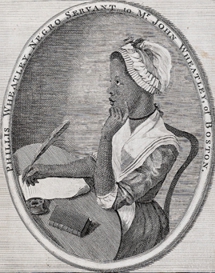 Today’s “Feisty Female” came to America as a slave, and during her all-too-brief life, made history by becoming the first African American woman to have her own book of poetry published. Most scholars believe she was born in Senegal around 1753.
In 1761 the young girl was sold into slavery and placed on a North American-bound ship named Phillis. She was said to have been a frail female child whose health the ship’s captain believed so precariously close to death that he wished to sell her quickly to gain a profit before she died.
She was purchased by the Wheatley family of Boston as a personal servant to Susanna, the wife of John Wheatley. According to the Poetry Foundation, Phillis Wheatley, named after the ship that brought her to America, was “pampered” in the Wheatley household, although not entirely excused from domestic duties.
Eighteen year-old Mary Wheatley and her brother Nathaniel helped educated her, and within sixteen months Phillis could read passages from the Bible. At the age of twelve she began studying Latin and English literature and studied the works of noted poets like Alexander Pope, John Milton, Homer and Ovid. The family recognized how gifted she was and, of course, a slave receiving such a liberal education was unheard of at the time.
Her first poem, entitled An Elegiac Poem, on the Death of that Celebrated Divine, and Eminent Servant of Jesus Christ, the Reverend and Learned George Whitefield, was published in 1770. Many scholars once believed that poem to have been her first published work, but in 1969 another poem, On Messrs. Hussey and Coffin, was discovered to have been published in 1767.
By the age of eighteen, Phillis had written twenty-eight poems and Susanna helped her place advertisements for subscribers in the Boston newspapers in early 1772. They found, however, that colonists would not support the work of an African. In May of 1771 Nathaniel had accompanied Phillis to London because Susanna thought she might find better opportunities to have her work published there.
While in England she met with the Lord Mayor of London and other prominent members of British society, and found an enthusiastic supporter in Selina Hastings, the Countess of Huntington. The Countess wrote a letter of introduction to bookseller Archibald Bell who helped her publish her first book of poems entitled Poems on Various Subjects, Religious and Moral.
Another reason for the journey to London in 1771 was Phillis’ health. According to the Poetry Foundation she suffered from a chronic asthmatic condition. As she was on her way back to America, the first edition of her poetry book was being circulated. It was the first book of poetry ever published by a Negro slave.
More than a third of her poems were about the deaths of prominent people, her friends or sometimes strangers. She was a regular correspondent with George Washington and had met Benjamin Franklin while in London. Other admirers of her work included John Hancock and Dr. Benjamin Rush, signers of the Declaration of Independence.
In 1774, three months before Susanna Wheatley died on March 3, Phillis Wheatley was manumitted. The British, who had abolished slavery, had been disapproving of the Wheatleys keeping her as a slave, although she was never really exposed to the harsh life most slaves experienced.
John Wheatley and his daughter Mary both died in 1778 and the only family she had ever really known had slipped away. On April 1, 1778 Phillis married John Peters, a free black who called himself “Dr. Peters”. He was apparently an ambitious entrepreneur, purported to have practiced law, operated a grocery store, worked as a baker and barber and had at one time applied for a license to run a bar.
Peters wore a wig, sported a cane and played the part of gentleman. To Boston society, however, this was viewed as evidence of a “shiftless” and arrogant black man. During and following the Revolutionary War it was particularly difficult for free blacks to compete with whites for jobs. After moving to Wilmington, John struggled financially and Phillis took work as a charwoman while he tried to fend off creditors and find work.
After the couple returned to Boston, they lived in a rundown section of the city where Phillis again struggled with her health. Her closest friends hadn’t been pleased with her decision to marry John Peters in the first place, and now the first African American woman to have a published book of poetry was living in poverty.
Even during those years of financial and physical challenges, Phillis Wheatley continued to write and publish her poems. During the fall of 1779, in an attempt to raise funds for her family, she ran advertisements for subscribers to a new work she had dedicated to Benjamin Franklin. Again, however, her work was rejected by Americans.
Phillis Wheatley’s life ended on December 5, 1784, alone and uncared for, since John, deeply in debt, had been jailed. The couple had children, but none survived to adulthood. Three and-a-half hours following her death, Phillis Wheatley’s last surviving child died and was buried with her.
Scholars believe that she wrote one hundred and forty-five poems. Ironically, the first American edition of Poems on Various Subjects wasn’t published until two years following her death. As the title of her first volume implies, she wrote on a variety of subjects, but historians have long puzzled over why she, an African slave, never wrote much about slavery.
Some believe that slavery was a conundrum of sorts for her, for it was what brought her to America. Yet, after being purchased by the Wheatley family and educated, that same institution led her to Christianity. That sentiment is noted in her most well-known poem, On Being Brought from Africa to America:
‘Twas mercy brought me from my pagan land,
Taught my beknighted soul to understand
That there’s a God, that there’s a Savior too:
Once I redemption neither sought nor knew.
Some view our sable race with scornful eye,
“Their color is a diabolic dye.”
Remember Christians; Negroes, black as Cain,
May be refin’d, and join th’ angelic train.
Recently, scholars have discovered other poems and letters which prove that she did in fact associate with eighteenth century abolitionists. The more scholars today study her work, the more convinced they are that Phillis Wheatley despised the institution of slavery. While a patriot and a strong advocate for America’s independence, she dared to chide fellow patriots in a poem eulogizing General David Wooster:
But how presumptuous shall we hope to find
Divine acceptance with the Almighty mind
While yet o deed ungenerous they disgrace
And hold in bondage Afric: blameless race
Let virtue reign and then accord our prayers
Be victory ours and generous freedom theirs.
Clearly, Phillis Wheatley held strong opinions regarding slavery and had no fear of possibly offending even revered patriots. Feisty Female, indeed!
Did you enjoy this article? Yes? Check out Digging History Magazine. Since January 2018 new articles are published in a digital magazine (PDF) available by individual issue purchase or subscription (with three options). Most issues run between 70-85 pages, filled with articles of interest to history-lovers and genealogists — it’s all history, right? 🙂 No ads — just carefully-researched, well-written stories, complete with footnotes and sources.
Want to know more or try out a free issue? You can download either (or both) of the January-February 2019 and March-April 2019 issues here: https://digging-history.com/free-samples/
Thanks for stopping by!
Tombstone Tuesday: The Christian Bibles of Greene County, Tennessee
I ran across this unique surname while researching ancestors in Pulaski County, Kentucky. If you regularly read Tombstone Tuesday articles, you’ll know that I’ve written a few of late highlighting some residents of that county, who as far as I know are not related to me – but you never know. That also led me to another interesting surname which I will be writing about soon – Outhouse – so stay tuned for that one.
I found four men buried in Greene County, Tennessee with the name “Christian Bible” and it appears that they were all descended from Johann Adam Bible, the immigrant who arrived in Philadelphia on a ship named Sandwich on November 30, 1750. As I wrote in Saturday’s surname article (read it here), it is believed that Johann was part of the great Palatine migration to America in the mid-eighteenth century. Briefly, here are his descendants’ stories.
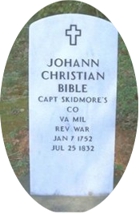
Christian Bible (1752-1832)
Christian Bible was born on January 7, 1752 in Montgomery County, Pennsylvania to parents Johann Adam and Maria Eva Margaretha (Muller) Bible. It’s possible his full name was Johann Christian Bible, since some family researches refer to him that way, and a tombstone erected in his honor displays his full name and honors his service in the Revolutionary War.
According to family historians, Christian first married Catherine Vollman (or Folman) in 1775 and following her death in 1787 or 1788, he married Margareth Speagle. As noted in his will, his children were: John, George, Adam, Lewis, Jacob, Abraham, Isaac, Christian, Elizabeth, Catherine, Sarah, and Mary.
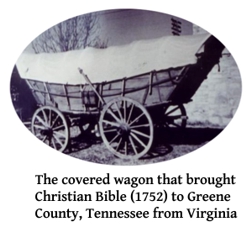
At the time of his death on October 22, 1833, it appears all of his children, except Christian who had pre-deceased him, and his second wife Margaretha were all still living and beneficiaries of his estate. To his sons he bequeathed tracts of land and each of his daughters, except Mary, would receive fifty pounds a year after his death. The daughters of his son Christian were to receive five dollars each.
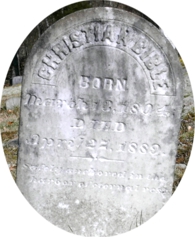
Christian Bible was born on March 13, 1804 in Greene County, Tennessee to parents John and Elizabeth (Pickle) Bible, and was the grandson of Christian Bible (1752-1832). On November 2, 1826, Christian married Mary Bower “according to the rules of the Lutheran Church”. In 1850 the following were enumerated as his children: Reuben, David, Lucretia, Levina, Martha and Thomas.
It appears that this Christian Bible probably didn’t serve during the Civil War, but possibly listed as a Southern Loyalist as recorded by the Southern Claims Commission following the war. That is interesting, because it appears yet another Christian Bible of Greene County, Tennessee was a Union soldier (his story follows this one).
Mary passed away on June 8, 1869 and in 1880 he was married to Elizabeth. Christian died on April 27, 1889 and is buried in the Gum Springs Cemetery in Greene County.
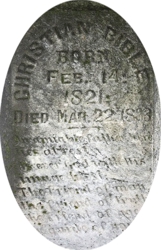
Christian Bible was born on February 14, 1821 in Greene County, the son of Adam and Elizabeth (Neas or Nehs) Bible, and grandson of Christian Bible (1752). On February 6, 1842 he married Louisa Marie Tucker and to their marriage were born the following children: Mary Elizabeth, Noah Luther, Martha Ellen, Lydia Ann, Louisa Jane Laura, Surena Emily and Nathan Hankins. All their children lived to adulthood except Louisa who died at the age of five in 1859.
This Christian Bible has an interesting history in regards to his Civil War service. Records indicate that Christian joined the Union Army (as opposed to his 1804 cousin also named Christian who was a Southern loyalist) on January 30, 1863 at Greeneville, Tennessee. He joined as a private and was mustered in on June 15, 1863, a member of Company F, 4th Regiment East Tennessee Infantry.
Family historians have discovered some interesting stories about Christian, including the fact he actively recruited men of Greene County and helped them get to the Union lines. It appears this may have occurred before his own enlistment in 1863, as according to the family records, the Confederates discovered what he was doing, forcing Christian to leave his home and join the Union Army. In a piece called “Christian’s Escapades”, family historians continued:
Somewhere near McMinnville he and most of his regiment were captured by Confederates and after being “robbed and stripped of belongings by the Rebels” were sent to Loudon, Tennessee. For there Christian took the train to Bulls Gap. Christian rejoined his reorganized regiment in December of 1863, but because of recurring sickness was unable to be an effective element of the unit.
Furthermore, military records indicate that on May 30, 1864 Christian deserted but returned to duty on September 13, 1864. He was mustered out of the military in Nashville on August 2, 1865, and on January 17, 1873, the charges of desertion were expunged from his military records. He later donated land on which the Mount Pleasant Methodist Church still stands today. Louisa died on March 30, 1890 and three years later Christian died on March 22, 1893.
And now for the last Christian Bible of Greene County, Tennessee!
Christian W. Bible (1847-1911)
Christian W. Bible was born on June 7, 1847 in Greene County, the son of Philip Henry and Barbara Ann Smith Bible, the grandson of Adam Bible and the great-grandson of Christian Bible (1752). Following his service during the Civil War in the 3rd Regiment of the Tennessee Volunteer Mounted Infantry (Union), he married Mary Carter on October 30, 1870.
In 1880 two children, James and Foie (sons), were enumerated. Following Mary’s death in 1885, Christian remarried Martha Elizabeth Brown in 1888. To their marriage were born at least four children: Lula, Flora, Carrie and Serena. Christian W. Bible died on January 31, 1911 and was buried in the Shiloh Cumberland Presbyterian Church Cemetery.
That’s a lot of “Christian Bibles” in Greene County, Tennessee (and a challenge to research!). I’m sure there were even more Christian Bibles born during that time (and since) – one family historian noted that at least one remained behind in Virginia rather than migrate with other Bible family members to Tennessee. It was an obviously well-regarded family name, and a quick survey of the Bible family name in Greene County at Find-A-Grave reveals that this family played an important role in the county’s history.
Did you enjoy this article? Yes? Check out Digging History Magazine. Since January 2018 new articles are published in a digital magazine (PDF) available by individual issue purchase or subscription (with three options). Most issues run between 70-85 pages, filled with articles of interest to history-lovers and genealogists — it’s all history, right? 🙂 No ads — just carefully-researched, well-written stories, complete with footnotes and sources.
Want to know more or try out a free issue? You can download either (or both) of the January-February 2019 and March-April 2019 issues here: https://digging-history.com/free-samples/
Thanks for stopping by!