
Tombstone Tuesday: Kinnis and Pocahontas Fritter
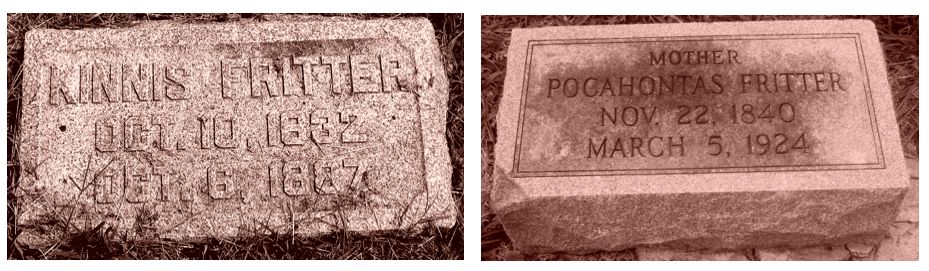
Several weeks ago I came across an entry at Find-A-Grave which intrigued me – Pocahontas McVeigh Fritter who is buried in Franklin County, Ohio. Both her first name and married name are both a bit unusual – there must be a story there. Then I found her husband Kinnis buried in Nebraska, several years preceding her death… definitely a story there!
Kinnis Fritter
Kinnis Fritter was born on October 10, 1832 in Virginia. I believe his father was Enoch (or Enock) Fritter, but the name of his mother is unclear. Enoch married Polly Knight in 1825 in Virginia, where Kinnis was born, but the History of Fairfield County, Ohio indicates Enoch Fritter married a woman named Elizabeth Courtright. If so, it’s possible Polly was his mother.
In 1850 Enoch was enumerated with wife Catherine and four children (Kinnis was “Dennis”). Here I found one of the many frustrating aspects of genealogical research – either the census taker or the transcriptionist butchers the name. In this case, I think it was the transcriptionist. To me it’s clear the name was written down as “Fritter”, but the transcriptionist recorded “Fartter”. In cases such as this, unless a researcher is utilizing a broad search for a particular name they may come up empty-handed and frustrated.
 Enoch was a farmer and died in 1856. Kinnis set out on his own path to success by becoming an attorney and politician. In that era, it would have been more common for young men to study law with an established law practice rather than receive a formal law school education. Throughout his years as an attorney Kinnis would himself mentor others.
He married Pocahontas McVeigh on October 25, 1859 and together they had several children. Alfred, Jennie, Lincoln, Rose, Kinnis, Tilden and Leo were enumerated in the 1870 and 1880 censuses, although the 1900 census record for Pocahontas indicates she gave birth to nine and at that time eight were still living. I found an obituary for another son, Martin, who was born in 1875.
Kinnis served as the mayor of Lancaster, Ohio from 1859 until 1862, succeeding his father-in-law Alfred McVeigh who served one term (1857-1858). Following his successive terms as mayor, Kinnis served as assistant county tax assessor and was heavily involved in Democratic politics at both the local and state levels.
Kinnis served on the board of the Fairfield County Savings and Building Association. In 1861 he and a business partner established The Fireside, a short-lived eight-page weekly. As an attorney, he was partnered with R.M. Clarke and Colonel J.M. Connell.
In 1864, Clarke had this to say about his partners: “They are known to the public as well for their legal learning and prompt business habits as for their honesty, social standing and moral worth. . . As a Claim Agent, Mr. Fritter has had the experience of twelve months in my office, and as I know, understands the Pension and Bounty Acts in all their bearings and requirements.”1 According to the last sentence, I gather that Kinnis perhaps worked with veterans and widows in regards to their claims for pensions or bounty land under the various acts passed by the United States Congress.
One newspaper clipping indicates Kinnis also worked with at least one insurance company, Security Fire Insurance of New York, as an agent. According to a 1962 article in the Lancaster Eagle-Gazette (11 Dec 1962, p. 12), at one point he was the owner of one of Fairfield County’s most impressive and historic homes before selling it in 1865.
Historical evidence shows that Kinnis was heavily invested in his community as an attorney, land owner, entrepreneur, politician and well-regarded citizen of Fairfield County. So why is he buried in Omaha, Nebraska having died there on October 6, 1887? The Find-A-Grave contributor wrote the following: “After Kinnis died Pocahantas [sic] and their children moved back to Ohio.”
This note would indicate Kinnis left his successful career sometime between the 1880 census when he was last enumerated and moved to Nebraska. Personally, I think perhaps not – unless there was some compelling reason to do so like an opportunity to start his own practice in a new place. But why Nebraska?
I’m not sure if the contributor has proof of what he’s written, but I have a different theory. Perhaps, since Kinnis was a claims agent he was there on business and suddenly died. As successful a person as historical evidence indicates Kinnis Fritter was, I can find no reference to him in Nebraska between 1880 and 1887 – as far as I can tell he wasn’t enumerated in the 1885 Nebraska State Census. (This search was somewhat comical since the only newspaper references I found to “Fritter” during that time frame were phrases such as “fritter away” or recipes for various types of fritters.)
One article in the Cleveland Leader clearly indicates Kinnis traveled outside of Ohio to conduct business. The news item indicates he was suing the telegraph company for damages:
Kinnis Fritter, an attorney, has just commenced a suit here against the Mutual Union Telegraph Company by recover $125, as damages sustained by him in making a trip to Fargo, Dakota, on a telegram received over that line. He had been negotiating with a man to go out to Fargo, and received the following message, “Write me at Fargo if you will come. I want you.” He did not wait to write, but started forthwith, and when he had found this man, that gentleman said he didn’t want him. When shown the message Miller denied that he ever sent such a message, but did send the following: “Write me at Fargo if you will come if I want you.” The “if” was left out, and now a suit is on hand.2
Thus, I find myself a bit stumped as to the reason Kinnis died in Nebraska on October 6, 1887, and skeptical of the Find-A-Grave entry. Nevertheless, it appears Kinnis Fritter was a highly successful businessman and politician. His son Lincoln was also an attorney and reportedly made his fortune in real estate, at one time his worth was estimated to have been a million dollars (Greenville Journal, 01 Oct 1908, p. 3). Lincoln died in 1908 of cholera while in the Philippines.
Pocahontas McVeigh Fritter
Pocahontas McVeigh was born on November 22, 1838 to Alfred and Mary Jane (Welsh) McVeigh, following their marriage two weeks earlier on November 8. Alfred was orphaned at the age of seven and according to his obituary was a “self-made man”. He completed his education at Marietta College and for a time taught school in West Virginia — one of his pupils was Stonewall Jackson.
As stated earlier in this article, Alfred served one term as mayor of Lancaster. He was an attorney and heavily involved in Democratic politics at the state and local level, serving as county auditor and state senator. Alfred later served as a Colonel during the Civil War. He and his son Powhatan (another child with an Indian name from early Jamestown, Virginia) were killed when a stage coach overturned between Columbus and Lancaster on September 16, 1864. Kinnis served as administrator of his father-in-law’s estate.
Whether it’s true Pocahontas moved to Nebraska and back to Ohio following her husband’s death or remained in Ohio while Kinnis traveled to Nebraska is unclear to me. In 1900 she was, however, living in Columbus, Ohio and enumerated as the head of household, her sons Lincoln (34), Kinnis (27), Tilden (24) and Leo (21) living with her, as well as her mother Mary Jane McVeigh. Her home was owned free and clear and she likely derived income from three boarders also enumerated in her household.
In 1910 she was again enumerated as head of household at the age of seventy-one. Her widowed daughter Rose Harwood and her daughter Helen, as well as son Leo lived with her. Following her son Lincoln’s death, Pocahontas took action against the executor of his estate, claiming she was the rightful beneficiary of his insurance policy issued by the American Insurance Union. The insurance company had instead paid the executor $2,250. She took it all the way to the Ohio Supreme Court and won her case.
Presumably, she continued to live in Columbus, although I could find no 1920 census record. Pocahontas died on March 5, 1924 of senility at the age of eighty-five. She is buried in the Green Lawn Cemetery in Franklin County, Ohio with her children Leo, Tilden and Rose.
 Did you enjoy this article? Yes? Check out Digging History Magazine. Since January 2018 new articles are published in a digital magazine (PDF) available by individual issue purchase or subscription (with three options). Most issues run between 70-85 pages, filled with articles of interest to history-lovers and genealogists — it’s all history, right? 🙂 No ads — just carefully-researched, well-written stories, complete with footnotes and sources.
Want to know more or try out a free issue? You can download either (or both) of the January-February 2019 and March-April 2019 issues here: https://digging-history.com/free-samples/
Thanks for stopping by!
Tombstone Tuesday: Flavius Terry Laffoon
 Flavius Terry Laffoon was born on July 28, 1833 in Lawrence County, Tennessee to parents Matthew and Elizabeth Murrell Laffoon. In 1840 Matthew and his family were enumerated in Giles County, Tennessee. Family historians estimate the family migrated to Arkansas around 1845, but by 1850 Elizabeth was a widow and living with her children in Carroll County, Arkansas. Nine of her children, including Flavius, were enumerated in the same household that year: Thomas (26); Elizabeth (22); Mary (20); Flavius (17); Edward (16); Lycurgus (14); Gideon (12); Evaline (8); Matthew (5).
Flavius married Judia (or Juda) Thomas, daughter of Nicholas and Amanda Thomas, on December 24, 1854 and together they had seven children: Thomas, John, William, Andrew Jackson, Amanda, James and Dora.
While not everyone in Arkansas supported the Confederate cause during the Civil War, nevertheless the state seceded from the Union on May 6, 1861. Some residents of the northern counties of the state (Searcy, Marion, Carroll, Izard, Fulton and Van Buren), however, were pro-Union and members of the Arkansas Peace Society as noted in another Tombstone Tuesday article published in 2014 (read it here).
On June 14, 1862 Flavius enlisted in Izard County and joined the 27th Arkansas Infantry which officially organized at Yellville the following month. Missourian James Shaler was appointed as colonel of the regiment, but soon proved to be unpopular with his charges. Shaler was vehemently anti-Union and focused on liberating his home state from the Union, although the 27th had been organized primarily for the defense of northern Arkansas.
Arkansans were outraged when Shaler replaced the Confederate flag with the Missouri flag. More outrage ensued when he attempted to transfer the entire regiment to a Missouri brigade. On April 4, 1863 military records indicate that Flavius was granted a 22-day furlough, but by May 24 was listed as being absent without leave.
Perhaps Flavius, having had enough of Shaler and his shenanigans, headed home. When he enlisted in 1862, Flavius left behind Judia and three young sons. His brother Gideon also served in the 27th (as were brothers William, Edward and Lycurgus). Captured in Woodruff County, Gideon later died in captivity of typhoid fever in June of 1864.
It appears that northern Arkansas remained the home of Flavius and his family, including his remaining siblings. Mining was a major industry in the area, but the Laffoons were mostly known as farmers. Flavius and Judia owned land in Marion County, having purchased forty acres in 1861. In 1870 their personal estate was valued at only $170, however.
Military records do not indicate Flavius was ever injured or wounded while serving, but on January 25, 1879 he died at the age of forty-five, leaving Judia with six minor children to provide for. Her son John died in 1881. Judia continued to live in Marion County and in 1908 filed for a Confederate Widow’s Pension. In 1910 she was living with her son William and his family. William died in 1914 and she continued to live with his wife until her death in 1929 at the age of ninety-one. She was buried in the Laffoon Cemetery in Marion County.

Although some family historians have suggested Judia was of Native American (Cherokee) descent, others have cast doubts as to that claim given the fact one of her brothers was born around the time of the so-called “Trail of Tears” and named Andrew Jackson Thomas. It does strain the bounds of credulity to believe Native Americans would name one of their children after the person responsible for forcibly removing them from their ancestral lands.
Thomas Madison Laffoon, Flavius and Judia’s oldest child, purchased land in 1883 for the Cabin Creek Cemetery, also known as the Laffoon Cemetery. A stone honoring Flavius was placed there, but whether he is actually buried there is unclear. It is believed most of the people buried there, perhaps as many as seventy, are related by birth or marriage to the Laffoon family.
Did you enjoy this article? Yes? Check out Digging History Magazine. Since January 2018 new articles are published in a digital magazine (PDF) available by individual issue purchase or subscription (with three options). Most issues run between 70-85 pages, filled with articles of interest to history-lovers and genealogists — it’s all history, right? 🙂 No ads — just carefully-researched, well-written stories, complete with footnotes and sources.
Want to know more or try out a free issue? You can download either (or both) of the January-February 2019 and March-April 2019 issues here: https://digging-history.com/free-samples/
Thanks for stopping by!
Tombstone Tuesday: The Trials and Persecution of Reverend Joy Hamlet Fairchild (Part One)
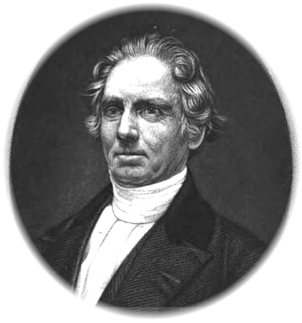 “I am either the worst of men, or the most persecuted and injured – either a knave or a martyr. Let the public read my story and judge for themselves.” J.H. Fairchild, Exeter, N.H., December 1844
While browsing through my list of potential Tombstone Tuesday articles, I stumbled across an interesting story, as they say “ripped from the headlines” of the 1840s and ’50s, about a minister unjustly tried for adultery in the Boston Municipal Court.
Joy Hamlet Fairchild was born on April 24, 1790 in Guilford, Connecticut to parents Lewis and Mehitable Waterous Fairchild. Lewis’ first wife Sarah Waterous was Mehitable’s sister and Joy was the eighth and last child of the second marriage. Lewis died when Joy was but thirteen months old and credited his mother’s prayers and counsels for his later successes in life — perhaps even his ability to face unthinkable challenges and controversy.

 This article is no longer available at this site. However, it will be enhanced and published later in a future issue of Digging History Magazine, our new monthly digital publication available by individual purchase or subscription. To see what the magazine is all about you can preview issues at our YouTube Channel. Subscriptions are affordable, safe and easy to purchase and the best deal for getting your “history fix” every month.
I invite you to check out Digging History Magazine. Since January 2018 new articles are published in a digital magazine (PDF) available by individual issue purchase or subscription (with three options). Most issues run between 70-85 pages, filled with articles of interest to history-lovers and genealogists — it’s all history, right? 🙂 No ads — just carefully-researched, well-written stories, complete with footnotes and sources.
Want to know more or try out a free issue? You can download either (or both) of the January-February 2019 and March-April 2019 issues here: https://digging-history.com/free-samples/
Thanks for stopping by!
Ghost Town Wednesday: Indianola, Texas
 Indianola is referred to as the “queen of Texas ghost towns” and could actually be filed under two Digging History Wednesday categories – ghost towns and wild weather. German immigrants began settling in the area in the mid-1840’s and in 1846 the town of Indian Point was established. The location was ideal as a deep-water port during the Mexican War and was the chief port of debarkation for thousands of European immigrants who would settle the western parts of Texas.
After the area was surveyed and lots were sold the town began to grow. In September of 1847 the post office opened and a few months later stagecoach service was established. The nearby town of Karlshaven had been home to some of the first European immigrants (Germans) and in February of 1849 the two communities merged and became known as Indianola.
With its rapid growth Indianola won the right to be the center of government for Calhoun County. Hotels, newspapers and other businesses were added and in 1853 the town was incorporated. By 1860 the town’s population was over one thousand, and although there were few slaves in the area, residents voted overwhelmingly in favor of secession.
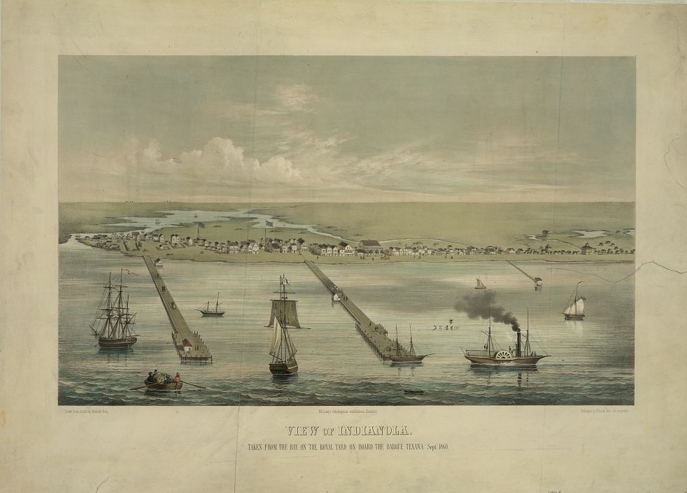
As a strategic deep-water sea port Indianola was targeted by Union forces. On October 26, 1862, Union gunboats bombed the port, looted the town and occupied it before withdrawing about a month later. Union forces returned again in November of 1863 and remained until the following year.
Following the Civil War Indianola continued to grow with its status as the second largest Texas port. By 1875 the population had grown to more than five thousand but its location at sea level left the town vulnerable to violent weather.
On September 16, 1875 Indianola was struck by winds of 110 miles per hour – the town was literally blown away. Five or six days later details began trickling in — the news was devastating. One Kansas newspaper called it “The Most Severe Flood Since the Days of Noah.”3 Initial reports estimated loss of life between 100 to 150, although impossible to pinpoint exactly.
Businesses, homes and churches were swept away. District Attorney D.W. Curin made a desperate plea for help: “We are destitute, and our town is gone. One-tenth of the people are gone. Dead bodies are strewn for twenty miles along the bay. Nine-tenths of the houses are destroyed. Send us help, for God sake.”4
Although the town was rebuilt, albeit on a smaller scale, the population began to decline and in 1880 less than two thousand called Indianola home. The “nail-in-the-coffin”, so to speak, came when a second hurricane struck on August 19, 1886 – this one more devastating than the first. Not only did wind and water destroy much of the town, but a fire broke out when winds blew over a kerosene lantern.
While other locations in Texas were affected, including San Antonio, Indianola’s devastation was complete. Understandably, Indianola residents were dispirited and demoralized. Some houses which managed to survive the storm were moved further inland. The town’s ice warehouse was floated across the bay and converted into a house.
One headline succinctly summed up the devastation: “A City in a Bad Place”.5 In late February of 1887, the Southern Pacific Railroad removed its track from Indianola to Port Lavaca, meaning a total abandonment was at hand. The loss of life (around four hundred) and damage to property was much too much to overcome. The county seat was moved to Port Lavaca and on October 4, 1887 the Indianola post office was permanently closed
Today there are very few remnants of the town, but some of the surviving structures can be seen at Victoria and Cuero, transported there following the second storm. Now a small unincorporated fishing village, the site is home to just a few residents. In 1963 Indianola was designated as a Texas Historic Landmark.
Galveston suffered an even more devastating storm fourteen years later. As Erik Larson pointed out in Isaac’s Storm, no one seemed to have grasped the significance of Indianola’s two devastating storms. Even though Galveston proposed to build a seawall, it never happened. In 1900 Galveston had its own devastating storm, a story that was featured in the March 2018 issue of Digging History Magazine.
Did you enjoy this article? Yes? Check out Digging History Magazine. Since January 2018 new articles are published in a digital magazine (PDF) available by individual issue purchase or subscription (with three options). Most issues run between 70-85 pages, filled with articles of interest to history-lovers and genealogists — it’s all history, right? 🙂 No ads — just carefully-researched, well-written stories, complete with footnotes and sources.
Want to know more or try out a free issue? You can download either (or both) of the January-February 2019 and March-April 2019 issues here: https://digging-history.com/free-samples/
Thanks for stopping by!
Tombstone Tuesday: Charles C. Mack
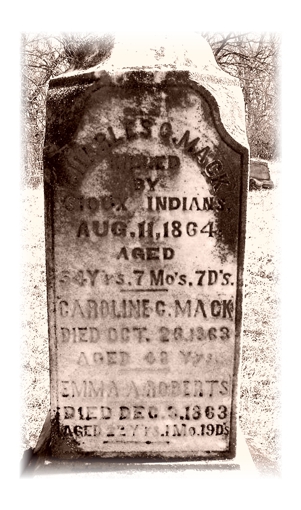 Charles C. Mack was born on January 4, 1810 to parents Jesse and Mary Ann (McCollister) Mack in Washington County, New York. It appears that Charles might have still been living with his parents in 1830, but around 1832-1834 he married Sophia Brown. Their first son, Jesse William, was born on Christmas Day of 1834. Three daughters followed: Emily (1836), Sarah (1839) and Emma (1841).
Emily died in 1841 at the age of four years, about eight months before Sophia gave birth to Emma. Sophia died on October 21, 1846 and Charles married a woman by the name of Caroline (maiden name unknown). In 1850 the Mack family was enumerated in Washington County, but not long afterwards, perhaps around 1852-1853, they migrated west to Minnesota Territory.
Charles Mack and his family were among the first settlers of what would become Blue Earth County, an area familiar to readers of Laura Ingalls Wilder’s book series. Mankato was the most prominent early settlement in the county. By the spring of 1852 most of the land around Mankato had been staked into 160 acre plots and more settlers began to arrive.
The area was also home to Sioux Indians, but on February 14, 1853 the United States Congress ratified two treaties which stripped the Indians of all land in Blue Earth County and beyond. A few weeks later on March 5, Blue Earth County was created by an act of the Territorial Legislature. Initially, the county was quite large, embracing “all of the State of Minnesota south of the Minnesota river, except the counties of Wabasha, Dakota, Goodhue, Rice, Scott, Filmore and that portion of Le Sueur which lies east and north of Wi Wi Creek opposite St. Peter.”6
The territory had first been claimed by the French in the early 1700’s and passed to Spain and back to France by the early 1800’s as part of the Louisiana Territory. Napoleon, fearing the territory would land in the hands of the British, sold it to the United States. The territory was later re-apportioned and until June of 1834 was part of Missouri when it became part of Michigan Territory. In April of 1836 Wisconsin Territory (which included what would become Minnesota) was created. Two years later it became part of Iowa, and on March 3, 1849 Congress finally granted Minnesota its own territory.
Presumably, the Mack family arrived sometime after the territory was organized. On August 6, 1853 the first board of Blue Earth County commissioners met in Mankato. There the county was divided into two election precincts, Mankato and Babcock’s Mill. C.C. Mack was designated as one of the election judges for the Mankato precinct.
Charles immersed himself into civic affairs of the newly formed county. Also organized at the August meeting was the county’s first petit and grand jury. C.C. Mack was chosen as one of the grand jurors.
Settlers continued to arrive and by 1855 several settlements were established in other parts of the county. Charles and his son Jesse were among those who relocated along the Blue Earth in the Shelby township. By 1860 the county was home to more than forty-eight hundred residents, with Mankato home to 376 families and Shelby home to 71 families.
Early that year a large party of Sioux had attacked the Chippewas of the Upper Mississippi. Upon their return to a camp near Mankato they celebrated their victory (more than a few scalps included). In early June the Chippewas came looking for vengeance, resulting in damage claims of almost $17,000 by local residents.
In 1860 a report indicated that almost four hundred families of Winnebago Indians lived in the area, some residing off the reservation in Wisconsin. Children were educated at the agency school, learning the basics of arithmetic, reading, grammar and geography. Girls were also taught house work. The report, however, did not incorporate the true picture of life for the Indians, including: “[T]he number of gallons of whisky consumed, the quarrels between themselves, and between them and the whites, the stealing from the Indians by the whites, and from the whites by the Indians, the filth and degradation everywhere.”7
In March of 1861 the Winnebago Treaty of 1859 was fully enacted whereby the Indians ceded the four western-most townships of their reservation in exchange for eighty-acre farm allotments to each family. As it turned out, the Indians were short-changed and protested the radical changes to their ancestral rights, this while the white population was calling for the removal of all Indians. The following month the United States was rent in two as the Civil War began. Clearly, President Lincoln and his administration had, as they say, “bigger fish to fry.”
Residents of Blue Earth County rallied to the Union cause and by the summer of 1861, “the whole land was ablaze with patriotism. The flag was everywhere in evidence.”8 The county’s recruits began to depart, but “so engrossed were the people everywhere in the great war they never thought of any peril at their own doors.”9
The county’s men were sent south leaving, as it turned out, their own homes defenseless. The Sioux Indians had been restless and angry over seeing their lands given to the whites. The Sioux had been promised payments from the federal government in June of 1862, but by August were experiencing great hardship due to the government’s inaction.
Frustration and anger boiled over and mushroomed into a massacre after several young Sioux quarreled with a whiskey trader. They shot him and others member of his family before a council of war was called. On August 18, government officials and traders were massacred, including soldiers, and the village’s buildings ransacked and burned.
News of the massacre began to spread throughout the county. Fields were abandoned as farmers and their families fled to the communities of South Bend, Mankato, Garden City, Vernon and Shelbyville. In some cases several families would crowd into one small log cabin. Barricades were erected and town buildings such as hotels and mills were utilized for shelter. Now without any military help available the residents of Blue Earth were on their own.
A group of ten mounted volunteers was dispatched to the village of New Ulm to investigate reports of Indian attacks. There they were confronted with the seriousness of the situation after finding several mutilated bodies. Help finally arrived, however, and on August 24 Mankato and South Bend were placed under martial law. Later the town of New Ulm was successfully defended as reinforcements arrived at Fort Ridgely. Despite the resurgent military presence, the killings continued. On September 14 four people were killed near Mankato while threshing wheat – troops were just a mile away. By this time, the Chippewa were volunteering their services to fight the Sioux.
By the end of September the uprising was subdued and trials began in October. On December 6, 1862, President Lincoln signed an order approving the execution of forty Sioux later that month. Interestingly, many of those condemned to die had been exposed to Christian teachings and two were professed Christians, Robert Hopkins Chaskay and Peter Big Fire.
Hopkins had actually been instrumental in rescuing white settlers at the Upper Agency and he and Peter Big Fire had started a spiritual revival among their fellow prisoners. Prisoners were actually anxious to hear about the Christian faith:
In their defeat by the whites the Indians seemed to regard their Gods as also defeated, and all their old superstition overthrown. Their pride was broken and their confidence in themselves gone. The white man’s civilization appealed to them as something worth having. It made him so superior to the Indian in power and wealth. The God who gave him such mysterious advantages over the red man must be the great God, and they would worship him, too, and become like the white man.10
Three hundred warriors remained in chains until on April 22, 1863 they were transported via steamboat to Davenport, Iowa where they remained until their sentences were commuted in the spring of 1866. Those surviving were taken to a new Sioux agency in Nebraska. Many were disenchanted with agency life and began to adapt to the white man’s culture.
The government had established Winnebago and Sioux reservations, but supplies never seemed to arrive on time as promised, giving rise to more hostility and anger. By the spring of 1864 Indian raids began anew and casualties began to mount. On the afternoon of August 11, a small band of Dakota killed Noble Root and wounded his two sons.
The Indians continued on to Shelby where they found some grazing horses, captured and drove them toward a fence in order to corral them. Charles Mack’s son Jesse, James Hindman and Cornelius Fox were working in a nearby field and the Indians noticed they too had some horses. They saw the Indians and quickly sprung into action, Jesse prodding the team to a gallop, madly racing toward Willow Creek.
Jesse hid his horses in a grove of trees and borrowed a neighbor’s gun. The Indians continued to pick off horses, however, and soon came upon Charles Mack, known around the community as “Squire Mack”, as he was cutting hay. Of course, the Indians wanted his horses and following an argument shot Charles dead. They continued their rampage through the community before escaping to the south.
Residents were alarmed at news of this fresh incursion and gathered that evening to make plans to defend their homes. Charles Mack’s body was found face down in a meadow. He was buried in the Old Willow Creek Cemetery. His tombstone reads: “Killed by Sioux Indians”. Buried with him are Caroline who passed away on October 26, 1863 and Emma A. (Mack) Roberts who died on December 9, 1863.
Several days following Charles’ death, the St. Cloud Democrat reported an interesting development which included a terse editorial statement regarding the government’s handling of Indian affairs:
A part of the gun wadding used by the Indians when they shot Mr. Chas. Mack was afterwards picked up, and upon close examination it proved to be part of a religious newspaper. A piece of this wadding, picked up the day after the murder, is now in the possession of Mr. H.L. Young of this place. This fact, and the remembrances of the Indian hanging at Mankato . . . lead us to the belief that they were a portion of the 400 pets, “civilized and christianized” at this place during the winter of 1862, and whom Uncle Abraham in the kindness of his heart, pardoned and turned loose in Dakota, a few months ago.11
By 1866, historians later declared “the sound of the war whoop, of fife and drum, of the firing of guns, of mourning for the slain have ceased, the sight of mutilated corpses, fleeing families, of marching soldiers, and of building forts have disappeared.”12
Jesse remained in Blue Earth County following his father’s death for several years, but by the mid-1880’s had migrated to Brown County, Kansas. There Jesse immersed himself in community affairs, and at one time was a member of the Prohibitionist Party. He later served as city marshal of Willis and once had this to say about fulfilling one’s civic duty to vote:
Do not leave your religion at home under the bed or behind some big hay stack, but carry it with you to the ballot box with the Bible on each shoulder. Not a Bible on one shoulder and a saloon on the other, you never will enter heaven with that kind of a path. They have no use for saloons over there nor drunkards neither.13
Jesse Mack died on October 21, 1912 and is buried in the Horton Cemetery of Brown County, Kansas.
Did you enjoy this article? Yes? Check out Digging History Magazine. Since January 2018 new articles are published in a digital magazine (PDF) available by individual issue purchase or subscription (with three options). Most issues run between 70-85 pages, filled with articles of interest to history-lovers and genealogists — it’s all history, right? 🙂 No ads — just carefully-researched, well-written stories, complete with footnotes and sources.
Want to know more or try out a free issue? You can download either (or both) of the January-February 2019 and March-April 2019 issues here: https://digging-history.com/free-samples/
Thanks for stopping by!
Surname Saturday: Renfrew

I haven’t done a Surname Saturday in awhile and today seemed a good day to highlight this particular surname after stumbling across an interesting story this week – and possibly a link to my own family history. The name I actually ran across while working on an ancestry research project was Renfro (Renfrow or Rentfrow). As it turns out, these are all variations of Renfrew, and as I suspected the name has Scottish origins.
The name originates from a town of the same name in Renfrewshire. Perhaps the earliest instance of the name was seen in the late thirteenth century when the name Adam de Reynfru was recorded in Edeneburk County. Early in the following century a Scottish prisoner of war by the name of Robert Reynfreu was imprisoned at the Old Sarum Castle between 1304 and 1307.
This article was enhanced and published in the June 2018 issue of Digging History Magazine. Preview the issue here or purchase here. I invite you to check out Digging History Magazine. Since January 2018 new articles are published in a digital magazine (PDF) available by individual issue purchase or subscription (with three options). Most issues run between 70-85 pages, filled with articles of interest to history-lovers and genealogists — it’s all history, right? 🙂 No ads — just carefully-researched, well-written stories, complete with footnotes and sources.
Want to know more or try out a free issue? You can download either (or both) of the January-February 2019 and March-April 2019 issues here: https://digging-history.com/free-samples/
Thanks for stopping by!
Tombstone Tuesday: Mary Susan Ann Rebecca Yankee Doodle Jay-Ho Bonaparte Dekelter Payne Spencer
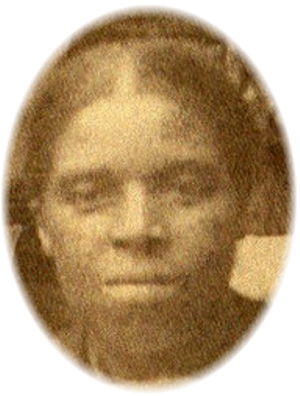 I don’t recall exactly how I came across this most unusual name, but knew there must be a story (and I was right!). There may not be many records which document her life, but I located an article written by her great-granddaughter Dr. Theresa Greene Reed and included in a book about the heritage and history of Amherst County, Virginia.
Mary (called Lucy by her slave owners) was born to parents Nathan and Susan Emaline Payne, slaves of Colonel Philip W. Payne of Campbell County, Virginia, on July 12, 1848. After Colonel Payne died in 1840, she and her mother were sold to Dr. Robert Wingfield and his wife Elizabeth Sisson Wingfield, owners of a plantation in Amherst County.

The Wingfields were married on December 20, 1841 and Emaline (“Mammy”) helped raise the Wingfield children after developing a close friendship with Elizabeth. Dr. Reed doesn’t mention what happened to Nathan when his daughter and wife were sold to the Wingfield family, but they were later reunited following the Civil War.
Mary and Emaline lived in a slave cabin near the Samuel Spencer plantation. On June 25, 1863 Mary met one of his slaves, Warwick Spencer, as they hid in the bushes at Gallows Field. Five slaves of General Jerisha Washington Dillard were hung that day, accused of killing their master. Not exactly an ideal way to meet your future husband, but perhaps it was love at first sight.
Almost two years passed before Mary and Warwick would see each other again. They met again in the spring of 1865 at Appomattox Court House, site of General Robert E. Lee’s surrender to General Ulysses S. Grant. While horseback riding, Mary came upon the scene and found Warwick tending Traveler, General Lee’s horse.
Slaves were officially freed (although Lincoln had enacted the Emancipation Proclamation on January 1, 1863) on June 19, 1865. Warwick and Mary were married by year’s end on December 26 at her father’s home. Joining them for a double wedding were Mary’s brother John and his bride Catherine Mundy.
Following her marriage, Mary changed her slave name of Lucy to Mary Susan Ann Rebecca Yankee Doodle Jay-Ho Bonaparte Dekelter Payne Spencer. Census records, however, enumerate her simply as “Mary S. Spencer”. Although I didn’t locate the 1870 census record, the first time former slaves would be enumerated with their full names, Dr. Reed wrote that John and Catherine and Warwick and Mary moved to Appomattox County where they worked as tobacco farmers.
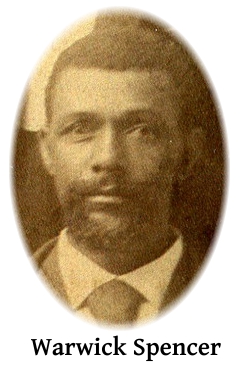 Warwick and Mary’s first three children were born in Appomattox County: Bettie Susan, Annie and Emaline. Mary was a midwife and said to have been “an astute businesswoman”. In 1873 the Spencers purchased a home in Lynchburg where Warwick worked for the Heald Bark Mill as an extract foreman.
Neither Warwick nor Mary ever learned to read or write, but regardless determined their children would be educated. Eight more children were born to their marriage, including: Charles, Edward, Warwick, Jr., Howard, Nelson, Marietta, John and Ophelia. Some became “school teachers, mail carriers, real estate dealers, a tailor and a saleswoman”, according to Dr. Reed. In 1909 the Spencer Shoe Company was incorporated in Lynchburg with Edward as president and Warwick, Jr. serving as secretary and treasurer.
The Virginia Seminary was founded in Lynchburg in 1886 as a school of higher learning for African Americans. In 1895 a plea for funds was raised, asking for one hundred and fifty persons to give ten dollars each. Donors included Warwick Spencer.
In 1880, Nelson and Emaline were living next to the Spencers. Nathan passed away in 1893 and Emaline lived with her daughter and son-in-law until her death in 1915. In 1905 Mary’s brother Nathan, Jr., head engineer at the Albermarle Soapstone Company, was tragically killed on the Alberene and Nelson Railroad when his head was crushed in a train accident.
In 1903 Warwick and Mary purchased property which had been part of Confederate Camp Davis. The property, split into lots for their children, later became known as Spencer Row as evidenced by census records. Son Edward’s home on Pierce Street was later registered in Virginia as a historic site.
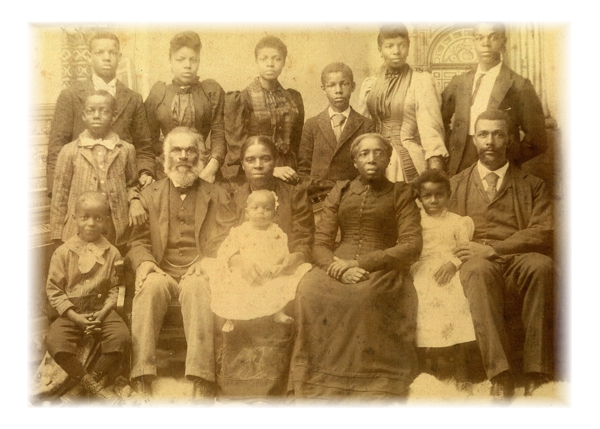
Warwick passed away on June 9, 1927 at the age of eighty. In 1930 Mary was living with her daughter Marietta and son-in-law Nathaniel Edwards on Spencer Row. Mary, aka Mary Susan Ann Rebecca Yankee Doodle Jay-Ho Bonaparte Dekelter Payne Spencer, died on March 22, 1936 at the age of eighty-seven.
Whether she ever legally used her elongated and emancipatory name is unclear. It may have been in some way merely symbolic as she celebrated her freedom and shed her slave name. Perhaps she set it aside later, sincer according to Dr. Reed, “Mary and Warwick Spencer lived very significant lives in quiet dignity and as outstanding, leading members of the Lynchburg community.”14
Did you enjoy this article? Yes? Check out Digging History Magazine. Since January 2018 new articles are published in a digital magazine (PDF) available by individual issue purchase or subscription (with three options). Most issues run between 70-85 pages, filled with articles of interest to history-lovers and genealogists — it’s all history, right? 🙂 No ads — just carefully-researched, well-written stories, complete with footnotes and sources.
Want to know more or try out a free issue? You can download either (or both) of the January-February 2019 and March-April 2019 issues here: https://digging-history.com/free-samples/
Thanks for stopping by!
Ghost Town Wednesday: Running Water, Texas
Ranchers were first attracted to this area of Hale County, Texas because of an abundance of water. The J.N. Morrison ranch was established in 1881 and many settlers who came to the area worked there. Ranch operations continued to grow as other cattleman joined the partnership, including Christopher Columbus (C.C.) Slaughter.
Slaughter wore many hats during his lifetime — as a Texas Ranger, banker, cattleman and more. As a highly successful businessman, Slaughter made his four million dollar fortune in cattle ranching and land speculation. Born in 1837, Slaughter was a part of history as the Texas Republic took shape. Between 1877 and 1905 he managed to amass more than a million acres of land – from just north of Big Spring and stretching to the New Mexico border — and forty thousand head of cattle . A Dallas newspaper once called him “the Cattle King of Texas”, a title I might add was given to more than one Texas cattle rancher.
In 1884 Dennis and Martha Rice purchased several sections of land in the area, hoping to establish a town and convince a railroad to lay track.15 They built a dugout south of the community of Edmonson and their settlement was first named Wadsworth. In December of 1890 the first post office was established and on January 28, 1891 the settlement was renamed Running Water to highlight the presence of nearby flowing water.

Rice was appointed the community’s first postmaster and worked as a railroad land speculator. Later in 1891 a school was established and by the following summer, after establishing the Running Water Townsite and Investment Company with $25,000 of initial capital, Rice held a picnic on July 4, ostensibly to sell town lots. On August 26, 1892 the town of Running Water was officially open. The investment company’s directors included Rice, C.C. Slaughter, George C. Pendleton, George Slaughter (all Texans) and R.A. Knight of South Dakota.16
While the prospect of abundant sources of water may have drawn settlers to the area, in the mid-1890’s drought and grasshoppers slowed migration. Then, the Texas legislature passed the so-called Four-Section Act in April of 1895, allowing the sale or lease of up to “four sections of school, asylum or public lands in all Texas counties except El Paso, Pecos and Presidio.”17
With passage of the Four-Section Act settlers again made their way to the area, many of them farmers. The town continued to grow as general stores, a blacksmith shop, grist mill, and Presbyterian, Methodist and Baptist churches were established. The Running Water school continued to expand and by 1924 was an independent district with a PTA organized in 1925 and four teachers by 1937.
Dennis Rice’s original plan included a railroad in order to sell land and attract more settlers. However, when the Fort Worth and Denver Railway began laying track three miles away in 1928, Running Water, like many other prairie towns across the plains of America, hung on for a few years before beginning its decline. On February 1, 1937 the post office was closed and moved to Edmonson Switch and the townspeople began to leave. The nearby springs dried up in the mid-1940’s and all that remains of Running Water is the town’s cemetery, surrounded by a barbed wire fence, near Edmonson.
Other Sources:
Open Plaques, Plainview, Texas
Texas State Historical Association
Did you enjoy this article? Yes? Check out Digging History Magazine. Since January 2018 new articles are published in a digital magazine (PDF) available by individual issue purchase or subscription (with three options). Most issues run between 70-85 pages, filled with articles of interest to history-lovers and genealogists — it’s all history, right? 🙂 No ads — just carefully-researched, well-written stories, complete with footnotes and sources.
Want to know more or try out a free issue? You can download either (or both) of the January-February 2019 and March-April 2019 issues here: https://digging-history.com/free-samples/
Thanks for stopping by!
Tombstone Tuesday: Abigail Fritter Grigsby (and the case for proving her actual age)
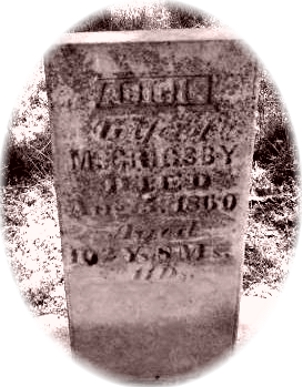 According to her gravestone, Abigail Fritter Grigsby died on August 5, 1860 at the age of 102 years, 8 months and 11 days. The picture I found at Find-A-Grave appears to be of the original gravestone. That would mean she was born on November 25, 1757 if this calculation tool is correct. The Find-A-Grave entry lists her birth date as November 11, 1764 and the death date as August 5, 1860. Clearly, there is some sort of discrepancy, but this isn’t the only “twist” to Abigail’s story …. read on.
Under oath and by her mark (“X”), Abigail Grigsby swore to the following facts on August 10, 1840 before the Marion County (Indiana) Probate Court:
Abigail Grigsby a resident of the County of Marion State of Indiana aged seventy nine years on the twenty fourth day of November next, who first being duly sworn, according to law, doth on her oath, make the following declaration, in order to obtain the benefits of the provisions made by the act of Congress, passed July 7, 1838, entitled an act granting half pay and pensions to certain widows, that she is the widow of Moses Grigsby, who was a pensioner of the United States of the North Carolina agency, and probably may have been transfered [sic] to the Indiana agency before his death, and she refers to his papers on file for evidence of his services. She further declares that she was married to the said Moses Grigsby in the County of Stafford State of Virginia about two weeks before Christmas day in the year Seventeen hundred and Eighty four, being about the Eleventh day of December, and that she was then twenty three years of age that her husband the aforesaid Moses Grigsby died on the Sixteenth day of June Eighteen hundred and Thirty Eight in Gibson County Indiana; that she was not married to him prior to his leaving the Service but the marriage took place previous the first of January Seventeen hundred and ninety four [illegible] at the time above stated.
She has no family record nor does she believe that the ages of her children were recorded by her husband. She is old and infirm and does not now that she could get a record from Stafford County in Virginia should there be any, and prays that the best evidence she can produce may be received her oldest daughter who is now dead was born in September Seventeen hundred and Eighty five and she was married to the said Moses Grigsby prior to the birth of said child, Nancy Grigsby.
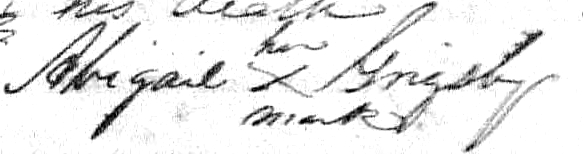
The presiding court officer, R.B. Duncan, was of the opinion: “Abigail Grigsby a resident of Marion County State of Indiana, an aged lady and is well known to the Court to be a lady of truth and made oath to the truth.” Nancy Bingman also swore under oath that Abigail was a “lady of truth”. Mrs. Bingman was aware that Moses had been a pensioner in North Carolina and that he had died on the date which Abigail stated in her declaration.
Her declaration tells me that under oath Abigail swore that she was not born on November 25, 1757 as her gravestone seems to indicate, but rather on November 11, 1761. Further proof can be obtained from her 1840 declaration when Abigail stated she was married in December of 1784 and was twenty-three years of age. The 1761 birth date fits perfectly because she would have just turned twenty-three one month prior to her marriage to Moses Grigsby.
However, the 1784 marriage date may have been incorrect because later in August of 1840 the County Clerk of Stafford County, Virginia certified that as best he could read (“in fair legible figures”) the original marriage record the marriage year was in fact 1785. In 1917 Mrs. C.H. Stewart of Delta, Colorado wrote to the Bureau of Pensions in Washington, D.C. requesting information regarding the marriage date and Abigail’s maiden name. In 1915 another woman (illegible) of Holden, Missouri also wrote to the bureau requesting the same information.
In response to one of these requests, the Bureau of Pensions forwarded the following information. Moses Grigsby had enlisted in Virginia and served from April of 1781 until May of 1783 under the command of Captain Abram Fitzpatrick and Colonel Samuel Hanes. Moses had first applied for his pension in October of 1820 in Stafford County, Virginia at the age of fifty-seven, implying that Moses was born ca. 1763.
The following remarks were added to the bureau’s response (as best I can translate them): “d. June 16, 1838 in Gibson County Ind. Soldier married December 1785 in Stafford Co., Va. Abigail or Abby, daughter of Moses Fritter. She was b. November 11, 1761 and was allowed pension on an app. of Aug. 10, 1840 while a res. of Marion Co. Ind.”
By an act of Congress passed on July 7, 1838 (5 Stat. 303), Abigail would have been entitled to a five-year widow’s pension since her marriage had clearly occurred before January 1, 1794. These pensions were subsequently extended by acts passed on March 3, 1843 (5 Stat. 647); June 17, 1844 (5 Stat. 680); and February 2, 1848 (9 Stat. 210). Thus, in 1840 Abigail’s widow’s pension application was well within the bounds of the law passed in 1838.
In July of 1848 Congress passed yet another act which provided not just an extension of benefits but life pensions for widows of soldiers who were married before January 2, 1800. It should be noted that Congress subsequently modified the lifetime widow’s pension requirement by lifting the marriage date restrictions. On March 9, 1878 widows of Revolutionary War soldiers who had served for less than a month or had participated in perhaps just one engagement were eligible for lifetime widow’s pensions.18
Moses’ original pension had been $96 per annum, according to the 1848 declaration of William Mendenhall, an acting Justice of the Peace in Marion County, Indiana. Abigail’s original pension was set at $56.66 per annum and in 1848 Abigail believed she was entitled to Moses’ original pension of $96 per annum. It appears she had been appealing to the courts to grant her Moses’ full pension for quite some time. In 1843 an Indianapolis attorney(?) believed she was entitled to “considerable arrears”. In October of 1850 William Mendenhall again appealed on her behalf for an increase and a settlement in regards to any pension pay which may have been in arrears as of that date.
Obviously, Abigail was in great need of income. In more than one declaration she was described as an “old indigent lady”. It appears that her tenacity paid off eventually since on June 4, 1855 her application for a land bounty (this was one determined woman!) indicates she had indeed been receiving Moses’ full pension of $96 per annum, although the date of the adjustment was not mentioned. By that time Abigail was well over ninety years old and obviously of feeble mind since all requested dates were filled in as “forgotten”, and as far as records “she has none in her possession.”
The land bounty application was filed in Dallas County, Iowa and included an affidavit from John Bingman and Elizabeth (illegible name) who had known Abigail for thirty years (remember, Nancy Bingman had made a similar declaration in 1840). Census records (United States 1850 and 1860 in Marion County, Indiana and the 1856 Iowa State) indicate that Abigail lived with John and his wife Nancy and it’s conceivable she had lived with them for several years. That she and the Bingman family were long-time acquaintances is evident by John and Nancy’s Stokes County, North Carolina marriage record.
In fact, Nancy may have been related to Abigail because her maiden name is listed as “Fletter” (Abigail’s maiden name was Fritter). Makes me wonder if Nancy was a Fritter instead of a Fletter (things that make me go “hmm”). I was wondering where in North Carolina Moses and Abigail had lived, so perhaps it was Stokes County.
There are still several questions about the life of Abigail Fritter Grigsby, yet quite a few historical facts emerged from the sixty-four pages of pension records I found at Fold3. I eventually located some census records which helped shed some light on her relationship with the Bingmans. In 1850 Abigail was enumerated at age 91 with a birth year of about 1759. On July 9, 1860 her age was listed as 102 and her personal estate was $15.
Less than a month later Abigail Fritter Grigsby died. Presumably, John and Nancy Bingman took it upon themselves to pay for her burial and gravestone. Abigail’s recently recorded age of 102 likely accounted for the inscription on her gravestone:
Wife of M Grigsby, aged 102 years 8 months 11 days
Under oath Abigail had repeatedly sworn her date of birth was November 11, 1761, which would mean she hadn’t yet reached the age of 99 at the time of her death, but rather was 98 years, 8 months and 25 days old.
Although I didn’t have enough time to thoroughly examine every pension record (64 pages), I’ve tried to summarize and hopefully present a credible case for Abigail Fritter Grigsby’s actual age at the time of her death in 1860. I often find that family researchers come across these Tombstone Tuesday articles and are thrilled to know more about their ancestor. My hope is that someday a Grigsby or Fritter family researcher may come across this article and find it helpful.
Did you enjoy this article? Yes? Check out Digging History Magazine. Since January 2018 new articles are published in a digital magazine (PDF) available by individual issue purchase or subscription (with three options). Most issues run between 70-85 pages, filled with articles of interest to history-lovers and genealogists — it’s all history, right? 🙂 No ads — just carefully-researched, well-written stories, complete with footnotes and sources.
Want to know more or try out a free issue? You can download either (or both) of the January-February 2019 and March-April 2019 issues here: https://digging-history.com/free-samples/
Thanks for stopping by!
Time-Capsule Thursday: Those Dang Saucers Appear Everywhere

This week in July 1952 was filled with headlines about the strange phenomenon of so-called “flying saucers” or UFOs (unusual or unidentified flying objects). The term had been around since the summer of 1947 when hundreds of incidences of unexplained objects in the sky were reported, many observed by commercial and Air Force pilots.
The Air Force began an investigation, but by late 1947 had found nothing that could have caused these sightings. However, sightings continued despite government reports. Some of these sightings occurred around nuclear power or atomic energy facilities. Sightings continued and the Air Force re-opened the investigation in the fall of 1951. By March of 1952 the project was officially named “Blue Book”.
This article is no longer available for free at this site. It was re-written and enhanced, complete with footnotes and sources and has been published in the October 2018 issue of Digging History Magazine. Other articles in this issue include “American Poltergeist (and other strange goings on)”, “Sister Amy and Her Murder Factory”, Genealogically Speaking: It’s Time to Rake the Leaves”, and more. Should you prefer to purchase the article only, contact me for more information.
I invite you to check out Digging History Magazine. Since January 2018 new articles are published in a digital magazine (PDF) available by individual issue purchase or subscription (with three options). Most issues run between 70-85 pages, filled with articles of interest to history-lovers and genealogists — it’s all history, right? 🙂 No ads — just carefully-researched, well-written stories, complete with footnotes and sources.
Want to know more or try out a free issue? You can download either (or both) of the January-February 2019 and March-April 2019 issues here: https://digging-history.com/free-samples/
Thanks for stopping by!