Genealogically-Speaking: Precious Memories as Vital Records
Here at Digging History there are a couple of tag lines I like to use to convey the site’s purpose. One quote belongs to Rudyard Kipling:
“If history were taught in the form of stories, it would never be forgotten.”
The other is one I use for Digging History Magazine:
“Uncovering history one story at a time”
Both are reflective of what I think history should be — just stories. Think about it — there’s a story (history) behind everything. I honestly can’t think of anything that doesn’t have a history (a story), can you? I absolutely love digging around in old newspaper archives (one of my research specialties), and I write a fair amount of the stories published either in the blog or magazine straight out of those old newspaper accounts. I particularly enjoy reading newspaper articles from the Victorian era — there’s just nothing quite like old-fashioned Victorian prose.
Nothing, however, can compare to the stories we pass down to our family. Genealogists are always searching for meaningful records of an ancestor’s existence: census records, land records, military service and so on. Sometimes I think we are so focused on those (often elusive) records to the exclusion of missing the stories.
 Today I drove my Mom and Dad over to my brother and sister-in-law’s house for a delicious Thanksgiving meal. Yesterday my Mom asked me to be sure and print a copy of a record she had come across years ago after my grandmother passed away. Today she had a story she wanted to tell around the Thanksgiving table.
It’s not one of those highly-sought-after records, yet both genealogically and historical significant to me and my family — especially because of the stories my Mom told us today. The record may not look like anything genealogically significant (click to enlarge). In fact, at first glance one might wonder whatever in the world is it?

There is, in fact, quite a bit of history on this 4×6 card — especially if you know the stories behind it. This is a record of about a year and a half of visits to see Dr. Duke, a Littlefield, Texas physician who was my grandparents’ family doctor when they lived in the small farming community of Spade. At the top is my grandfather’s name. Although his name was “Roosevelt Young” (named in honor of Theodore Roosevelt, U.S. President in 1902), he signed his name “R. Young”. However, everyone called him “Bud” (also noted on the card) and his address was Littlefield Star Route 2.
The card is a record of visits and care for Bud’s family, several of which were for my Mom. My grandmother once said my Mom was “born sick”. She has experienced lung and breathing issues all of her life. The first entries on this card (4-42) for $1.00 and $15.00 were for a hospital stay when my Mom (seven years old) was unconscious for three days, her life literally hanging in the balance. Today she told us the tearfully emotional story of how her mother got on her knees and prayed and gave her daughter to the Lord’s care, after the doctor had told my grandparents he had done all he could do and it wasn’t up to him any longer. So, as my grandmother prayed, it truly was in God’s hands.
Mom told us today that while she was unconscious those three days she would sing “When the Saints Go Marching In” — the beginning of her “singing career” she now likes to say! On this Thanksgiving Day the record took on new meaning because we heard the poignant story behind it. It now means more than just a card with dates and dollar amounts — it’s a precious memory.
If you’re a genealogist, don’t toss these kind of records aside if you run across them. There may just be an interesting story, or, if you’re fortunate enough, a precious memory.
Digging History Magazine – November 2018
It’s November . . . a month of remembrance and thanksgiving. This month’s issue features quite a bit of World War I history:
- The War to End All Wars. World War I, also referred to as “The Great War”, was considered the first modern war, and until 1917 was a European war, albeit with increasingly dire and daunting implications for the United States. It would also be the first major conflict both prosecuted and propagandized at the direction of the nation’s Commander in Chief.
- Mining Genealogical Gold: Finding Records of the Great War (and the stories behind them). World War I, aka “The Great War” is historically considered the first modern war. Both historically and genealogically speaking, the records generated during this volatile time in American history are potentially a treasure trove of fascinating information. The best part? Lots of stories!
- Rolling Up Their Sleeves: World War I and the Road to Suffrage. After decades of campaigning for equality and the right to vote, women were ever so close to victory by the time the United States entered World War I in 1917. At war’s end even Woodrow Wilson was ready to acquiesce and push through the Constitution’s Nineteenth Amendment.
- PANDEMIC! On the Home Front: Blue as Huckleberries and Spitting Blood. Spring 1918. War headlines were intense enough by the spring of 1918 – the world was reeling from a war unlike any other in the history of the world. Soon – very soon – the world would be reeling from a different kind of war.
- Remembering Tombstone Tuesday. A look back at the very first article published at the original Digging History blog.
- Feisty Females: She Taught Amelia to Fly. When Amelia Earhart wanted to learn how to fly an airplane, the deal she struck with her parents required she be taught by a woman pilot. That pilot, Neta Snook, was a woman of many “firsts” – one of the first female aviators, she was the first woman accepted into a flying school, the first to run a commercial airfield and the first woman to run her own aviation business..
- Believe it or not . . . stranger things have happened: The Luckiest Fool in the World. World War I, the most deadly conflict in recorded history, was over and a bit more light-hearted era was just around the corner. Alvin “Shipwreck” Kelly made a name for himself as flag pole sitter — a one-of-a-kind daredevil.
- The Roaring Twenties: Wing-Walking. Another Roaring Twenties fad that actually led to amazing advancements in aviation technology. Ormer Locklear wasn’t just a daredevil — was a sky-devil.
- Way Beyond the Call of Duty: Milton Rubenfeld
- and more
Single issue purchase here ($3.99).
Affordable subscription options available here. Note that the 3-month, 6-month and one year subscriptions now come with a 30-day trial.
Digging History Magazine – October 2018
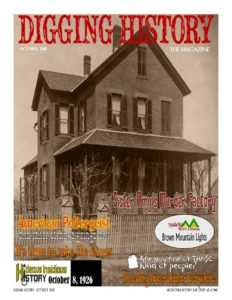 It’s October and everyone thinks Halloween . . . spooky stuff, you know? This month’s issue goes right along with that theme:
- American Poltergeist (and other strange goings-on). America has had its share of strange other-worldly phenomena. America’s first ghost made an appearance (or so they say) in 1800. Early colonists seeing flying ships . . . hallucinations or the real thing?
- Sister Amy’s Murder Factory. It’s a long and winding saga of what some call America’s first female serial killer. Was she crazy-crazy, crazy-manipulative, wicked-crazy or just plain crazy? You be the judge.
- Brown Mountain Lights: Appalachia’s Historical Mystery. A historical perspective from Kalen Martin-Gross, an Appalachian native.
- Genealogy Speaking: It’s Time to Rake the Leaves. It’s fall, it’s Family History Month, and what better time to take a closer look at the “leaves” on your Ancestry.com tree. You might be surprised at some records which may not be useful at all.
- Are you one of THOSE kind of people? If you’re a genealogist, you know THOSE kind of people I’m talking about — those who can’t pass up a cemetery stroll. What is with genealogists and dead people?
- Those Dang Saucers Appear Everywhere. You’ve heard about UFOs seen in the 1940s and 1950s. In July 1952 there were an unusually high number of sightings. What was that all about? Plus, an extensive look at the so-called Lubbock Lights.
- Hideous Insidious History. Quite often history inspires us. Unfortunately, sometimes it disgusts us. We don’t need to look away, but instead learn from it and pledge it will never happen again. A new column introduced this month.
- Grave Headlines. People (supposedly dead) coming up out of their coffins (and scaring the bejeezus out of funeral attendees!). No way (yes way!).
- Joseph Faubion: The Man Who Died Twice
- and more
Single issue purchase here ($3.99).
Affordable subscription options available here. Note that the 3-month, 6-month and one year subscriptions now come with a 30-day trial.
I Am Becoming . . . Therefore, I Must . . .
 To be a writer, one must write. And so, on October 1, 2018, the 25th anniversary of becoming a self-employed entrepreneur, I write. It’s not what I started out doing 25 years ago, yet I am slowly, but surely, pursuing my dream of becoming a writer. Honing my God-given skills. As long as you’re alive and kicking you can pursue your dreams. Therefore, I must continue to write.
Will I write a book(s) someday? Perhaps so. I have amassed a portfolio of several hundred articles over the last few years, any number of which could be expanded into a book. I have also amassed more article ideas than I’ll ever have time to write. The great thing about history is you never run out of something to write. What happened two minutes ago is history.
I rather enjoy researching and writing my monthly publication, Digging History Magazine. I am also a genealogist, helping people discover their roots. I write their family stories as well. As I pointed out recently, researching and writing makes me a better genealogist.
It’s cathartic in a way, writing about long ago events, making a connection with the past. I am there. I try to take my readers there. Not all history is inspiring and uplifting, unfortunately. Parts of it – to our corporate chagrin – are outright disgusting. I wrote one of those kinds of stories for the October issue. History doesn’t always have a happy ending.
I am always exhilarated once I get a 60-70 page issue written, graphics designed, edited, finalized (yes, I do it all — it’s just me!), up for sale in the Magazine Store and off to subscribers to enjoy their monthly history fix. The magazine site, however, is not inexpensive to operate, and subscriptions and single issue purchases have been too few and far between this first year. I have been discouraged way more than I’ve been encouraged . . . yet, I will continue to write.
I make it a point to personally email each new subscriber to thank and tell them what a blessing they are to me – because they are, even if they’ve only purchased an $8 three-month subscription. I’ve experienced plenty of disappointment this year. Nevertheless, even those three-month subs inspire me – propel me — to keep writing.
This summer I made a new friend who purchased a three-month subscription, but just wanted to try it out. I cancelled the subscription so she wouldn’t be charged again three months later. However, something happened and she was mistakenly charged anyway (I’m still a newbie at this subscription administration thingie!). I emailed her right away to apologize and tell her I’d get her a refund if she still wanted to end her subscription. To my joyful surprise she emailed me back: “Please keep the subscription. I enjoy your magazine!” Was it perhaps kismet that she was mistakenly charged? I don’t know but those eight words were a much-needed pat on the back . . . keep writing.
I continue to write and publish and hope. I am a writer. Therefore, I will write . . . and write . . . and write.
If you are a subscriber, YOU ARE A BLESSING TO ME — make no mistake about it! If you enjoy the magazine, refer a friend — you’ll be a DOUBLE BLESSING TO ME! If you’re not a subscriber, I invite you to try it out. I promise you won’t be bored because history is more than a bunch of dates. We are uncovering history one story at a time. Rudyard Kipling said it best: “If history were taught in the form of stories, it would never be forgotten.”
3-month, 6-month and one-year subscriptions are available. Don’t like the magazine? Just tell me before the 30-day trial period is up and I’ll cancel (delete) your account and you won’t be charged further. Why would I take a chance on giving away an issue without the promise of a recurring subscription? My new friend told me, “Please keep the subscription. I enjoy your magazine!”.
Sharon Hall, PROUD Writer, Graphic Designer, Editor and Publisher of Digging History Magazine
Following is Easy . . .
September is about to wrap up and I’ve already given away one free issue of Digging History Magazine today. Would love to give away some more (today or any day)! Following is easy and you’ll get notification of occasional blog posts and special offers. The current special offer ends on December 31, 2018 (more details below). Click the image below and it will take you directly to the Digging History Magazine web site; scroll to the bottom of the page; type your email and subscribe.

 Whether you buy a subscription now or not, I’d love to share the magazine I’m so proud to write, publish and edit! Like I say, it’s free — what have you got to lose?
Best,
Sharon Hall, Publisher and Editor, Digging History Magazine
A New (and Improved) Way to Preview Digging History Magazine
 Digging History Magazine is pleased to announce a new way to preview each month’s issue of the magazine. We now have a YouTube channel with previews of all issues published since January 2018. These previews will continue to be published on a monthly basis with links for purchase.
Better than downloading a sample of just a few pages, you will be able to view snippets from all articles. A link to that month’s issue is provided in the video description (below the video). This month’s video preview can be viewed here. Please take the time to watch, “Like” and “Share” to help us spread the word.
In addition to purchasing individual copies ($2.99) of the magazine, a more economical way is to purchase a subscription. Each of the four budget-minded options is billed automatically until you tell me you want to cancel:
- Month-to-Month (a small savings over single issue purchase)
- Three-Month ($8)
- Six-Month ($16)
- One Year ($32)
Purchase subscriptions here with PayPal or a credit card. Have questions or need help with purchasing a subscription? Contact me at [email protected].
Here’s what people are saying about Digging History Magazine:
- I have recently subscribed to Sharon Hall’s Digging History Magazine after looking at several of the free articles. I’ve just finished reading the January issue. I’ve already learned a good bit and am having a great time doing it. The articles, which are extremely well written, are a joy. I especially appreciate the use of family stories to both engage the reader and at the same time emphasize and illustrate what to look for while researching. The combination of the author’s extensive knowledge, experience, love of stories and sense of humor are a winning mix. Each of the articles has been a great read. Time and money well spent. I strongly recommend that you take a look yourself. If you are interested in family history, I suspect you will be as hooked as I am. I look forward to digging into the rest of the issues. (And yes, I just had to add that last sentence.)
- Not only packed with good articles but many helpful hints you can use to research your own family history. Good Job Sharon!
- Fantastic issue on the Klondike! I have just dug into the articles, and it looks great. Excellent issue, as usual.
- I found the story about Stephen Paul in the April 2018 issue of Digging History Magazine to be very interesting. The writer intertwined her own voice with the research material in a way that is very compelling.
- I enjoyed this issue of Digging History, especially the story about Snowball, AK. I like that the unsolved mystery and the research into it raises new questions as well as giving possible answers to old ones. The author’s writing style really drew me in as a reader.
- What an issue! There is so much in this issue I did not know; like the predated Mecklenburg Declaration of Independence. Growing up in Virginia, and being an avid history buff, I know what a talented and intelligent man Thomas Jefferson was. . . I look forward each and every month for these magazines and thoroughly enjoy them cover to cover. Thank you, Sharon, for you continued dedication to supply us “history geeks” with such historically packed issues!
See what you’re missing? 🙂
Sharon Hall, Publisher and Editor, Digging History Magazine
3 to 25
 3 to 25. Whatever does that mean? To me it means a milestone. Three weeks from today, October 1, marks the 25th anniversary of being a self-employed entrepreneur. In 1993 I started my first business, The Perfect Solution. Through the years I’ve had some fantastic clients (still do!) and I appreciate each and every one of them.
I currently operate two more businesses: Digging History (providing ancestry research and custom family charts) and Digging History Magazine (a monthly digital publication focused on history and genealogy, available by single issue purchase or subscription).
How does one celebrate 25 years of being in business for oneself? What does one wish for? Business for Digging History and Digging History Magazine has been slow and sporadic this year. My initial goal for subscribers is 50 and I’m currently at 22. I’d like to boost that number up before year’s end to 50 (or more!). I love what I do — I LOVE history and want to share my passion with like-minded history nuts.
Subscriptions are easy to purchase at the Magazine Store. Here are the instructions:
- Select a subscription option.
- Checkout
- Scroll down and select a payment method and provide all requested information.
- Purchase and your subscription will begin and your first issue will be delivered post haste.
That’s it — EZ-PZ!
Want to “gift” a subscription to someone you know with a love of history. Contact me at [email protected] with your friend’s name and email address and I’ll send you an invoice (choose payment preference: credit card or PayPal) so they can begin receiving monthly issues courtesy of your generosity.
3 to 25 — care to make my day?
Blessings,
Sharon Hall, Publisher and Editor, Digging History Magazine
Dying (or Lying) to Get on the Dawes Rolls (or how my ancestors were Indians one minute and the next, not so much)
 This month’s issue of Digging History Magazine features the great state of Oklahoma, the Sooner State. This issue was inspired by my great grandfather, Noah Seborn Young. I discovered something about him and a lot about Oklahoma’s history (and a radical one at that!) as I researched and wrote this month’s issue.
However, my favorite article this month is about another ancestor and her family, my third great grandmother Elizabeth Louisa Boone Hensley Brummett Dodson. You’ll have to buy a copy and read the story of her elongated name! The article is a story which includes extensive information about the family’s attempts to get on the Dawes Indian Rolls in the late nineteenth and early twentieth centuries. I found the case files totally fascinating and dripping with all kinds of information, from which I’ve gleaned a story. Were they “dying” (as in desperate) to get on the Rolls or “lying”?
I’ve cheekily entitled it “Dying (or Lying) to Get on the Dawes Rolls (or how my ancestors were Indian one minute and the next, not so much).
It’s informative with a little humor here and there — you gotta laugh sometimes at the things your ancestors did! History isn’t boring — it’s downright fun sometimes!
The September 2018 issue is on sale in the Magazine Store or you can receive it with a subscription if purchased this month.
Sharon Hall, Publisher and Editor, Digging History Magazine
On This Day 122 Years Ago . . .
 the Klondike Gold Rush was off and running as George Carmack, brother-in-law Skookum Jim and his nephew Dawson Charlie filed the Discovery Claim on Bonanza Creek in the Canadian Yukon on August 16, 1896. Men (and women) began flocking to the Yukon as newspapers dubbed the gold fever “Klondicitis”. A Honolulu newspaper just knew it was a fever and it was catching:
IT’S KLONDICITIS!
The Disease That Threatens the Country
In California five victims of the new disease known as “Klondicitis” were being committed to the state asylum. A preacher turned his back for good on the pulpit and headed for the North, a sure case of Klondicitis!
This month’s feature article in Digging History Magazine, “Dreamers and Drifters, Gunslingers and Grifters (Simply a Great Mad Rush)”, includes not only a poignant story about a couple of young dreamers who just knew they could strike it rich, but stories about drifters like George Carmack and grifter-extraordinaire Jefferson “Soapy” Smith. My third cousin, thrice-removed, Wyatt Earp, caught the Alaskan gold fever a bit later — he and Josephine had a grand time (while it lasted).
And, it was good while it lasted as some came out rich beyond their wildest imaginations (“Klondike Christmas: A True Rags-to-Riches Story”) and more than a few went home discouraged and empty-handed (or, unfortunately, died trying).
This month’s issue is on sale here, or consider purchasing a three-month, six-month or one-year subscription here. Easy and safe to purchase or subscribe and subscription payments are recurring until you tell me you want to cancel. Buy a one-year subscription and apply the discount code “2OFFSPGS” at checkout for an additional $2 off.
Sharon Hall, Publisher and Editor, Digging History Magazine
Like Peeling an Onion: Uncovering History One Story at a Time
 This month’s issue of Digging History Magazine seemed excruciatingly long to complete (it did run over my “normal” deadline of the first day of the month). It’s out today, and even though it took a bit longer, I think it was well worth it to spend the extra time writing the lead article about the dreamers and drifters, gunslingers and grifters who caught Klondike fever. They even had a name for it — KLONDICITIS!
The lead article features an “onion story” of sorts — one I’ve long wanted to write since stumbling across the original source material several years ago. The more I researched (like peeling layers of an onion) the more the story developed. Throw in some newspaper research with the original source material and something more than an article was written — more of short story about two young dreamers who married one evening and caught the next train to Seattle before hopping on a boat to Alaska and the Klondike. Jesse and Lepha Mae (Bennett) Edgren were in love, full of hope for the future and oh so sure they could strike it rich in the Klondike.
I won’t be “spoiling” the story here, only to say it’s both a heartwarming story, yet full of pathos — perhaps more than any of the hundreds of stories which came out of the Klondike Gold Rush. I thoroughly enjoyed researching and writing it and I hope (if you’re not already a subscriber) you’ll consider purchasing a copy which includes this short story/saga of Jesse and Mae.
Pick up your copy of the August issue here or buy a subscription here. Buy a one-year subscription and use the “2OFFSPGS” discount code at checkout for $2 off.
Sharon Hall, Publisher and Editor, Digging History Magazine