
Ghost Town Wednesday – Dawson, New Mexico
 In 1869 John Barkley Dawson purchased 250,000 acres of land on the Vermejo River from Lucien Maxwell (Maxwell Land Grant). For the next twenty years, Dawson developed the ranch land and built a ranch house.
 Coal was discovered and the deposits laid under much of Dawson’s range. The Maxwell Land Grant and Railway Company, an English corporation, purchased the remaining part of the original Maxwell Land Grant and then proceeded to remove squatters and lease tenants of the original grant. All through the 1880s the company was successful in removing many occupants. In the early 1890s, the company filed suit against Dawson. The case processed through the court system and was eventually settled in Dawson’s favor by the U.S. Supreme Court.

 This tragic story has been updated and published in the March 2018 issue of Digging History Magazine. Preview the issue here or purchase here. I invite you to check out Digging History Magazine. Since January 2018 new articles are published in a digital magazine (PDF) available by individual issue purchase or subscription (with three options). Most issues run between 70-85 pages, filled with articles of interest to history-lovers and genealogists — it’s all history, right? 🙂 No ads — just carefully-researched, well-written stories, complete with footnotes and sources.
Want to know more or try out a free issue? You can download either (or both) of the January-February 2019 and March-April 2019 issues here: https://digging-history.com/free-samples/
Thanks for stopping by!
Tombstone Tuesday – The Immigrant Miners of Dawson, New Mexico
One hundred years ago today, on October 22, 1913, a massive coal mine explosion occurred in Dawson, New Mexico at the Stag Canyon Fuel Company’s Mine No. 2. Today’s “Tombstone Tuesday” pays tribute to some of the immigrant miners who perished on that horrific day. This story was a bit heart-wrenching after going through the immigration records and wondering had these men known what was ahead would they have come to America after all.
In looking for the grave records for that fateful day (what little there are), I found name after name listing October 22, 1913 as the date of death. Above that would be a notation regarding birth as “Unknown”. Most were buried with only a Miners Cross and no grave stone. A memorial has been erected in the cemetery listing the names of the dead. The list of immigrants killed included those from Greece, Italy, Russia, Hungary, Austria, Slavic nations, Ireland, Mexico and Bohemia.
This article was enhanced, complete with sources, and published in the March 2018 issue of Digging History Magazine. Should you prefer to purchase the article only, contact me for more information.
Want to know more or try out a free issue? You can download either (or both) of the January-February 2019 and March-April 2019 issues here: https://digging-history.com/free-samples/
Thanks for stopping by!
Military History Monday – Obscure U.S. Civil Wars: The Honey War of 1839
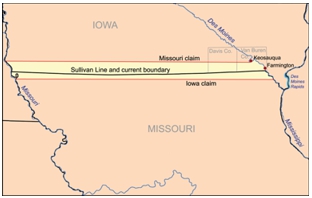 Tweren’t really nothing much this little “war” — just a misunderstanding (maybe a little blown out of proportion), which was eventually settled by the U.S. Supreme Court, over the interpretation of the Louisiana Purchase and various treaties in ensuing years.
The disputed land was an approximately 10 mile-wide strip — was that land part of northern Missouri or southern Iowa? In 1820, Missouri entered the Union with the northern boundary being the so-called “Sullivan Line” or “Indian Boundary Line”. In 1816, surveyor John Sullivan conducted a survey in order to delineate the space between Osage Indian Territory and what was then just called Missouri Territory (new treaties had been drawn up with the Indians after the War of 1812). Sullivan erected markers along the way, but by the late 1830s those markers had more or less disappeared, making it unclear where the boundary lines laid.
I ran across one person’s theory relating to Sullivan’s line that I found interesting. I’m not sure who the author is, however. This person had gleaned from other web sites the theory of “magnetic declination” or the difference between what the compass indicates is north (magnetic north pole) and what is really north (geographic north pole). He/she postulated the following:
From where he started in western Missouri, the (21st-century) declination is approximately 4 1/2 degrees; at the Des Moines, the declination is 2 degrees. Thus, as Sullivan worked east, the “straight” line angled to a decidedly east-north-easterly direction, especially in the eastern third, and he reached the Mississippi in what is now downtown Fort Madison, approximately three miles north of where he should have been. Whoops. The problem was compounded when the southern boundary of the Wisconsin Territory was stated to be the northern border of Missouri, locking the two in an endless loop.
There was mention of “Des Moines Rapids” in the survey as being some point of delineation. Then in the late 1830s when Iowa was ready to join the Union, “Des Moines Rapids” became a point of contention. Apparently, these rapids were actually located in the Mississippi River, just above where the confluence of the Des Moines River and the Mississippi is located (I guess they took the phrase literally that the rapids were in the Des Moines River).
Another survey, conducted by J.C. Brown, was commissioned by the state of Missouri. Since the Sullivan markers are now missing or difficult to locate, and he doesn’t seem to know that the rapids are located in the Mississippi, he sets out to find the rapids in the Des Moines River. He assumes he finds them (wrong assumption) in an area now known as Keosauqua. His survey results in adding a wider strip of land across the northern border than Sullivan’s original survey.
Missouri is satisfied with the results (of course) and wants to levy taxes in that newly acquired territory. However, most people in that soon-to-be-disputed strip of land considered themselves Iowans and didn’t take kindly to being taxed by Missouri.
One anecdote told is that Samuel Riggs and Jonathan Riggs were cousins and both sheriffs of their respective counties. Samuel was sheriff of Davis County, Iowa and Jonathan was sheriff of Schuyler County, Missouri. Jonathan arrested Samuel for breaking the laws of the state of Missouri and, in turn, Samuel arrested Jonathan for holding the office of sheriff in Missouri while living in Iowa. Samuel kept Jonathan in jail for two months.
With the arrest of Jonathan Riggs and the cutting down of three honey bee trees by a Missourian as payment for taxes, hundreds of Iowans and Missourians rushed to the disputed area to defend their claims in December 1839. Since Iowa was such a young state, they didn’t have much of a militia. One story relates that the Iowa militia was armed mostly with antique shotguns, flintlocks and ancestral swords — not exactly a fierce-looking military force. According to one author (Tales from Missouri and the Heartland, by Ross Malone), the Missourians were armed with a variety of weapons, including a sausage stuffer that one man planned to use (?!?). I can just imagine that there was plenty of whiskey brought along too!
The governors of both states then engaged in a war of words. After a month-long standoff, a committee of men from both militias met and and asked the two governors to submit the matter to Congress to resolve. Eventually the case known as State of Missouri v. State of Iowa was referred to the U.S. Supreme Court to decide. Ultimately, the “war” was won by Iowa, deciding that the original “Sullivan Line” was indeed the correct boundary.
Did you enjoy this article? Yes? Check out Digging History Magazine. Since January 2018 new articles are published in a digital magazine (PDF) available by individual issue purchase or subscription (with three options). Most issues run between 70-85 pages, filled with articles of interest to history-lovers and genealogists — it’s all history, right? 🙂 No ads — just carefully-researched, well-written stories, complete with footnotes and sources.
Want to know more or try out a free issue? You can download either (or both) of the January-February 2019 and March-April 2019 issues here: https://digging-history.com/free-samples/
Thanks for stopping by!
Ghost Town Wednesday: Bethsheba, Oklahoma — No Roosters Allowed!
 Today’s ghost town (spelled either “Bethsheba” or “Bathsheba”) may or may not have existed, according to some. Purportedly, in 1893 an all-female village was established in Oklahoma in an area called “Cherokee Strip”. These women so vehemently scorned men that they didn’t even allow male animals in their settlement.
Some historians believe that the “myth” of this all-female village (which only lasted three weeks) was fabricated by a Kansas reporter. However, it seems no one has ever been able to pinpoint just exactly where Bethsheba was located.
This humorous and informative article has been enhanced and published in the May 2018 issue of Digging History Magazine. Preview the issue here or contact me to purchase the individual article. I invite you to check out Digging History Magazine. Since January 2018 new articles are published in a digital magazine (PDF) available by individual issue purchase or subscription (with three options). Most issues run between 70-85 pages, filled with articles of interest to history-lovers and genealogists — it’s all history, right? 🙂 No ads — just carefully-researched, well-written stories, complete with footnotes and sources.
Want to know more or try out a free issue? You can download either (or both) of the January-February 2019 and March-April 2019 issues here: https://digging-history.com/free-samples/
Thanks for stopping by!
Tombstone Tuesday – S.A. Applin
I was at the hair salon chatting with my stylist about “Tombstone Tuesdays”. She mentioned that there were some cemeteries in Muleshoe, Texas (Bailey County) that might be interesting. So, I looked up Bailey County and clicked on one of the smaller cemeteries (60 marked graves).
I clicked on the very first name on the list, S.A. Applin – not knowing whether this was male or female because only initials were on the grave stone (hand-etched it appears).
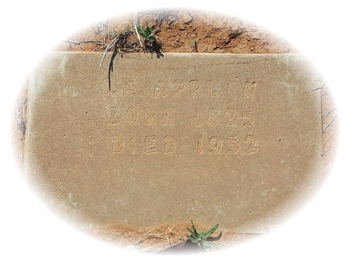
I had to enlarge the first picture by clicking to another page and was finally able to read the etching. There was only a birth year and death year… hmmm. This makes it a bit challenging to find information, and again I wondered whether this was a man or a woman.
I noticed also listed on the page were three children, so I surmised that S.A. must have been their mother:
Luther Applin (1915-1915)
Floyd Applin (1916-1916)
Ira Applin (1918-1918)
Now I knew there must REALLY be a story to tell … three successive infant deaths! These children, however, were buried in a cemetery in Sharp (Milam County), Texas.
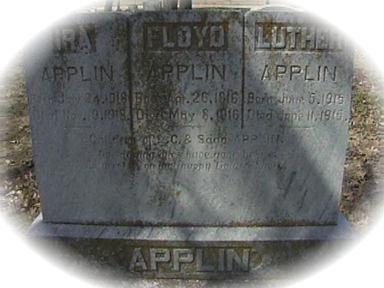
Still I didn’t know what “S.A.” stood for, nor her maiden name. You can barely see the inscription of the parents’ names so I just did a Google search of “S.A. Applin” and also a search at both Ancestry.com and Family Search. I finally found some census records with her name as Sadie and a death certificate for one of the children which listed her maiden name as “Brown”.
Her husband was Lee C. (Cisero) Applin. Now I had enough information to do some deeper digging. However, I didn’t have to search long before I found a large amount of family research already done on this family, including stories from one of their other children, Verna.1
I found out that Sadie (Sarah was here birth name) was one of three children of Charley Brown (who had been born in 1850 in France) – John, Charley and Sarah. Very interestingly, all three of the Brown children married three Applin children – all grandchildren of the same grandfather, George Applin. So, they were first cousins.
When I read that, I thought maybe those three babies died because of complications of a first cousin marriage (first cousin marriages were common). I subsequently found some information on the children:
Luther was born on June 5, 1915 and died on June 10, 1915 of blood poisoning. Floyd was born on April 26, 1916 and died on May 8, 1916 of infant death (there’s a certificate number but I didn’t try to locate that). The source stated that Ira was born on July 24, 1918 and died on November 19, 1918 with no death record. However, I found a death certificate for Ira on Family Search and his cause of death was listed as “gastro-enteritis”. “Heredity Luco” (whatever that is) was listed as a contributing factor …. which again makes me wonder about the first cousin marriage angle.
I came across some posts on a message board on Ancestry which were discussing the Applin family. One person commented that the Rh factor would explain the early deaths of these children – something that was probably common with first cousin marriages and a medical fact unknown to them at the time. (Backing up just a bit – Lee was married three times. He married Ranie Nelson on March 6, 1910 and one child, Annie, was born on January 30, 1911. Ranie died not long after the birth of her child – because Lee married Sadie in 1913. Sadie died in 1932 and Lee married Winnie Harris in 1933.)
Subsequently, Lee and Sadie adopted two children Luella and Jack Lemmon and had a another child of their own, Verna Lee (born after the death of the three babies).
The Browns and Applins were originally from Milam County, so I’m not sure why they were in Bailey County in 1932. In the 1920 Census they were still living in Milam County, but by the 1930 Census they had relocated to Bailey County. I’m not sure why the Applin family moved to Bailey County. According to a family source:
Apparently there were originally 550 acres owned by John Marion Applin. After he died the land was divided amongst his heirs. Lee inherited 80 acres. Lee’s land had a very low section where beautiful Willow trees grew. This is the area where the well was placed. The water was only about 5 feet below the surface. Verna remembers that when their neighbor’ wells would dry up during the summer, they would come to this well to get water.2
According to a granddaughter, Lee and Sadie were living in Baileyboro when his mother died in 1926, so sometime between 1920 and 1926 the family had moved to Bailey County. The granddaughter relates that Lee picked cotton in Progress, Texas (Bailey County) and then on to Baileyboro, where Sadie died in 1932.
According to Verna, her mother was a kind, hard-working woman. Here is Verna’s account:
I only remember my mother at a very young age since I was only 9 when she died. Sadie died of food poisoning 4-12-1932. The story is that Sadie, and others at that time, were trying a new method of “canning” using cans rather than jars. This proved to be fatal for some. Sadie was apparently tasting food as she was preparing dinner. The home-canned corn contained botulism, which made her sick immediately. This prevented others in the family from becoming ill. My Dad never forgave the doctor who attended Sadie that night. He was known as a drunk and he was apparently drunk when he tried to look after Sadie. Her death certificate contains evidence of this, as he was apparently so drunk he made a mess of the information. The certificate shows he scribbled over another woman’s certificate and put information in wrong. He put Lee Applin in the area marked for Sadie’s father, etc.
She was a very hard working woman, very kind, but could be strict when disobeyed. I remember my adopted sister, Luella, and I trying to keep Jack, Luella’s brother, from entering a room through a window. My mother had told us to stop and we disobeyed. I was pushed through the window and cut my back. However, that didn’t keep me from getting the strap along with Jack and Luella.
Another time I remember coyotes were trying to get the chickens out of the chicken house. Mom took the shotgun and went banging at them. I still don’t know if she killed a coyote or some of the chickens. Since my father was sick (gallbladder), she did all of the planting of cotton, maize, and corn. She also rode the cultivator that was pulled by a team of horses. We all picked cotton and cut the maize with a “hook bill” knife, then threw it onto the wagon that the horses pulled. I still have a scar on my thumb I received from a “hook bill” knife when I was carving something to shoot rocks with (a sling shot).
When mother had a bit to rest, she sat in a rocking chair and her dog “Brown Skinner” would jump in her lap. She loved to pet him. After she died, the dog walked through the house continually searching for her. He wouldn’t eat and he eventually grieved himself to death.
She always canned fruit and vegetables for us. I remember going to church in a wagon. I must have been real young. Later Dad drove a school bus and owned a Model T. Mother milked several cows. We separated the milk and sold the cream to buy groceries. She also raised baby turkeys. She treated them like babies. She was gentle and kind, and loving. She was really one of a kind.3
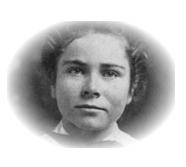
This article wasn’t much of a challenge to write, with all the recorded histories of family members, but a memorable one. As Verna relates, Sadie “was really one of a kind” – much loved wife and mother.
Did you enjoy this article? Yes? Check out Digging History Magazine. Since January 2018 new articles are published in a digital magazine (PDF) available by individual issue purchase or subscription (with three options). Most issues run between 70-85 pages, filled with articles of interest to history-lovers and genealogists — it’s all history, right? 🙂 No ads — just carefully-researched, well-written stories, complete with footnotes and sources.
Want to know more or try out a free issue? You can download either (or both) of the January-February 2019 and March-April 2019 issues here: https://digging-history.com/free-samples/
Thanks for stopping by!
Military History Monday: The History of Obscure U.S. Civil Wars (a.k.a., Border Conflicts)
I ran across an article written in 2010, somewhat facetiously, about some lesser known “civil wars” which were largely the result of border conflicts between states or territories. These conflicts loosely come under the topic of military history in some respects, but they all involved disputes which required intervention either by state or local militias or police and/or National Guardsmen.
One of the amusing aspects of some of these stories is that they were between states which today are fierce college football rivals.
The Red River Bridge War
 I’ll write about this little month-long war today because it is said to be the basis of an intense college rivalry between Oklahoma and Texas, and they actually call it the “Red River Rivalry” (or “Red River Shootout”). Today is a good day to write about this little “war” because two days ago the annual “shootout” was held at the Cotton Bowl.
In July 1931, a controversy erupted over the opening of a free bridge which paralleled the span of a toll bridge operated by the Red River Bridge Company. The free bridge had been built jointly by both Texas and Oklahoma.
On July 3, Red River Bridge Company filed an injunction to stop the Texas Highway Commission from opening the bridge, claiming that the state had agreed to purchase the toll bridge for $60,000 and then pay $10,000 a month for fourteen months (for an unexpired contract). On July 10, a temporary injunction was granted and the Governor of Texas, Ross S. Sterling, ordered barricades to be placed on the Texas side of the newly constructed bridge.
Now, it’s Oklahoma Governor William “Alfalfa Bill” Murray’s turn to fire a shot. On July 16, Murray declared the bridge open by executive order, claiming that the bridge ran north and south across the Red River and that Oklahoma held clear title of both sides of the river by virtue of the boundaries set by the Louisiana Purchase of 1803. Also, the state of Oklahoma was not named in the Texas injunction.
The Oklahoma highway crews crossed the bridge and destroyed the barricades on the Texas side, which prompts the Texas governor to send in the Texas Rangers (well, three of them, accompanied by an Adjutant General of the Rangers and Texas National Guardsmen) to rebuild the barricades, protect the highway crews and enforce the injunction.
On July 17, Governor Murray orders his highway crews to tear up the northern approaches of the toll bridge. Traffic over the river comes to a screeching halt. Meetings (heated ones I’m sure) were held July 20 and 21 in Sherman and Denison, Texas, demanding that the bridge be re-opened. By July 23, the Texas Legislature had passed a bill allowing the bridge company to sue the state. Satisfied that their interests were addressed, the bridge company joined the state in asking that the injunction be vacated. On July 25, that occurred and the free bridge was opened on the Texas side.
Now you would think this should have settled everything because the new bridge could be opened and used. However, Governor Murray was still blocking the northern approaches of the toll bridge, and the bridge company had subsequently filed a petition in federal district court in Muskogee to stop the blockage. Murray claimed that his authority as the commander of the Oklahoma National Guard superseded that of the federal district court. So he ordered a National Guard unit to the bridge and even went down there himself “armed” with an antique revolver (the papers called it a visit to the “war zone”).
The injunction against the state of Oklahoma wasn’t being enforced but on July 24, since the free bridge was to be opened, Murray ordered his Guardsmen to allow access over the toll bridge they had been blocking. Then, on July 27 Murray claimed to have heard of an attempt to shut down the free bridge forever, so he extended martial law to the Oklahoma boundary marker on the south bank of the river. Consequently, Oklahoma Guardsmen were posted at both ends of the free bridge and Texas now claimed an “invasion” (or the papers did at least).
By August 6, the whole controversy was over when the injunction was vacated and the Oklahoma Guardsmen were withdrawn. War over. According to this web site, Oklahoma claims to have won the “war”:
http://www.okhistory.org/about/transcript.php?episodedate=2010-07-10
In 1995, the bridge was blown up and replaced by a new one (no controversies this time).
Did you enjoy this article? Yes? Check out Digging History Magazine. Since January 2018 new articles are published in a digital magazine (PDF) available by individual issue purchase or subscription (with three options). Most issues run between 70-85 pages, filled with articles of interest to history-lovers and genealogists — it’s all history, right? 🙂 No ads — just carefully-researched, well-written stories, complete with footnotes and sources.
Want to know more or try out a free issue? You can download either (or both) of the January-February 2019 and March-April 2019 issues here: https://digging-history.com/free-samples/
Thanks for stopping by!
Ghost Town Wednesday – Hawaiian Ghost Town Where??

Iosepa, Utah – Hawaiian Ghost Town
Skull Valley, Utah is the site of the West’s only Hawaiian ghost town. Iosepa was established in 1889 by Mormons and largely populated by Pacific Islanders Mormon converts (Hawaiians). Mormon missionaries had been sent to Hawaii and Polynesia in the 1850s, and the Mormon converts wanted to be able to participate in sacred rituals (the Salt Lake Temple was being built). The name of the town, Iosepa, is a variation of “Joseph” in honor of Joseph Smith. By the way, it wasn’t necessarily easy for the Hawaiians to leave, but sometime in the 1870s emigration restrictions were lifted so the converts could make their way to Utah.
This article was published in the May 2018 issue of Digging History Magazine. I invite you to check out Digging History Magazine. Since January 2018 new articles are published in a digital magazine (PDF) available by individual issue purchase or subscription (with three options). Most issues run between 70-85 pages, filled with articles of interest to history-lovers and genealogists — it’s all history, right? 🙂 No ads — just carefully-researched, well-written stories, complete with footnotes and sources.
Want to know more or try out a free issue? You can download either (or both) of the January-February 2019 and March-April 2019 issues here: https://digging-history.com/free-samples/
Thanks for stopping by!
Tombstone Tuesday – Albert Samsill

“How much of life how much of joy is buried with our darling boy” – this is the heartfelt epitaph on the grave stone of Albert Hathaway Samsill – a random grave stone in County Cemetery located in the Lubbock (Texas) County listing of cemeteries. I picked County Cemetery randomly because it had only 19 internments, probably of people long forgotten.
This article is no longer available for free at this site. It was re-written and enhanced, complete with footnotes and sources and has been published in the November 2018 issue of Digging History Magazine. Should you prefer to purchase the article only, contact me for more information.
I invite you to check out Digging History Magazine. Since January 2018 new articles are published in a digital magazine (PDF) available by individual issue purchase or subscription (with three options). Most issues run between 70-85 pages, filled with articles of interest to history-lovers and genealogists — it’s all history, right? 🙂 No ads — just carefully-researched, well-written stories, complete with footnotes and sources.
Want to know more or try out a free issue? You can download either (or both) of the January-February 2019 and March-April 2019 issues here: https://digging-history.com/free-samples/
Thanks for stopping by!