
Genealogically Speaking: Curious Kin (Thomas Jefferson Roach and His “Sister Wives”)

Thomas Jefferson Roach and His “Sister Wives”
I don’t mean to imply “Sister Wives” (as in the TLC reality show of the same name) meant Thomas Jefferson (“T.J.”) Roach was a polygamist. Quite the contrary, since according to family history Thomas was of the Baptist faith. He does, however, have a unique story.
Thomas Jefferson Roach was born on August 25, 1825 in Orange County, Virginia to parents William and Tincey (Row) Roach. On January 27, 1845 T.J. married Alice Farish in Caroline County, Virginia. Census records indicate their first child, Eugenia, was born around 1849.
By 1860 the family had migrated from Virginia to Cherokee County, Texas. Their oldest son, George W., was nine years old that year and had been born in Virginia. The next child, John, was six years old and had been born in Texas. Presumably the family migrated sometime between 1851 and 1854. Two more children, Robert (4) and Mary K. (six months old) were also enumerated in 1860.
According to Cherokee County history T.J. owned and operated a sawmill on Tail’s Creek in Pine Town (now Maydelle). From November of 1856 to April of 1860 he was Postmaster of Pine Town, this in addition to farming. Thomas was a deacon and one of the charter members of The Pleasant Grove Missionary Baptist Church, organized on September 16, 1854.1 In 1855 he had been named a squire which meant he could perform wedding ceremonies.
There is no official record of Alice’s death, although family historians believe she died around 1861 en route to Virginia, perhaps to visit her mother, Clementine, who had been widowed in 1845 when her husband, George Buckner Farish, passed away. It is presumed Alice was buried along the way in an unmarked grave, perhaps in Louisiana or Mississippi. One source, The Tracings, indicates Alice appears on a Mortality Schedule with a death date of April 1860.2 This is curious, however, since she was enumerated on July 23 in Cherokee County for the 1860 census. If true, it seems more likely the family departed sometime after the census date, especially if she died in 1861.
Alice was decidedly unhappy with life in Texas. T.J., like so many others, had come to Texas to seek his fortune, but Alice longed to go home to Virginia. In letters back home she wrote of her contempt for the life T.J. had chosen for his family:
I would rather be poor in Virginia than rich in Texas. . . Texas is a poor man’s country. You have no idea how many poor people there are in Texas. It takes all they have to bring them here and many of them would leave but they have not the means to leave with. They are moving constantly from one portion of the State to another. You rarely see a family but that they are willing to move . . . Texas is a rough country to live in. We have a plenty coarse diet, but I can tell you that dainties are a rarity. Mrs. Herndon says she had to eat so much corn bread that it scratches her throat. She likes Texas as bad as I do. They use the great-quantity of coffee, tobacco and snuff. You seldom meet with a lady young or old but that they use snuff and tobacco. Mr. Roach married a couple last Thursday and he said there as 150 persons and nearly every lady after supper had a pipe in her mouth. Would you not think they were well smoked?3
Perhaps the journey, which would cost $700 round-trip, was a compromise of sorts between the reluctant wife and her fortune-seeking husband.
Although no official records appear to exist, family historians estimate T.J. married Sallie, his first “sister wife” in 1862. Sallie was Alice’s younger sister. In 1860, Sallie was still single and living with Clementine in Caroline County, Virginia. Sallie was available and Thomas needed a wife to raise his children. The couple returned to Texas, although it’s unclear when that occurred. Of note, Alice and T.J.’s youngest child Mary (Mollie) was left with family in Virginia, never to be reunited with her father and siblings in Texas. Mollie apparently never married either.
Sallie died not long after their return from Virginia. Thomas served during the Civil War, joining the Texas 35th Cavalry, Company F, in September 1863. As a 1st Sergeant he served under the command of Captain John T. Wiggins of Rusk. Where the children lived and were cared for during this period of time is unknown, although some records indicate that other members of the Farish family had at some point migrated to Texas.
On February 14, 1865, T.J. married his third wife, Mary Josephine Broome, in Cherokee County. The Tracings notes two children born early in their marriage did not survive. Around 1869 their son Eugene was born and in 1871 another son, Gus Wallace, was born.
Thomas also operated a steam-powered sawmill south of Pine Town. When the county decided to build their own transportation company (a horse-drawn tramway) after being by-passed the Houston and Great Northern Railroad Company. In exchange for company stock, Thomas agreed to provide crossties and narrow wooden rails. It was, without a doubt, a rather risky investment.4
While the railroad met with much excitement in Rusk at its opening on April 29, 1875, it had been constructed on a shoestring budget, utilizing prison labor from the Texas State Penitentiary, and already on shaky ground financially. T.J.’s contributions didn’t fare well, either, as it soon became apparent his rails proved woefully inadequate. Without infusions of stockholder capital, it all went bust in 1879 when the railroad was auctioned off for the grand total of $90.50. T.J. was never paid for the lumber provided.
Nevertheless, T.J. continued to lumber area forests, perhaps supplying wood to his father-in-law Cicero Broome, Josephine’s father. Cicero, born in North Carolina, left Alabama for Texas in 1848. For some time Cicero had been either a “gin maker” (1850 census) or in the milling business. He also owned a furniture factory, manufacturing “primitive wooden cotton gins and mill wheels”.5
While there is no official record of Josephine’s death, on March 23, 1876 T.J. was wed a fourth time to Elizabeth Bobbitt. Family historians report Elizabeth and her twins died in childbirth, presumably in 1877.
On November 14, 1877 T.J. married his second “sister wife”, Kate Bobbitt, who was Elizabeth’s half-sister by their father Anthony T.S. Bobbitt. According to census records, Kate would have been at least twenty-five years younger than T.J. By the time they were married most of Thomas’ children were grown – only Eugene and Wallace, children from his marriage to Josephine, remained with their father. To their family, T.J. and Kate added three more children: Nannie (November 1880), Thomas Jefferson (December 1884) and James (December 1886). T.J. continued to farm in Cherokee County and in 1881 took on the additional duties of Notary Public, which according to Cherokee County History, Texas Governor Oran M. Roberts had appointed him to that office.
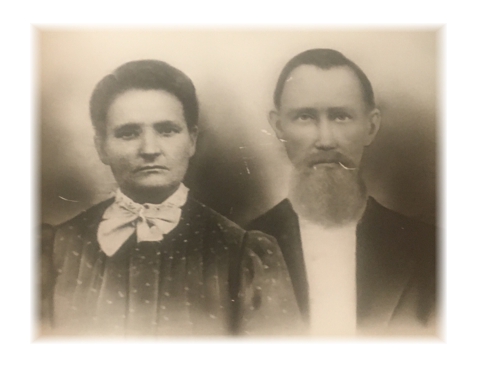 Although it isn’t known for sure which wife this is, given the number of short-lived marriages, this may be a picture of T.J. and Kate.
Thomas Jefferson Roach died on February 14, 1891 in Maydelle, Cherokee County, Texas. He was buried in what is today known as the Roach Cemetery in Maydelle. His sons Eugene and Gus Wallace are buried there, as are their wives and two of his grandchildren. Kate, the only one of Thomas’ wives to outlive him, married John T. Jones on December 17, 1900 and died in Rusk in 1919.
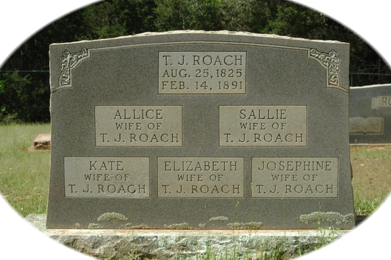
The life and times of Thomas Jefferson Roach and his wives demonstrate quite clearly the dangers faced by pioneers who left the comfort of their settled homes in places like Virginia, the Carolinas, Alabama, and Mississippi and joined hundreds of others who had “gone to Texas” during the great migration which took place in the nineteenth century.
With very few doctors to tend the sick and mothers in childbirth, many deaths occurred, leaving widows and widowers and motherless, fatherless children behind. And, with all the siblings, half-siblings, cousin marriages and the like, it’s easy to see why serious genealogical research is not for the faint of heart!
 Thanks for stopping by! For more stories like this one, consider subscribing to Digging History Magazine. Purchasing a subscription entitles you to subscriber benefits (20% off all services, including custom-designed family history charts) AND a chance to win your very own custom-designed family history chart! Details here (or click the ad below).

Footnotes:
Genealogy by Subscription

Do you want to learn more about your family history and need to budget the cost of research (or a custom-designed family history chart)? Digging History offers a unique way to do just that with a month-to-month genealogical research subscription. For one hour per month, the subscription is $35 (plus tax for Texas residents), billed monthly to your credit card until you tell me you want to cancel and/or your project is complete. That way you only purchase once and are continually billed until cancellation. I will perform one hour of research (or chart) work each month and provide a progress report.
Want to purchase more time per month? The price will drop a bit, and I will set up a special discount and invoice. If interested in more hours per month contact me first to discuss: [email protected]
TO SAVE EVEN MORE, consider subscribing to Digging History Magazine (three budget-minded options). All subscribers receive 20% off all services. For subscribers, I’ll set you up with a special discount. If you have questions regarding Genealogy by Subscription, please contact me: [email protected]. Note: After signing up, and before I begin research, you will receive a one-hour free consultation.
Purchasing a subscription also entitles you to a chance to win your very own custom-designed family history chart! Details here (or click the ad below).
Genealogically Speaking: Curious Kin (The “Ocean Sisters” of Johnson County, Tennessee)
The “Ocean Sisters” of Johnson County, Tennessee
Andrew Garfield Shoun and Elizabeth Powell married in 1817 and began raising a family in 1818 with the birth of their first child Andrew. Then came George Hamilton (1822), Rachel Catherine (1823), Isaac Harvey (1825) and Joseph Nelson (1827). In 1829 their first “Ocean” daughter, Elizabeth Atlantic Ocean, was born, followed by Mary and another “Ocean” daughter, Barbary Pacific Ocean, in 1834. They rounded out their family with Elva Olivene (1836) and Frances Eve (1838).
Most of their children had “normal” names like Andrew, George and Mary, but for some reason they blessed two of their daughters with middle names of the Atlantic and Pacific Oceans. Elizabeth was obviously named after her mother. Barbary, according to will records, appears to have been a family name (her grandmother was named either Barbara or Barbary).
Elizabeth Atlantic Ocean Shoun
Elizabeth Atlantic Ocean Shoun was born on April 8, 1829 in Johnson County, Tennessee. In 1850 she was still residing with her parents and siblings at the age of twenty-one. She married Isaac Rambo later that decade on December 7, 1856; he was twenty-three and she twenty-seven. Their names appeared on their marriage license, dated December 5, as Isaac Rambow and Atlantic Shown.
Census records indicate that Isaac and Atlantic never had children. However, her nieces and nephews called Atlantic “Aunt Tackie” – perhaps “Aunt Tackie” being easier to pronounce than “Atlantic”. Although they had no children of their own, their lives later became intertwined with Pacific and her family.
Barbary Pacific Ocean Shoun
Barbary Pacific Ocean Shoun was born on May 12, 1834 in Johnson County. In 1850, she and Atlantic were enumerated with their full names on that year’s census. At the age of nineteen, Pacific married John Monroe “Roe” Gentry on December 11, 1853. Her name appeared as “Pecific O. Shown” on their marriage license. So, apparently the sisters went by their “ocean names”. To her nieces and nephews she was known as “Aunt Siffie” – again presuming “Aunt Siffie” was easier to pronounced than “Pacific”. (In actuality, adults have trouble pronouncing it as well!)
On March 19, 1854, Isaac Lafayette Gentry was born. He would go by the nickname “Fate”. Another son, Robert Phillip, was born on January 2, 1856, followed by Thomas who was born in 1859. Thomas was enumerated as “Thomas A.R.N. Gentry” for the 1860 census, and since no other record of him seems to exist, it is presumed he died as a young child. Pacific was enumerated as “Barbara P.O.”
Pacific’s life took an unfortunate turn when John, presumably called to serve in the Civil War, never returned. According to family history she also suffered a paralyzing stroke, although it is unclear exactly when that occurred. Her sons Isaac and Robert were then raised by their Aunt Tackie. Family historians also believe that Atlantic cared for Pacific, and while Isaac and Atlantic went into town on Saturdays their gardener would rape Pacific. The man was run out of town, yet supposedly Pacific became pregnant and had another son, but the gardener was forced to take him to raise.6
Whether or not the story is true, for some reason Pacific wasn’t enumerated in the 1870 census with her children Isaac and Robert who were living with Isaac and Atlantic Rambo. This particular record was somewhat difficult to locate because the person who transcribed the record listed Isaac and Atlantic as “Isaac and Atlantie Rennels” – although the actual record clearly reads “Rambo”.
However, by 1880 Isaac Gentry was married with a young family of two and Pacific was living with them. It is likely she remained with Isaac and his family for the remainder of her life. Although I found no official records, family historians believe Pacific died on October 22, 1892 and was buried in the Wilson Cemetery, the same one where Atlantic is buried, although Find-A-Grave lists only Atlantic.
Back to Atlantic. Following her husband Isaac’s death in 1899 she lived with Robert Gentry and his family and was enumerated with them in 1900. Apparently Isaac Rambo had been well off because in 1910, Atlantic was enumerated at the age of eighty-two with her “own income” and two servants, N. Hamilton and Dora S. Blackburn. Nephew Lafayette (Fate) Gentry lived nearby. Elizabeth Atlantic Ocean Shoun Rambo died on April 6, 1912, just two days before her eighty-third birthday.
It would certainly be interesting to know why Andrew and Elizabeth Shoun gave these two daughters such unusual names. It seems to have forged a bond between them, perhaps in part because of the uniqueness of their names. Certainly, when circumstances called for it Atlantic was there for her younger sister Pacific – caring both for her and her sons, who in turn kept an eye on Aunt Tackie in her later years.
Thanks for stopping by! For more stories like this one, consider subscribing to Digging History Magazine. Purchasing a subscription entitles you to subscriber benefits (20% off all services, including custom-designed family history charts) AND a chance to win your very own custom-designed family history chart! Details here (or click the ad below).
Footnotes:
Genealogically Speaking: Curious Kin (Part 1)
I often run across some of the most unusual names while researching either my own family or a client’s. I have to say, though, I don’t think I’ve ever seen a set of children named so “uniquely”.
They were all kin, as in related (brothers), but were also all “Kin___”. It reminded me of the Newhart television series shtick: “Hi, I’m Larry, and this is my brother, Darryl, and my other brother, Darryl.”
For this particular family the shtick might have gone something like this: “Hi, I’m Kin, and this is my other brother, Kin, and my other brother, Kin, and my other brother, Kin, and my other brother, Kin.” Perhaps I should explain – it’s a bit of an “adventure” so be patient.
I had been recently researching a DNA match I came across at MyHeritage. While I didn’t originally test through MyHeritage, I had taken my raw DNA (through Ancestry.com) and uploaded it to MyHeritage to see the matches which might might pop up. I had done the same thing by uploading my DNA to FamilyTreeDNA. In the DNA world, as the saying goes, the more ponds you can fish in the better.
It seems the majority of my matches are 3rd to 5th cousins (or even more distant), although occasionally a second cousin match will pop up. Honestly, right now I’m looking for 1st, 2nd and 3rd cousins matches – anything farther out would take too much time and effort. Thus, I often just glance at the “3rd to 5th Cousin” matches. However, I had received a 1st cousin once removed match and was curious to see who it was. I recognized the name, although I don’t believe I’ve ever met him in person.
I started scrolling through some recent matches (most were 3rd to 5th cousins). I kept scrolling until one somewhat startling match jarred my memory a bit. In preparation for watching the new season of Finding Your Roots with Dr. Henry Louis Gates, Jr., I had recently been watching some old episodes. I had made a mental note of it at the time, but hadn’t followed up (and, of course, forgot about it!).
This particular 2017 episode featured the ancestry of Phillip Calvin McGraw, aka Dr. Phil. His grandmother’s surname was Strickland. I have three Strickland lines in my family – two from my father’s side (different branches) and one from my mother’s side, although the name is “Stricklin” which I believe may be a spelling variation. What jarred my memory was the MyHeritage match of someone named “Phillip McGraw” in his 60’s (Dr. Phil was 68 at the time) and his tree was private. Hmm.
So, I started looking around to see if I could find Dr. Phil’s tree. I discovered a portion of it on someone else’s tree. The last Strickland on this particular tree was Matthew Payton Strickland, born in Pickens County, Alabama. I discovered his father’s name was Kinyard and kept searching back until I came to Abel Strickland and his wife Nancy, parents of at least five male children, who were named thusly:
● Kindred (1788)
● Kinsburd (or Kinsbird) (1790)
● Kinsmon (1792)
● Kinnel (or Kinuel) (ca. 1793)
● Kinyard (ca. 1795)
Along the way I discovered another “Kin” – Kinchen Strickland. There must be a story about these about all the “Kin” Strickland names, but this Strickland kin hasn’t uncovered it as of yet.
I’ve run across more than a few “curious kin” over the years. Stay tuned for more in this series.
Thanks for stopping by! For more stories like this one, consider subscribing to Digging History Magazine. Purchasing a subscription entitles you to subscriber benefits (20% off all services, including custom-designed family history charts) AND a chance to win your very own custom-designed family history chart! Details here (or click the ad below).
Footnotes:
Ways to Go In Days of Old (Death by Pimple)

I ran across this particular “way to go in days of old” while researching a Surname Saturday blog article several years ago about the Pimple surname (after seeing the name in a list of Revolutionary War veterans). As I researched the unusual surname, I came across several references to “death by pimple” – and, of course, I was intrigued. As is usually the case, these are the best kinds of stories to feature, giving us a sense of how our ancestors dealt with diseases, infections, pestilence and more in a time when medicine and technology we depend on today was non-existent.
You might be surprised to learn that pimples, or “zits” as we now colloquially refer to them, are an age-old problem, one which today we often attribute to poor diet choices. However, the history of unsightly facial eruptions stretches further back than one might imagine, a potentially deadly malady well into the twentieth century. That’s not to say doctors weren’t aware of its serious nature. They just didn’t have the means to effectively treat infections, many of which stemmed from “home remedies” to alleviate the “pox of pimples.”
I am always curious to determine when something was first referenced in newspapers, or at least those available in online newspaper archives. One of the earliest instances of “pimple” I found was cosmetic:
There is newly Prepared a most rich and excellent Beautifying Water, call’d The PEARL COSMETICK, being very Safe, and of admirable Virtue, for taking away Heats, Redness, Pimples, Freckles, &c. Clearing and making the Skin Fair, tho of the brownest Complexion; and excellently freeing it from all manner of Defilements.7
The first instance found in a search of “pimple” at Newspapers.com yielded an article about a suspect in the disappearance of a surgeon who “hath been set upon by some ill people.”
Whereas On Monday last at eight of the clock in the morning, Mr. David Rose, Chirurgeon and Man-midwife, went out of his house in Gun-yard, in Houndsditch without Aldgate, London, and was not heard of since, and having some Million Lottery Tickets about him, together with a Silver Watch made by Lowndes(?), an old Rose Diamond Ring, one Diamond being out, a Gold Seal Ring with T.H.O. engraved on it, within the figure of a Rose, besides several Silver Instruments, and other things of value; there is sufficient reason to suspect that he hath been set upon by some ill people. He is a short square man, with an oval Face, red and full of pimples, and is about 60 years of age, and wears a dark bob Perriwig. Therefore whoever brings news of him to his House aforesaid, or to his Brother, Philip Rose, Dr. Of Physick, living in Brewers Street near Golden-Square, so that he may be see alive or dead, shall certainly be rewarded. . .8
Clearly, one of this man’s most distinct physical characteristics was his “oval Face, red and full of pimples”. Early on, it appears to have been used as a means to identify someone – pimples were a distinct feature. A much earlier reference is notable in William Shakespeare’s play, Henry V, published around 1599, occurring in Act III, Scene 6:
Original: His face is all bubukles and whelks and knobs and flames o’ fire; and his lips blows at his nose, and it is like a coal of fire, sometimes plue and sometimes red, but his nose is executed, and his fire’s out.
Modern Translation: His face is all pustules and pockmarks, and pimples and inflammation, and his lips blow up toward his nose, which is like a red-hot coal, sometimes blue, sometimes red. But his nose is dead, and the fire’s put out.9
These facial eruptions were unsightly, prompting English women, as early as the mid-1660s, to attempt concealment:
Our Ladies here have lately entertained a vaine Custome of spotting their Faces, out of an affectation of a Mole to setoff their beauty, such as Venus had, and it is well if one black patch will serve to make their Faces remarkable; for some fill their Visages full of them, varied into all manner of shapes and figures.10
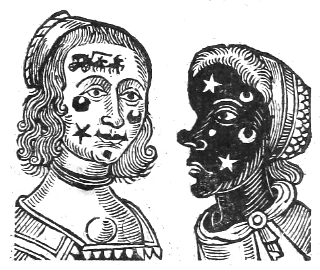
The opinion expressed in John Bulwer’s 1653 work, The Artificial Changeling, was not at all complimentary:
This is as odious, and as senseless an affectation as ever was used by any barbarous Nation in the World; And I doubt our Ladies that use them are not well advised of the effect they work; for these spots in Faire Faces advantage not beauty as they suppose . . . This Palliative Artifice which introduceth an acquisite complexion to deceive the Spectatours Eye for a moment is altogether to be rejected by women, especially Christians.11
. . . . .
Suffice it to say, there were numerous, and often questionable “cures” for pimples, including the popular so-called “patent medicines” (essentially nothing but quackery) which became popular in the late 1800s and early 1900s. These were touted as “miracle cures” for any number of maladies and hawked in newspapers around the country. These so-called “patent medicines” were unregulated and, frankly, downright dangerous in many cases.
These so-called “patent medicines” often claimed some “secret” ingredient, but in fact the product’s owner could change the formula on a whim, keep the product name, and the unsuspecting public would never know the difference. Conversely, a true patent medicine would, by United States patent law, be required to disclose all ingredients. Furthermore, the product becomes public property after a certain period of time. Today this is where we get our “generic drugs”.
Really, though, how could anyone believe that taking a swig or two every day of “Golden Medical Discover” or popping one of “Dr. Pierce’s Pleasant Purgative Pellets” was going to cure a skin disorder or relieve one of rush of blood to head? Were these any better than home remedies which had been around for centuries? Traditional medicine gradually grew out of folk remedies, but it was well into the twentieth century before breakthroughs in medicines such as penicillin provided doctors with tools to fight infection and disease. Improper care in treating acne could actually lead to one’s demise without an effective means to treat infection.
Receipts and Remedies, published in 1908, provided “useful hints for everyone on health, beauty, clothing, food, [a] housewife’s complete handbook”. With the premise that the “best way of doing things are often contributed to periodicals by practical men and women who have worked out the problems in their own experience”12 the book was meant to be a handy housewife’s handbook, with advice for dealing with everything from abrasions to wrinkles. For pimples:
When pimples are not very bad washing them every morning with very hot water and ichthyol soap will be found beneficial. If the pimples are very persistent some internal remedy should be prescribed by one’s physician, and at the same time some ointment or lotion should be used. The following remedies are among the best that could be used. Local treatment consists in keeping the skin very clean, and in applying some good healing ointment.
A good ointment for pimples is: Ointment of oleate of zinc, one ounce; ointment of rose-water, one ounce, camphor, ten grains. This should applied to the pimples on retiring at night.
A good lotion for pimples is the following: Carbolic acid, fifteen drops; borax, one drachm; glycerine, four drachms; tannic acid, one-half drachm; alcohol, one ounce, rose-water, two and a half ounces. Dissolve and mix well together. Apply night and morning.
This lotion for pimples is recommended by an authority: To five ounces of elder-flower water add one ounce of spirits of camphor and one drachm of milk of sulphur. Shake thoroughly. Wash the face at night with warm water and soap, and after drying the face apply the lotion with a sponge, allowing it to dry on.
White pimples should be pricked with a clean needle and the little mass gently pressed out. A little cold cream may then be applied to the spots.
A French beauty specialist recommends the following treatment: Boric acid powder, fifty grams; magistery of sulphur, ten grams; distilled cherry laurel water, forty grams; gum arabic, twelve grams. If this does not effect the cure try the following: Magistery of sulphur, twelve grams; sublimate of sulphur, eight grams; rectified alcohol, twenty grams; rose-water, fifteen grams; tragacanth, six grams. Apply night and morning. This is a very strong remedy; in fact a very radical cure for an acute attack of acne.13
The problem, of course, with these remedies (if one had the time and wherewithal to make them!) was they would likely have very little if any effect on an infection, and certainly not for a case of Black Erysipelas (as it was called) or blood poisoning brought on by picking at a pimple.
It was all well and good (based on medical knowledge available at the time) to advise “popping” a pimple with a clean needle and gently pressing the white mass out. However, it’s quite certain the so-called “deaths by pimple” I kept seeing were caused by either a dirty finger or some instrument that was neither clean nor sterile, which in turn invoked the rapid spread of deadly bacteria. The obituaries of these unfortunate souls who died due to an infected pimple should have been a cautionary tale. Here is a sampling of the stories I found:
DIED OF BLOOD POISONING
Daughter of Mr. and Mrs. Joseph
Washburn of DeKalb Picked Pimple
which Resulted in Death
Mr. and Mrs. W. S. Washburn left this morning to attend the funeral of Mr. Washburn’s niece, the 21-year-old daughter of Mr. and Mrs. Joseph Washburn of DeKalb, who died Monday as a result of blood poisoning. About a week ago Miss Washburn had a slight pimple on her forehead which she picked with her finger and brought the blood. Poisoning developed later and which resulted in her death Monday.14
This young woman’s untimely death took place while she and her family were in the process of relocating from Sapulpa, Oklahoma to Portland, Oregon in the summer of 1920. Having been recently enumerated in Sapulpa for the 1920 census. Charlotte was very much alive, but not for long, unfortunately:
YOUNG WOMAN DIES OF BLOOD POISONING
Miss Charlotte E. Avery, daughter of Dr. and Mrs. Amos Avery, of Oklahoma, died at the Littleton hospital Wednesday. Death was due to blood poisoning. She left Pueblo with her parents Monday morning, and while on the way a pimple developed on her forehead. By the time they reached Littleton Miss Avery was ill and was rushed to the hospital for treatment but the poison had made such headway that she died Wednesday.
The family was on their way by auto to Portland, Oregon where they expected to locate. . . Miss Avery was nineteen years old.15
Not a pimple, but deadly nonetheless after self-treating with a non-sterile instrument, not at all surprising given the man’s living environment:
DIED A HORRIBLE DEATH
Friday the body of Austin Gilbert was found at his residence, near Brighton, this county. Gilbert was one of the most eccentric characters in this county. He was about forty-five years old, a bachelor, worth several thousand dollars, yet lived alone in a house little better than a hog pen. Death resulted from blood poisoning, caused by carbuncles which nearly covered his body. He opened them with a dirty pair of shears, which caused poisoning.16
He Picked a Pimple
Frank J. Herr, a prominent farmer, died here from blood poisoning. Three weeks ago he noticed a small pimple on his hand and picked it open. He took cold, blood poisoning followed and death was the result. A wife and twelve children survive.17
Just a few examples of how folks died in the days before effective antibiotics (and effective sanitation measures) were available. The rest of this extensive article is available in the March-April 2020 issue of Digging History Magazine. You can purchase it here.
Thanks for stopping by! For more stories like this one, consider subscribing to Digging History Magazine. Purchasing a subscription entitles you to subscriber benefits (20% off all services, including custom-designed family history charts) AND a chance to win your very own custom-designed family history chart! Details here (or click the ad below).
Footnotes:
OK, I Give Up . . . What is it? (Early American Civic Duties)

 As genealogists we have all come across terms which are unfamiliar for one reason or another. Many times the word or terminology is obsolete, or it might mean something altogether different in the twenty-first century. Such was the case as I was recently researching maternal ancestors, investigating possible French ancestry after coming across my third great grandmother’s Widow’s Pension Application.
My seventh great grandfather, Henry Chadeayne, was born in France in 1678 and in 1740 was chosen as one of his town’s officers. In New Rochelle, New York Henry was appointed a “sessor”. The word is part of a common word used today, “assessor”, as in one who assesses or collects taxes. It was, however, some of the other offices which caught my attention. Uncertain of what the terms meant, I (as I am prone to do) set off on a little adventure to see what I could learn.
I should also mention I was intrigued by some of the meeting agenda items. Apparently, the question of where sheep were allowed to pasture was of great concern as a “Majority of Voices” voted “that Sheep shall be no commoners.”18 Since the term “commoner” today generally means someone who is of lower social status, I wasn’t sure what the word meant in this context. It appears the term refers to “commonage” which means the use of something, like a pasture, in common with others. But, I’ve digressed – back to civic duty.
Some of the offices were more familiar like “town clerk”, “constable” and “overseer of highways”. Pretty obvious what these positions entailed. However, what exactly was a “fence viewer”? Or, for that matter, what were the duties of a “pounder”? Along the way I ran across a few more.
Pounder
Ever hear the saying, “he couldn’t get elected dogcatcher”? In early America the job of pounder (or key-keeper) may have been similar to that of “dogcatcher”, but it wouldn’t have been referred to derisively, as in a low-level political appointment. A pounder was responsible for herding a variety of animals, whether stray or wild, into an enclosure of some sort (a pound) and often located on his own property.
As local customs and conditions necessitated, a town might pass ordinances regulating just how free animals were to roam throughout city limits. In the early 1800s these Connecticut towns were apparently needing to address the issue. In the case of Farmington, it seems just about anyone with a means to corral wandering animals could be a key-keeper or pounder – and apparently profit from it:
Be it enacted by the inhabitants of the town of Farmington . . . that no horses, cattle, asses or mules shall be allowed to go at large on the highways, commons, or uninclosed lands in said town; and it shall be lawful for any proprietor or holder of lands in said town, or any other person by his or her order, to impound any horse, cattle, ass, or mule, found or suffered to go at large as aforesaid, in a pound within said town nearest to the place where taken; and the owner or owners of such horse, cattle, ass, or mule, as impounded shall pay for each the sum of sixteen cents to the key-keeper, before the same shall be released from said pound, three-fourths for the use of the impounder and one-fourth for the use of the key-keeper.19
In 1800 a “bye-law, for restraining Geese and Swine, from going at large within the limits of the City of Norwich”20 was passed. While geese and swine wandering within the city limits faced imminent impoundment, the new ordinance only stipulated enforcement for precisely a period of one year and one month, enacted on (no kidding) April 1, 1800.
While animals may have been allowed to previously roam freely throughout a settlement, as small towns and townships grew into cities the citizenry wanted containment, preventing animals from “going at large”. I suppose “going at large” could be interpreted more than one way, couldn’t it? As far as being a pounder in days of old, it might have been a “dirty job” but someone had to do it.
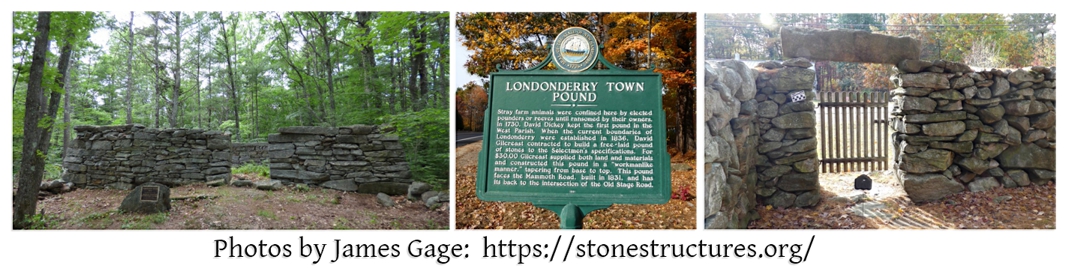
Hog Reeve
Much like a pounder, a hog reeve wrangled stray animals of the porcine variety. This particular civic office was common throughout New England, and an important one since hogs were seen as a menace by reason of their propensity to root around in local fields and gardens. Whereas a cow might eat the tops off a potato, a hog would dig it up.
By law all swine were required to be yoked and have nose rings. Part of a hog reeve’s duty was to outfit ring-less hogs, and charge its owner for neglect of the law.
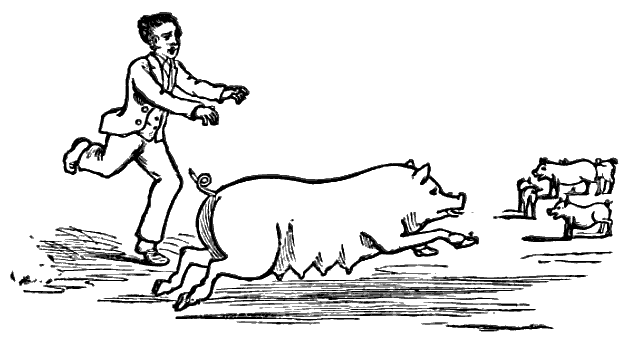 New Hampshire is an example of a state which still elects hog reeves, even if done so primarily in jest. In 1988 a young lawyer, newly-married, decided to run for hog reeve of Cornish, New Hampshire. Why?
Tradition dictates it, according to a 1989 Boston Globe article. Why the task would often fall to younger men may be somewhat debatable, however. The Globe suggested a reeve “may have been chosen from the town’s recently married men because they would be the most vigorous.”21 One genealogical resource suggests that “young men were adept at putting rings on young ladies’ fingers.”22
It was a vitally important issue early in New Hampshire’s history, as evidence by a law already on the books and in apparent need of further legislation in 1767:
AN ACT IN ADDITION TO THE LAWS OF THIS PROVINCE FOR REGULATING THE MANAGEMENT OF SWINE
Although lengthy and full of “legalese” the act points out the importance of preventing swine from “going at large un-ringed” since pigs were prone to root up soil, “destroying the meadow and pasture land, and the fruit growing on tilled land”. Since owners were often “careless of injuring their neighbours”:
Be it therefore Enacted by the Governor, Council and Assembly:
That no Swine of any kind shall be suffered to go at large, or be out of the inclosure of the owner thereof – And if the owner of any swine of any sort or kind shall suffer them he owns, or is possessed of, so to be, and go at large out of his or her inclosure, he or she shall forfeit and pay the sum of six shillings for the first offence, and twelve shillings for the second . . .23
Thus, while some New England towns passed local ordinances addressing such issues, in New Hampshire it was state law. Like many other towns throughout New England, New Hampshire also needed a fence viewer.
Fence Viewer
This civic position still exists today, although not exclusively in the New England area (some places in the Midwest still elect or appoint fence viewers). For example, someone serving as trustee of a small town or township or a county commissioner might have fence viewer responsibilities.
In early America, however, this civic position carried weight in terms of local governance. By the way, if your ancestor served as a fence viewer during the Revolutionary War (and you can prove it), you qualify to join either Daughters of the American Revolution (DAR) or Sons of the American Revolution (SAR) as a patriot descendant.
The Massachusetts Colony made provisions for fences in 1647 “For the better preserving of Corn from damage, by all kinde of Cattle, and that all Fences of Corn-fields, may from time to time be sufficiently upheld and maintained.”24 The job of fence oversight at that time fell to the selectmen of all towns:
for the repairing of all Fences both general and particular, within their several townships, excepting Fences belonging to Farms of one hundred Acres or above and have power to impose upon all Delinquents, twenty shillings for one offence; and if any Select men shall neglect to make Orders as aforesaid, they shall forfeit five Pounds to the use of the Town, and so for every Months default from time to time.25
Thus, so important was the job of fence viewer that if a selectman failed in his duties he would be required to pay the town for dereliction of duty. In order to prevent such dereliction, however, selectmen could appoint up to two additional persons per year to “view the Common fences, of all their Corn-fields, to the end, to take due notice of the real defects and insufficiency thereof.”26 Furthermore, any perceived defects or insufficiencies required proof provided by two or three witnesses.
A town’s fence viewer would take his job seriously, regularly walking through the town to “see that the fence be sett in good repaire, or else complain of it”.27 It was, of course, to an owner’s advantage to keep his fence in good repair. If he didn’t, and an animal broke through it, he would be liable for any damages. If the fence remained un-repaired the fine might be doubled and paid to the person who eventually performed the repair, often the fence viewer cum fence repairer.
Fence laws set requirements for sound construction as well as height limitations. In early America a “sufficient fence” would have been required to be at least four to five feet high. In New Jersey a sufficient fence would measure “Four Foot and Four Inches High.”28
Whether a fence viewer actually measured a fence’s height or just “eyeballed” it, one anecdotal account in Vermont newspapers in 1868 pokes a bit of fun (perhaps that state’s fence viewers took their work a little too seriously sometimes?):
FENCES AND FENCE VIEWERS IN MORRISTOWN:
Fence Viewers – E.M. Irish, weight 300 lbs; Leonard Wood, height 6 feet 8 inches, and “Banty” Terrill, size of a tame cherry!
Voted, That all fences upon which Irish could sit, that Wood couldn’t straddler, nor Banty crawl through, should be deemed legal fences!29
In addition to regularly inspecting a town’s fences, a fence viewer might be required to walk the town’s boundaries with its selectmen, an annual tradition meant to ensure a nearby town wasn’t encroaching upon their own:
“Beating the bounds” was a specially important duty in the colonies where land surveys were imperfect, land grants irregular, and the boundaries of each man’s farm or plantation at first very uncertain. In Virginia this beating the bounds was called “processioning.” Landmarks were renewed that were becoming obliterated; blazes on a tree would be somewhat grown over – they were deeply recut; piles of great stones containing a certain number for designation were sometimes scattered – the original number would be restored. Special trees would be planted, usually pear trees, as they were long-lived. Disputed boundaries were decided upon and announced to all the persons present, some of whom at the next “processioning” would be living and be able to testify as to the correct line. This processioning took place between Easter and Whitsuntide, that lovely season of the year in Virginia; and must have proved a pleasant reunion of neighbors, a May-party. In New England this was called “perambulating the bounds,” and the surveyors who took charge were called “perambulators” or “boundsgoers.”30
Fence viewers arbitrated boundary disputes as well. While New England and parts of the Midwest may have required the services of fence viewers, Westerners – Texans in particular – have at times mildly mocked the tradition:
A Connecticut editor has been elected fence viewer, and now calls upon all persons having fences to be viewed to bring them to his office.31
Three clergymen have been chosen fence viewers in Charlotte, Vt. They were given to railling [sic].32
Every state has fence laws, even Texas, although I couldn’t locate a record of the need for fence viewers in the Lone Star State. After all, who would have needed them when you had barbed wire?
Thanks for stopping by! For more stories like this one, consider subscribing to Digging History Magazine. Purchasing a subscription entitles you to subscriber benefits (20% off all services, including custom-designed family history charts) AND a chance to win your very own custom-designed family history chart! Details here (or click the ad below).
Footnotes:
Manumission: Free at Last (or perhaps not?)

If you’ve researched Southern slave-holding ancestors, you may be aware of the term “manumission”. If not, it simply means the act of freeing one’s slave(s). As such, manumission differed from emancipation set forth by government proclamation, Abraham Lincoln’s 1863 Emancipation Proclamation being a prime example.
Manumission was not a new concept to American slave owners. It’s almost as old as slavery itself. Aristotle thought slavery was quite natural and even necessary. And while there were varying degrees of slavery, all forms limited the Greek slave in one way or another, albeit with a modicum of certain rights extended just for being a human being.
Romulus, the founder and first king of ancient Rome, is thought to have begun the practice in that ancient society by granting parents the right to sell their own children into slavery. Romans would go on to enslave thousands through conquest.
As opposed to Greek slavery, as long as someone was a Roman slave they possessed no rights – none. But, following a slave’s manumission full citizenship rights were extended, including the right to vote.
American slavery was, however, racially-based and transcendent of those ancient traditions. For the American slave owner it was a matter of economics, as set forth in actuarial tables – a sort of justification for at least gradual manumission of slaves – published in The Pennsylvania Packet on January 17, 1774. A “neighboring province” had been recently considered justification for gradual manumission in the last legislative session.26
Virginia passed a law in 1782 following the Revolutionary War allowing slave owners to manumit at will without government approval. In part, perhaps this new law propelled Robert Carter III, one of the state’s wealthiest men, to begin freeing his slaves.
Some have surmised Carter underwent a religious conversion. By signing a Deed of Gift on August 1, 1791 and presenting the same in Northumberland District Court on September 5, he set in motion the gradual manumission of his considerable slave holdings. At the time he enumerated – each one by name and age – over 450 slaves. It is an extraordinary document and thought to have been responsible for the greatest number of slaves freed by one man in all of American history.
He began by providing a table of locations (spread over several counties) where his slaves lived, referencing each named slave with a specific location. He seems to have been intent on crossing all T’s and dotting all I’s.
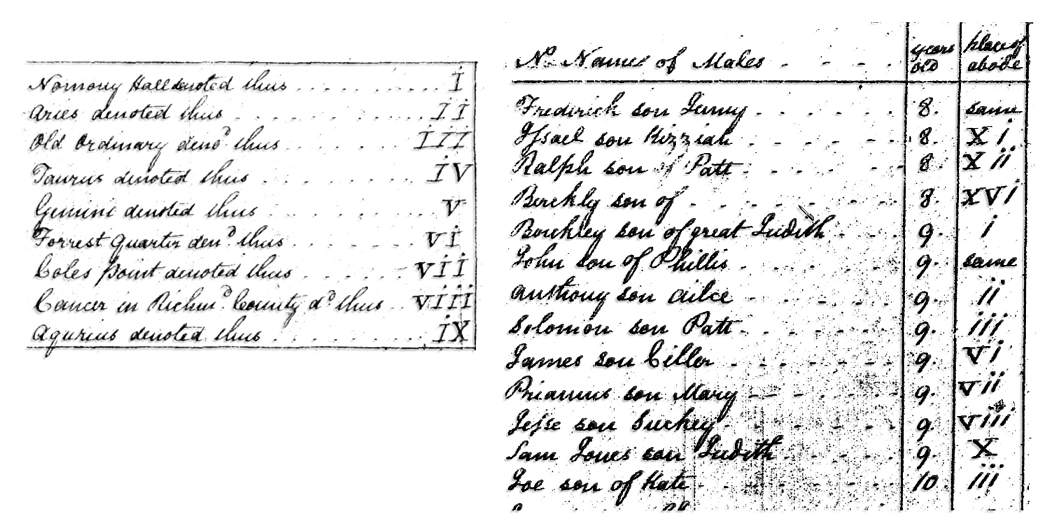
By the time manumission was completed some three decades later, somewhere between 500 and 600 were thought to have been freed, albeit not without a bit of legal wrangling. In 1793 Robert Carter removed to Baltimore and left the measured and deliberate process in the hands of Baptist minister Benjamin Dawson. When Carter died in 1804 his heirs sued Dawson in order to halt manumission, but lost in an 1808 ruling in the Virginia Court of Appeals.33
This is just one example of the manumission of slaves, something which genealogists with slave-owning ancestors will find interesting. One of the most extraordinary cases occurred in Mississippi, one that was litigated for years before being settled in favor of two manumitted slaves. This article is excerpted from the January-February 2019 issue of Digging History Magazine. Purchase it here.
P.S. Speaking of manumission in Mississippi, there is an interesting story in the February 17, 2026 episode of Finding Your Roots on PBS which featured the ancestry of singer Lizzo. It makes the aforementioned Mississippi case even more interesting since apparently manumission was against the law in Mississippi.
Thanks for stopping by! For more stories like this one, consider subscribing to Digging History Magazine. Purchasing a subscription entitles you to subscriber benefits (20% off all services, including custom-designed family history charts) AND a chance to win your very own custom-designed family history chart! Details here (or click the ad below).
Footnotes:
Must-See Documentary
 For all my genealogy and history-loving friends . . . I discovered this documentary through Crista Cowan’s (“The Barefoot Genealogist”) podcast. If you’re a fan of Finding Your Roots on PBS, you will love this documentary which highlights an interesting (and moving — bring your tissues!) piece of American immigration history. You can watch for free on Tubi or rent through PBS on Amazon.
By the way, Crista has a series, “Stories That Live in Us”, which is currently highlighting all states in a lead-up to America’s 250th birthday. The series started with Hawaii, the 50th, and is working back to America’s beginnings. This week was Mississippi. You can find her podcast on YouTube: https://www.youtube.com/@CristaCowan. Very interesting and informative series!
Free to Enslave?

The premise may seem unbelievable, given what our history books have always taught us. It is true – there were free men and women of color who owned slaves. The question is, why would someone previously enslaved choose to enslave others?
In 1790 in the St. Phillip’s and St. Michael’s Parish of Charleston, South Carolina, a number of free persons of color (male and female) were enumerated as such by “Free” appearing before their given name. A number of these free blacks also owned slaves.
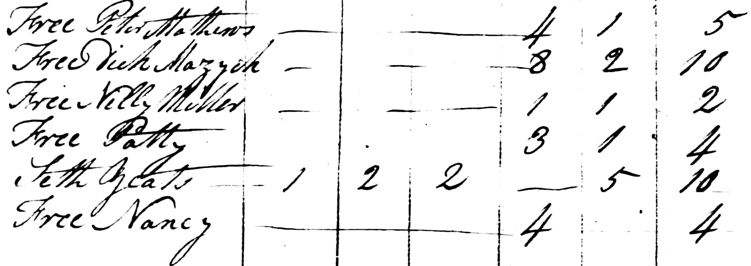
In this particular extracted section, four out of five of the free persons of color owned slaves (next to last column is number of slaves owned), in an aggregate amount equal to the number of slaves owned by Seth Yeats, presumably a white person. According to Larry Koger, author of Black Slaveowners: Free Black Slave Masters in South Carolina, 1790-1860, there were 36 black slave masters enumerated in Charleston City in 1790. Furthermore, Koger asserts that Peter Basnett Mathews (enumerated as “Free Peter Mathews”) “bought slaves only to emancipate them and asked nothing in return for their acts of benevolence.”34
The slave owned by Mathews in 1790 is said to have been a black man named Hercules, “who was acquired for humanitarian reasons and later emancipated by the colored man.”35 Mathews, a butcher by trade, was one of a number of free black artisans of Charleston who often challenged the societal status quo. He drew attention to South Carolina’s new constitution which provided for Bills of Rights, available to all free citizens, excepting those of the Negro race. Peter, along with another butcher named Matthew Webb and Thomas Cole, a bricklayer and builder, petitioned the South Carolina Senate for redress.
Even though they were free citizens and taxpayers, as well as peaceful contributors to society, they were denied trial by jury and sometimes subjected to “unsworn testimony of slaves.”36 Fifty years after passage of the state’s Negro Act of 1740 which made it illegal for slaves to assemble, raise their own food, earn their own money or learn to write, free Negroes were still being discriminated against simply because of the color of their skin. Not surprisingly, the Senate rejected their petition.
In 1793 Peter Mathews’ home and papers were searched when state officials feared a black uprising. He certainly had nothing to hide and cooperated fully. What sort of papers might Mathews have possessed?
An extensive account of his ancestry (or, at least it seems to be implied) is provided within the voluminous research presented in a two-volume book entitled, Free African Americans of North Carolina, Virginia, and South Carolina, From the Colonial Period to About 1820, by Paul Heinegg. Peter Mathews is briefly mentioned at the end of the Matthews family history, perhaps because the author was unsure of just where (or if) in the family line he belonged.
Nevertheless, if Peter was indeed part of this line of free Negroes, the family’s history is believed to have begun with Katherine Matthews, “born say 1668, was a white servant woman living in Norfolk County [Virginia] in June 1686 when she was presented by the grand jury for having a ‘Mulatto’ child. She may have been the ancestor of . . .”37 (followed by a long enumeration of possible descendants). If this assumption is correct, it is possible all of Katherine’s mulatto children were considered free since laws at the time (passed in 1662) stated that a person of color was either free or slave based on the mother’s status.
Peter Basnett Mathews died in 1800 and wrote a will expressing his final wishes in regards to bequeathing what worldly goods he had accumulated to his wife Mary and their children. The opening paragraph indicates his status as a “Man of Colour and Butcher by Trade” There is no mention of slaves, as presumably all he may have ever owned were by then emancipated.

Peter Mathews is just one example. One former enslaved family had the distinction of being South Carolina’s largest slave-owning operation. This article is from the archives, the January-February 2019 issue of Digging History Magazine. Purchase it here.
Thanks for stopping by! For more stories like this one, consider subscribing to Digging History Magazine. Purchasing a subscription entitles you to subscriber benefits (20% off all services, including custom-designed family history charts) AND a chance to win your very own custom-designed family history chart! Details here (or click the ad below).
Footnotes:
Seawillow: What’s in a Name?

Seawillow
Seawillow is a rather lyrical and poetic sounding name isn’t it? I ran across this name while researching a friend’s African American ancestry. Where in the world did this name come from? Wouldn’t you just know – there’s a story behind it!
A search for the name at any newspaper archive site reveals the name appears to have been used most often by Texans – and rightly so, since the story from which the name evolved occurred around Beaumont in 1855. She was the very first baby girl given this special name.
October 22, 1855 must have been a stormy day to be born along the Neches River, which meanders southeast over 400 miles from eastern Van Zandt County, emptying into the Gulf of Mexico below Beaumont. Today, the area averages well over 40 inches of rain per year and flooding occurs on average every five years.
The day Reverend John Fletcher and Amelia (Rabb) Pipkin’s daughter came into the world was a perilous one as flood waters trapped them on a raft, along with several family slaves, the situation dramatically heightened since Amelia was about to give birth. The oft-told story is related at the Find-A-Grave page for Seawillow Margaret Ann Pipkin Wells [edited]:
The day Seawillow was born there was a disastrous flood on the Neches River in Beaumont, Texas. The Rev. John F. Pipkin and his pregnant second wife, Amelia Rabb, and some of the family slaves were swept along on a raft. Just before the birth of his daughter, a human chain was formed by the slaves to fasten the raft to a willow tree. The Reverend looked up through the branches of the Willow tree and gave thanks to God for the safe delivery of his daughter in the midst of the flood water. Thus, the name Seawillow.38
In 1942 one of John’s sons, Stephen Walker Pipkin, was interviewed and related how he was born in the family home “maintained on Briar Island”39, located in the southwest part of Orange County. S.W. had just purchased his father’s former ranch property.
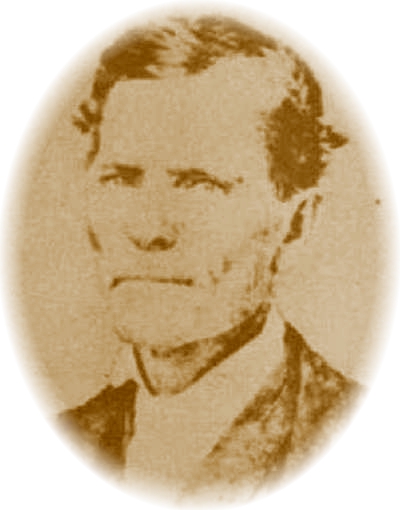 John Pipkin had a significant influence all those years ago, earning the sobriquet “father of Beaumont churches.”40 For some time following his arrival from Arkansas in the early 1850s, he was the only preacher in those parts. Despite his staunch Methodist faith, he “was not guided by denominational fetters, but extended to all who needed wise counsel or humane help in sorrow, sickness or death, and who served at baptisms, marriages or funerals as the general ministrant of Beaumont.”41 Like many other preachers of the day John was bi-vocational, operating a saw mill and also served three terms as County Judge for Jefferson County.
John, the son of Reverend Lewis and Mary Pheraby (Beasley) Pipkin, was born in Sparrow Swamp, Darlington District, South Carolina on August 14, 1809. After his first wife died he married Amelia Rabb, a widow, in 1844 in Conecuh County, Alabama. By 1850 the family was living in Ouachita County, Arkansas.
After Amelia died on January 23, 1867 of pneumonia John’s married daughter, Nora Lee Holtom, wrote a letter to Stephen Warner Pipkin asking whether he could take Seawillow (or board her for a year) so she could attend school with her cousin Mary. John would gladly compensate for her care. However, by 1870 Seawillow was living with John and his new wife Mattie.
Seawillow grew up in Beaumont and later taught school in Caldwell County (Luling and Lockhart). On November 22, 1883 she married Littleberry Walker Wells. On February 22, 1886 their first daughter was born – Seawillow Lemon – and the first of several descendants named Seawillow.
The farming community where they lived continued to grow and by 1899 required a post office. It was named “Seawillow”. Littleberry died on January 30, 1900 and Seawillow on May 30, 1912, both buried in the Wells Cemetery in Seawillow.
My friend’s great grandmother, Seawillow Hubert, was born on December 14, 1880 in Orange County. Although I haven’t been able to find a direct connection to the Pipkin family, it’s certainly possible one of her ancestors was either a slave of John Pipkin’s or the story of how his slaves had helped save his daughter’s life became legend among slaves and former slaves.
Through the years, Seawillow Hubert’s name was spelled (or transcribed) variously as “Serilla”, “Suvilla”, “See William” or “Seawillow”. It was a bit difficult to discern what her actual name was, but this Seawillow’s Find-A-Grave entry clearly records her name. I had to know where that name came from, so thus the little “side adventure”.
Not only did I learn the likely origins of her name, I learned quite a bit of history about the Beaumont area and the Pipkin family. While I usually write these types of articles about surnames, this turned out to be quite interesting learning the history of someone’s forename.
 As I always like to say, keep digging!
Thanks for stopping by! For more stories like this one, consider subscribing to Digging History Magazine. Purchasing a subscription entitles you to subscriber benefits (20% off all services, including custom-designed family history charts) AND a chance to win your very own custom-designed family history chart! Details here (or click the ad below).
Footnotes: