
Untangling the Web of Twisted History: We’ve Always Been Told (Family Lore – Part 1)


One of my favorite maxims – “genealogy is not for the faint of heart” – is the underlying premise of this multi-part article, a collection of challenges I’ve run across in my “research adventures” in pursuit of my own family history or that of my clients. Genealogy is fraught with challenges and the all-too-often need to untangle twisted history, but untangle I must (or at least try!) – whether it’s a client with family lore they wish to prove (or disprove) to scaling brick walls built on years of misleading information via either genealogical fraud, inheritance scams or Internet speculation. In recognition of October being Family History Month, this article has been excerpted from the May-June 2020 issue of Digging History Magazine.
We’ve Always Been Told: Family Lore (Part 1)
I’ll start this off with my least favorite (by far) research objective. It is the “we’ve always been told we were related to [someone famous (or infamous)]” or just about any variation thereof. First and foremost, I loathe these “challenges” because there is considerable pressure on the researcher (me) to uncover the real story, especially when I know the client really, really, really wants to be related to so-and-so in order that they may join this or that heritage society.
To be honest, I much prefer just letting the natural course of research take us to whatever interesting (or not so interesting) conclusions regarding ancestry. I had a client some time back (and I didn’t keep the notes, unfortunately) who had a penchant for joining multiple heritage societies. Personally, I’m not particularly interested in such things, but she certainly was. She wanted to join one associated with early Jamestown settlers.
Looking back, I think the reason I didn’t keep many notes was the fact I made fairly quick work of disproving the connection she was sure was hers. That was an easy one – most aren’t.
Dr. John Briscoe: The Society of the Ark and the Dove
One such case I encountered wasn’t necessarily family lore, but a client’s desire to be directly descended from Dr. John Briscoe, an early Maryland settler who purportedly came at the invitation of none other than Lord Baltimore (Cecil Calvert, the Second Lord Baltimore) himself. Still, it’s a classic example of “untangling the web of twisted history”.
A wedding announcement (of all things) published in 1904 proclaimed the bride a direct descendant of Dr. John Briscoe and provided the following background:
The bride of last night is a great-grand-daughter of the late Major Thomas Briscoe of Jefferson county, W. Va., who was a direct descendant of Dr. John Briscoe, the first by that name in this country, having sailed by invitation from Lord Baltimore, as the following indicates:
Briksheugh, New Biggin,
Cumberland County, England.
September 1, 1633
Dr. John Briscoe, Greeting:
Dear Sir: As the privy council have decided that I shall not be disturbed or dispossessed of the charter granted by his majesty, the ‘Ark’ and pinnace ‘Dove’ will sail from Gravesend about 1st of October, and if you are of the same mind as when I conversed with you, I would be glad to have you join the colony.
With high esteem,
Your most obedient servant,
CECILIUS BALTIMORE
Furthermore, the Briscoe family “may” have been been connected to Pocahontas:
Among the many interesting alliances of the Briscoes none is more so than that which brings a connection with the descendants of Pocahontas. This comes through the Edward Tayloe Briscoe line by his marriage to Miss Sallie Ferguson Vaughn, whose lineage goes directly back to Pocahontas, the beautiful Indian princess, and to her father, the great Powhatan.1
The first thing I noticed about this letter addressed to Dr. John Briscoe was the language. It didn’t sound very seventeenth century-like as evidenced by the phrase “I would be glad to have you join the colony”. The person who discovered the letter deemed it to be original. However, after the Maryland Historical Society examined the document, its originality was deemed questionable. The Society believed it to be a copy, hoping the original would eventually be discovered.
By the early twentieth century it appears to have been a foregone conclusion that Dr. John Briscoe was indeed a passenger, and likely the first Briscoe to walk on American soil. Genealogists often refer to the first person in their ancestry to arrive in America as the progenitor of all descendants. However, whether Dr. John Briscoe was the progenitor of ALL subsequent Briscoe lines is debatable, and actually a bit difficult to trace. It seems there were more than a few men of distinction who were subsequently named “Dr. John Briscoe”.
According to British Roots of Maryland Families, written by Robert W. Barnes, an article by Alexander H. Bell, published in the September 1933 issue of the National Genealogical Society Quarterly (NGSQ), questioned “whether a Dr. John Briscoe ever really came to Maryland, and whether the person referred to in Maryland records was not really a John Biscoe [different name, different person]”. In 1958 another NGSQ article, “The John Briscoe Story” was written by Vice Admiral and Mrs. William S. Pye with the purpose of refuting the “negative article published some twenty five years earlier by A.H. Bell.”2
Although Barnes cautioned that another source, Visitation of the County of Cumberland in the Year 1615, must be used with care since some generations likely needed more documentation, he traced the ancestry of Dr. John Briscoe back to Robert Briscoe, Lord of Brisco in County Cumberland (ninth great grandfather).
According to Barnes, Dr. John Briscoe was the son of Leonard and Mabel (Sands) Briscoe, born circa 1612 at Crofton Hall, County Cumberland, England:
He is said to have accepted the invitation of Cecilius Calvert and to have come to Maryland as one of the Gentlemen Adventurers on the Ark and the Dove Expedition. He was a member of the Court that met at St. Mary’s City. He should not be confused with a contemporary named John Biscoe. The ancestor of the Briscoe family of MD is usually referred to as “Dr.” Dr. John Briscoe m. Elizabeth Dubois who was b. in England, and said to have been a descendant of the Huguenot family of County De Roussey, Marquis Du Bois. Dr. Briscoe was believed to have been an Anglican, but his descendants m. into the leading Roman Catholic families of Maryland.3
This family appears to begin its twisted history here as not everyone can agree on the children of John and Elizabeth:
Some sources say that Dr. John had a son, John, Jr., who was the father of Philip Briscoe, but if the latter was in fact born in 1648 he is most likely to have been a son and not the grandson of the Doctor. [One researcher determined] that Dr. John and Elizabeth DuBois Briscoe had at least three children: GEORGE; JOHN; m. Ann Jackson (Worthington) and had issue; and PHILIP, b. c1648, d. c1724; m. Susanna Swann.4
Yet another Maryland source prefaces Briscoe family history by refuting previously published research:
The ancestry of Dr. John Briscoe [another Dr. John], who settled in Frederick (afterwards Berkeley) County, Virginia, about 1752, and his brother George Briscoe, who accompanied or more probably followed him, as given in Colonial Families of the United States of America, Vol. III, p. 84, is incorrect. They were, it seems, sons of Dr. Philip Briscoe, son of Philip, usually called Colonel Philip, and Susanna (Swann) Briscoe.5
This particular source (Colonial Families of the United States of America) states Dr. John Briscoe was born around 1590, versus Robert Barnes’ claim of 1612. This twenty-two year difference is substantial, but not uncommon in genealogical research. Sometimes we simply don’t know for certain.
Sometime after William Pye wrote his article for NGSQ, The Society of the Ark and the Dove rejected the claims due to contrived material (e.g. “twisted history”) in John Briscoe’s lineage. Some went so far as to wonder whether there ever was a Dr. John Briscoe who married Elizabeth DuBois.
The Society seems to have set aside their doubts about Dr. John Briscoe, however. In 2005 they published a book, The Ark and the Dove Adventurers, listing him among the gentlemen adventurers. It is a bit curious, however, that they don’t list him under the “Adventurer List” link on their web site, while still offering their publication as a source.
The book provides the lineage of four or five generations of descendants, beginning with their children George (who may never have married), John and Philip. Philip’s line of descendants is prominently featured and doesn’t appear to link with my client’s Briscoe line (as far as I can tell). Only John Jr.’s children are listed (Thomas, (yet another) Dr. John Briscoe, James, Mary, Anna, and perhaps another daughter named Elizabeth). Nothing in that book, however, jumps out as a link to my client’s Briscoe family in Virginia. Her second great grandfather, Thomas Briscoe, was born in Virginia and later migrated to Morgan County, Alabama.
If there were a connection to Dr. John Briscoe, I would be inclined to assume it was through John, Jr., although I’ve been unable to find any proof whatsoever. The farthest back any of the Alabama Briscoes have been confidently able to trace is Thomas.
My client was just sure she is related, however – as she pulled out her pendulum and it answers “yes you are related to Dr. John Briscoe”. I am not kidding about the pendulum . . . she seemed quite serious! Of course, I told her that proves absolutely nothing, nor will it gain you entry into a heritage society. Without definitive proof of a direct link to Dr. John Briscoe, it won’t happen (most societies are quite particular about sources, proof and such).
(Update: In all fairness, some time later the client informed me that her pendulum had apparently changed “its” mind – she was NOT related to John Briscoe!)
 As one lecturer pointed out in a webinar I attended years ago, sometimes we just have to “let it go”. Not everything we’ve always heard via family lore, or for that matter, famous people we wish to be connected to, materializes. Beware – sometimes the truth can be a bit deflating. Next week: Debunking a Family Legend: Escaping the Bataan Death March.
Thanks for stopping by! Please consider subscribing to Digging History Magazine. The current series features the history of individual states and how to find the best historical and genealogical records. Purchasing a subscription entitles you to subscriber benefits (20% off all services, including custom-designed family history charts) AND a chance to win your very own custom-designed family history chart! Details here (or click the ad below).

Footnotes:
It Was a Victorian Thing: Get Me Out of Here (I’m Not Dead Yet!) – Part 2
 In case you missed it, here’s Part 1 of this short series. Part 2 highlights how Victorians addressed their fear of being buried alive — as the saying goes, necessity is the mother of invention!
Necessity: The Mother of Invention
One of the hallmarks of the 1800s – the “century of acceleration” – was an explosion of innovation, invention and medical advancements. Faced with challenges, Victorians sought ways to circumvent them, although some of their inventions were more than a bit ill-conceived. Such was the case with devices like safety coffins, life detectors and grave signals.
Christian Eisenbrandt
One of the first patents addressing the fear of being buried alive was granted to Christian Eisenbrandt, a German maker of fine brass and woodwind instruments. Many American fifers serving during the War of 1812 were equipped with Eisenbrandt’s fifes.
Besides his reputation for finely-crafted musical instruments, Eisenbrandt became known for his “Life Preserving Coffin, In Doubtful Cases of Actual Death”.
The American Institute Fair, established in1828 “to promote improvements in the mechanic arts; to encourage American industry in agriculture, manufactures, and commerce; and to sustain such a system of policy, as will protect the great national interests of our country”,6 began holding its annual fair in New York City in 1829. The fair’s spacious location where visitors “had ample room and verge enough to gratify the appetite for the ingenious, the beautiful and the marvelous”7 was filled with the latest innovations – more or less a precursor to the World’s Fair established later in the nineteenth century.
Perhaps the most talked about invention highlighted during the 1843 fair was Eisenbrandt’s recent invention. As one journalist noted, a group of ladies passing the exhibit expressed alarm at such a device, prompting the journalist to “examine the beauty of this latest receptacle of humanity, and the appropriateness of its descriptive label”. Eisenbrandt’s premise:
In a warm climate, ours in the summer, where the dead are obliged to be buried soon after disease, as for instance, during the prevalence of yellow fever, and at other times, instances of have been known of persons having been buried before life was really extinct; to guard against which the inventor of this coffin has contrived an arrangement of springs and levers, on its inside, whereby its inmate, by the least notion of either head or hand acting thereon, will instantly cause the coffin lid to fly open, a circumstance which will entirely remove all uneasiness of premature interment from the minds of anxious relatives.
The inventor would advise all families or communities who may feel disposed to make use of his Life Preserving Coffins, so constructed as to give persons deposited therein a chance for life, by placing a lock on its door that will open either from the inside or outside also with a bell, and with openings to admit pure air, and into which no other coffins are admitted, and a key which should be placed inside to allow any one who may be resuscitated egress, until decomposition actually takes place, when they may be removed, and finally deposited in the ground, thereby keeping the vault free from the accumulation of foul air.
Obviously skeptical, the correspondent concluded, “Of its practicability the reader may judge for himself.”8
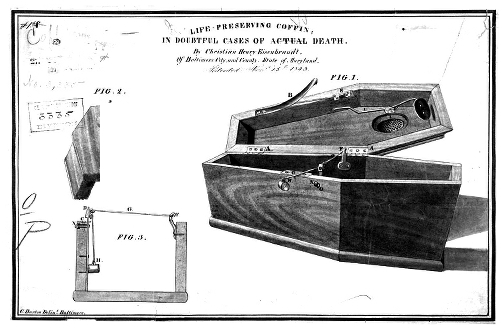
The coffin was crafted in such a way so that the slightest movement would cause the spring-loaded lid to pop open. All of which begs the question, did it work after being buried underground. The answer was “no” it only worked while the coffin was above ground in a vault. Still, Eisenbrandt seemed rather sure of himself as the patent description indicates:
I . . . have invented a new and useful improvement in coffins, which I term a life-preserving coffin in doubtful cases of death . . . the inventor of this coffin has contrived an arrangement whereby any one who may not really have departed this life may by the slightest motion of either the head or hand acting upon a system of springs and levers cause the instantaneous opening of the coffin lid.9
Franz Vester
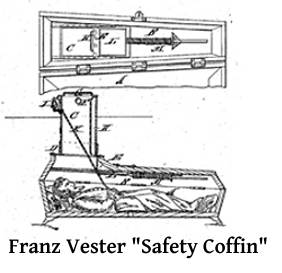 Eisenbrandt’s invention had obvious design and practical usage flaws since it only worked above ground, but in 1868 it was reported by The Spectator:
A German of the name of Franz Vester, living in the United States, has actually been good enough to invent the safety coffin, the merit of which consists in its enabling any one who happens to be buried alive in such a coffin, in his usual state of health and nerve, to rectify the mistake when he discovers it by either climbing out through a sort of chimney, or if he be not equal to that gymnastic effort, by ringing a bell for the sexton to come and help him.
The “safety coffin” is higher and bigger than ordinary coffins, so as to admit of the free movement of the body, and under the head is a receptacle for wine and refreshments. A box about two feet square rises from the head of the coffin to about a foot above the ground, and in this box there is a sort of ladder by which a person interred alive can climb out, if he is vigorous enough. A spring inside enables the occupant to ring a bell and, as we understand, to unclose the external lid of the chimney, which cannot be unclosed from outside.
Vester buried himself alive in one of his coffins and after being “interred” for morethan an hour, emerged within a minute of giving the signal “with no more perceptible exhaustion than would be caused by walking two or three blocks under the hot sun.”
Well and good for Vester, but someone actually buried alive probably wouldn’t be “springing” out! Or, as The Spectator cheekily concluded, “unfortunately, persons are not buried alive in a state of nerve and bodily vigour that would enable them on awaking unexpectedly in the grave to search for and consume lunch, touch springs, and climb a chimney, even if they could hope to make more sure of being buried by their friends in a properly appointed ‘safety coffin’ than of not being buried alive at all.”10
Theodore A. Schroeder and Hermann Wuest
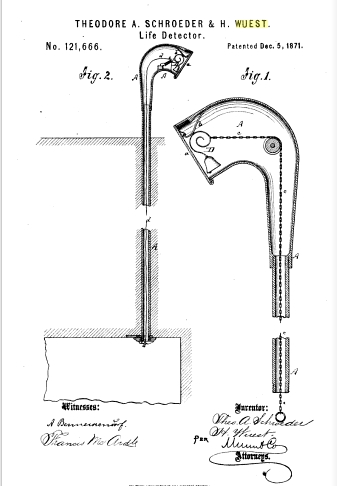 These two chaps from Hoboken, New Jersey had ideas of their own, filing a patent on December 5, 1871 for “a new and useful Improvement in Life-Detectors”. The device, looking much like an ear trumpet, was purported to be an improvement “in means for detecting the recurrence of life in persons that have been buried in a state of trance or apparent death.”11
Schroeder and Wuest believed that “an instant admission of air at the moment of recurrence of symptoms of life” was not at all overrated. Not only would the lid of the tube be adapted to open, allowing air, it would warn of the need for assistance. They believed it would truly be a life-saving invention.
The battery-operated device was designed to create a circuit inside the coffin. If a corpse stirred, the circuit would be broken, a bell would ring and fresh air would rush into the coffin. If the lid remained closed for three or more days after burial, the tube would be withdrawn – the person inside presumed then to have actually died, case/lid closed!
Albert Fearnaught
Buried alive? Fear not! No kidding, that was the man’s name. Albert Fearnaught of Indianapolis was a photographer with a “new and useful improvement in Grave Signals”. The casket would be equipped with tubes, springs and stoppers, and a cord connected “to the wrist of the supposed corpse.”
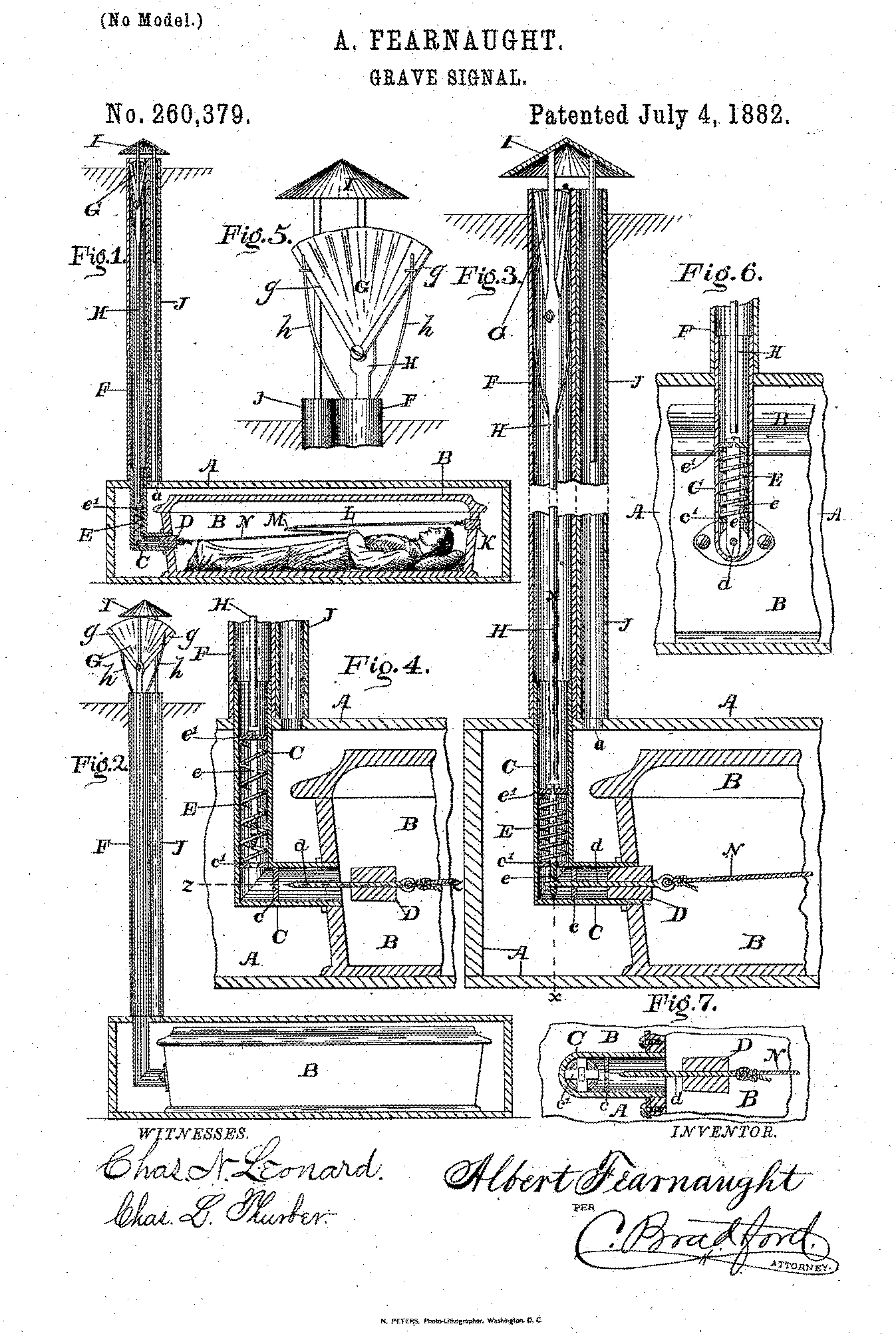
After the casket was closed two other tubes were put into position and, should it turn out the once-thought deceased person was merely in “suspended animation”, the slightest movement of the hand (voluntary or involuntary) would cause two stoppers to pop out. (These devices seemed to have involved a lot of “popping out” didn’t they?) In turn, a spring released which threw up the signal flag and at the same time established a circuit whereby air could circulate from the outside, providing ventilation until someone noticed the flag and rescued the person who was formerly in “suspended animation.” Patent #260379 was granted on July 4, 1882.12
The parade of patented grave-signaling devices continued and as the nineteenth century was nearing its close electric switches and dry cell batteries were being employed. One device invented by Frenchman M.C.H. Nicolle in 1899, involving hammer and glass, seemed rather ill-conceived.
A hammer would swing down and break a glass window that was positioned directly over the corpse’s head, allowing ventilation, if any corpse movement was detected. His device and others were specifically designed for people who had been buried in a trance. Waking up from a trance, only to find broken glass in your face, doesn’t seem at all useful does it?
In the early 1900s electrical devices were invented and one, a sort of “telegraphic” signaling device, was invented by Monroe Griffith of Sioux Falls, Iowa in 1901. The hands and feet of the corpse were wired in order to signal movement. However, unlike earlier devices that might ring a bell, sound a buzzer or raise a flag, the wires came out of the grave and would be connected, for instance, to “the home of the cemetery sexton or police station.”13
Bizarre? Definitely. Necessary? Maybe.
The Brooklyn Daily Eagle reported in 1904 that medical records of years gone by cited numerous alleged instances of being buried alive. The article pointed out a number of medical conditions which might have mimicked death, including “conditions of trance, catalepsy human hibernation, self induced sleep, fainting fits, intense cold and narcotic influence.”14
One such incident had occurred in Brooklyn when a young woman named Virginia McDonald was interred in the city’s Greenwood Cemetery. Her mother had a premonition shortly after her daughter’s interment that she was in fact still alive. It continued to bother her but her family was skeptical. Still, she persisted until the family, to satisfy her, had the grave opened. Virginia by that time was indeed dead, but there was clear evidence she had been buried alive. The body was “lying on the side, the hands were bitten and there was every evidence of premature burial.”15
Another woman, dancing at a ball, swooned and doctors pronounced her dead. Her husband wanted her buried with all the finery and jewels she was wearing at the ball. The undertaker, thinking it a waste of money, proceeded to take the jewels for himself. You just know what happened don’t you – as he was taking the rings from her fingers, the woman awoke and “was afterward restored to health.”16
Another incident cited by Dr. Felix Hartman, who wrote about premature burials, involved a man whose pulse had stopped and appeared to have ceased breathing as well. He was placed on an autopsy table and when the knife was applied he jumped from the table and ran out of the room. According to the Daily Eagle, “the operating surgeon died of apoplexy, but at last accounts the lively corpse was still enjoying the best of health.”17
After embalming fluid became more widely used to prepare the body for burial, these concerns and fears became less of an issue. Still, these inventions, bizarre though they were, were innovative for the times.
However, these inventions were designed to more than likely fail simply because they were so complicated.
Give them an “E” for effort though!
Thanks for stopping by! Please consider subscribing to Digging History Magazine. The current series features the history of individual states and how to find the best historical and genealogical records. Purchasing a subscription entitles you to subscriber benefits (20% off all services, including custom-designed family history charts) AND a chance to win your very own custom-designed family history chart! Details here (or click the ad below).
Footnotes:
It Was a Victorian Thing: Get Me Out of Here (I’m Not Dead Yet!) – Part I
Merriam-Webster defines fear as “an unpleasant often strong emotion caused by anticipation of awareness of danger.”8 When fear becomes exaggerated, inexplicable and illogical it escalates to the level of phobia. While it isn’t uncommon for human beings to fear death, Victorians had a decidedly good reason for a heightened sense of dread in regards to life’s inevitable conclusion.
A September 20, 1963 article in LIFE magazine suggested this peculiar phobia was perhaps inspired by the nineteenth century master of creepy stories, Edgar Allan Poe.15 Indeed, stories like “The Premature Burial” or “The Fall of the House of Usher” were themed with heightened paranoia.
In a time before embalming became standard practice the fear of being buried alive (taphephobia) seems to have been palpable. Why else would there be a need for “safety coffins” or “grave signals”? Was it rational? If so, why? Victorians began to address this particular dread via invention, but the fear of being buried alive had been around for quite sometime.
Some of the earliest newspaper accounts were published before the mid-eighteenth century:
A Milkwoman’s Daughter at Endfield was lately buried alive there. When she was going to be interr’d, some People at the Funeral, thought she looked fresh, and taking a Lookingglass, and applying it to her Lips, they fancied they perceived a Dew on it as from Breath; but the cruel Mother mock’d and reviled them, and swore she should be buried, and so she was; but this coming to the Ears of a near relation, he got the Grave dug up, and the Coffin open’d, when she was found with her Knees drawn up, and the Nosegay in her hand bitten to pieces, struggling for Life. A Surgeon was sent for to bleed her, but it was then too late.16
John Frohock, Esq., Counsellor at Law, who died last Week at Ipswich in Suffolk, having always had a terrible Apprehension of being buried alive, has ordered by his Will, that the Lid of the Coffin in which he is to be put, shall be made with Hinges to open easily; and that four Persons be appointed continually to attend his Corpse, not only before ‘tis bury’d, but for eight Days after Interrment in his Vault; in which time, if he should happen to come to Life, he intends to rap against the Coffin Lid, and his Attendants are in such case to furnish their proper Assistance.17
The story of someone almost being buried alive appeared in a Maryland newspaper in 1754:
Dublin, August 31. We have an Account from Cork, that a Gentlewoman swooned away, and to all Appearance seemed to be quite dead, insomuch that she was washed and stretched; but some Time after a Sprig of Holly, which had been hung up in the Room directly over where she lay, happening to fall upon her Face, brought her to Life. It is said, her Husband pays great Adoration to this Holly Bush, as the sole Means of preventing his Wife from being buried alive.18
A series of examples subsequently appeared in newspapers, some suggesting more time should be allowed before officially pronouncing some completely dead. Via the South-Carolina Gazette in 1755:
If you are of Opinion, that this Letter can in any Shape benefit Mankind, you will be pleased to publish it in the Gazette. It is intended to prevent the too precipitate Interments of the Dead. The Intention is laudable, however unequal I may be for the Subject, which is of Important enough to claim universal Attention. Men may flatter themselves, that they never shall have the Plague, Small-Pox, or any other particular Disease, and thereforce regard with Indifference those Writings that treat of them; but none are ignorant, that Death is inevitable to all, none need to be taught that Life is desirable, or to have it proved, that being buried alive is the greatest Misfortune to which human Nature can be subject.19
The correspondent included some examples from history which he hoped would “be sufficient to put all Persons on their Guard.” Romans kept their dead seven days before incinerating them. Might one pause to wonder whether the mid-eighteenth century practice of burying the dead within 24 hours should be questioned with one historical example of someone revived after lying under water for 16 hours? One man had (allegedly) lived to be 77 after being under water for seven weeks at the age of 17!
In 1768 one woman desired her death to be unquestioned:
A Lady in Holborn [a London district] made her Will a few Days ago, in which she left 50l. to her Surgeon, on Condition that he cuts her Throat as soon as she has been dead 12 hours; the Fear of being buried alive has occasioned this Legacy.20
An Englishman in the early nineteenth century proposed a rather unique (and sensual) way to ensure he wasn’t buried alive:
Mr. Fransham, of Norwich, who died lately, was so apprehensive of being buried alive, that repeatedly and earnestly before his decease, he requested that his body should be laid before a fire, that wine should be offered to his lips, and the arms of a young woman clasped round his neck, before he was given up as irrecoverable.21
A helpful suggestion for undertakers?
Undertakers should never neglect to ascertain, by plunging a knife into part of a corpse, whether life is extinct. This practice would prevent the horrible fear of being buried alive.22
Numerous references of “buried alive” or “coffined alive” can be found in nineteenth century newspapers. During epidemics of diseases such as cholera or yellow fever these types of stories would appear, a reminder yet again that one of life’s greatest fears wasn’t death itself, but the fear of being buried alive. Newspapers began providing detailed accounts, some quite horrifying and sounding like fiction.
BURIED ALIVE – ALMOST, NOT QUITE. The New Orleans Picayune says – A scene strange as any founded on fiction occurred in this city on Sunday last. We will give it in the words of the gentleman who furnished us with the fact. His veracity and its truth may be relied on.
It appears that a young Spaniard was lying in the last stages of yellow fever, next door to the printing office of Mr. G., in Chartres street. The physician, Dr. B., was sent for, but before his arrival, the young man had ceased to live, according to the opinions of those in the house, so that when he arrived he found his patient covered with a white linen, and reported as dead.
That very evening they washed and cleansed the young man, and having put on his burial dress, they laid him on his bed until the morning. In the morning a coffin was got, and all the necessary preparations were made. He was then taken and put into his coffin, but no sooner was he dropped in it than he jumped up and asked where they were going to place him. They then conducted him in a carriage to a colored nurse woman’s house. He is yet very sick, but may perhaps live. It appears that he was in a state of lethargy.23
This incident apparently drove a man’s sister into a sort of catatonic state:
COFFINED ALIVE
Supposed Death of a Young Man of
Forest, Ohio – He Recovers and His
Sister Loses Her Reason
In January 1877 twenty-two year-old Charles Hueston “with a disease supposed be a congestion of the lungs” was pronounced dead after remaining unconscious for approximately two hours. Of course, his family was devastated as they hadn’t arrived in time to see him before his untimely death.
Charles’ body was laid out to begin preparations for burial. While the barber was shaving the corpse the razor slipped and brought forth “a jet of deep colored blood”. Some bystanders proposed that perhaps he wasn’t dead after all, “but little heed was paid to these speculations”.
Preparations continued as he was dressed and placed in the coffin, “but as a precautionary measure the lid was not screwed down.”
The coffin was placed on a passenger train, accompanied by his family. His sister, however, determined to remain with his coffin while her parents rode in the passenger coach. About an hour from their destination “a loud, unearthly shriek was heard, and in a second the young girl was prostrate upon the floor in a swoon.”
Several people rushed to the scene and were also “nearly paralyzed” by what they witnessed. “The supposed corpse of Charles Hueston was living, moving, breathing. The head was thrust above the coffin, and the face, with its deathly pallor, presented a weird and ghastly spectacle. The young man was evidently amazed at his surroundings, and the first returning gleams of consciousness found him in a position of bewilderment. Loving hands and kind hearts devoted themselves to the care of the man who had, as it were, so suddenly risen from the dead, and of the young girl who so suddenly had been brought to the very portals of the grave.”
Charles was expected to fully recover, but his sister had “not had one moment of consciousness since the wild shriek which she gave in the car at the dreadful spectacle which met her eyes. It is feared, indeed, that her reason is permanent dethroned.”24
The most disturbing stories, of course, were instances of a coffin being opened after someone either heard a noise (and ignored it) or a family member fearing their loved one had been mistakenly buried alive, only to find evidence of an escape attempt.
In 1877 a man who had gone to California for his health had died and was being shipped back East in a metallic coffin. In Ogden, Utah the corpse was signed over to the care of express messenger Frank Burgess. In western Nebraska Burgess heard sounds coming from the coffin, leading him to believe the dead man had come back to life.
Again the noise was heard, and the attention of the messenger was riveted to the coffin, and the horrible possibility that the dead might be alive thrust itself upon the messenger so forcibly that he called the attention of other employees to it, but, after listening a moment, they merely laughed at him. The convictions of the express messenger, however, were so strong that he had heard moans from the coffin that he had the case opened when the train made its next halt. The weather was very cold, and upon the inside of the glass plate of the coffin there had accumulated a thin film of frost, such as might have been deposited by the breath of a person confined in such narrow quarters. The face was also drawn up against the glass plate, and other disturbances indicated life. While Burgess had no doubt the man, though dead then, had been alive in the coffin, the other employees explained an accumulation of frost on the glasses the natural exhalations of the dead body, and the disturbances of the corpse as due to the movements in shipping.
Once the coffin arrived at its destination it was opened, revealing “unmistakable proofs of the terrible truth”. The now for-certain deceased man’s “hands were clinched, the lips bitten, and the mouth filled with bloody froth.”25
Stop by next week for Part 2. Necessity being the mother of invention, a number of innovative devices were conceived. One of the hallmarks of the 1800s – the “century of acceleration” – was an explosion of innovation, invention and medical advancements. Faced with challenges, Victorians sought ways to circumvent them, although some of their inventions were more than a bit ill-conceived. Such was the case with devices like safety coffins, life detectors and grave signals.
Thanks for stopping by! Please consider subscribing to Digging History Magazine. The current series features the history of individual states and how to find the best historical and genealogical records. Purchasing a subscription entitles you to subscriber benefits (20% off all services, including custom-designed family history charts) AND a chance to win your very own custom-designed family history chart! Details here (or click the ad below).
Footnotes:
It Was a Victorian Thing: Memento Mori
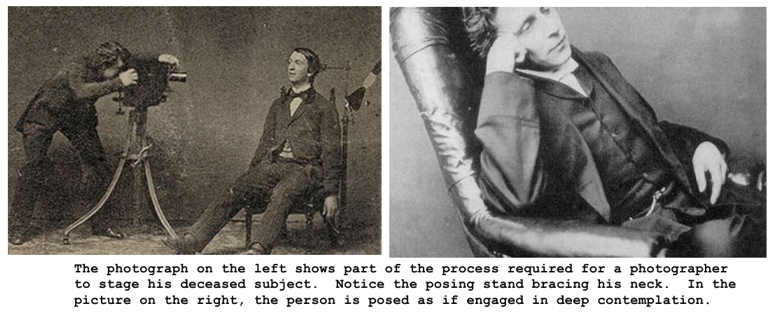
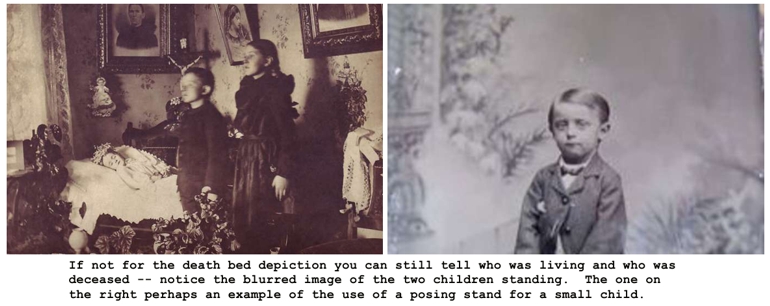
Today it might sound creepy, but post-mortem pictures were not uncommon, especially during the Victorian era. I’m not talking about taking pictures of the dearly departed in their casket – that is practiced even today as a way to have closure when a loved one passes. The term used for the practice is “memento mori”, which in Latin means “remember death.”
If you’ve seen pictures taken in the 1800s that looked at little “odd” or “stiff”, chances are the picture was taken after the person had passed away. We have to remember, too, that photography in the 1800’s was very (very) different than the instant world we live in today.
Before 1839, only people who were well-off enough to afford it had their portraits painted. Following the invention of the daguerreotype in 1839, more people could afford a photograph, although taking the photograph was hardly a “snap” in those days. Because of the longer exposure times required in the early days of photography, subjects would have to remain still for several minutes to ensure a blur-free photograph.
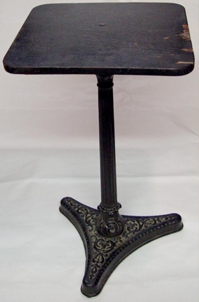 Sitting still might be less of a problem for adults, but imagine requiring a squirmy child to sit still for up to thirty minutes. Photographers in the nineteenth century often employed the use of stands or tables for their subjects to lean against. One device called a “Brady stand” was made of cast iron and height-adjustable.
Another device called a “posing stand” could be employed to provide even more stability to the 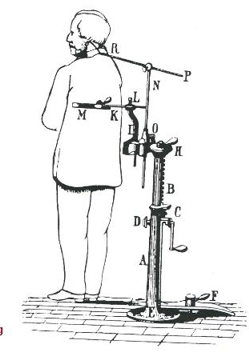 subject (dead or alive) allowing them to stand for extended periods of time. This particular device was also height-adjustable and provided bracing in both the neck and back areas. Just something to think about the next time you look through a bunch of old pictures of your ancestors – and remember NOTHING was as easy and quick as it is today.
Several years ago, I ran across an interesting article at Answers.com and the pictures posted below were part of the article, although I’m uncertain as to where they originated. They are quite interesting, providing insight into the techniques employed by these photographers and instilling an appreciation (even awe) for their skills (and patience!). These types of photographs, of course, are not likely to be taken these days, but I found the history behind them fascinating.


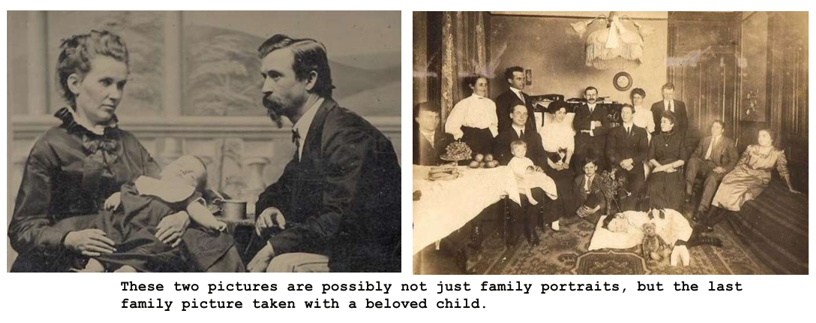
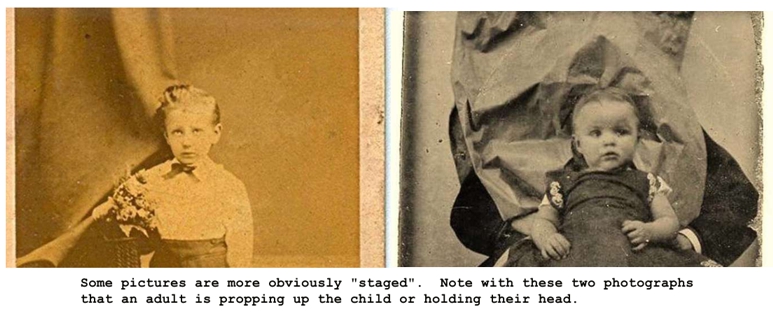
Like me, you may be thinking of taking a closer look at some of those old family pictures!
Thanks for stopping by! Please consider subscribing to Digging History Magazine. The current series features the history of individual states and how to find the best historical and genealogical records. Purchasing a subscription entitles you to subscriber benefits (20% off all services, including custom-designed family history charts) AND a chance to win your very own custom-designed family history chart! Details here (or click the ad below).
Footnotes:
Of Collar and Corset: Saved by His Collar


Last week it was “Killed by His Collar”. Conversely, celluloid collars were known to have saved more than a few fashionable man. Just another example of “It Was a Victorian Thing”.
SAVED BY HIS COLLAR: One of Those Derided Celluloid Affairs Proves a Friend in Need
A celluloid collar was perhaps the means of saving Thomas Randall’s life on Monday night. Randal is a peaceable-looking Canuck who was sitting at a table in George W. Rich’s saloon, No. 114 Main Street, reading a paper early that evening when a laborer on the dock named Daniel McNerney, as the police report, came up and sat down. McNerney had been drinking freely and began cursing at Randall. The latter remonstrated and McNerney drew out a pocket-knife and made a plunge at Randall. The side of the blow caught Randall in the neck, but its force was spent in passing through the celluloid collar.26
SAVED BY HIS COLLAR
How Mary Twopence Shot Her Husband, a Barber, at Orange
Mrs. Mary Twopence of Orange, N.J., is in the County Jail for shooting her husband in the neck, says the New York Advertiser. Mr. Twopence is a barber, and has his shop on Dodd Street. The Twopences are colored. They have frequently quarreled. Mr. Twopence returned home yesterday afternoon at 5 o’clock. He and his wife had their usual quarrel. He threatened to cut her heart out, and she said she would chill his blood.
The family ax was in the yard. It had a razor edge. Mr. Twopence rushed out into the yard, seized the ax, and, the wife says, shouted to her: “You black devil, I’ll cut you deep!”
“You can’t scare me, honey,” screamed his wife, who hurried upstairs and grabbed up a 32-caliber revolver, which they kept in the bed-room. Husband and wife met at the foot of the stairs. Twopence raised his ax. As the gleaming blade was poised aloft Mrs. Twopence pointed the revolver at her husband. He dodged, turning his face away.
The next moment the woman fired. The bullet struck Twopence’s collar, which was very stiff, and, glancing off, imbedded itself in the fleshy part of his neck.
“Don’t shoot any more! I’se got enough!” yelled the barber.
“I’se done you, sho’ ‘nuff, nigger dis time,” said Mrs. Twopence.
Neighbors at this moment rushed in and Mrs. Twopence was arrested. Dr. Chambers took the bullet from Twopence’s neck, and said the collar saved his life.27
What was it about stiff celluloid collars with potential to shield or horrifically act as a type of “heretic’s fork” (a gruesome invention of the Inquisition to torture suspected witches and heretics)?
Celluloid: Functional or Deadly?
In 1862 Englishman Alexander Parkes, a prolific inventor, developed the world’s first plastic material, dubbing it “Parkesine”. As a self-taught expert chemist and metallurgist, Parkes had invented and patented a number of innovative processes and materials. In 1850 Parkes “secured a patent for a self-acting calcining furnace, and also a method of extracting silver from metallic lead by means of zinc, a method known as Parkes’ zinc desilverising process.”28
Thereafter, Parkes directed his ingenuity toward discovering a substitute for “ivory, pearl, amber, indiarubber, guttapercha, &c.” On October 22, 1855 he secured a patent for “using compounds of nitro cellulose with camphor, gums, resin, oils, and solvents.” He called it “Parkesine”.29
In America John Wesley Hyatt obtained Parkes’ patent (later challenged in court unsuccessfully) and U.S. Patent No. 105,338, dated July 12, 1870, was issued to John W. Hyatt, Jr. and Isaiah S. Hyatt (brother). By experimenting with Parkesine Hyatt developed a material, quite by accident, which came to be known as celluloid.
One of Hyatt’s first inventions was a substitute for ivory in billiard balls developed in 1869, a combination of paper flock, shellac and collodion [used in early photographic processing to coat and produce a photographic plate]. An accidentally-overturned bottle of collodion sparked an idea as he observed the substance solidifying. The discovery would come to be both blessing and curse, the difference between life and death, as evidenced by articles cited above.
In 1870 Hyatt established the Albany Dental Plate Company, producing false teeth, piano keys and billiard balls utilizing celluloid, followed by the Celluloid Manufacturing Company in 1872 (moved the following year to Newark, New Jersey). Hyatt had already discovered a number of ways to use celluloid, even as other businesses like the Celluloid Brush Company and the Celluloid Novelty Company were opening their doors around the same time.
One of the first uses for celluloid was false teeth. In 1874 Hyatt, as Secretary of the Celluloid Manufacturing Company, spoke at the New Orleans Dental College to about fifty of the city’s dentists. He demonstrated by molding two sets of teeth, explaining how easily the substance could be manipulated. It was an excellent base for artificial teeth, far superior to rubber and aesthetically pleasing. Hyatt urged “general adoption” of celluloid.30
The use of celluloid in the manufacture of false teeth, billiard balls and piano keys was, of course, related to what the Smithsonian called “the ivory problem”.31 Even though not exactly factual, concerns arose over the possibility of ivory supplies being depleted, at a time when the sport of billiards was rising in popularity. In response an American billiard company, Phelan and Collender, offered a $10,000 reward to anyone who could invent a material to replace ivory.
Parkes’ Parkesine came close, but Hyatt’s development of celluloid was easier to produce on a commercial level. The problem with celluloid, however, was its flammability. Hyatt was well aware of the problem, and not at all surprising, since the main components of celluloid were nitrocellulose, flash paper and gun cotton. How much more dangerous could this substance be?
Not long after the Celluloid Manufacturing Company was founded, fire broke out and destroyed part of the Albany plant. In September 1875 a far more serious incident occurred at the Newark facility.
TERRIBLE EXPLOSION AT NEWARK
A Celluloid Factory Blown Up
Large Loss of Life and Property – Number of the Killed Uncertain – Several Persons Believed to be Buried in the Ruins – One Dead Body Taken Out – Thirteen Persons Badly Wounded – The Accident Caused by Overheating Celluloid.
A fire was discovered about 6 o’clock last evening in the drying room on the second floor of the building of the Celluloid Manufacturing Company in Newark. . . Charles Burrows, the foreman of the drying room, in which the fire broke out, immediately turned on the steam, with the purpose of extinguishing the fire, but he had hardly done so and reached the door, when there was a terrible explosion, caused by the overheating of a quantity of celluloid in process of manufacture.32
The New York Times wondered whether the public should be wary of this new substance which might suddenly explode in someplace other than a manufactory plant?
EXPLOSIVE TEETH
The recent explosion in Newark has made many people aware, for the first time, of the existence of celluloid. That pleasing compound, which presents itself to the ordinary eye in the guise of a white substance somewhat resembling ivory, is said to be composed of gun-cotton, camphor, and a number of other articles which even the most sanguine and visionary elephant would never dream of attempting to convert into ivory. . .
Now that a celluloid factory has blown up, it is a matter of a good deal of interest to persons possessed of celluloid hairbrushes and billiard-balls to know whether those article will explode. The hair-brush is a favorite tool of ladies who desire to drive nails into the wall, and who cannot remember where they last laid away the hammer; but surely a hair-brush which is liable to explode on sharply striking a nail, and to blow the fair hammerer out of the window, is to be regarded with grave suspicion. No man can play billiards with any real satisfaction, if he knows that the billiard-balls may at any moment explode in a series of three closely-connected explosions, thereby spoiling a promising run, and burying the players under the wreck of table and cues. Still worse would be the fate of a possessor of a set of celluloid teeth who should, in a moment of forgetfulness, insert the lighted end of his cigar into his mouth. The scene that would follow would make men and angels weep…
It is only fulfilling a charitable duty to inform the possessors of celluloid teeth and brushes that they are safe from the danger of actual explosion. Nevertheless, it is asserted that celluloid will take fire with the utmost case, and, having taken fire, will burn with great rapidity, giving off meanwhile a highly flammable gas. If you bring your celluloid hair-brush in contact with the gas-light, it will only be necessary to drop it promptly in the water-jug and rush out into the open air. If you set your celluloid teeth on fire, the Fire Department should be instantly summoned, and in the meantime the mouth and nostrils should be hermetically sealed, as are the hatchways of a burning ship – for the double purpose of keeping out the air and keeping in the inflammable gas. If these precautionary measures are kept in mind, it may be quite possible to use celluloid brushes and billiard-balls and teeth without any very great danger. At any rate, it is a comfort to know that celluloid will not explode, and that a man can go to bed with a serene confidence that his teeth will not go off in the middle of the night with a tremendous concussion, and without even giving the knowledge – held by most people to be so thoroughly satisfactory – of what it was that killed him.33
The Times wasn’t alone in its concerns since products made of celluloid continued to be manufactured and sold to public which may or may not have been aware of the potential dangers – “in total ignorance of the fact that they grind with celluloid with they masticate their food, that they punch celluloid with a cue when they rattle festive balls, and that celluloid is [explosive] . . . Cigar smokers and benzine consumers had better take notice because a fire engine is not always handy, and it would be unpleasant, to say the least of it, to have the top of one’s head burned off, or a friend reduced to ashes from the action of an ignited billiard-ball.”34
Advertisements for celluloid teeth appeared in newspapers around the country. “Some demented dentist” was perfecting a “diabolical invention” – false teeth made of celluloid. Claims of billiard balls igniting, breastpins going off, “leaving their wearers on their backs in convulsions”.
Did anyone really want to be on edge wondering whether “his incisors or bicuspids” might explode at a dinner party. It was one thing if a collar or knife handle combusted and quite another if a set of false of teeth exploded:
If they explode it only befalls that one’s ears are blown off or his fingers dispersed about the dining-room, but in the case of an appendage so intimate as a set of teeth a like occurrence would leave the wearer no organs wherewith to curse the inventor.35
A grand announcement was made in 1890 as the Celluloid Manufacturing Company, the Celluloid Brush Company and the Celluloid Novelty Company joined forces with a goal of creating a new “celluloid combination”. Camphor had become prohibitively expensive and it was, of course, highly flammable. The new partnership would focus on manufacturing “a new incombustible plastic material”.36
Unfortunately, it was a problem which was never solved as stories continued to appear in newspapers around the country for several years, even into the early twentieth century:
- In 1886 a three-year old child was holding a celluloid comb when it came into contact with a gas flame, immediately exploding, melting and sending “flaming matter running over the child’s face, shoulders and arms.”37
- A Celluloid Comb Exploded. A young woman in Edinburg, Indiana was severely burned when the celluloid comb she was wearing in her hair exploded after “holding her head too near a fire.”38
- Exploding celluloid spread flames which gutted a five-story building in New York City in 1901. The building housed several businesses, one of them being a “perfumery establishment”. The smell of “ordinary smoke was nothing by comparison to that laden with the sickening smell of musk or even of high-priced colognes.”39
- A “little device utilized by women to hold up their lace collars – a piece of celluloid about two inches long and a quarter of an inch wide, worth 5 cents the half dozen – cost the United States Laundry Company a fire loss of $90,000 and imperiled 200 laundry workers” in Portland, Oregon in 1910. The collar had been tucked away in another garment and hung in the drying room with hundreds of garments. When hung close to heated pipes which lined the room the little piece of celluloid exploded “and instantly the room was aflame.”40
- A Rock Island, Illinois police officer was near death after he used kerosene to start a fire. His clothes caught on fire and then his celluloid collar exploded, severely burning his neck and shoulders.41
- In 1920 a man was willing to let his barber “give him the works” as long as he didn’t have to take off his collar. The barber essayed a single. Whoof! An explosion. The collar was celluloid.”42
Despite these disturbing stories, collars, combs, and even children’s toys, continued to explode and cause harm. In 1924, Mrs. Robert Cartwright of Brooklyn demanded action, asking that all products made of celluloid be prominently labeled as “combustible” in order to protect the public. Another woman had recently received severe burns from “exploding celluloid water wave curlers”.43
By mid-twentieth century celluloid was being replaced by synthetic polymers. Today, celluloid objects are collector’s items which should, of course, be handled with great care. As the Vintage Celluloid Collectibles web site points out:
Proper handling of Celluloid items are very important considering its extreme flammability. Keep Celluloid items in a well ventilated room. Do not store Celluloid in tightly closed containers and keep away from flames. It’s all about celluloid’s flammability.44
While researching this article I came across a few astonishing headlines and stories related to collars and exploding teeth, although not expressly mentioned as being made of celluloid. The imagery alone . . .
False Teeth Explode; Wreck Dental Office
Shenandoah Doctor’s Assistant Faints and Patient Nearly Swallows Rubber Sheet
A set of false teeth had “behaved in a very improper manner” in 1914 in a Shenandoah, Iowa dentist office. Upon placing the false teeth in a vulcanizer to be boiled, the jar exploded, blowing out two window lights into the street, narrowly missing pedestrians. The dental assistant fainted and the patient “nearly swallowed the rubber mouth protector.”45
SAVED BY HIS COLLAR
It’s hard to imagine this man’s life was spared by his collar after being run down by a locomotive. “He fell directly before the front wheels, but a projecting bolt caught his collar and held his head a few inches above the rail while the locomotive dragged him 300 feet. He was half choked and fainted when released by the train crew, but speedily recovered. Aside from a few bruises he is unhurt.”46
MAN BETWEEN 2 RATTLERS IS SAVED BY HIS COLLAR
William Shoupe didn’t normally wear a stiff collar while on the job as an oil field worker near Crystal Falls, Texas in October 1921. On his way to work his “flivver” broke down and he got and under the vehicle to fix the problem. Shoupe had been working away on his back for over thirty minutes when reaching for a pair of pliers he noticed a little peck on his neck. Must to his surprise he turned over and discovered a rattlesnake. He, of course, high-tailed it out from under the car. “An examination showed that the snake had been pinned down and had not been able to reach a vulnerable spot of Shoupe’s body. His venomous darts could not pierce the oil worker’s collar. The snake was killed and was found to have four rattles.”47
Oh the stories I find in newspaper archives! This article was extracted from the fifth issue of 2019 which focused on all things Victorian, a truly unique era.
Thanks for stopping by! Please consider subscribing to Digging History Magazine. The current series features the history of individual states and how to find the best historical and genealogical records. Purchasing a subscription entitles you to subscriber benefits (20% off all services, including custom-designed family history charts) AND a chance to win your very own custom-designed family history chart! Details here (or click the ad below).
Footnotes:
Of Collar and Corset: Killed by His Collar
As noted in the last two articles, you can file this article under something I like to call “It Was a Victorian Thing”. “Saved by Her Corset” and “Killed by Her Corset” focused on deadly and life-saving female fashion. Now let’s take a look at the gents. Read any mid-to-late nineteenth century newspaper and you’re likely to find any number of ways people died, some rather gruesomely. Several years ago I started paying attention to some of them, although I don’t recall exactly how I came across these particular headlines in a number of newspapers across the United States.
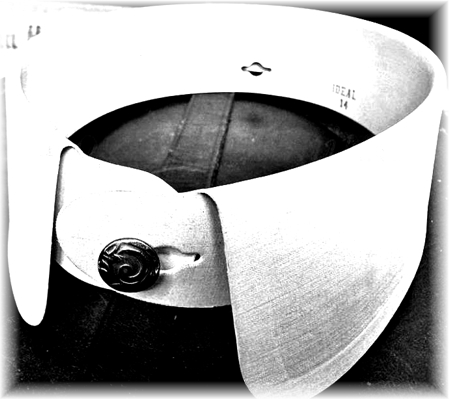 According to the National Museum of American History, a male fashion accessory was introduced in the early 1800s, known as a separable collar. Men utilized the collar in order to look “dressed up”, its stiffness facilitated by pressing and heavy starching. Along with separable cuffs, it was a way for men of modest means to make themselves more presentable when the occasion called for it.
The early collars were generally made of linen and heavily starched to maintain stiffness. However, in the 1870s a new material was introduced, a plastic type of celluloid which had the appearance (and feel) of fine linen. In a way these were labor-saving devices, requiring no washing as this 1878 advertisement suggests.
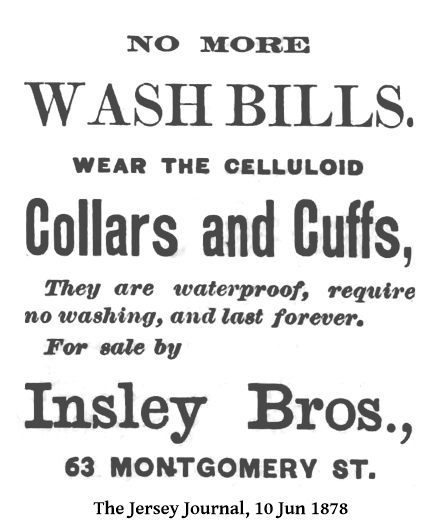
After stumbling across the “killed by her corset” or “saved by her corset” headlines I began noticing similar headlines – “killed by his collar” or “saved by his collar”. Again, what was that all about? Much like corsets, the issue was related to the material used to manufacture fashionable men’s high collars.
Killed by His Celluloid Collar
William Wood, twenty-two years old, of Morristown, N.J., on Saturday night came to his death in a very singular manner. He was employed as a gardener. On Saturday night he was found stupidly drunk on a sidewalk by a policeman and was taken to the station house. Several of his friends secured his release by promising to take him home. Instead they left him in an outhouse. In the morning he was found dead. Examination showed that Wood lay in such a position that his stiff celluloid collar had pressed against his windpipe and strangled him.29
KILLED BY HIS COLLAR
Celluloid Neckband Brings a Carbuncle to a Jersey City Policeman
The almost obsolete celluloid collar question has been revived by the death of Policeman Enoch Perry, in Jersey City. Policeman Perry expired from the effects of a carbuncle on his neck, caused, his relatives say, by a celluloid collar, which he was compelled to wear by order of the police authorities. Sometime ago an order was issued from police headquarters in Jersey City requiring patrolmen to wear white gloves and collars. White cotton gloves were specified and a regulation collar made of celluloid was named as the decoration for the police neck.
There was much objection to the form of collar ordered. Patrolmen who had been comfortable all their lives with their necks encased in the upper works of a flannel shirt revived stories of the explosive qualities of celluloid and spread them. Within three days every policeman wearing a celluloid collar walked his beat in momentary fear that his head would be blown off.
Perry was the loudest objector on the force, but being a policeman of 25 years’ experience, he wore the collar. A few days ago a carbuncle developed on his neck and Perry told his fellow policemen that it had been caused by the irritation of the celluloid collar.48
Man Killed by His Collar
At the inquest into the death of Alexander Alcorn, who was found dead a few days ago sitting in a chair, the coroner’s physician who made the post-mortem examination testified that he had found a ring mark about Alcorn’s neck made by the collar and that the man had accidentally strangled himself to death while sitting asleep.
“The man was in a weak physical condition,” added the physician, “and the pressure of the tight collar on his neck was sufficient to produce strangulation.”49
ALMOST KILLED BY HIS COLLAR
Baseball Player Throws Back His Head and Cuts an Artery in the Neck
A stiff high collar nearly cost Edward Lateril his life yesterday while playing baseball. Running for a high fly, he threw back his head to look for the ball, and the sharp edge of the high collar severed an artery in the neck. He almost died from the loss of blood before he could be taken to the Emergency Hospital and the flow stopped.50
Killed by His Collar
High standing collars are now exclusively in vogue. The laws of health, however, require that the next should be left bare, or nearly so, and unrestrained in its movements. Hence, the collar should be loose and turn-down. More than one case has been recorded in which tight collars have almost caused suffocation, the victims being revived with difficulty. Some two years ago, on the arrival of the train from Nice at Paris, a rich American traveler was found dead in one of the compartments – strangled as the inquest disclosed, by his high collar, whose buttons had left its mark upon his skin. Nor is this at all an unlikely accident, since there is a point in the throat close to “Adam’s apple,” pressure upon which will stop respiration at once, and bring about asphyxia. Moreover, a collar which hardly feels uncomfortable while the wearer is standing may draw much tighter when he sits down, and should be fall asleep in it, may produce congestion, coma, and a fatal termination.51
As evidenced by these examples of “killed by his collar” articles, the dangers of either a tight collar or the sharp points of an overly stiff collar presented a potential and deadly hazard, most notably if one happened to fall asleep while wearing a celluloid collar. As with corsets which “killed”, these collars also “saved”, most notably from death by murder.
Next week, the extraordinary ways these same collars saved lives — plus a tie-in to “explosive teeth”. Stay tuned!
Thanks for stopping by! Please consider subscribing to Digging History Magazine. The current series features the history of individual states and how to find the best historical and genealogical records. Purchasing a subscription entitles you to subscriber benefits (20% off all services, including custom-designed family history charts) AND a chance to win your very own custom-designed family history chart! Details here (or click the ad below).
Footnotes:
Of Collar and Corset: Killed by Her Corset

We can file this short series consisting of excerpts from a couple of articles published several years ago under something I like to call “It Was a Victorian Thing”. Last week the curious nineteenth century headline, “Saved by Her Corset” was analyzed. This week’s headline was seen in newspapers after corset makers switched from whalebone to steel to fashionably shape female Victorian waists.
Killed by Her Corset
While researching “Saved by Her Corset” headlines I began noticing “Killed by Corset” headlines as well, although these deaths weren’t caused by tight-lacing as doomful doctors had hypothesized for decades. Just as there was a reason for “Saved by Her Corset” headlines, there was a reason for “Killed by Corset” headlines.
Many of the “Killed” headlines occurred after corset designers began using steel stays. When the cost of whalebone increased dramatically in 1876, winter corsets would be fitted with steel stays that season, despite the dangers:
Owing to the disaster to the Arctic fleet, whalebone has gone up nearly 50 per cent in value, and only steel corsets will be worn this winter. Steel corsets are more objectionable than whalebone, on the ground of danger from lightning, but as there is a good deal more “give” to them, even when embraced by the left arm, we haven’t much of an opinion of a girl who won’t be willing to risk the lightning.22
Taking a fully steel-corseted stroll during a lightning storm was indeed a deadly hazard. This story was tragic in more ways than one:
On Allum Creek, in the county of Franklin, we are informed that a young lady was struck by lightning, and expired immediately. She had on a steel corset board, which it is supposed drawed [sic] the lightning. Young ladies should be cautious how they make use of steel. She was to have been married in a few weeks. This is an evidence that “in the midst of life we are in death.”23
Steel Corsets
Three young ladies were killed by lightning at Jacobsboro, Ohio, Sunday, while returning home from church. It is thought that their steel corsets was [sic] the cause of their death, as a young lady who was without a steel corset was only stunned. Now what young lady will discard steel corsets on this warning?24
Killed by Her Corset Stays
Mrs. George Lewis and Mrs. Frank Sheets were driving today when their horse ran away. Mrs. Lewis jumped and broker her arm. Mrs. Sheets was thrown from the buggy, her corset broke and the stays were driven into her stomach, killing her.25
Killed by a Corset
A lady bicyclist was killed in Massachusetts yesterday by having a corset steel run into her heart. This all goes to show the folly of trying to be a new woman and at the same time sticking to the foibles and superstitions of the old woman. Cycling is certainly the avocation of the new woman – and, in fact, sometimes seems to be the vocation; while the corset belongs without a doubt to the ante-bloomer woman. An attempt to reconcile these two extremes is bound to prove futile.26
Miss Friend’s Tight Stays Displaced Her Heart and Ended Life
Miss Frankie Friend, aged 27, of Norwalk, died here last night under peculiar circumstances. She got off a car from Cleveland and became faint and weak. She was assisted to the waiting room by two women and later set to a physician’s office. She was dead when placed on a couch.
A post-mortem examination today showed her heart to be entirely out of place on account of her corset, which was ten sizes too small. Tight lacing killed her.27
The corset wasn’t merely an undergarment – it reflected societal and cultural norms and more than a few controversies of the Victorian era. Yet, the ladies still argued mightily for its virtues.
There is no doubt that Fashion makes the world more brilliant – a better place to live in.28
Some argued just as vociferously against corsets, forming “anti-lacing” societies. I’m always amazed at what Victorians, in particular, found to fret, fume, feud and fight over. Someday I’ll have to write about the “butter battle” – oh, what a feud that was!
Thanks for stopping by! Please consider subscribing to Digging History Magazine. The current series features the history of individual states and how to find the best historical and genealogical records. Purchasing a subscription entitles you to subscriber benefits (20% off all services, including custom-designed family history charts) AND a chance to win your very own custom-designed family history chart! Details here (or click the ad below).
Footnotes:
Of Collar and Corset: Saved by Her Corset
Saved by Her Corset
We can file this short series consisting of excerpts from a couple of articles published several years ago under something I like to call “It Was a Victorian Thing”.
Read any mid-to-late nineteenth century newspaper and you’re likely to find any number of ways people died. Several years ago I started paying attention to some of them, although I don’t recall exactly how I came across these particular headlines in a number of newspapers across the United States. The first headlines and stories I noticed weren’t about someone dying in an unusual way, but rather saved from dying. Those headlines would typically read something like “Saved by Her Corset”:
SAVED BY HER CORSET STEEL
The life of Annie Blondi, seventeen years old, of Liberty avenue and Linwood street, Brooklyn, was saved yesterday morning by her corset. Michael Bianco, an Italian forty-four years old, who lives in the same house, fired a pistol shot at the girl and the bullet struck her corset steel and glanced off.52
SAVED BY HER CORSET
A Young Trojan’s Attempt to Kill the Girl He Says He Married
Troy, Nov. 15 – Edward Daly, son of James Daly, of this city, made a desperate attempt to kill Mollie Nealon last night by shooting her. Daly says he married the girl some time ago, but she will not admit it. . . Yesterday he purchased a revolver and went into a saloon, and said he was going to shoot himself. The pistol was taken away form him. This afternoon Daly bought another revolver and last night he met the Nealon girl uptown and started with her for her home. He told he was going to shoot himself, but he wanted to kill her first. He pointed the pistol at her several times, but she said he was “only fooling.” When within a block of Miss Nealon’s home Daly shot at her, and the bullet struck her over the left breast. She ran into the house and fell in a faint. The bullet was found imbedded in Miss Nealon’s corset, and it is believed the corset saved his [sic] life. Daly declares he will kill her and himself.53
Saved by Her Corset
Herman Witke made a desperate attempt to kill Maggie Christman, 18 years of age, at Racine, Wis., The other morning, and a corset was all that saved the girl’s life. . . Witke had been paying her attention and they were engaged to be married. They had a quarrel. . . He caught hold of her and threw her to the ground in the back yard, pulled a revolver and pressed it to her breast and fired three shots, the girl fighting desperately for her life. The explosion of the revolver set her clothing on fire, but she broke away and ran to Main street. It was found that one of the bullets struck a steel of her corset, broke it and cut her flesh at the pit of the stomach, which was the only wound she sustained, and the corset saved her life.54
SAVED BY HER CORSET
Mrs. Stokes Fires Two Shots at Herself, but is too Well Armored
In 1888 a Chicago woman attempted suicide “because she could obtain no relief for her sore eyes.” Her eyes had been troubling for some time, keeping her awake at nights. One morning she was so despondent that she decided to end it all. She loaded a revolver, went to her bedroom and fired a shot at her breast. “The bullet was deflected by one of the steel ribs in her corset. She fired a second shot. The bullet glanced from another corset rib, and inflicted a slight flesh wound in her left breast.”55 Darned corset – oh my sore eyes!
This one was definitely “over-dramatic”:
SHE WAS SAVED BY HER CORSET
Margaret Mather Uses a Real Dagger and Stabs Herself in the Breast
Peterboro, Ontario, Sept. 30. – The presentation of “Romeo and Juliet” in Bradburn’s opera house Saturday night by Miss Margaret Mather and her company very nearly resulted in real tragedy. The dagger which Miss Mather used in the last scene had been stolen at Kingston and she used a sharp dagger belonging to one of the company. In the intensity of her zeal in acting she forgot about the change in the weapons and when she rose in anguish form the prostrate form of the poisoned Romen she plunged the dagger into her breast. The sharp point of the weapon wen through her corset and pierced the flesh a little below the heart. Despite the pain and bleeding she finished the scene amid the plaudits of the audience, who were unaware that any real pain was suffered. She was carried half fainting to the dressing room. Fortunately, the wound, although painful, was not serious, the corset having arrested the force of the blow.56
These are but a few of the “Saved by Her Corset” headlines I collected and wrote about.
Up until the late 1870s, corsets utilized whalebone (most of the stories noted above appear to have occurred while the woman was wearing a steel corset). Whalebone was not bone at all, but “an elastic, horny substance growing in place of teeth in the upper jaw of certain whales.”57 It was cartilage-like, strong yet flexible. Perfect for shaping the waist, “in spite of all the fat that nature can lay on.” When the cost of whalebone increased dramatically in 1876, winter corsets would be fitted with steel stays that season.
That’s around the time when “corset” headlines, unfortunately, shifted to also include “Killed by Her Corset”. Stay tuned next week for Part 2. The full article was published in the May-June 2019 issue of Digging History Magazine.
Thanks for stopping by! Please consider subscribing to Digging History Magazine. The current series features the history of individual states and how to find the best historical and genealogical records. Purchasing a subscription entitles you to subscriber benefits (20% off all services, including custom-designed family history charts) AND a chance to win your very own custom-designed family history chart! Details here (or click the ad below).
Footnotes:
Eleven Days of Hellish Heat

I know, I know …. it’s summer. It’s supposed to be hot, but I’m ready for a break in this heat. This article was originally published in the August 2018 issue of Digging History Magazine (on sale at a reduced price). It was a contrast to several articles also included in this issue related to the 1898 Alaskan Gold Rush.
Today, with widespread availability of air conditioning this weather nightmare which occurred 107 (now 115) years ago might seem a bit far-fetched as everything east of the Rocky Mountains, including areas of Canada, was baking under intense heat in July 1911. In Iowa and Nebraska the oat and corn crops were burning up, with temperatures between 102 and 108.
On the East Coast, as residents prepared to head to the beaches for an extended Fourth of July holiday, things were heating up as well. New York City recorded temperatures between 94 and 100 degrees on July 2. As of early morning July 3 at least ten victims were thought to have died as a direct or indirect result of the heat (9 had drowned) with numbers expected to climb.
The Midwest continued to bake and one location in Ontario, Canada had hit a record 108 degrees. Four hundred thousand had descended on Coney Island the day before, seeking relief from the heat. There was no wind to speak of and the overcrowding probably made it even hotter. Animals suffered as well as policemen were forced to shoot dozens of horses.
The New York Tribune observed how civility abounded despite the searing heat. That was about to change as the heat spell dragged on for several days. Hartford, Connecticut hit an all-time high of 100 degrees on July 3; Beverly, Massachusetts recorded a temperature of 108. Other cities around the country hit the century mark as well. Generally speaking, it was hot from coast to coast, yet the East Coast seemed to suffer the most. The heat reminded one of the fire and brimstone of early Methodism, the Tribune opined.58
Dying from excessive heat and the inability of one’s body to maintain normal fluid levels and such or drowning while out for a swim to cool off were tragic ways to die, but some people literally went insane and committed irrational acts, including suicide, in response to soaring and unrelenting temperatures. One of the ways those supposedly overcome with excessive heat decided to end it was by swallowing carbolic acid.
At the time it appears ingestion of carbolic acid was one of the preferred methods for offing oneself. A search at Newspapers.com for “carbolic acid” during the month of July 1911 will yield well over 1,500 results. Since the turn of the twentieth century it was one of the most commonly used poisons in suicide cases (a similar search for the phrase, plus the word “suicide” in the time period 1900-1920 will yield over 109,000 results).
Carbolic acid, a common household disinfectant at the time, was also being touted as a means to rid one’s home of the pesky housefly – “twenty drops of carbolic acid on a hot shovel. The vapor is deadly to the pest.”59 Here are just a few examples of heat-crazed acts of suicide by carbolic acid (or so it was said):
- In Baltimore, where temperatures hovered near 100 degrees, a heat-crazed man swallowed carbolic acid.60
- Mrs. August Kiehl of Oshkosh, Wisconsin was preparing breakfast and at 5:15 a.m. Committed suicide by drinking carbolic acid in the basement of her home. “No particular reason can be assigned for the act, except that the excessive heat unbalanced her mind, the temperature going considerably above 100 degrees.”61
- “William A. Rausch [of Chicago], told his wife he could not endure the heat; went into basement and swallowed carbolic acid.”62
Swallowing poison was by no means the only insanity-driven method used to escape heat prostration. And, to be fair, not all of the suicides during the time period in question may have actually been heat-driven. However, when normal, well-adjusted people suddenly decided to end it all, soaring and sustained heat was blamed.
Across the country record temperatures were being recorded, but the eastern seaboard seems to have suffered the most and, in particular, Hartford, Connecticut.
Hartford, Connecticut
The alarming heat, and the public’s response, moved officials in Hartford to open fire hydrants and allow residents to ride ferries and trolleys for free – anything to generate a personal breeze or some means to find relief. Some would ride the merry-go-round for the same reason.
Parks were filled with people seeking heat relief, even choosing to sleep (what little sleep could be had) there at night. Mothers walked the streets at night trying to comfort their crying babies, all the while afraid to lay them down for fear they wouldn’t wake up.
Desperate to get above the heat, some would climb up fire escapes, head to the hills or ascend to the rooftops in hopes of finding relief. In Hartford, John Merlo, an Italian railroad worker, climbed to the roof of his tenement building to sleep. Amazingly, one newspaper account noted the building had a tin roof (which hardly seems to be a good idea in a heat wave!) and Merlo had taken nightly refuge there since the heat wave began. That alone seems a bit “insane”!
Around midnight one night he was sleeping and apparently rolled over the shallow gutter and fell to his death. Merlo fell four stories, striking his head directly on the concrete below and was instantly killed, apparently unaware of falling.
One of the most shocking incidents of death by insanity occurred near the end of the heat wave. Thousands had been adversely affected and more than a few said to have been driven mad. However, when Hartford resident Lyman Dudley Smith suddenly snapped on the morning of July 10 it caused quite a stir.
Smith, a highly respected school teacher and author of the Smith System of Penmanship, was vacationing at his brother’s summer cottage in Maine, no doubt trying to escape the heat – to no avail. Maine, as well as parts of Canada, were breaking heat records as well. Although he had been suffering from an attack of grippe, his actions were attributed to the heat. Smith committed suicide by slitting his own throat with a penknife.
The heat took a toll on infrastructure as well. Asphalt streets oozed and “pitched boiled out of wood block pavements.”63 The heat was also literally bending railroad and trolley tracks, causing derailments. On the other side of the country, a deadly incident was reported in Oregon when a “sun kink” caused rails to spread under the hot sun.64 “Spreading rails” caused an accident in St. Louis.65
As one might imagine, ice was in great demand and headlines announcing “ice famines” were common during that 11-day stretch, especially in Indiana. The ice shortage was compounded in New Castle, Indiana by a number of typhoid fever cases. In Muncie, Indiana ice was sold only in 5-cent quantities and soda shops were closed. Only those homes with children could expect to purchase up to 25-pound quantities.
Demand for ice attributed to a horrific accident in Boston when two children were attempting to get some ice chips off an ice cart. A four-year-old boy was standing on the wheel when the horses started. He was “ground to death” under the wheel while a five-year old girl was crushed by a falling block of ice.66 Ice plants were running at full capacity in Kansas City, yet an ice shortage still loomed.
The Fourth of July held promise of even more heat and the annual celebration’s own brand of insanity. Still, one newspaper reported on July 5 that the Fourth had actually been “sane” in comparison to previous record-setting years. President Taft had admonished citizens to “refrain from dangerous celebration” and apparently it had an effect. In 1910 131 deaths had occurred around the country as the result of “over-celebrating” with fireworks, canons and other explosive devices. In 1911 only 24 deaths had been reported – 12 by fireworks; 7 by firearms; 2 by gunpowder and 3 by toy pistol.67
One incident of attempted murder was blamed on heat craziness when bookbinder George Besal attacked his mother with shears and threatened his cousin. It took four men to get him loaded into an ambulance, and while en route to the hospital he managed to break out of the straitjacket he’d been fitted with. Although Besal had attacked his mother the month before, this attack was blamed on the heat.
The heat disrupted everyday life during the heat wave as services such as coal and mail delivery were suspended. Early 1900s fashion still meant men wore suit jackets (shed those) and women long skirts and corsets. Some women switched to a decidedly breezy undergarment called a summer undermuslin instead.
On the evening of July 6 a violent, but heat-relieving, storm pounded parts of Connecticut. One tenement house in Litchfield County was struck, severely injuring two women hit by a bolt of lightning. While the storm brought rain and a measure of relief and an all-too-brief respite, two days later heat was again the topic of conversation.
Unique, even strange, headlines continued to appear in newspapers around the country, but especially in New England. On the morning of July 10, the Norwich Bulletin reported:
FIFTY MADE INSANE BY HOT WAVE
A retired drug merchant was one of the victims and physicians claimed the cause was “paralysis of the brain, caused by heat”68 Reports of heat-crazed suicide were still being reported, BUT one column over was a hopeful bit of news:
COOLER WEATHER IS DUE THIS WEEK
Kansas and Oklahoma had just received much-needed rain and it was heading east. Indeed, rain and cooler weather did eventually come.
Boston too had been overwhelmed with the heat wave. Boston Commons was dubbed the largest boarding house in New England – as many as five thousand men, women and children slept there nightly.
By July 11, Boston was looking forward to the promise of rain and cooler temperatures. In fact, it was the only answer to a situation which had become a crisis. The state’s bathhouses had been overwhelmed with thousands of bathers and thousands more were still waiting in line.
Demand far exceeded the number of available bathhouses and citizens were up-in-arms. On the evening of July 12 Hartford residents heard distant thunder, although nothing happened. Some time later, however, lightning began to flash and rain poured for over an hour.
Then, something happened that hadn’t occurred in several days – a refreshing breeze followed the storm. The New England heat wave was over!
What a relief, but what had caused the aberrant weather patterns? It wasn’t that New England didn’t experience hot weather in the summer, but normally cool ocean breezes made it tolerable. According to the New England Historical Society, “hot, dry air from the southern plains flowed into Canada and then swept south and toward the [east] coast.”69
While newspapers made much of the 1911 heat wave (as well they should have), in terms of deaths from the heat it was reminiscent of another New England heat wave which had occurred fifteen years earlier in 1896. That stretch of heat (with up to 90 percent humidity) lasted almost two weeks. More than 1,500 people died from heat-related illnesses – and suicide. Headlines like this one appeared:
Scores of Persons Stricken Down by the Heat
Insanity Drives to Suicide and Murder
In St. Louis one man who was said to have become demented from the heat jumped off a roof. A domestic servant ran screaming down a levee, jumped in the river and drowned, obviously demented from the heat it was reported. In Baltimore Richard Lyons, a car builder, “driven insane by the heat . . . beat out with a hammer the brains of Jennie Shipley.”70
Much like the 1911 event, the morning of August 13 brought a little breeze and by the following morning rain had fallen in some places, the heat wave ended. As many as 1500 had died in New York City alone. In a strange twist of fate – weather and politics – police commissioner Theodore Roosevelt made a name for himself by passing out free ice to the city’s poor, no doubt ingratiating himself to the New York’s teeming masses.
The 1911 heat wave wasn’t the first, nor would it be the last to make headlines. The introduction of air conditioning would, or course, eventually make “heat-crazed insanity” characteristic of the 1896 and 1911 heat waves less common, but can you imagine what it would be like today if we, like our ancestors, had to live under those conditions. Would we go crazy too?
 Thanks for stopping by! Please consider subscribing to Digging History Magazine. The current series features the history of individual states and how to find the best historical and genealogical records. Purchasing a subscription entitles you to subscriber benefits (20% off all services, including custom-designed family history charts) AND a chance to win your very own custom-designed family history chart! Details here (or click the ad below).
Footnotes:
Documenting Family History: July Was a Busy Month
July was a busy month. After wrapping up the latest issue of Digging History Magazine, featuring the Prairie State of Illinois, I tackled a number of client projects — genealogical research, writing family stories and designing family history charts. Here are some examples.
Family Stories: The Fine Print
I’ve recently developed a new service to accompany the custom-designed family history charts. I call it “The Fine Print” which tells the stories represented on these custom-designed charts (no two are alike!). A name, date or newspaper clipping only tells part of the story. This project is still ongoing, but here are a few page samples:
Custom-Designed Family History Charts
The latest custom-designed family history charts were part of a unique project, one which included documentation of birth parents as well as adoptive parents. It was truly an honor to help document this family’s amazing history — from missionaries to numerous American patriots (including close relatives of the father of our country, George Washington) to a Salem witch. By the way, these charts were designed for subscribers to Digging History Magazine making them eligible for a significant discount (20% off all services, including charts).
For more information about my services, including custom-designed family history charts (and the stories behind them): https://digging-history.com/services/
Thanks for stopping by! Please consider subscribing to Digging History Magazine. The current series features the history of individual states and how to find the best historical and genealogical records. Purchasing a subscription entitles you to subscriber benefits (20% off all services, including custom-designed family history charts) AND a chance to win your very own custom-designed family history chart! Details here (or click the ad below).