
History is filled with stories of “feisty females”. Many lived their lives skirting societal norms to carve out their own piece of history. It seems so much more has been written about the brave men who served during the Revolutionary War, yet women served in various (and important) capacities as well, even on the battlefield. One of the more interesting characters, however, was thought to have assisted in the years leading up to the war by passing information to Benjamin Franklin in a purportedly unique way.
Patience Wright
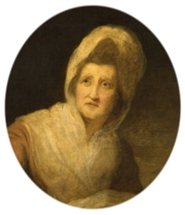 Patience Wright (née Lovell) was born in 1725 in Oyster Bay (Long Island), New York. Her parents were Quakers who moved to Bordentown, New Jersey when Patience was four years old. Her parents insisted that she and her sisters dress in white, symbolic of their purity, and the family followed a strict vegetarian diet.
Patience, spirited and headstrong, managed to escape her home and head to Philadelphia where in 1748 she married an older man, Joseph Wright, a barrel maker. The age difference came to be an issue as she would later remark to a friend “that [he had] nothing but Age and Money to recommend himself to her favour.”1
When Joseph died in 1769, she found herself in need of income. At a young age, Patience and her sister Rachel sculpted small figures out of bread dough to amuse themselves. She, along with her sister Rachel, also a widow, began to produce wax sculptures to sell. They soon became well known for their amazing life-like sculptures.
Patience had a unique method of “birthing” her art pieces. This method would become as well known as the sculptures themselves. Wax must be kept warm in order to be pliable. She would work the wax in her lap and under her skirts, and then reveal fully formed heads and torsos as if they were being birthed. She then gave special attention to minute details of her sculptures, adding lip and cheek colors and eyelashes.
The two sisters opened two businesses, one in Philadelphia and one in New York, in 1770. Their shop in New York was located on Queen Street, but in 1771 the entire block was destroyed by fire, leaving Patience financially devastated.
Patience met Jane Franklin Mecom, Benjamin Franklin’s youngest sister, and through Jane she was able to obtain an introduction from Franklin to London high society. After her move to London, his letter opened doors of opportunity and her work was soon in demand. To the lords and ladies of England she was thought to be eccentric, most notably because she wore wooden shoes and kissed both male and female on the cheek, regardless of their class. Some were accepting of her eccentricities while others expressed disdain.
Wright’s informal manner was something of a shock to the courtly set, and yet not entirely unwelcome. Her base language and friendly liberties, coupled with her work in a medium distinct from any art yet seen, made Wright something of a novelty – wholly American. Rough-hewn but strong, coarse but honest, she was the New World made flesh.2
Not everyone was enthralled with her, however. Abigail Adams remarked to her sister after meeting Patience at a London party: “Her person and countenance resemble an old maiden in your Neighbourhood Nelly Penniman, except that one is neat, the other the Queen of sluts.”3
In 1775 The London Magazine called her a “Promethean modeler” and described her work:
In her very infancy she discovered a striking genius, and began with making faces with new bread and putty, to such excellence that she was advised to try her skill in wax. . . Her natural abilities are surpassing, and had a liberal and extension education been added to her innate qualities, she had been a prodigy.4
Patience cheekily referred to King George III and his wife as “George” and “Charlotte” and they were devoted patrons, at least until she became more outspoken in her criticism of his handling of colonial matters. Even though she lived and worked in London, she was still very much an American patriot.
She corresponded with Benjamin Franklin and is said to have relayed information she overheard in her sculpting sessions regarding members of Parliament and their views on possible war with the colonies (verbatim as written originally):
to say the parlement will not meett untill more explicit acount comes from Ld. How, by a vesel sent for that purpose to bring Inteligens &c. This deception has gave meney of the wise English membrs to go on ther pleasures some one way some to ther Contry seats, that by thir means only about 50 membrs will attend at the cokpitt nor be ready at the House to apose the renewil of the aCursed act that keeps poor Platt confind in Newgate with others of our Contry men.5
After Patience’s death, Rachel would claim her sister passed letters to America in wax heads and busts: “how did she make her Cuntry [sic] her whole attention, her Letters gave us ye first alarm…she sent Letters in buttons & pictures heads to me, ye first in Congress attended Constantly to me for them in that perilous hour.”6
Her work as a “spy” was later impacted when the war began and she fell out of favor with her loyal patrons because of her strident patriotic sentiments. She wrote many letters to Franklin while he was in Paris, but apparently she had fallen out of favor with him as well (or had at least wearied him):
This is the 5th lettr I have wrot to Dr. Frankling and meny other to mr. Scayrs [Sayre], Bankcroft &c. none of which I have Recd. any answr. Mrs. Wright most respectful Complnts to dr. Frankling and hopes he is well, and most humbly begs some direction how to proced.7
She even suggested at one point that Franklin encourage a rebellion in England as well. She never received a response. In 1780 she moved to Paris, seeking to open a wax works there. Her attempts at establishing a patronage were largely rebuffed, for after all France at the time was on the brink of its own revolution. The French were also not as enthralled with Patience Wright and her unique talents as were her English patrons. She returned to London in 1782.
In an apparent attempt to “drum up some business” she wrote letters to both George Washington and Thomas Jefferson:
I most sincerely wish not only to make the likeness of Washington, but of those five gentlemen, who assisted at the signing the treaty of peace, that put an end to so bloody and dreadful a war. The more public the honours bestowed on such men by their country, the better. To shame the English king, I would go to any trouble and expense to add my mite in the stock of honour due to Adams, Jefferson, and others, to send to America.8
 She never received a response from either man. A Smithsonian web site article entitled “The Madame Tussaud of the American Colonies Was a Founding Fathers Stalker”, tongue-in-cheek implies Patience was a stalker.
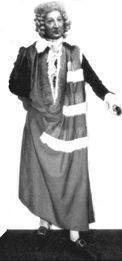
Patience Wright died in London in 1785 at the age of sixty. According to the Smithsonian article, Rachel wrote to Benjamin Franklin asking for funds to bury her sister, but no record exists of a response. Patience was buried somewhere in London and much of her unique work forgotten by history. Wax is not a particularly enduring substance, although some like those sculpted by Madame Tussaud have been preserved. Patience Wright’s only remaining wax figure is of William Pitt, a.k.a. Lord Chatham, on display in Westminster Abbey.
P.S. Here are two more articles featuring other “feisty females” of the American Revolutionary War: Mercy Otis Warren and Nancy Morgan Hart.
 Thanks for stopping by! For more stories like this one, consider subscribing to Digging History Magazine. Purchasing a subscription entitles you to subscriber benefits (20% off all services, including custom-designed family history charts) AND a chance to win your very own custom-designed family history chart! Details here (or click the ad below).

Footnotes:
- Angela Serratore, “The Madame Tussaud of the American Colonies Was a Founding Fathers Stalker”, Smithsonian Magazine, accessed on June 27, 2018 at https://www.smithsonianmag.com/history/the-madame-tussaud-of-the-american-colonies-was-a-founding-fathers-stalker-180948610/
- Ibid.
- Ibid.
- The London Magazine, Volume 44, “A Sketch of the Character of Mrs. Wright”, 556 (accessed June 27, 2018 at https://books.google.com/).
- Serratore, “Madame Tussaud.
- Ibid.
- Ibid.
- Ibid.