


I know, I know …. it’s summer. It’s supposed to be hot, but I’m ready for a break in this heat. This article was originally published in the August 2018 issue of Digging History Magazine (on sale at a reduced price). It was a contrast to several articles also included in this issue related to the 1898 Alaskan Gold Rush.
Today, with widespread availability of air conditioning this weather nightmare which occurred 107 (now 115) years ago might seem a bit far-fetched as everything east of the Rocky Mountains, including areas of Canada, was baking under intense heat in July 1911. In Iowa and Nebraska the oat and corn crops were burning up, with temperatures between 102 and 108.
On the East Coast, as residents prepared to head to the beaches for an extended Fourth of July holiday, things were heating up as well. New York City recorded temperatures between 94 and 100 degrees on July 2. As of early morning July 3 at least ten victims were thought to have died as a direct or indirect result of the heat (9 had drowned) with numbers expected to climb.
The Midwest continued to bake and one location in Ontario, Canada had hit a record 108 degrees. Four hundred thousand had descended on Coney Island the day before, seeking relief from the heat. There was no wind to speak of and the overcrowding probably made it even hotter. Animals suffered as well as policemen were forced to shoot dozens of horses.
The New York Tribune observed how civility abounded despite the searing heat. That was about to change as the heat spell dragged on for several days. Hartford, Connecticut hit an all-time high of 100 degrees on July 3; Beverly, Massachusetts recorded a temperature of 108. Other cities around the country hit the century mark as well. Generally speaking, it was hot from coast to coast, yet the East Coast seemed to suffer the most. The heat reminded one of the fire and brimstone of early Methodism, the Tribune opined.1
Dying from excessive heat and the inability of one’s body to maintain normal fluid levels and such or drowning while out for a swim to cool off were tragic ways to die, but some people literally went insane and committed irrational acts, including suicide, in response to soaring and unrelenting temperatures. One of the ways those supposedly overcome with excessive heat decided to end it was by swallowing carbolic acid.
At the time it appears ingestion of carbolic acid was one of the preferred methods for offing oneself. A search at Newspapers.com for “carbolic acid” during the month of July 1911 will yield well over 1,500 results. Since the turn of the twentieth century it was one of the most commonly used poisons in suicide cases (a similar search for the phrase, plus the word “suicide” in the time period 1900-1920 will yield over 109,000 results).
Carbolic acid, a common household disinfectant at the time, was also being touted as a means to rid one’s home of the pesky housefly – “twenty drops of carbolic acid on a hot shovel. The vapor is deadly to the pest.”2 Here are just a few examples of heat-crazed acts of suicide by carbolic acid (or so it was said):
- In Baltimore, where temperatures hovered near 100 degrees, a heat-crazed man swallowed carbolic acid.3
- Mrs. August Kiehl of Oshkosh, Wisconsin was preparing breakfast and at 5:15 a.m. Committed suicide by drinking carbolic acid in the basement of her home. “No particular reason can be assigned for the act, except that the excessive heat unbalanced her mind, the temperature going considerably above 100 degrees.”4
- “William A. Rausch [of Chicago], told his wife he could not endure the heat; went into basement and swallowed carbolic acid.”5
Swallowing poison was by no means the only insanity-driven method used to escape heat prostration. And, to be fair, not all of the suicides during the time period in question may have actually been heat-driven. However, when normal, well-adjusted people suddenly decided to end it all, soaring and sustained heat was blamed.
Across the country record temperatures were being recorded, but the eastern seaboard seems to have suffered the most and, in particular, Hartford, Connecticut.
Hartford, Connecticut
The alarming heat, and the public’s response, moved officials in Hartford to open fire hydrants and allow residents to ride ferries and trolleys for free – anything to generate a personal breeze or some means to find relief. Some would ride the merry-go-round for the same reason.
Parks were filled with people seeking heat relief, even choosing to sleep (what little sleep could be had) there at night. Mothers walked the streets at night trying to comfort their crying babies, all the while afraid to lay them down for fear they wouldn’t wake up.
Desperate to get above the heat, some would climb up fire escapes, head to the hills or ascend to the rooftops in hopes of finding relief. In Hartford, John Merlo, an Italian railroad worker, climbed to the roof of his tenement building to sleep. Amazingly, one newspaper account noted the building had a tin roof (which hardly seems to be a good idea in a heat wave!) and Merlo had taken nightly refuge there since the heat wave began. That alone seems a bit “insane”!
Around midnight one night he was sleeping and apparently rolled over the shallow gutter and fell to his death. Merlo fell four stories, striking his head directly on the concrete below and was instantly killed, apparently unaware of falling.
One of the most shocking incidents of death by insanity occurred near the end of the heat wave. Thousands had been adversely affected and more than a few said to have been driven mad. However, when Hartford resident Lyman Dudley Smith suddenly snapped on the morning of July 10 it caused quite a stir.
Smith, a highly respected school teacher and author of the Smith System of Penmanship, was vacationing at his brother’s summer cottage in Maine, no doubt trying to escape the heat – to no avail. Maine, as well as parts of Canada, were breaking heat records as well. Although he had been suffering from an attack of grippe, his actions were attributed to the heat. Smith committed suicide by slitting his own throat with a penknife.
The heat took a toll on infrastructure as well. Asphalt streets oozed and “pitched boiled out of wood block pavements.”6 The heat was also literally bending railroad and trolley tracks, causing derailments. On the other side of the country, a deadly incident was reported in Oregon when a “sun kink” caused rails to spread under the hot sun.7 “Spreading rails” caused an accident in St. Louis.8
As one might imagine, ice was in great demand and headlines announcing “ice famines” were common during that 11-day stretch, especially in Indiana. The ice shortage was compounded in New Castle, Indiana by a number of typhoid fever cases. In Muncie, Indiana ice was sold only in 5-cent quantities and soda shops were closed. Only those homes with children could expect to purchase up to 25-pound quantities.
Demand for ice attributed to a horrific accident in Boston when two children were attempting to get some ice chips off an ice cart. A four-year-old boy was standing on the wheel when the horses started. He was “ground to death” under the wheel while a five-year old girl was crushed by a falling block of ice.9 Ice plants were running at full capacity in Kansas City, yet an ice shortage still loomed.
The Fourth of July held promise of even more heat and the annual celebration’s own brand of insanity. Still, one newspaper reported on July 5 that the Fourth had actually been “sane” in comparison to previous record-setting years. President Taft had admonished citizens to “refrain from dangerous celebration” and apparently it had an effect. In 1910 131 deaths had occurred around the country as the result of “over-celebrating” with fireworks, canons and other explosive devices. In 1911 only 24 deaths had been reported – 12 by fireworks; 7 by firearms; 2 by gunpowder and 3 by toy pistol.10
One incident of attempted murder was blamed on heat craziness when bookbinder George Besal attacked his mother with shears and threatened his cousin. It took four men to get him loaded into an ambulance, and while en route to the hospital he managed to break out of the straitjacket he’d been fitted with. Although Besal had attacked his mother the month before, this attack was blamed on the heat.
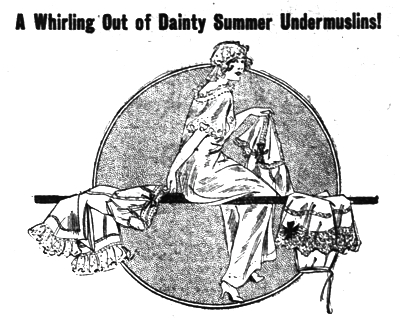
The heat disrupted everyday life during the heat wave as services such as coal and mail delivery were suspended. Early 1900s fashion still meant men wore suit jackets (shed those) and women long skirts and corsets. Some women switched to a decidedly breezy undergarment called a summer undermuslin instead.
On the evening of July 6 a violent, but heat-relieving, storm pounded parts of Connecticut. One tenement house in Litchfield County was struck, severely injuring two women hit by a bolt of lightning. While the storm brought rain and a measure of relief and an all-too-brief respite, two days later heat was again the topic of conversation.
Unique, even strange, headlines continued to appear in newspapers around the country, but especially in New England. On the morning of July 10, the Norwich Bulletin reported:
FIFTY MADE INSANE BY HOT WAVE
A retired drug merchant was one of the victims and physicians claimed the cause was “paralysis of the brain, caused by heat”11 Reports of heat-crazed suicide were still being reported, BUT one column over was a hopeful bit of news:
COOLER WEATHER IS DUE THIS WEEK
Kansas and Oklahoma had just received much-needed rain and it was heading east. Indeed, rain and cooler weather did eventually come.
Boston too had been overwhelmed with the heat wave. Boston Commons was dubbed the largest boarding house in New England – as many as five thousand men, women and children slept there nightly.
By July 11, Boston was looking forward to the promise of rain and cooler temperatures. In fact, it was the only answer to a situation which had become a crisis. The state’s bathhouses had been overwhelmed with thousands of bathers and thousands more were still waiting in line.
Demand far exceeded the number of available bathhouses and citizens were up-in-arms. On the evening of July 12 Hartford residents heard distant thunder, although nothing happened. Some time later, however, lightning began to flash and rain poured for over an hour.
Then, something happened that hadn’t occurred in several days – a refreshing breeze followed the storm. The New England heat wave was over!
What a relief, but what had caused the aberrant weather patterns? It wasn’t that New England didn’t experience hot weather in the summer, but normally cool ocean breezes made it tolerable. According to the New England Historical Society, “hot, dry air from the southern plains flowed into Canada and then swept south and toward the [east] coast.”12
While newspapers made much of the 1911 heat wave (as well they should have), in terms of deaths from the heat it was reminiscent of another New England heat wave which had occurred fifteen years earlier in 1896. That stretch of heat (with up to 90 percent humidity) lasted almost two weeks. More than 1,500 people died from heat-related illnesses – and suicide. Headlines like this one appeared:
Scores of Persons Stricken Down by the Heat
Insanity Drives to Suicide and Murder
In St. Louis one man who was said to have become demented from the heat jumped off a roof. A domestic servant ran screaming down a levee, jumped in the river and drowned, obviously demented from the heat it was reported. In Baltimore Richard Lyons, a car builder, “driven insane by the heat . . . beat out with a hammer the brains of Jennie Shipley.”13
Much like the 1911 event, the morning of August 13 brought a little breeze and by the following morning rain had fallen in some places, the heat wave ended. As many as 1500 had died in New York City alone. In a strange twist of fate – weather and politics – police commissioner Theodore Roosevelt made a name for himself by passing out free ice to the city’s poor, no doubt ingratiating himself to the New York’s teeming masses.
The 1911 heat wave wasn’t the first, nor would it be the last to make headlines. The introduction of air conditioning would, or course, eventually make “heat-crazed insanity” characteristic of the 1896 and 1911 heat waves less common, but can you imagine what it would be like today if we, like our ancestors, had to live under those conditions. Would we go crazy too?
 Thanks for stopping by! Please consider subscribing to Digging History Magazine. The current series features the history of individual states and how to find the best historical and genealogical records. Purchasing a subscription entitles you to subscriber benefits (20% off all services, including custom-designed family history charts) AND a chance to win your very own custom-designed family history chart! Details here (or click the ad below).

Footnotes:
- New York Tribune, July 4, 1911, accessed at www.newspapers.com on July 24, 2026, 1.
- News-Journal (Mansfield, Ohio), July 1, 1911, accessed at www.newspapers.com on July 24, 2026, 14.
- The Greenville News (North Carolina), July 7, 1911, accessed at www.newspapers.com on July 24, 2026, 1.
- Green Bay Press-Gazette, July 3, 1911, accessed at www.newspapers.com on July 24, 2026, 2.
- The Los Angeles Times, July 2, 1911, accessed at www.newspapers.com on July 24, 2026, 1.
- Hartford Courant, July 7, 1911, accessed at www.newspapers.com on July 28, 2026, 11.
- Arkansas City Daily Traveler, July 12, 1911, accessed at www.newspapers.com on July 28, 2026, 8.
- Quad-City Times (Davenport, Iowa), July 10, 1911, accessed at www.newspapers.com on July 28, 2026, 1.
- The Bristol Daily Courier (Pennsylvania), July 5, 1911, accessed at www.newspapers.com on July 28, 2026, 2.
- The Seattle Star, July 5, 1911, accessed at www.newspapers.com on July 28, 2026, 1.
- New England Historical Society, “1911 Heat Wave”, accessed on July 28, 2026 at http://www.newenglandhistoricalsociety.com/the-1911-heat-wave-was-so-deadly-it-drove-people-insane/.
- Norwich Bulletin, July 10, 1911, accessed at www.newspapers.com on July 28, 2026, 1.
- The Boston Globe, August 10, 1896, accessed at www.newspapers.com on July 28, 2026, 1.