


I ran across this particular “way to go in days of old” while researching a Surname Saturday blog article several years ago about the Pimple surname (after seeing the name in a list of Revolutionary War veterans). As I researched the unusual surname, I came across several references to “death by pimple” – and, of course, I was intrigued. As is usually the case, these are the best kinds of stories to feature, giving us a sense of how our ancestors dealt with diseases, infections, pestilence and more in a time when medicine and technology we depend on today was non-existent.
You might be surprised to learn that pimples, or “zits” as we now colloquially refer to them, are an age-old problem, one which today we often attribute to poor diet choices. However, the history of unsightly facial eruptions stretches further back than one might imagine, a potentially deadly malady well into the twentieth century. That’s not to say doctors weren’t aware of its serious nature. They just didn’t have the means to effectively treat infections, many of which stemmed from “home remedies” to alleviate the “pox of pimples.”
I am always curious to determine when something was first referenced in newspapers, or at least those available in online newspaper archives. One of the earliest instances of “pimple” I found was cosmetic:
There is newly Prepared a most rich and excellent Beautifying Water, call’d The PEARL COSMETICK, being very Safe, and of admirable Virtue, for taking away Heats, Redness, Pimples, Freckles, &c. Clearing and making the Skin Fair, tho of the brownest Complexion; and excellently freeing it from all manner of Defilements.1
The first instance found in a search of “pimple” at Newspapers.com yielded an article about a suspect in the disappearance of a surgeon who “hath been set upon by some ill people.”
Whereas On Monday last at eight of the clock in the morning, Mr. David Rose, Chirurgeon and Man-midwife, went out of his house in Gun-yard, in Houndsditch without Aldgate, London, and was not heard of since, and having some Million Lottery Tickets about him, together with a Silver Watch made by Lowndes(?), an old Rose Diamond Ring, one Diamond being out, a Gold Seal Ring with T.H.O. engraved on it, within the figure of a Rose, besides several Silver Instruments, and other things of value; there is sufficient reason to suspect that he hath been set upon by some ill people. He is a short square man, with an oval Face, red and full of pimples, and is about 60 years of age, and wears a dark bob Perriwig. Therefore whoever brings news of him to his House aforesaid, or to his Brother, Philip Rose, Dr. Of Physick, living in Brewers Street near Golden-Square, so that he may be see alive or dead, shall certainly be rewarded. . .2
Clearly, one of this man’s most distinct physical characteristics was his “oval Face, red and full of pimples”. Early on, it appears to have been used as a means to identify someone – pimples were a distinct feature. A much earlier reference is notable in William Shakespeare’s play, Henry V, published around 1599, occurring in Act III, Scene 6:
Original: His face is all bubukles and whelks and knobs and flames o’ fire; and his lips blows at his nose, and it is like a coal of fire, sometimes plue and sometimes red, but his nose is executed, and his fire’s out.
Modern Translation: His face is all pustules and pockmarks, and pimples and inflammation, and his lips blow up toward his nose, which is like a red-hot coal, sometimes blue, sometimes red. But his nose is dead, and the fire’s put out.3
These facial eruptions were unsightly, prompting English women, as early as the mid-1660s, to attempt concealment:
Our Ladies here have lately entertained a vaine Custome of spotting their Faces, out of an affectation of a Mole to setoff their beauty, such as Venus had, and it is well if one black patch will serve to make their Faces remarkable; for some fill their Visages full of them, varied into all manner of shapes and figures.4
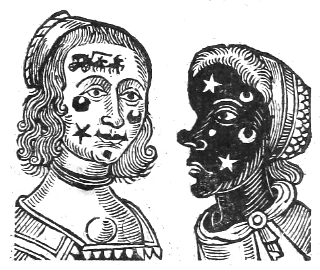
The opinion expressed in John Bulwer’s 1653 work, The Artificial Changeling, was not at all complimentary:
This is as odious, and as senseless an affectation as ever was used by any barbarous Nation in the World; And I doubt our Ladies that use them are not well advised of the effect they work; for these spots in Faire Faces advantage not beauty as they suppose . . . This Palliative Artifice which introduceth an acquisite complexion to deceive the Spectatours Eye for a moment is altogether to be rejected by women, especially Christians.5
. . . . .
Suffice it to say, there were numerous, and often questionable “cures” for pimples, including the popular so-called “patent medicines” (essentially nothing but quackery) which became popular in the late 1800s and early 1900s. These were touted as “miracle cures” for any number of maladies and hawked in newspapers around the country. These so-called “patent medicines” were unregulated and, frankly, downright dangerous in many cases.
These so-called “patent medicines” often claimed some “secret” ingredient, but in fact the product’s owner could change the formula on a whim, keep the product name, and the unsuspecting public would never know the difference. Conversely, a true patent medicine would, by United States patent law, be required to disclose all ingredients. Furthermore, the product becomes public property after a certain period of time. Today this is where we get our “generic drugs”.
Really, though, how could anyone believe that taking a swig or two every day of “Golden Medical Discover” or popping one of “Dr. Pierce’s Pleasant Purgative Pellets” was going to cure a skin disorder or relieve one of rush of blood to head? Were these any better than home remedies which had been around for centuries? Traditional medicine gradually grew out of folk remedies, but it was well into the twentieth century before breakthroughs in medicines such as penicillin provided doctors with tools to fight infection and disease. Improper care in treating acne could actually lead to one’s demise without an effective means to treat infection.
Receipts and Remedies, published in 1908, provided “useful hints for everyone on health, beauty, clothing, food, [a] housewife’s complete handbook”. With the premise that the “best way of doing things are often contributed to periodicals by practical men and women who have worked out the problems in their own experience”6 the book was meant to be a handy housewife’s handbook, with advice for dealing with everything from abrasions to wrinkles. For pimples:
When pimples are not very bad washing them every morning with very hot water and ichthyol soap will be found beneficial. If the pimples are very persistent some internal remedy should be prescribed by one’s physician, and at the same time some ointment or lotion should be used. The following remedies are among the best that could be used. Local treatment consists in keeping the skin very clean, and in applying some good healing ointment.
A good ointment for pimples is: Ointment of oleate of zinc, one ounce; ointment of rose-water, one ounce, camphor, ten grains. This should applied to the pimples on retiring at night.
A good lotion for pimples is the following: Carbolic acid, fifteen drops; borax, one drachm; glycerine, four drachms; tannic acid, one-half drachm; alcohol, one ounce, rose-water, two and a half ounces. Dissolve and mix well together. Apply night and morning.
This lotion for pimples is recommended by an authority: To five ounces of elder-flower water add one ounce of spirits of camphor and one drachm of milk of sulphur. Shake thoroughly. Wash the face at night with warm water and soap, and after drying the face apply the lotion with a sponge, allowing it to dry on.
White pimples should be pricked with a clean needle and the little mass gently pressed out. A little cold cream may then be applied to the spots.
A French beauty specialist recommends the following treatment: Boric acid powder, fifty grams; magistery of sulphur, ten grams; distilled cherry laurel water, forty grams; gum arabic, twelve grams. If this does not effect the cure try the following: Magistery of sulphur, twelve grams; sublimate of sulphur, eight grams; rectified alcohol, twenty grams; rose-water, fifteen grams; tragacanth, six grams. Apply night and morning. This is a very strong remedy; in fact a very radical cure for an acute attack of acne.7
The problem, of course, with these remedies (if one had the time and wherewithal to make them!) was they would likely have very little if any effect on an infection, and certainly not for a case of Black Erysipelas (as it was called) or blood poisoning brought on by picking at a pimple.
It was all well and good (based on medical knowledge available at the time) to advise “popping” a pimple with a clean needle and gently pressing the white mass out. However, it’s quite certain the so-called “deaths by pimple” I kept seeing were caused by either a dirty finger or some instrument that was neither clean nor sterile, which in turn invoked the rapid spread of deadly bacteria. The obituaries of these unfortunate souls who died due to an infected pimple should have been a cautionary tale. Here is a sampling of the stories I found:
DIED OF BLOOD POISONING
Daughter of Mr. and Mrs. Joseph
Washburn of DeKalb Picked Pimple
which Resulted in Death
Mr. and Mrs. W. S. Washburn left this morning to attend the funeral of Mr. Washburn’s niece, the 21-year-old daughter of Mr. and Mrs. Joseph Washburn of DeKalb, who died Monday as a result of blood poisoning. About a week ago Miss Washburn had a slight pimple on her forehead which she picked with her finger and brought the blood. Poisoning developed later and which resulted in her death Monday.8
This young woman’s untimely death took place while she and her family were in the process of relocating from Sapulpa, Oklahoma to Portland, Oregon in the summer of 1920. Having been recently enumerated in Sapulpa for the 1920 census. Charlotte was very much alive, but not for long, unfortunately:
YOUNG WOMAN DIES OF BLOOD POISONING
Miss Charlotte E. Avery, daughter of Dr. and Mrs. Amos Avery, of Oklahoma, died at the Littleton hospital Wednesday. Death was due to blood poisoning. She left Pueblo with her parents Monday morning, and while on the way a pimple developed on her forehead. By the time they reached Littleton Miss Avery was ill and was rushed to the hospital for treatment but the poison had made such headway that she died Wednesday.
The family was on their way by auto to Portland, Oregon where they expected to locate. . . Miss Avery was nineteen years old.9
Not a pimple, but deadly nonetheless after self-treating with a non-sterile instrument, not at all surprising given the man’s living environment:
DIED A HORRIBLE DEATH
Friday the body of Austin Gilbert was found at his residence, near Brighton, this county. Gilbert was one of the most eccentric characters in this county. He was about forty-five years old, a bachelor, worth several thousand dollars, yet lived alone in a house little better than a hog pen. Death resulted from blood poisoning, caused by carbuncles which nearly covered his body. He opened them with a dirty pair of shears, which caused poisoning.10
He Picked a Pimple
Frank J. Herr, a prominent farmer, died here from blood poisoning. Three weeks ago he noticed a small pimple on his hand and picked it open. He took cold, blood poisoning followed and death was the result. A wife and twelve children survive.11
Just a few examples of how folks died in the days before effective antibiotics (and effective sanitation measures) were available. The rest of this extensive article is available in the March-April 2020 issue of Digging History Magazine. You can purchase it here.
 Thanks for stopping by! For more stories like this one, consider subscribing to Digging History Magazine. Purchasing a subscription entitles you to subscriber benefits (20% off all services, including custom-designed family history charts) AND a chance to win your very own custom-designed family history chart! Details here (or click the ad below).

Footnotes:
- The Post Man and The Historical Account (London), December 12, 1702, accessed at www.newspapers.com on February 23, 2026, 2.
- The Post Man and The Historical Account (London), March 4, 1701, accessed at www.newspapers.com on February 23, 2026, 2.
- Henry V, Act III, Scene 6, SparkNotes, accessed on February 23, 2026 at https://www.sparknotes.com/nofear/shakespeare/henryv/page_126.
- John Bulwer, The artificiall changling (London: W. Hunt, 1653), 261 (accessed on March 23, 2020 at https://archive.org/details/anthropometamorp00jbjo).
- Bulwer, 261-267.
- Louis Andrew Flemming, Receipts and Remedies (Philadelphia: The Penn Publishing Company, 1908), 3 (accessed at https://archive.org/details/receiptsremedies00flem on February 23, 2026).
- Flemming, 208-209.
- Gouverneur Free Press, August 14, 1907, accessed at https://nyshistoricnewspapers.org on February 23 ,2026, 3.
- Littleton Independent, July 23, 1920, accessed at https://www.coloradohistoricnewspapers.org on February 23, 2026, 1.
- Democratic Northwest and Henry County News (Napoleon, Ohio), March 17, 1892, accessed at www.newspapers.com on February 23, 2026, 3.
- The Sentinel (Carlisle, Pennsylvania), January 26, 1891, accessed at www.newspapers.com on February 23, 2026, 4.