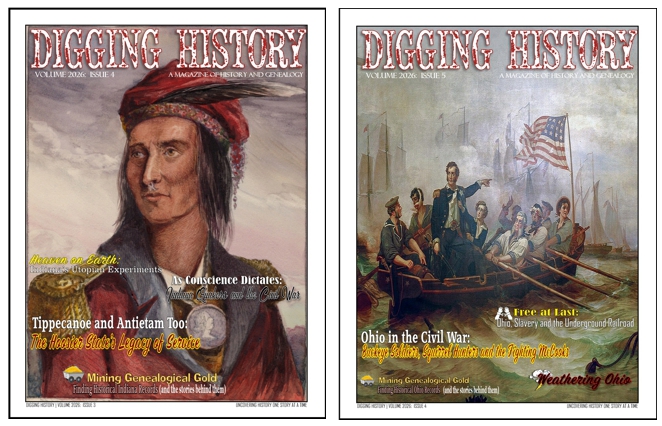
The last two issues of Digging History Magazine are available in the magazine store, part of a series of issues featuring each state — its history and how to find the best historical and genealogical records.
Indiana
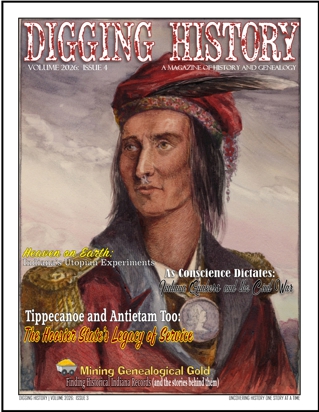 ● Mining Genealogical Gold: Finding Historical Indiana Records (and the stories behind them). Indiana sits at the crossroads of America, and therein lies both its greatest opportunity and its defining challenge. For more than three centuries, Indiana has been a place where different peoples, cultures, economies, and ideas have met, mingled, and sometimes clashed. French fur traders and Miami warriors, Yankee settlers and Southern migrants, German immigrants and African American families fleeing the Jim Crow South, steelworkers and farmers, industrialists and laborers – all have found their way to Indiana, drawn by its central location, abundant resource, and promise of opportunity. Their stories, woven together across time, form the rich tapestry of Hoosier history.
● Citizen Soldiers: The Hoosier State’s Legacy of Service. Indiana, the “Hoosier State”, has a long and distinguished legacy of sending its citizen soldiers into conflicts near and far. This article discusses the state’s involvement in four nineteenth century conflicts, beginning with the early Indiana wars through the Civil War.
● As Conscience Dictates: Indiana Quakers and the Civil War. At various times in America’s history, one religious group has been confronted with unique challenges in regards to their tenets of faith. While Quakers generally supported secular governance, they were opposed to any war conducted to support that government. It was simply forbidden to take up arms for any cause. Failure to adhere to these beliefs might result in excommunication.
● Heaven on Earth: Indiana’s Utopian Experiments. Across the wide prairies of the Midwest, long before interstate highways and grain elevators came to define the landscape, dozens of small towns rose from the soil with a daring dream at their center. These were Utopian settlements, built by reformers, visionaries, religious groups, and social philosophers who believed they could remake society on better terms. For a few brief decades in the nineteenth century they drew settlers westward with promises of equality, shared labor, spiritual harmony, or perfect economic balance. Many of these towns flourished for a time, yet most ultimately vanished, leaving behind faint traces in county records, overgrown cemeteries, and stories whispered through generations.
Purchase the Indiana issue here.
Ohio
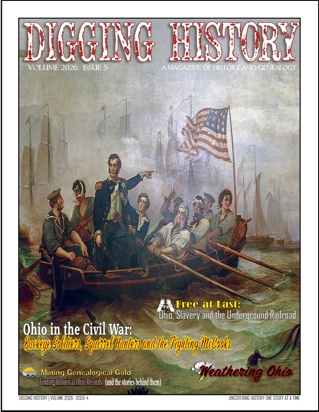 ● Mining Genealogical Gold: Finding Historical Ohio Records (and the stories behind them). There’s a reason why presidential candidates spend more time in Ohio diners than perhaps anywhere else in America. There’s a reason why eight presidents hailed from this single state, why inventors here gave us the light bulb, the airplane, and the cash register, why generals from Ohio saved the Union, and why the phrase “As Ohio goes, so goes the nation” became political gospel. Ohio isn’t just another state on the map between the coasts. It is, and has been for more than two centuries, the very heart of the American experiment.
● Free at Last: Ohio, Slavery and the Underground Railroad. Ohio’s geography made it inevitable that the state would become a battleground in the struggle over slavery. Stretching along the Ohio River for over four hundred miles, the state shared its entire southern border with slave-holding Virginia and Kentucky. Across that river, just yards of water away, lay bondage. On the northern shore lay freedom, at least in theory.
● Ohio in the Civil War: Buckeye Soldiers, Squirrel Hunters and the Fighting McCooks. When the news reached Ohio on April 13, 1861, that Confederate batteries had opened fire on Fort Sumter in Charleston harbor, the response was immediate and electric. The decades of debate, compromise, and mounting tension over slavery had finally erupted into open warfare, and Ohioans responded with a fervor that surprised even themselves.
● Weathering Ohio. Since Ohio was founded in 1803, adverse weather events have affected Ohioans to one degree or another – from the severe cold and snow events of the nineteenth century to the tornadoes and floods of the twentieth, and everything in between. Ohioans have seen it all – heavy snow, unseasonal frost and snow, ice storms, extreme cold or heat, drought, floods, windstorms, tornadoes, hail and lightning.
● Grandma Gatewood: The Woman Who Walked Away Her Pain on the Appalachian Trail. This article was originally published in the May 2018 issue of Digging History Magazine, penned by guest writer, Kalen Martin-Gross. It seemed appropriate to include it in this issue as a testament to the hard-working people of this region, especially those who overcame difficult circumstances to make their mark on history.
Purchase the Ohio issue here.
The last issue of 2026 will feature the “Keystone State” of Pennsylvania. Stay tuned!
Thanks for stopping by! Please consider subscribing to Digging History Magazine. The current series features the history of individual states and how to find the best historical and genealogical records. Purchasing a subscription entitles you to subscriber benefits (20% off all services, including custom-designed family history charts) AND a chance to win your very own custom-designed family history chart! Details here (or click the ad below).