

Do you suffer from friggatriskaidekaphobia (and you say, “I don’t even know how to pronounce it, so how could I be afflicted with it!?!”). One man, William Fowler, took on the challenges of superstitions related to the number “13”. One newspaper referred to Fowler’s organization as a “strange club”, composed of men who practiced “wanton superstition”. Amazingly, they managed to hang around until the 1920s. Were members just out for a “jolly good time”? In case you missed it, here’s Part 1 of this article.
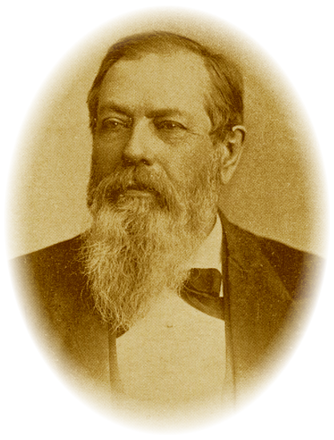 Captain Fowler began planning his club in 1880, after “something occurred in his place one night that roused his latent disgust for superstition of all sorts, and directed its whole force against that popular hallucination as to the unluckiness of thirteen people sitting down to table together.”1 On January 13, 1882 the first meeting of the Thirteen Club convened in New York’s Knickerbocker Cottage at 7:13 p.m. All dinners were held with thirteen members around each table. William Fowler, whose name of course had thirteen letters, led the procession for the second dinner which was held in the banquet room lighted by thirteen gas jets.
Successive meetings of the Thirteen Club were always held on the 13th of the month. On March 13, 1882 the meeting convened at 8:13 p.m. at the thirteen-letter Knickerbocker in Room 13 and each table seated thirteen members. The New York Times described it this way:
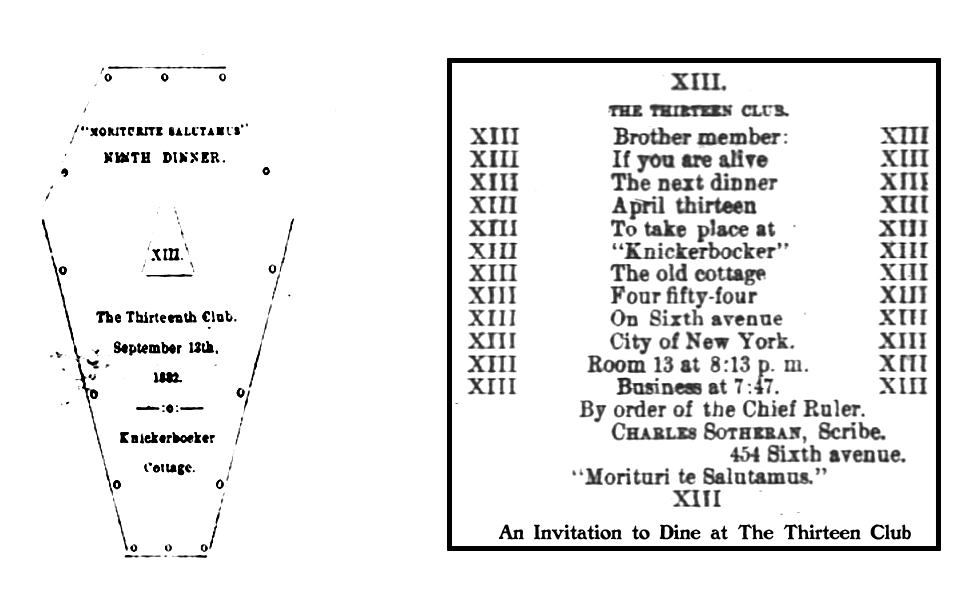
Each table was lighted by 13 colored candles, and prominent on each were big platters of lobster salad, moulded into coffins, surrounded by 13 little craw-fish, and bearing “13” on the coffin plates. The menu cards exhibited the mournful motto: Morituri te Salutamus [Translation: “we who are about to die salute thee”].2
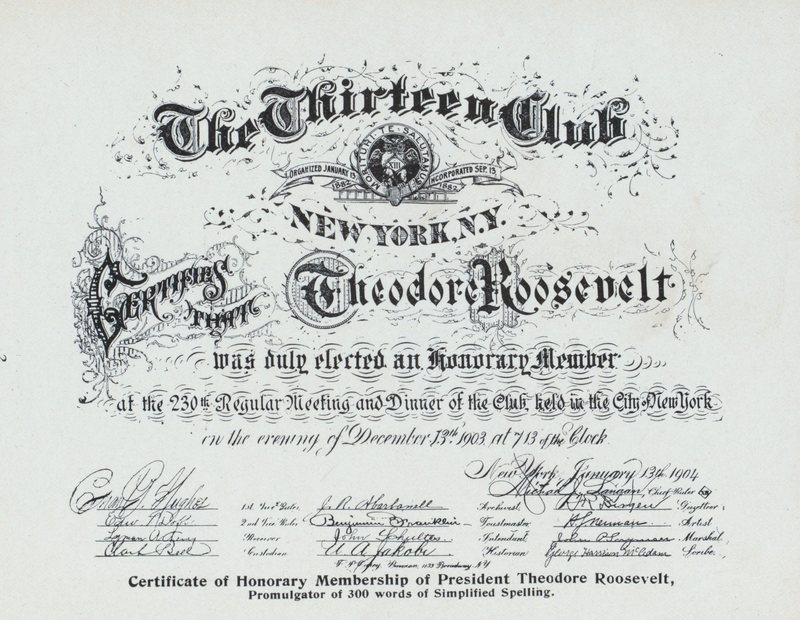
During the business session, following a thirteen-course dinner served by thirteen waiters, several honorary members were elected, including President Chester A. Arthur. Presidents Grover Cleveland, Benjamin Harrison, William McKinley and Theodore Roosevelt would later join the Thirteen Club as honorary members, as did P.T. Barnum, who lent his wholehearted support:
P.T. Barnum on Superstitions.
If the proposition of my name as an honorary member of the Thirteen Club will aid in the smallest degree in removing the ridiculous and shameful superstition which exists in relation to number thirteen, I shall feel honored in being so proposed. In my autobiography I dedicated a chapter to No. XIII, and showed by a letter form my clergyman what a fortunate and honored number it is. It is humiliating that in this nineteenth the superstition still lingers among intelligent persons. No person ought to be hanged on Friday for the next fifty years.
I am in full accord with your society, so far as it tries to expel superstition in regard to No. 13, or Friday, or anything else. For fifty years I have, so far as possible, made it a point to start my enterprises on Fridays.3
Primarily, the club was challenging “the superstition that the seating of 13 at table will be followed by the death of one or more of the party within the year.” That notion, combined with all the other ways the club dared to thumb their noses at silly superstitions, was challenged and mocked during monthly meetings. April’s meeting included a large cake surrounded by thirteen lilacs with a figurine of an old woman on a broom chasing a black cat. The whole affair, intentionally no doubt, “was funereal, and suggested a feast at which undertakers only were bidden”.4
It was certainly an “odd organization”. The club’s secretary went so far as to send a letter to New York’s Governor Porter, “requesting him to use whatever influence he can to remove the superstition from Friday as an unlucky day by inducing Judges to select some other day than Friday for hangings.”5
On September 13, 1882 the Thirteen Club was officially incorporated with the express purpose of combating “by argument, by essays, literary articles and example, the prevalent superstition against ‘Fridays’ and against thirteen at a table – superstitions believed to be at variance with the enlightened intelligence of the present century.”6
The club continued to expand and charter other branches. By April of 1884 there were 338 members, or “twice thirteen times thirteen”,7 and by 1887 membership had risen to about five hundred. These were essentially men’s social clubs, although some branches allowed women to join.
Some referred to it as a “strange club”:
TREACHEROUS THIRTEEN
MEN WHO PLAY WANTON WITH SUPERSTITION
A Strange Club in New York, Whose Aim in Life is to Slop One Over the Round Dozen – Now Dinner is Served for the Eccentric Old Baldheads – Peculiar Invitations
An Atlanta Constitution correspondent had the opportunity to meet none other than Captain Fowler, “one of New York’s most jovial and good-hearted men” at the November 13, 1882 meeting. included a depiction of the menu card, noting the club’s last meeting had featured a “handsome rosewood coffin, in which rattled the bones of a delicious and well proportioned female skeleton.”8
When asked whether any misfortune had befallen any member of the club since its founding, Fowler answered, “No, not to any member, though there have been a number of accidents and deaths which have been attributed to the unseen influence of our club. You know that none of these would have occurred if our organization had not been in existence.”9 Fowler was certain of his claims and had a number of newspaper notices to prove it:
On the evening of the 14th [sic] of January, while the members of the “Thirteen club” were seated at their first dinner, a collision occurred on the Harlem railroad, in which thirteen persons were killed, and thirteen coaches wrecked. On the same evening Caroline Richings [well-known opera singer] died, after celebrating the thirteenth anniversary of her marriage by a dinner, at which thirteen persons were present. . .
Some time during the summer an actor, named Billings, went out with a friend in the evening. He was invited to join a party of comrades. At first gave his consent, but suddenly stopped and counted the number present. “That’s an unlucky number,” he said, and refused to sit with them. He then accompanied John Matthews to a restaurant on Third avenue. Here he found another group of his friends numbering Thirteen, and he refused to remain. He went home and committed suicide.10
Nevertheless, very few members had resigned, for after all they had a “jolly good time” at each meeting by relating anecdotes that exposed, mocked and debunked popular superstitions of the day.
Were Atlantians too superstitious to join? After all, it only cost one dollar and thirteen cents for the initiation fee, $13.13 for the charter, monthly dues were thirteen cents and lifetime membership for only thirteen dollars. They were impressed with Fowler, yet wary of the club’s unusual orthodoxy, cautioning that although an interesting club, “and if it does not lead to dissipation – and dissipation is far worse than superstition – it may do much good.”11
 The Thirteen Club may have encouraged another “eccentric and silly” club in 1884. The Jerusalem Club had recently met in Boston where “seventeen of its members sat down the other night to a dinner of dog meat. It was not surprising to learn that they highly enjoyed it.”12
More than three years since its founding the club continued to flourish, at least thirteen members showing up for each dinner. But, how were they doing at challenging the superstition about thirteen people seated around a table? “Thus far no member has died within the year prescribed by superstition as the allotted time of life after dining in a party of thirteen.” One member, however, had died within fifteen months of his last dinner at the club and one ex-member who had never attended died.13
William Fowler passed away unexpectedly in 1897 (no where near the 13th of the month). His obituary was extensive and provided additional details about his life and how the number “13” was “strangely interwoven”:
The number 13 was strangely interwoven with Capt. Fowler’s life, and as he grew old this fact and his good fortune made him regard it as a mascot rather than as a numeral of ill omen. He was born in the old Seventh Ward in this city, Oct. 7, 1827, and spent his life here. He was graduated from Public School No. 13 when thirteen years old, and became a printer’s apprentice, but soon left that employment to become a builder, with John D. Trimble, the architect, as a partner.
The firm erected thirteen public buildings in this city, among them the old Bowery Theatre, the New Bowery, the Broadway Theater at the corner of Pear Street . . .
When Capt. Fowler was twice thirteen years [26] of age he was chosen to the command of the “Old City Blues” of the Twelfth Regiment of the N. Y. S. M., and was at the head of this company until April 13, 1861, when he, as Captain of 100 Union volunteers, went to Washington. For three years he was a soldier, and he was proud to relate that during that time he was in just thirteen great battles.
On account of severe wounds, he was forced to resign his commission Aug. 13, 1863, and on the 13th of the following month he took possession as owner of the old-fashioned house, which he christened the Knickerbocker Cottage. . .
Capt. Fowler belonged to thirteen secret and social organizations. He was a thirty-second-degree Mason, and had been an officer in all the lower bodies of the order. He was also thirteenth on the membership roll of the Nobles of the Mystic Shrine.
In 1880, being impressed by the singular recurrence of the number thirteen in his life, Capt. Fowler threw down the gauntlet to fate and set about to organize the Thirteen Club. It took him one year to secure the requisite number of members. Only well-known men were asked to join, and while, of course, they laughed at the popular superstition against thirteen, when it came to enrolling their name in the proposed club, they made excuses.
Thirteen men of the requisite nerve finally agreed to meet, and Sept. 13, 1881, was fixed for the first banquet of the club. Twelve of them arrived early. The banquet hall was arranged to defy superstition. Everything on the table was arranged in a series of thirteen; spilled salt was everywhere, and to enter they had to pass under crossed ladders. What made eleven of them more uncomfortable than anything else was a motto prepared by the Captain and suspended on the wall. On a red background, in white letters, was: “Nos Morituri Te Salutamus” (“We about the die salute you.”)
Long the twelve waited for the missing member. When the hour grew late and it seemed the banquet would be a failure a happy idea struck the Captain. One of the colored waiters, the whites of whose eyes were already showing, was drafted. Trembling like a leaf, he was dragged to a desk and told he should become a member. Despite his howls he was put through the first rites of initiation, and was just being shoved through the ladders when the missing guest arrived.14
A most unusual obituary full of history of a different kind!
Despite the club’s motto members insisted the mortality rate of their club was no different than that of other organizations or associations, for they themselves were mere mortals after all.
The Thirteen Club remained steadfast in its guiding principles. In 1907 they traveled to Washington, D.C., a “trysting place of city and country bred superstitions”, a place where “the wiseacre and the soothsayer amalgamate and hybridize.” The reason for the trip was clearly unwavering: “The mission of the Thirteen Club is to open the dark portals of the mind and the hatchways of the soul for the double purpose of letting in light and expelling the darkness and the gloom therein.”15
Still, some questioned whether the club (or others established elsewhere) was successful in debunking the notion of “unlucky thirteen”. Whether they ever did or not, the fellows (and ladies, beginning in 1891) had a jolly good time, although by the mid-1920s these types of clubs were becoming passé.
Friggatriskaidekaphobes, fear not! There is help (and they seem to have a “jolly good time” as well!):
https://www.friggatriskaidekaphobia.com/
Thanks for stopping by! Please consider subscribing to Digging History Magazine. The current series features the history of individual states and how to find the best historical and genealogical records. Purchasing a subscription entitles you to subscriber benefits (20% off all services, including custom-designed family history charts) AND a chance to win your very own custom-designed family history chart! Details here (or click the ad below).

Footnotes:
- Democrat and Chronicle (Rochester, New York), April 3, 1884, accessed at www.newspapers.com on November 13, 2026, 2.
- The New York Times, March 15, 1882, accessed at www.newspapers.com on November 13, 2026, 8.
- The Des Moines Register, April 8, 1886, accessed at www.newspapers.com on November 13, 2026, 6.
- The New York Times, April 14, 1882, accessed at www.newspapers.com on September 3, 2019, 2.
- The New York Times, May 7, 1882, accessed at www.newspapers.com on November 13, 2026, 12.
- Detroit Free Press, November 19, 1882, accessed at www.newspapers.com on November 13, 2026, 10.
- The San Francisco Examiner, December 27, 1884, accessed at www.newspapers.com on November 13, 2026, 4.
- The Atlanta Constitution, November 12, 1882, accessed at www.newspapers.com on November 13, 2026, 1.
- Ibid.
- Ibid.
- Ibid.
- Reading Times, February 11, 1884, accessed at www.newspapers.com on November 13, 2026, 2.
- Democrat and Chronicle (Rochester, New York), April 3, 1884, accessed at www.newspapers.com on November 13, 2026, 2.
- The New York Times, July 7, 1897, accessed at www.newspapers.com on November 13, 2026, 12.
- “Washington Trip” (Thirteen Club), accessed on November 13, 2026 at https://digitalcollections.nypl.org/items/510d47db-88a2-a3d9-e040-e00a18064a99.