
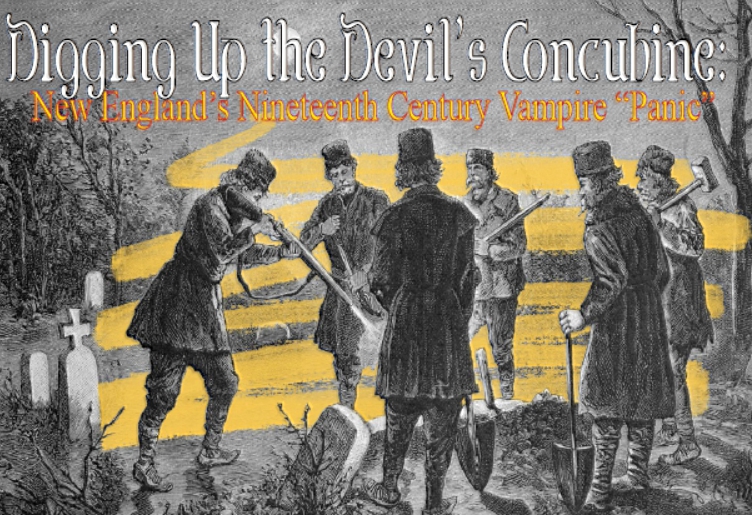
Throughout New England’s colonial era, a number of so-called “panics” or “hysteria” infected the populace with irrational fears – which produced even more irrational responses to those fears. The Salem Witch Trials, as well as the Connecticut witch panic which pre-dated them by several decades, were prime examples. However, a century later yet another wave of hysteria was brewing – one which would linger until the 1890s when a young woman in Rhode Island was exhumed in order to perform what can only be described as an “undead ritual”.
While the mass hysteria surrounding Salem eventually faded (even though there were sporadic cases in the eighteenth century), another type of panic would supplant it. From the earliest colonial days the pall of sickness and death hung over settlers who had already risked everything to come to New England – not to mention the very real threats posed by Indian attacks and wild beasts. With that pall arose not only fear but various customs and superstitions. It appears to have been a way to deal with calamity.
Of course, settlers brought along customs and superstitions from their former homes abroad and wouldn’t dare shun them lest some awful fate might befall them. Many of them centered around death itself, like opening all the doors and windows so the recently departed could could find its way to the next world. Mirrors were thought to be capable of trapping the departed’s spirit. Thus, the oldest person in the household was tasked with turning all the mirrors in the house to the wall, or at the very least cover them, until the body was taken out for burial. Some even believed if they saw their own reflection in the mirror before this ritual was done they too would die – within six months. In fact, it was customary for all pictures and mirrors throughout the home to be draped with white linen.
These rituals all seem rather strange (and certainly unnecessary) today, but in the eighteenth and nineteenth centuries it was widely accepted. The aforementioned rituals are strange enough, but what about exhuming a family member’s body, what one source referred to as “in search of a spectral bloodsucker”.
At some point a widely-held belief arose as a way to rationalize the misfortune of contracting the terrible wasting disease of consumption (or tuberculosis as we refer to it today). For whatever reason, the cause of consumption was blamed on vampires:
In understanding the thought process of eighteenth- and nineteenth-century families affected by consumption, we must, for a moment, travel back in time and look at a few aspects of how they coped with the fragility of their mortal tenure upon this earth. The notion of death was offset by their extreme faith in religion and the afterlife. They held comfort in the fact that death was but a temporary separation of loved ones. . . .
Puritan funerals were treated as festivals, and liquor was always served. In fact, funerals were regarded as important social events. Children were required to attend at an early age in order to become accustomed to the ceremony. . . .
Painting a quick picture of life in New England helps one to understand why people felt the way they did. It is important to note that all of the documented vampire cases in New England take place in rural, remote areas where certain education, superstition and customs were handed down from generation to generation. . . .
When tuberculosis actually melded its way into superstition is a matter of conjecture that also varies from culture to culture. In medieval Hungary, it was thought that the illness was caused by a doglike demon eating away at the lungs, and when the victim coughed, it was the demon barking. The disease, causing its victims to become gaunt and pale, also gave rise to many other superstitions. Strange remedies were instituted for the disease. One English remedy was to swallow live baby frogs before breakfast. Another was to have the afflicted person sleep where he would be exposed to the breath of cattle. Some sufferers were made to drink broths made by stewing the body of a dead cat or rooster. A cure for dropsy was to drink toad ashes every morning for three days while the moon was waxing. This was known to be a surefire cure for the ailment. (See the link below to purchase this issue with complete bibliography.)
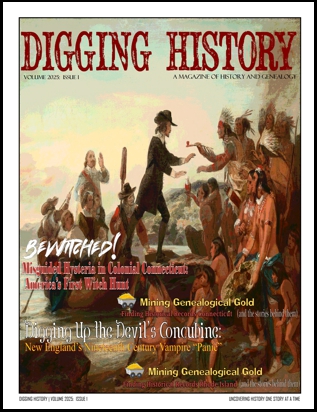 This excerpt has been extracted from an extensive feature article in the January-February 2025 issue of Digging History Magazine, which featured the New England states of Connecticut and Rhode Island. The issue is available for purchase here. The articles featured in this issue includes:
- Bewitched! Misguided Hysteria in Colonial Connecticut: America’s First Witch Hunt
- Mining Genealogical Gold: Finding Historical Records of Connecticut (and the stories behind them)
- Digging Up the Devil’s Concubine: New England’s Nineteenth Century Vampire Panic
- Mining Genealogical Gold: Finding Historical Records of Rhode Island (and the stories behind them)
- The Dash: Ezra Stiles (1727-1795)
Thanks for stopping by! Please consider subscribing to Digging History Magazine. The current series features the history of individual states and how to find the best historical and genealogical records. Purchasing a subscription entitles you to subscriber benefits (20% off all services, including custom-designed family history charts) AND a chance to win your very own custom-designed family history chart! Details here (or click the ad below).