
 In case you missed it, here’s Part 1 of this short series. Part 2 highlights how Victorians addressed their fear of being buried alive — as the saying goes, necessity is the mother of invention!
Necessity: The Mother of Invention
One of the hallmarks of the 1800s – the “century of acceleration” – was an explosion of innovation, invention and medical advancements. Faced with challenges, Victorians sought ways to circumvent them, although some of their inventions were more than a bit ill-conceived. Such was the case with devices like safety coffins, life detectors and grave signals.
Christian Eisenbrandt
One of the first patents addressing the fear of being buried alive was granted to Christian Eisenbrandt, a German maker of fine brass and woodwind instruments. Many American fifers serving during the War of 1812 were equipped with Eisenbrandt’s fifes.
Besides his reputation for finely-crafted musical instruments, Eisenbrandt became known for his “Life Preserving Coffin, In Doubtful Cases of Actual Death”.
The American Institute Fair, established in1828 “to promote improvements in the mechanic arts; to encourage American industry in agriculture, manufactures, and commerce; and to sustain such a system of policy, as will protect the great national interests of our country”,1 began holding its annual fair in New York City in 1829. The fair’s spacious location where visitors “had ample room and verge enough to gratify the appetite for the ingenious, the beautiful and the marvelous”2 was filled with the latest innovations – more or less a precursor to the World’s Fair established later in the nineteenth century.
Perhaps the most talked about invention highlighted during the 1843 fair was Eisenbrandt’s recent invention. As one journalist noted, a group of ladies passing the exhibit expressed alarm at such a device, prompting the journalist to “examine the beauty of this latest receptacle of humanity, and the appropriateness of its descriptive label”. Eisenbrandt’s premise:
In a warm climate, ours in the summer, where the dead are obliged to be buried soon after disease, as for instance, during the prevalence of yellow fever, and at other times, instances of have been known of persons having been buried before life was really extinct; to guard against which the inventor of this coffin has contrived an arrangement of springs and levers, on its inside, whereby its inmate, by the least notion of either head or hand acting thereon, will instantly cause the coffin lid to fly open, a circumstance which will entirely remove all uneasiness of premature interment from the minds of anxious relatives.
The inventor would advise all families or communities who may feel disposed to make use of his Life Preserving Coffins, so constructed as to give persons deposited therein a chance for life, by placing a lock on its door that will open either from the inside or outside also with a bell, and with openings to admit pure air, and into which no other coffins are admitted, and a key which should be placed inside to allow any one who may be resuscitated egress, until decomposition actually takes place, when they may be removed, and finally deposited in the ground, thereby keeping the vault free from the accumulation of foul air.
Obviously skeptical, the correspondent concluded, “Of its practicability the reader may judge for himself.”3
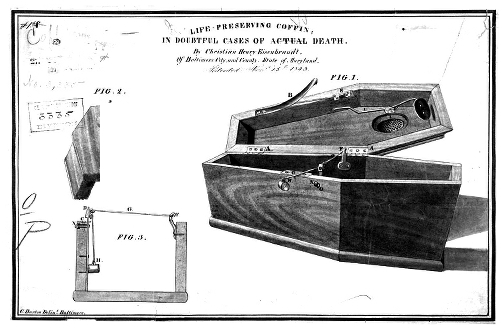
The coffin was crafted in such a way so that the slightest movement would cause the spring-loaded lid to pop open. All of which begs the question, did it work after being buried underground. The answer was “no” it only worked while the coffin was above ground in a vault. Still, Eisenbrandt seemed rather sure of himself as the patent description indicates:
I . . . have invented a new and useful improvement in coffins, which I term a life-preserving coffin in doubtful cases of death . . . the inventor of this coffin has contrived an arrangement whereby any one who may not really have departed this life may by the slightest motion of either the head or hand acting upon a system of springs and levers cause the instantaneous opening of the coffin lid.4
Franz Vester
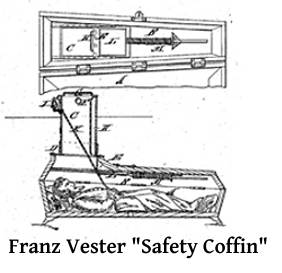 Eisenbrandt’s invention had obvious design and practical usage flaws since it only worked above ground, but in 1868 it was reported by The Spectator:
A German of the name of Franz Vester, living in the United States, has actually been good enough to invent the safety coffin, the merit of which consists in its enabling any one who happens to be buried alive in such a coffin, in his usual state of health and nerve, to rectify the mistake when he discovers it by either climbing out through a sort of chimney, or if he be not equal to that gymnastic effort, by ringing a bell for the sexton to come and help him.
The “safety coffin” is higher and bigger than ordinary coffins, so as to admit of the free movement of the body, and under the head is a receptacle for wine and refreshments. A box about two feet square rises from the head of the coffin to about a foot above the ground, and in this box there is a sort of ladder by which a person interred alive can climb out, if he is vigorous enough. A spring inside enables the occupant to ring a bell and, as we understand, to unclose the external lid of the chimney, which cannot be unclosed from outside.
Vester buried himself alive in one of his coffins and after being “interred” for morethan an hour, emerged within a minute of giving the signal “with no more perceptible exhaustion than would be caused by walking two or three blocks under the hot sun.”
Well and good for Vester, but someone actually buried alive probably wouldn’t be “springing” out! Or, as The Spectator cheekily concluded, “unfortunately, persons are not buried alive in a state of nerve and bodily vigour that would enable them on awaking unexpectedly in the grave to search for and consume lunch, touch springs, and climb a chimney, even if they could hope to make more sure of being buried by their friends in a properly appointed ‘safety coffin’ than of not being buried alive at all.”5
Theodore A. Schroeder and Hermann Wuest
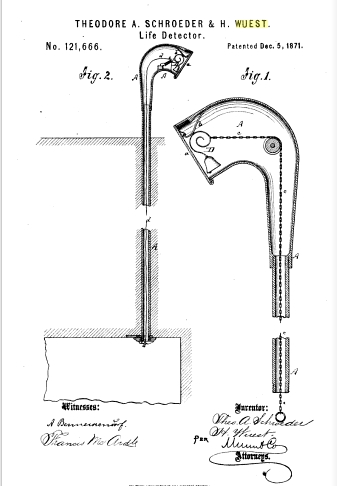 These two chaps from Hoboken, New Jersey had ideas of their own, filing a patent on December 5, 1871 for “a new and useful Improvement in Life-Detectors”. The device, looking much like an ear trumpet, was purported to be an improvement “in means for detecting the recurrence of life in persons that have been buried in a state of trance or apparent death.”6
Schroeder and Wuest believed that “an instant admission of air at the moment of recurrence of symptoms of life” was not at all overrated. Not only would the lid of the tube be adapted to open, allowing air, it would warn of the need for assistance. They believed it would truly be a life-saving invention.
The battery-operated device was designed to create a circuit inside the coffin. If a corpse stirred, the circuit would be broken, a bell would ring and fresh air would rush into the coffin. If the lid remained closed for three or more days after burial, the tube would be withdrawn – the person inside presumed then to have actually died, case/lid closed!
Albert Fearnaught
Buried alive? Fear not! No kidding, that was the man’s name. Albert Fearnaught of Indianapolis was a photographer with a “new and useful improvement in Grave Signals”. The casket would be equipped with tubes, springs and stoppers, and a cord connected “to the wrist of the supposed corpse.”
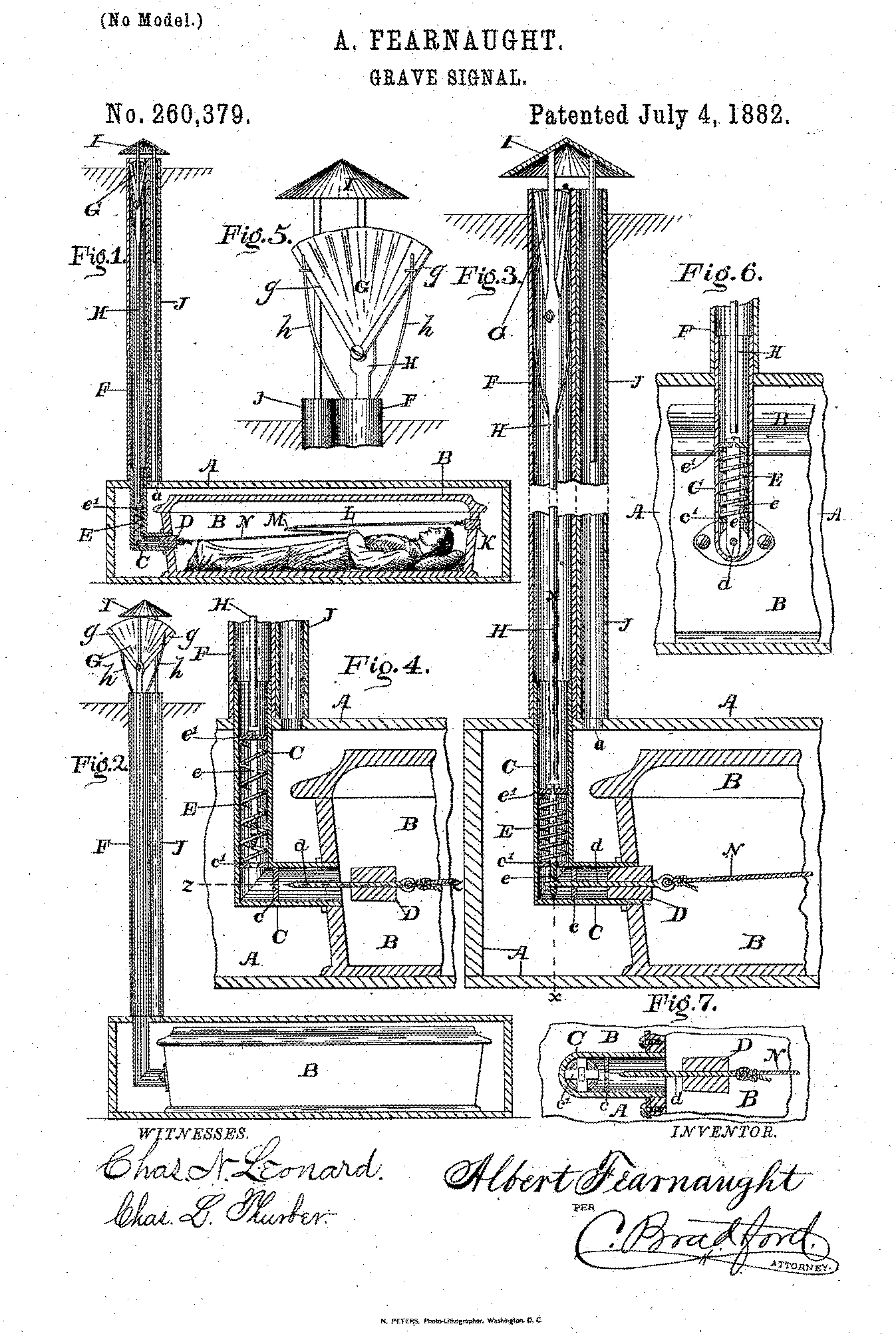
After the casket was closed two other tubes were put into position and, should it turn out the once-thought deceased person was merely in “suspended animation”, the slightest movement of the hand (voluntary or involuntary) would cause two stoppers to pop out. (These devices seemed to have involved a lot of “popping out” didn’t they?) In turn, a spring released which threw up the signal flag and at the same time established a circuit whereby air could circulate from the outside, providing ventilation until someone noticed the flag and rescued the person who was formerly in “suspended animation.” Patent #260379 was granted on July 4, 1882.7
The parade of patented grave-signaling devices continued and as the nineteenth century was nearing its close electric switches and dry cell batteries were being employed. One device invented by Frenchman M.C.H. Nicolle in 1899, involving hammer and glass, seemed rather ill-conceived.
A hammer would swing down and break a glass window that was positioned directly over the corpse’s head, allowing ventilation, if any corpse movement was detected. His device and others were specifically designed for people who had been buried in a trance. Waking up from a trance, only to find broken glass in your face, doesn’t seem at all useful does it?
In the early 1900s electrical devices were invented and one, a sort of “telegraphic” signaling device, was invented by Monroe Griffith of Sioux Falls, Iowa in 1901. The hands and feet of the corpse were wired in order to signal movement. However, unlike earlier devices that might ring a bell, sound a buzzer or raise a flag, the wires came out of the grave and would be connected, for instance, to “the home of the cemetery sexton or police station.”8
Bizarre? Definitely. Necessary? Maybe.
The Brooklyn Daily Eagle reported in 1904 that medical records of years gone by cited numerous alleged instances of being buried alive. The article pointed out a number of medical conditions which might have mimicked death, including “conditions of trance, catalepsy human hibernation, self induced sleep, fainting fits, intense cold and narcotic influence.”9
One such incident had occurred in Brooklyn when a young woman named Virginia McDonald was interred in the city’s Greenwood Cemetery. Her mother had a premonition shortly after her daughter’s interment that she was in fact still alive. It continued to bother her but her family was skeptical. Still, she persisted until the family, to satisfy her, had the grave opened. Virginia by that time was indeed dead, but there was clear evidence she had been buried alive. The body was “lying on the side, the hands were bitten and there was every evidence of premature burial.”10
Another woman, dancing at a ball, swooned and doctors pronounced her dead. Her husband wanted her buried with all the finery and jewels she was wearing at the ball. The undertaker, thinking it a waste of money, proceeded to take the jewels for himself. You just know what happened don’t you – as he was taking the rings from her fingers, the woman awoke and “was afterward restored to health.”11
Another incident cited by Dr. Felix Hartman, who wrote about premature burials, involved a man whose pulse had stopped and appeared to have ceased breathing as well. He was placed on an autopsy table and when the knife was applied he jumped from the table and ran out of the room. According to the Daily Eagle, “the operating surgeon died of apoplexy, but at last accounts the lively corpse was still enjoying the best of health.”12
After embalming fluid became more widely used to prepare the body for burial, these concerns and fears became less of an issue. Still, these inventions, bizarre though they were, were innovative for the times.
However, these inventions were designed to more than likely fail simply because they were so complicated.
Give them an “E” for effort though!
Thanks for stopping by! Please consider subscribing to Digging History Magazine. The current series features the history of individual states and how to find the best historical and genealogical records. Purchasing a subscription entitles you to subscriber benefits (20% off all services, including custom-designed family history charts) AND a chance to win your very own custom-designed family history chart! Details here (or click the ad below).

Footnotes:
- The Long Island Star, March 27, 1828, accessed at www.newspapers.com on September 14, 2019, 1.
- New York Daily Herald, October 12, 1843, accessed at www.newspapers.com on September 14, 2019, 2.
- Ibid.
- U.S. Patent #US3335A, “Coffin to be Used in Cases of Doubtful Death”, accessed on September 14, 2019 at https://patents.google.com/patent/US3335A/en.
- The Spectator (London: F.C. Westley, September 19, 1868), 1091 (accessed on September 14, 2019 at https://babel.hathitrust.org/cgi/pt?id=mdp.39015030334851&view=1up&seq=1).
- U.S. Patent #US121666A, “Improvement in Life-Detectors for Coffins”, accessed on September 14, 2019 at https://patents.google.com/patent/US121666A/en.
- U.S. Patent #US260379, “Grave-Signal”, accessed on September 14, 2019 at https://patents.google.com/patent/US260379/
- U.S. Patent #US666605A, “Apparatus for signaling from graves”, accessed on September 14,
2019 at https://patents.google.com/patent/US666605A/en. - The Brooklyn Daily Eagle, February 28, 1904, accessed at www.newspapers.com on September 14, 2019, 8.
- Ibid.
- Ibid.
- Ibid.