
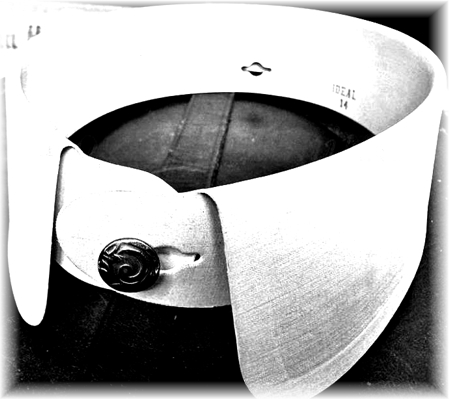

Last week it was “Killed by His Collar”. Conversely, celluloid collars were known to have saved more than a few fashionable man. Just another example of “It Was a Victorian Thing”.
SAVED BY HIS COLLAR: One of Those Derided Celluloid Affairs Proves a Friend in Need
A celluloid collar was perhaps the means of saving Thomas Randall’s life on Monday night. Randal is a peaceable-looking Canuck who was sitting at a table in George W. Rich’s saloon, No. 114 Main Street, reading a paper early that evening when a laborer on the dock named Daniel McNerney, as the police report, came up and sat down. McNerney had been drinking freely and began cursing at Randall. The latter remonstrated and McNerney drew out a pocket-knife and made a plunge at Randall. The side of the blow caught Randall in the neck, but its force was spent in passing through the celluloid collar.1
SAVED BY HIS COLLAR
How Mary Twopence Shot Her Husband, a Barber, at Orange
Mrs. Mary Twopence of Orange, N.J., is in the County Jail for shooting her husband in the neck, says the New York Advertiser. Mr. Twopence is a barber, and has his shop on Dodd Street. The Twopences are colored. They have frequently quarreled. Mr. Twopence returned home yesterday afternoon at 5 o’clock. He and his wife had their usual quarrel. He threatened to cut her heart out, and she said she would chill his blood.
The family ax was in the yard. It had a razor edge. Mr. Twopence rushed out into the yard, seized the ax, and, the wife says, shouted to her: “You black devil, I’ll cut you deep!”
“You can’t scare me, honey,” screamed his wife, who hurried upstairs and grabbed up a 32-caliber revolver, which they kept in the bed-room. Husband and wife met at the foot of the stairs. Twopence raised his ax. As the gleaming blade was poised aloft Mrs. Twopence pointed the revolver at her husband. He dodged, turning his face away.
The next moment the woman fired. The bullet struck Twopence’s collar, which was very stiff, and, glancing off, imbedded itself in the fleshy part of his neck.
“Don’t shoot any more! I’se got enough!” yelled the barber.
“I’se done you, sho’ ‘nuff, nigger dis time,” said Mrs. Twopence.
Neighbors at this moment rushed in and Mrs. Twopence was arrested. Dr. Chambers took the bullet from Twopence’s neck, and said the collar saved his life.2
What was it about stiff celluloid collars with potential to shield or horrifically act as a type of “heretic’s fork” (a gruesome invention of the Inquisition to torture suspected witches and heretics)?
Celluloid: Functional or Deadly?
In 1862 Englishman Alexander Parkes, a prolific inventor, developed the world’s first plastic material, dubbing it “Parkesine”. As a self-taught expert chemist and metallurgist, Parkes had invented and patented a number of innovative processes and materials. In 1850 Parkes “secured a patent for a self-acting calcining furnace, and also a method of extracting silver from metallic lead by means of zinc, a method known as Parkes’ zinc desilverising process.”3
Thereafter, Parkes directed his ingenuity toward discovering a substitute for “ivory, pearl, amber, indiarubber, guttapercha, &c.” On October 22, 1855 he secured a patent for “using compounds of nitro cellulose with camphor, gums, resin, oils, and solvents.” He called it “Parkesine”.4
In America John Wesley Hyatt obtained Parkes’ patent (later challenged in court unsuccessfully) and U.S. Patent No. 105,338, dated July 12, 1870, was issued to John W. Hyatt, Jr. and Isaiah S. Hyatt (brother). By experimenting with Parkesine Hyatt developed a material, quite by accident, which came to be known as celluloid.
One of Hyatt’s first inventions was a substitute for ivory in billiard balls developed in 1869, a combination of paper flock, shellac and collodion [used in early photographic processing to coat and produce a photographic plate]. An accidentally-overturned bottle of collodion sparked an idea as he observed the substance solidifying. The discovery would come to be both blessing and curse, the difference between life and death, as evidenced by articles cited above.
In 1870 Hyatt established the Albany Dental Plate Company, producing false teeth, piano keys and billiard balls utilizing celluloid, followed by the Celluloid Manufacturing Company in 1872 (moved the following year to Newark, New Jersey). Hyatt had already discovered a number of ways to use celluloid, even as other businesses like the Celluloid Brush Company and the Celluloid Novelty Company were opening their doors around the same time.
One of the first uses for celluloid was false teeth. In 1874 Hyatt, as Secretary of the Celluloid Manufacturing Company, spoke at the New Orleans Dental College to about fifty of the city’s dentists. He demonstrated by molding two sets of teeth, explaining how easily the substance could be manipulated. It was an excellent base for artificial teeth, far superior to rubber and aesthetically pleasing. Hyatt urged “general adoption” of celluloid.5
The use of celluloid in the manufacture of false teeth, billiard balls and piano keys was, of course, related to what the Smithsonian called “the ivory problem”.6 Even though not exactly factual, concerns arose over the possibility of ivory supplies being depleted, at a time when the sport of billiards was rising in popularity. In response an American billiard company, Phelan and Collender, offered a $10,000 reward to anyone who could invent a material to replace ivory.
Parkes’ Parkesine came close, but Hyatt’s development of celluloid was easier to produce on a commercial level. The problem with celluloid, however, was its flammability. Hyatt was well aware of the problem, and not at all surprising, since the main components of celluloid were nitrocellulose, flash paper and gun cotton. How much more dangerous could this substance be?
Not long after the Celluloid Manufacturing Company was founded, fire broke out and destroyed part of the Albany plant. In September 1875 a far more serious incident occurred at the Newark facility.
TERRIBLE EXPLOSION AT NEWARK
A Celluloid Factory Blown Up
Large Loss of Life and Property – Number of the Killed Uncertain – Several Persons Believed to be Buried in the Ruins – One Dead Body Taken Out – Thirteen Persons Badly Wounded – The Accident Caused by Overheating Celluloid.
A fire was discovered about 6 o’clock last evening in the drying room on the second floor of the building of the Celluloid Manufacturing Company in Newark. . . Charles Burrows, the foreman of the drying room, in which the fire broke out, immediately turned on the steam, with the purpose of extinguishing the fire, but he had hardly done so and reached the door, when there was a terrible explosion, caused by the overheating of a quantity of celluloid in process of manufacture.7
The New York Times wondered whether the public should be wary of this new substance which might suddenly explode in someplace other than a manufactory plant?
EXPLOSIVE TEETH
The recent explosion in Newark has made many people aware, for the first time, of the existence of celluloid. That pleasing compound, which presents itself to the ordinary eye in the guise of a white substance somewhat resembling ivory, is said to be composed of gun-cotton, camphor, and a number of other articles which even the most sanguine and visionary elephant would never dream of attempting to convert into ivory. . .
Now that a celluloid factory has blown up, it is a matter of a good deal of interest to persons possessed of celluloid hairbrushes and billiard-balls to know whether those article will explode. The hair-brush is a favorite tool of ladies who desire to drive nails into the wall, and who cannot remember where they last laid away the hammer; but surely a hair-brush which is liable to explode on sharply striking a nail, and to blow the fair hammerer out of the window, is to be regarded with grave suspicion. No man can play billiards with any real satisfaction, if he knows that the billiard-balls may at any moment explode in a series of three closely-connected explosions, thereby spoiling a promising run, and burying the players under the wreck of table and cues. Still worse would be the fate of a possessor of a set of celluloid teeth who should, in a moment of forgetfulness, insert the lighted end of his cigar into his mouth. The scene that would follow would make men and angels weep…
It is only fulfilling a charitable duty to inform the possessors of celluloid teeth and brushes that they are safe from the danger of actual explosion. Nevertheless, it is asserted that celluloid will take fire with the utmost case, and, having taken fire, will burn with great rapidity, giving off meanwhile a highly flammable gas. If you bring your celluloid hair-brush in contact with the gas-light, it will only be necessary to drop it promptly in the water-jug and rush out into the open air. If you set your celluloid teeth on fire, the Fire Department should be instantly summoned, and in the meantime the mouth and nostrils should be hermetically sealed, as are the hatchways of a burning ship – for the double purpose of keeping out the air and keeping in the inflammable gas. If these precautionary measures are kept in mind, it may be quite possible to use celluloid brushes and billiard-balls and teeth without any very great danger. At any rate, it is a comfort to know that celluloid will not explode, and that a man can go to bed with a serene confidence that his teeth will not go off in the middle of the night with a tremendous concussion, and without even giving the knowledge – held by most people to be so thoroughly satisfactory – of what it was that killed him.8
The Times wasn’t alone in its concerns since products made of celluloid continued to be manufactured and sold to public which may or may not have been aware of the potential dangers – “in total ignorance of the fact that they grind with celluloid with they masticate their food, that they punch celluloid with a cue when they rattle festive balls, and that celluloid is [explosive] . . . Cigar smokers and benzine consumers had better take notice because a fire engine is not always handy, and it would be unpleasant, to say the least of it, to have the top of one’s head burned off, or a friend reduced to ashes from the action of an ignited billiard-ball.”9
Advertisements for celluloid teeth appeared in newspapers around the country. “Some demented dentist” was perfecting a “diabolical invention” – false teeth made of celluloid. Claims of billiard balls igniting, breastpins going off, “leaving their wearers on their backs in convulsions”.
Did anyone really want to be on edge wondering whether “his incisors or bicuspids” might explode at a dinner party. It was one thing if a collar or knife handle combusted and quite another if a set of false of teeth exploded:
If they explode it only befalls that one’s ears are blown off or his fingers dispersed about the dining-room, but in the case of an appendage so intimate as a set of teeth a like occurrence would leave the wearer no organs wherewith to curse the inventor.10
A grand announcement was made in 1890 as the Celluloid Manufacturing Company, the Celluloid Brush Company and the Celluloid Novelty Company joined forces with a goal of creating a new “celluloid combination”. Camphor had become prohibitively expensive and it was, of course, highly flammable. The new partnership would focus on manufacturing “a new incombustible plastic material”.11
Unfortunately, it was a problem which was never solved as stories continued to appear in newspapers around the country for several years, even into the early twentieth century:
- In 1886 a three-year old child was holding a celluloid comb when it came into contact with a gas flame, immediately exploding, melting and sending “flaming matter running over the child’s face, shoulders and arms.”12
- A Celluloid Comb Exploded. A young woman in Edinburg, Indiana was severely burned when the celluloid comb she was wearing in her hair exploded after “holding her head too near a fire.”13
- Exploding celluloid spread flames which gutted a five-story building in New York City in 1901. The building housed several businesses, one of them being a “perfumery establishment”. The smell of “ordinary smoke was nothing by comparison to that laden with the sickening smell of musk or even of high-priced colognes.”14
- A “little device utilized by women to hold up their lace collars – a piece of celluloid about two inches long and a quarter of an inch wide, worth 5 cents the half dozen – cost the United States Laundry Company a fire loss of $90,000 and imperiled 200 laundry workers” in Portland, Oregon in 1910. The collar had been tucked away in another garment and hung in the drying room with hundreds of garments. When hung close to heated pipes which lined the room the little piece of celluloid exploded “and instantly the room was aflame.”15
- A Rock Island, Illinois police officer was near death after he used kerosene to start a fire. His clothes caught on fire and then his celluloid collar exploded, severely burning his neck and shoulders.16
- In 1920 a man was willing to let his barber “give him the works” as long as he didn’t have to take off his collar. The barber essayed a single. Whoof! An explosion. The collar was celluloid.”17
Despite these disturbing stories, collars, combs, and even children’s toys, continued to explode and cause harm. In 1924, Mrs. Robert Cartwright of Brooklyn demanded action, asking that all products made of celluloid be prominently labeled as “combustible” in order to protect the public. Another woman had recently received severe burns from “exploding celluloid water wave curlers”.18
By mid-twentieth century celluloid was being replaced by synthetic polymers. Today, celluloid objects are collector’s items which should, of course, be handled with great care. As the Vintage Celluloid Collectibles web site points out:
Proper handling of Celluloid items are very important considering its extreme flammability. Keep Celluloid items in a well ventilated room. Do not store Celluloid in tightly closed containers and keep away from flames. It’s all about celluloid’s flammability.19
While researching this article I came across a few astonishing headlines and stories related to collars and exploding teeth, although not expressly mentioned as being made of celluloid. The imagery alone . . .
False Teeth Explode; Wreck Dental Office
Shenandoah Doctor’s Assistant Faints and Patient Nearly Swallows Rubber Sheet
A set of false teeth had “behaved in a very improper manner” in 1914 in a Shenandoah, Iowa dentist office. Upon placing the false teeth in a vulcanizer to be boiled, the jar exploded, blowing out two window lights into the street, narrowly missing pedestrians. The dental assistant fainted and the patient “nearly swallowed the rubber mouth protector.”20
SAVED BY HIS COLLAR
It’s hard to imagine this man’s life was spared by his collar after being run down by a locomotive. “He fell directly before the front wheels, but a projecting bolt caught his collar and held his head a few inches above the rail while the locomotive dragged him 300 feet. He was half choked and fainted when released by the train crew, but speedily recovered. Aside from a few bruises he is unhurt.”21
MAN BETWEEN 2 RATTLERS IS SAVED BY HIS COLLAR
William Shoupe didn’t normally wear a stiff collar while on the job as an oil field worker near Crystal Falls, Texas in October 1921. On his way to work his “flivver” broke down and he got and under the vehicle to fix the problem. Shoupe had been working away on his back for over thirty minutes when reaching for a pair of pliers he noticed a little peck on his neck. Must to his surprise he turned over and discovered a rattlesnake. He, of course, high-tailed it out from under the car. “An examination showed that the snake had been pinned down and had not been able to reach a vulnerable spot of Shoupe’s body. His venomous darts could not pierce the oil worker’s collar. The snake was killed and was found to have four rattles.”22
Oh the stories I find in newspaper archives! This article was extracted from the fifth issue of 2019 which focused on all things Victorian, a truly unique era.
Thanks for stopping by! Please consider subscribing to Digging History Magazine. The current series features the history of individual states and how to find the best historical and genealogical records. Purchasing a subscription entitles you to subscriber benefits (20% off all services, including custom-designed family history charts) AND a chance to win your very own custom-designed family history chart! Details here (or click the ad below).
 Footnotes:
- Buffalo Weekly Express, December 1, 1887, accessed at www.newspapers.com on August 22, 2026, 5.
- The San Francisco Call, August 30, 1891, accessed at www.newspapers.com on August 22, 2026, 7.
- Iron (London, England), July 25, 1890, accessed at www.newspapers.com on September 3, 2026, 16.
- Ibid.
- The Times-Picayune (New Orleans), March 7, 1874, accessed at www.newspapers.com on September 3, 2026, 1.
- Kat Eschner, “Once Upon a Time, Exploding Billiard Balls Were An Everyday Thing”, accessed on September 6, 2019 at https://www.smithsonianmag.com/smart-news/once-upon-time-exploding-billiard-balls-were -everyday-thing-180962751/#ZLqlIQCI5jJdxyzv.99
- New York Tribune, September 9, 1875, accessed at www.newspapers.com on September 3, 2026, 1.
- The New York Times, September 16, 1875, accessed at www.newspapers.com on September 3, 2026, 4.
- Decatur Daily Republican, September 23, 1875, accessed at www.newspapers.com on September 3, 2026, 3.
- New York Tribune, August 7, 1878, accessed at www.newspapers.com on September 3, 2026, 4.
- Wheeling Register (Wheeling, West Virginia), December 29, 1890, accessed at www.genealogybank.com on September 3, 2026, 1.
- The Weekly Wisconsin (Milwaukee), December 4, 1886, accessed at www.newspapers.com on September 3, 2026, 3.
- The Indianapolis News, February 7, 1899, accessed at www.newspapers.com on September 6, 2019, 6.
- The New York Times, December 23, 1901, accessed at www.newspapers.com on September 6, 2019, 2.
- Sioux City Journal, August 11, 1920, accessed at www.newspapers.com on September 6, 2019, 2.
- Quad-City Times (Davenport, Iowa), January 24, 1916, accessed at www.newspapers.com on
September 6, 2019, 13. - Los Angeles Herald, March 5, 1920, accessed on September 3, 2026 at
https://cdnc.ucr.edu/?a=d&d=LAH19200305.2.47&e=——-en–20–1–txt-txIN——–. - The Chat (Brooklyn, New York), May 3, 1924, accessed at www.newspapers.com on September 6, 2019, 66.
- “All About Celluloid’s Flammability”, accessed on September 6, 2019 at
https://vintage-celluloid-collectibles.com/all-about-celluloids-flammability. - St. Joseph Gazette, June 29, 1914, accessed at www.newspapers.com on September 7, 2019, 1.
- Detroit Free Press, August 30, 1907, accessed at www.newspapers.com on September 7, 2019, 3.
- The St. Louis Star and Times, October 9, 1921, accessed at www.newspapers.com on September 7, 2019, 34.