

As noted in the last two articles, you can file this article under something I like to call “It Was a Victorian Thing”. “Saved by Her Corset” and “Killed by Her Corset” focused on deadly and life-saving female fashion. Now let’s take a look at the gents. Read any mid-to-late nineteenth century newspaper and you’re likely to find any number of ways people died, some rather gruesomely. Several years ago I started paying attention to some of them, although I don’t recall exactly how I came across these particular headlines in a number of newspapers across the United States.
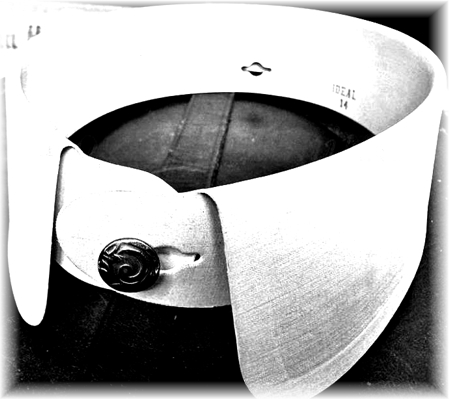 According to the National Museum of American History, a male fashion accessory was introduced in the early 1800s, known as a separable collar. Men utilized the collar in order to look “dressed up”, its stiffness facilitated by pressing and heavy starching. Along with separable cuffs, it was a way for men of modest means to make themselves more presentable when the occasion called for it.
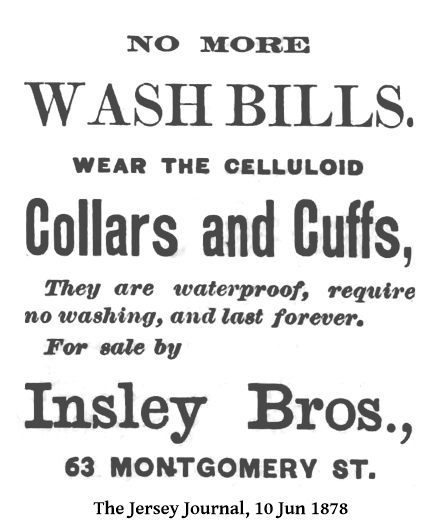
The early collars were generally made of linen and heavily starched to maintain stiffness. However, in the 1870s a new material was introduced, a plastic type of celluloid which had the appearance (and feel) of fine linen. In a way these were labor-saving devices, requiring no washing as this 1878 advertisement suggests.
After stumbling across the “killed by her corset” or “saved by her corset” headlines I began noticing similar headlines – “killed by his collar” or “saved by his collar”. Again, what was that all about? Much like corsets, the issue was related to the material used to manufacture fashionable men’s high collars.
Killed by His Celluloid Collar
William Wood, twenty-two years old, of Morristown, N.J., on Saturday night came to his death in a very singular manner. He was employed as a gardener. On Saturday night he was found stupidly drunk on a sidewalk by a policeman and was taken to the station house. Several of his friends secured his release by promising to take him home. Instead they left him in an outhouse. In the morning he was found dead. Examination showed that Wood lay in such a position that his stiff celluloid collar had pressed against his windpipe and strangled him.1
KILLED BY HIS COLLAR
Celluloid Neckband Brings a Carbuncle to a Jersey City Policeman
The almost obsolete celluloid collar question has been revived by the death of Policeman Enoch Perry, in Jersey City. Policeman Perry expired from the effects of a carbuncle on his neck, caused, his relatives say, by a celluloid collar, which he was compelled to wear by order of the police authorities. Sometime ago an order was issued from police headquarters in Jersey City requiring patrolmen to wear white gloves and collars. White cotton gloves were specified and a regulation collar made of celluloid was named as the decoration for the police neck.
There was much objection to the form of collar ordered. Patrolmen who had been comfortable all their lives with their necks encased in the upper works of a flannel shirt revived stories of the explosive qualities of celluloid and spread them. Within three days every policeman wearing a celluloid collar walked his beat in momentary fear that his head would be blown off.
Perry was the loudest objector on the force, but being a policeman of 25 years’ experience, he wore the collar. A few days ago a carbuncle developed on his neck and Perry told his fellow policemen that it had been caused by the irritation of the celluloid collar.2
Man Killed by His Collar
At the inquest into the death of Alexander Alcorn, who was found dead a few days ago sitting in a chair, the coroner’s physician who made the post-mortem examination testified that he had found a ring mark about Alcorn’s neck made by the collar and that the man had accidentally strangled himself to death while sitting asleep.
“The man was in a weak physical condition,” added the physician, “and the pressure of the tight collar on his neck was sufficient to produce strangulation.”3
ALMOST KILLED BY HIS COLLAR
Baseball Player Throws Back His Head and Cuts an Artery in the Neck
A stiff high collar nearly cost Edward Lateril his life yesterday while playing baseball. Running for a high fly, he threw back his head to look for the ball, and the sharp edge of the high collar severed an artery in the neck. He almost died from the loss of blood before he could be taken to the Emergency Hospital and the flow stopped.4
Killed by His Collar
High standing collars are now exclusively in vogue. The laws of health, however, require that the next should be left bare, or nearly so, and unrestrained in its movements. Hence, the collar should be loose and turn-down. More than one case has been recorded in which tight collars have almost caused suffocation, the victims being revived with difficulty. Some two years ago, on the arrival of the train from Nice at Paris, a rich American traveler was found dead in one of the compartments – strangled as the inquest disclosed, by his high collar, whose buttons had left its mark upon his skin. Nor is this at all an unlikely accident, since there is a point in the throat close to “Adam’s apple,” pressure upon which will stop respiration at once, and bring about asphyxia. Moreover, a collar which hardly feels uncomfortable while the wearer is standing may draw much tighter when he sits down, and should be fall asleep in it, may produce congestion, coma, and a fatal termination.5
As evidenced by these examples of “killed by his collar” articles, the dangers of either a tight collar or the sharp points of an overly stiff collar presented a potential and deadly hazard, most notably if one happened to fall asleep while wearing a celluloid collar. As with corsets which “killed”, these collars also “saved”, most notably from death by murder.
Next week, the extraordinary ways these same collars saved lives — plus a tie-in to “explosive teeth”. Stay tuned!
Thanks for stopping by! Please consider subscribing to Digging History Magazine. The current series features the history of individual states and how to find the best historical and genealogical records. Purchasing a subscription entitles you to subscriber benefits (20% off all services, including custom-designed family history charts) AND a chance to win your very own custom-designed family history chart! Details here (or click the ad below).
 Footnotes:
- New York Daily Herald, November 9, 1886, accessed at www.genealogybank.com on August 22, 2026, 5.
- Topeka State Journal, May 19, 1898, accessed at www.genealogybank.com on August 22, 2026, 9.
- Virginian-Pilot (Norfolk, Virginia), December 9, 1906, accessed at www.genealogybank.com on August 22, 2026, 10.
- Santa Fe Daily New Mexican, August 19, 1909, accessed at www.genealogybank.com on
August 22, 2026, 2. - Wichita Daily Star, November 29, 1897, accessed at www.newspapers.com on September 6, 2019, 2.