
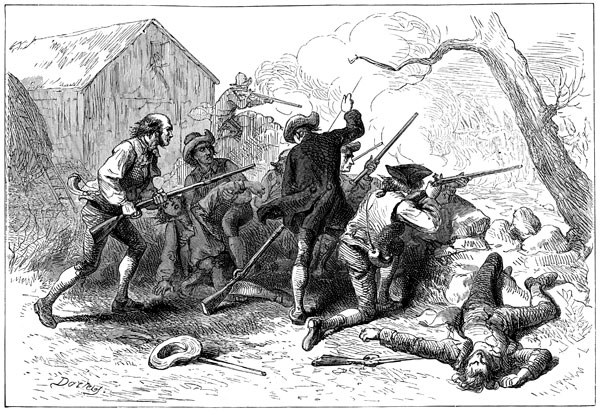
These men died on April 19, 1775, more than a year prior to the day we are about to celebrate, commemorating the 250th anniversary of the signing of the Declaration of Independence. They were the first to give their lives for our freedoms.
It was a lop-sided skirmish that lit the fuse – about 700 British against 77 militiamen assembled on the Common. A British officer yelled, “Throw down your arms! Ye villains, ye rebels.”1 Shots were fired. The British claimed they were fired upon; however, militia Captain John Parker later testified he ordered dispersion of his troops. Fifty years later he recanted; shots had been fired by his troops, but the British had still fired upon his men.
The Redcoats suffered one injury while eight militiamen died and nine were wounded. Most of the eight casualties have since been immortalized, their names attached to various Lexington public buildings. Briefly, their biographies (some briefer than others):
Samuel Hadley
Samuel Hadley was born on July 9, 1746 to parents Benjamin Thomas and Ruth (Lawrence) Hadley, one of twelve children. Four of their six sons served in the Revolutionary War, including Samuel who died on April 19, 1775.
In 2009 a Lexington public building was dedicated to the memory of Samuel Hadley. It was noted the Hadleys were farmers and pioneers who raised livestock for wool and crops such as flax which they wove into fabric. They were active members in community life, were prominent in local religious activities and served in a variety of military groups.2
Two hundred years later historians noted that Samuel Hadley and John Brown were “killed before they could clear the green.”3
Caleb Harrington
Caleb Harrington was born on October 27, 1751 to parents Moses and Sarah (Foster) Harrington. Though his family was poor and not prominent in the community, Caleb managed to acquire a piece of property to rent in 1771, perhaps the result of an indenture agreement entered into as a teenager.4
On that fateful day in 1775 Moses Harrington was on the green with his youngest son, as well as other family members (nephews and cousins). As Caleb and two other men went to the meetinghouse for more powder they were approached by a group of British officers on horseback.
In danger of being cut off, the three men decided to flee. One escaped harm, another was hit but survived. Caleb, a member of Captain Parker’s company, was shot and killed near the west end of the meeting house.
Jonathan Harrington, Jr.
He was one of three men named Jonathan Harrington present that day.5 Jonathan Harrington, Jr. was born in 1745 to parents Henry and Sarah (Laugthon) Harrington. He later married Ruth Fiske. Apparently their home was not far from the common green, as various legends claim that Jonathan, mortally wounded, crawled to his home and died at Ruth’s feet.
However, several years later John Munroe,son of Robert Munroe, testified that Harrington, along with his father, was killed on the Common.6 Orator Edward Everett gave a different account several years later, one which mirrored the legend:
Harrington’s was cruel fate. He fell in front of his own house, on the north of the common. His wife, at the window, saw him fall, and then start up, the blood gushing from his breast. He stretched out his hands towards her, as if for assistance, and fell again. Rising once more on his hands and knees, he crawled across the road toward his dwelling. She ran to meet him at the door, but it was to see him expire at her feet.7
An early twentieth century account would state Harrington fell near his barn, yet nine years later the same historian embellished the story thusly:
He is mortally wounded on the northerly end of the Common. Across the road is his home. He struggles to reach it, falls, but with renewed effort rises and staggers to his own door-stone. His wife meets him there, and he dies in her arms.8
Dramatically so or not, there is no doubt Jonathan Harrington, Jr. was a casualty that day.
Robert Munroe
As was the case with the Harrington family there were various members of the Munroe family on the common that day as well – and related by marriage or blood to the Harringtons.9
Ensign Robert Munroe appears to have been the oldest man killed that day, he having been born in 1712 to parents George and Sarah Munroe, and descended from Scottish immigrant William Munroe. He was also the first man killed:
The first man killed was Ensign Robert Munroe, sixty-four years old and a veteran of the French war. He had been a British color bearer in 1745. He had two sons, two sons-in-law and seven other relatives in the Lexington fight.10
Isaac Muzzy
Isaac Muzzy was a distant cousin to members of the Munroe family present that day11 and born to parents John and Rebecca (Reed) Muzzy on December 16, 1744. He was descended from immigrant Abraham Mussey who arrived in Massachusetts in 1633.12
Several buildings and landmarks in Lexington are named for this family.
Asahel Porter
As one source notes the parentage of Asahel Porter is unclear, but perhaps the son of William Porter.13 It is known, however, that Porter was a farmer from Woburn who, you might say, was at the wrong place at the wrong time.
On the morning of April 19 he and Josiah Richardson were on the road to Boston to sell their goods when they were accosted and arrested by British soldiers. Forced to march amongst the ranks heading to Lexington, Asahel Porter appears to have been attempting escape as they neared the Common. One historic account recorded:
They [Porter and Richardson] started for Boston and their route lay through West Cambridge. They were mounted on horses with their market stuff in panniers. Near West Cambridge they were halted by the advancing column of the British. In spite of their assertion that they were peaceable citizens, they were made prisoners and made to accompany the troops to Lexington. Here the British set them at liberty on condition they should go peaceably about their business. Richardson, walked off slowly, but Porter, after walking a few steps, started to run, when he was shot by soldiers.14
Felled near a wall, Asahel Porter was immortalized with a marble stone on April 21, 1875, one hundred years following his burial.15
Jonas Parker, Sr.
Jonas Parker was born on February 6, 1721, along with twin sister Sarah, to parents John and Sarah (Whitney) Parker. He and Sarah were the oldest children of twelve. Jonas became united with the Munroe family in 1745 when he married Lucy Munroe. John Parker, captain of the militia, was his cousin.
Jonas, while not as wealthy as his kin, is assumed to have been employed as some sort of woodworker or perhaps a wheelwright as noted by the inventory of his estate. He was also of strong character and unafraid:
Jonas Parker, the strongest and best wrestler in Lexington, had promised never to run from British troops and he kept his vow. A wound brought him to his knees. Having discharged his gun, he was prepared to load it again, when as sound a heart as ever throbbed for freedom was stifled by a bayonet!16
Jonas, Jr. was also present on the Common and is said to have witnessed his father’s death.
John Brown
Unfortunately, little seems to have been written about John Brown. While he may have had relatives present on the common that day, he was not related to the Munroe family.17 According to Massachusetts birth records, John Brown was born on August 12, 1751 to parents Daniel and Ann (Bright) Brown in Lexington.18
These were the first men of the Revolution to sacrifice their lives for the cause of liberty. Many like them died on future battlefields of the Revolutionary War, while some lived long enough to become pensioners. Some outlived them all. More on these war veterans and their amazingly long lives in a series which begins in the weeks following July 4, entitled “Celebrating America 250: The Last Men of the Revolution”.
 Thanks for stopping by! For more stories like this one, consider subscribing to Digging History Magazine. Purchasing a subscription entitles you to subscriber benefits (20% off all services, including custom-designed family history charts) AND a chance to win your very own custom-designed family history chart! Details here (or click the ad below).
 Footnotes:
- “Battles of Lexington and Concord”, accessed at
https://www.history.com/topics/american-revolution/battles-of-lexington-and-concord on June 25, 2018May 26, 2026. - Town of Lexington Massachusetts, accessed on May 27, 2026 at https://www.lexingtonma.gov/m/faq?cat=45#question-290.
- The Times and Democrat (Orangeburg, South Carolina), April 13, 1975, accessed at www.newspapers.com on May 27 2026, 6.
- The Lexington Minute Men, “American Revolution Biography about Caleb Harrington”, accessed on May 27, 2026 at https://lexingtonminutemen.com/wp-content/uploads/2025/06/caleb_harrington.pdf.
- Boston 1775, “Where Did Jonathan Harrington, Jr. Die?”, accessed on June 26, 2018 at http://boston1775.blogspot.com/2014/04/where-did-jonathan-harrington-jr-die.html.
- Ibid.
- Ibid.
- Ibid.
- Nutfield Genealogy, “Cousins at the Battle of Lexington”, accessed June 26, 2018 at https://nutfieldgenealogy.blogspot.com/2010/04/cousins-at-battle-of-lexington.html.
- Evening Star (Washington, D.C.), July 23, 1911, accessed at www.newspapers.com on May 27, 2026,16.
- Nutfield Genealogy.
- The Lexington Minute Men, “Biography of Isaac Muzzy”, accessed on June 26, 2018 at http://www.lexingtonminutemen.com/isaac-muzzy.html.
- Boston 1775, “The Mysteries of Asahel Porter”, accessed on May 27, 2026 at http://boston1775.blogspot.com/2010/04/mysteries-of-asahel-porter.html.
- William Richard Cutter, Transcript of Epitaphs in Woburn First and Second Burial Grounds:
Chronologically Arranged with Brief Illustrative Notes (Woburn: Andrew, Cutler & Co., 1890), 47. - The New England Historical and Genealogical Register for the Year 1875, Volume XXIX (Notes and Queries) (Boston: New England Historical and Genealogcial Society, 1875), 317.
- Fox Lake Gazette (Fox Lake, Wisconsin), August 4, 1859, accessed at www.newspapers.com on June 26, 2018, 1.
- Nutfield Genealogy.
- Ancestry.com. Massachusetts, Town and Vital Records, 1620-1988 [database on-line]. Provo, UT, USA: Ancestry.com Operations, Inc., 2011, accessed on June 26, 2018.