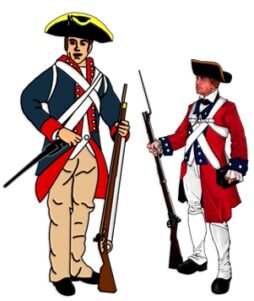
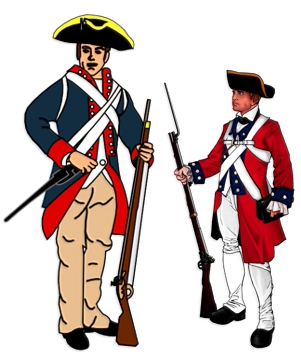
 One of the first things which compels many of us to begin our quest to learn more about our genealogical roots is the desire to find ancestors who had “fire in their bellies” during the volatile American era known as The Revolutionary War – the rebels and patriots. To be sure, it’s a matter of great pride and joy to find such an ancestor – or many ancestors if you are so fortunate – who either served on the front lines or provided aid and comfort to their fellow patriots. But, what about those ancestors who didn’t necessarily see eye-to-eye with their rabble-rousing friends and family, desiring instead to remain loyal to the British Crown? Even today some consider them traitors to the “American cause”, but shouldn’t we be curious to know their reasons? These days there are numerous resources available to discover more about our Revolutionary War patriot ancestors, but how do we uncover those on the “other side”? As it turns out, there are also vast resources for finding loyalists ancestors.
They called themselves “Loyalists”. The patriots – the rebels – called them “Tories”. To be considered a Tory meant you unwaveringly supported royal authority. On the other hand, patriots, such as the group who called themselves “Sons of Liberty”, had a decidedly different view. In the summer of 1765, the onerous Stamp Act spurred the formation of the organization known as Sons of Liberty. Ironically, the name was taken from a speech delivered in the British Parliament earlier that year when Lieutenant Colonel Isaac Barré, a British army officer and politician, referred to colonists resisting royal authority as “sons of liberty”.
Resistance had been on the rise for some time, and if the British government didn’t quite yet “get it”, Benjamin Franklin plainly informed them so in early 1766 as he testified before Parliament:
Q. What was the temper of America toward Great Britain before the year 1763?
A. The best in the world. They submitted willingly to the government of the crown, and paid, in their courts, obedience to the acts of Parliament. Numerous as the people are in the several old provinces, they cost you nothing in forts, citadels, garrisons, or armies, to keep them in subjection. They were governed by this country at the expense only of a little pen, ink, and paper; they were led by a thread. They had not only a respect, but an affection for Great Britain; for its laws, its customs and manners, and even a fondness for its fashions, that greatly increased the commerce. Natives of Britain were always treated with particular regard; to be an Old-England man was of itself a character of some respect, and gave a kind
of rank among us.
Q. And what is their temper now?
A. O, very much altered.
– Colonial agent Benjamin Franklin, before Parliament, February 1766 1
Even as he plainly spoke those words, Franklin himself yet remained loyal to the British government, this despite being fully aware of the growing resentment in colonial America. He was very proud of his British heritage and his goal had always been to ensure “that a consolidating Union, by a fair and equal Representation of all the Parts of this Empire in Parliament, is the only firm Basis on which its political Grandeur and Stability can be founded.” 2
Benjamin Franklin would, of course, eventually part ways with “the Empire”, but by this time he had made a career out of taking various royal government positions, most notably and recently as head of the American postal system. He himself would have likely been considered a “Loyalist” at the time, and later regarded with a great deal of suspicion even after he took his seat as Pennsylvania’s newest delegate to the Second Continental Congress in 1775.
In 1775 disdain for anyone calling himself(or herself) a loyalist was evident at a Philadelphia meeting attended by several men from Paxtang (Dauphin County):
In 1775 several Paxtang men were in Philadelphia. One of them, who belonged to that vilified class of ten years previous, the “Paxton Boys,” [vigilantes] denounced, in the presence of Mr. [Joseph] Galloway and other gentlemen whose loyalist sympathies were pronounced, those opposed to resistance to English oppressions as Tories: One of the latter asked, “Pray, sir, what is a Tory?” “A Tory,” promptly replied the patriot, “is a thing whose head is in England and its body in America and its neck ought to be stretched.” 3
And it wasn’t just the gentlemen – the ladies apparently had their own disdain of loyalists. One newspaper called it a “droll affair” which occurred in Kinderhook, New York:
The following droll affair lately happened at Kinderhook, New York. A young fellow, an enemy to the liberties of America, going to a quilting frolic, where a number of young women were collected, and he the only man in company, began his aspersions on Congress, as usual, and held forth some time on the subject, till the girls, exasperated at his impudence, laid hold of him, stripped him naked to the waist, and instead of tar, covered him with molasses, and for feathers took the down tops of flags, which grow in the meadows, and coated him well and then let him go.4
This incident occurred in the early fall of 1775, a few months after the first shots of the war were fired on Boston Commons on the 19th of April. Tensions had been escalating over the past decade since the onerous Stamp Act was imposed on colonial America, and patriot mobs tarring and feathering Loyalists wasn’t uncommon. Estimates vary as to just how many colonists remained loyal to the British Crown. Families divided over the question of loyalty.
According to a blog article at Ancestry, approximately one-third of all colonists remained loyal to the Crown, an estimated half-million. Who were these Loyalists? You could count on those who depended on a favorable relation with Britain to be Loyalists – businessmen, wealthy landowners and those employed in the service of the colonial government. Another element was the clergy of the Established Church.
These are the people patriots like Samuel Adams and John Adams had to contend with as they attempted to turn hearts and minds toward revolution. By then loyalty to the British Crown had been ingrained in American culture and the mindset of the citizenry. Why rock the boat?
Might you have ancestors who chose to “rock the boat”? For tips and resources to assist you in finding them, you’ll find them in this issue of Digging History Magazine, featuring Massachusetts and is long and storied history.
FYI, purchase a subscription to Digging History Magazine and you’ll receive this issue as part of the current promotion (see link below)!
 Thanks for stopping by! For more stories like this one, consider subscribing to Digging History Magazine. Purchasing a subscription entitles you to subscriber benefits (20% off all services, including custom-designed family history charts) AND a chance to win your very own custom-designed family history chart! Details here (or click the ad below).
Footnotes:
- “Franklin before the House of Commons”, accessed on December 17, 2024 at https://www.bartleby.com/lit-hub/a-library-of-american-literature/franklin-before-the-house
-of-commons/. - “From Benjamin Franklin to Lord Kames, 25 February 1767”, accessed December 17, 2024 at https://founders.archives.gov/documents/Franklin/01-14-02-0032.
- The Pennsylvania Magazine of History and Biography (Philadelphia: The Historical Society
of Pennsylvania, 1877), 880 (accessed on December 17, 2024 at https://archive.org/details/pennsylvaniamaga1902hist/mode/2up). - Frank Moore, Diary of the American Revolution: From Newspapers and Original Documents, Volume I (New York: Charles Scribner, 1860), 141 (accessed on December 17, 2024 at https://archive.org/details/diaryofamericanr01moor/mode/2up).