If you missed it, here’s Part 1 of this thought-provoking article, part of a series leading up to the celebration of America’s 250th birthday.
By the time of John McKnitt Alexander’s death in 1817 historians were busy ensuring New England and the middle colonies received prominence when documenting Revolutionary War history. As Syfert pointed out:
. . . the American Revolution began at the battle of Lexington; major battles were then fought in Boston, New York and Philadelphia; the winter at Valley Forge; and then . . . Cornwallis surrendered at Yorktown. Various other incidents might have occurred, and, oh yes, there was the Battle at Saratoga, but they weren’t worthy of particular attention. In short, if General Washington wasn’t there, it just didn’t matter.1
Was it regional prejudice as Syfert suggests? Perhaps so since, after all, the South was far less developed than northern cities and states for that matter. About the time of John McKnitt Alexander’s death, controversy was already brewing and Alexander’s record of the Mecklenburg proceedings (and subsequent declaration) were about to explode into a controversy which would grab headlines for decades (and decades) to come.
Southerners, and North Carolinians in particular, were galled by Northern claims of American historical superiority. Congressman William Davidson of Mecklenburg began to investigate how best to set the record straight and ensure the proper place in history his constituency deserved. The opening shots, you might say, were fired when Dr. Alexander published his article in 1819.
Most of the original controversy arose when Dr. Alexander didn’t adequately explain exactly how he had obtained a “true copy” (of what?). What had been passed into his hands were his father’s “rough notes” and a full page document, legible, but unsigned and undated. This is apparently the copy he used to send to William Davidson and the Register. He would note it was a copy in “an unknown hand”.
The papers had been found by Dr. Alexander in his father’s home along with a roll of pamphlets from the bygone Revolutionary era. No one has ever been able to definitively identify who produced the copy. As was the custom of the times, the April 30 story was picked up and printed in other newspapers, including the Essex Register (Salem, Massachusetts). Former President John Adams read the story and the crux of the decades-to-come controversy was formed.
Why would John Adams be so intensely interested in the Mecklenburg Declaration? After reading it, he was struck by the fact it sounded so similar in tone to Thomas Jefferson’s Declaration of Independence as to make him wonder if Jefferson had plagiarized the Mecklenburg Declaration. If you have seen HBO’s John Adams series you know how the two men drifted apart, especially following their bitter rivalry which climaxed with Jefferson’s narrow defeat of John Adams in 1800.
Yet, in later years when both were ensconced in retirement, they began to exchange correspondence in early 1812. Adams had once concluded Jefferson to be a fraud, a “shadow man”.2 The two men never agreed on much, if at all. They simply were polar opposites, both in politics and temperament.
Over the years of their renewed “friendship” they exchanged over 150 letters, although the vast majority were written by Adams. After reading the Mecklenburg account in his local newspaper he wrote to Jefferson wondering why he had never heard of this document. His missive implied, even if subtly so, that had Jefferson known of it he had deliberately concealed it. If he, John Adams, had been made aware of it he would have championed it all the way to July 4, 1776 himself. Perhaps his logic was, as Syfert wrote:
The subtext was unmistakable: You knew about this, and suppressed it. If you had not kept the Mecklenburg Declaration secret, I would have used it to lead a movement toward independence, not you. I would now have the credit for American Independence, not you. And now I have found you out.3
Surely now Adams had proof of what he had suspected all along – Thomas Jefferson was a fraud, perhaps a plagiarist. One sentence of his June 1819 letter to Jefferson said it all, referring to his new awareness of the Mecklenburg Declaration:
The genuine sense of America at that moment was never expressed as well before, nor since.4
Many of Adams’ letters were lengthy; this one was, by contrast, rather short – only 229 words. Yet, he managed to denigrate Thomas Paine and his Common Sense pamphlet, as well as point out more than once that the Mecklenburg Declaration was produced a year before Jefferson’s. Indeed, some passages of the 1776 document were strikingly similar in tone and wording. Could Jefferson really have been guilty of plagiarism? Adams certainly thought so, for it was evident to him Jefferson had “copied the spirit, the sense, and the expressions of it verbatim”5 as he had written to another correspondent, William Bentley, on July 5.
He and Bentley continued to correspond and it becomes more evident that Adams was convinced Jefferson was both a fraud and a plagiarist. What did Thomas Jefferson make of all this? Adams had enclosed a copy of the article in his June 22 letter. After reading the article and Adams’ letter he did indeed have an opinion.
Quite simply he wrote back, “I believe it spurious”, although he did backtrack a bit before closing the letter of July 9. He declined to outright proclaim the whole Mecklenburg document a fabrication, but instead decided to count it as fact until proven otherwise. Still, he ended the letter saying, “For the present, I must be an unbeliever in the apocryphal gospel.”6
Jefferson may have been attempting to appear diplomatic and even-handed in his response, but human nature would tend to assume he was “hot under the collar”. Adams, however, continued to “investigate” and correspond with Bentley. He simply would not let it pass and became increasingly concerned with the question of which came first, the Mecklenburg Declaration or the one he himself signed in 1776. Was Jefferson a plagiarist who had lifted passages from MecDec or was MecDec a fabrication which utilized passages of the Declaration of Independence in an attempt to discredit Jefferson and this vital piece of American history? Let the national debates begin!
Thomas Jefferson and John Adams died on the same day, July 4, 1826, appropriately enough, on the 50th anniversary of the Declaration of Independence. Fate often takes strange twists. Their years-long correspondence was discovered in 1829 and published excerpts became available. North Carolinians in particular were provoked after Joseph Seawell Jones wrote “A Defense of the Revolutionary History of the State of North Carolina from the Aspersions of Mr. Jefferson” in 1834.
To North Carolinians the Mecklenburg committee members were worth of glory and a hallowed place in history, not aspersion. Thomas Jefferson, not so much. Southerners rose together and defended the much-maligned Mecklenburg Declaration of Independence. The Southern Literary Messenger proclaimed “The Question Settled”7 in June 1839 since a man by the name of Peter Force had uncovered a 1775 newspaper which had published something referred to as “resolutions”. This would add a new layer of complexity to the controversy.
Were there two separate documents, one a declaration of independence and the other a set of resolutions, which by contrast were rather bland? To ardent and unwavering Jefferson supporters it was a stick worth chasing – and chase (and bash) they did for years to come. It would later appear Jeffersonians won out after all when William Henry Hoyt published a scathing book in 1907. The title said it all and set the tone for debate for years to come:
The Mecklenburg Declaration of Independence: A Study of Evidence Showing that the Alleged Early Declaration of Independence by Mecklenburg County, North Carolina, on May 20th, 1775, is Spurious
Blow by blow, Hoyt attempted to make mincemeat of MecDec, although he claimed to have at first attempted to write a defense of it. However, he would come to the conclusion that the “declaration” dated May 20 was really the “resolves” dated May 31, 1775 which Peter Force had discovered years earlier. Hoyt’s arguments were presented at length and included an extensive appendix of documents to support his conclusions.
In actuality his claims proved little, yet they were impressive enough to introduce widespread doubt as to the veracity of the whole Mecklenburg Declaration historical narrative. His approach, “death by a thousand cuts” as Syfert referred to it, was largely successful, however.
Through the years various witnesses to the events of May 20, 1775 had been interviewed and provided sworn testimony. After Hoyt’s claims became widely published others would be emboldened to challenge MecDec even more vigorously, sometimes viciously. A.S. Salley, Jr., a member of the South Carolina Historical Commission would hammer the historic claims of neighbor North Carolina. Salley was sure whatever testimony had been provided was either
coerced or coached.
On and on it went. North Carolinians continued to celebrate May 20 as a hallowed day in their history, while detractors continued to argue otherwise. Even after an important document, a diary entry written by a Moravian who happened to take note of Captain Jack’s passage through his neck of the woods during the period of time in question, the debate continued to slant toward disbelief.
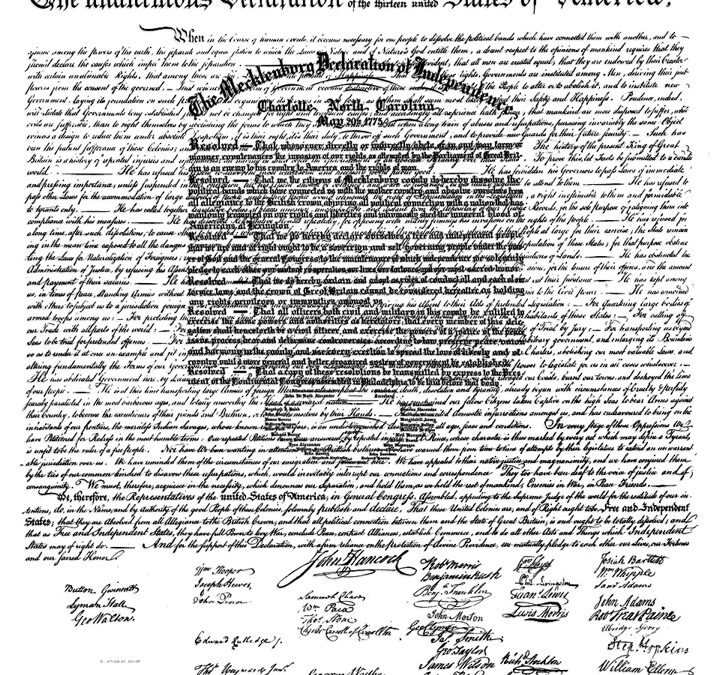
In 1906 a supporter of MecDec produced a copy with “signatures”. While there had been earlier attempts to fraudulently produce the document, this one was merely meant to be commemorative in nature. Still, it engendered more controversy and derision. MecDec deniers simply would not relent.
Over the years massive amounts of ink have been spilled in defense or detraction of the Mecklenburg Declaration. At times it seemed impossible to prove beyond doubt what actually occurred.
After reading Scott Syfert’s book, this writer tends to agree with his even-handed presentation and conclusions. He used the premise of Occam’s razor which is defined by Merriam-Webster as “a scientific andphilosophical rule that entities should not be multiplied unnecessarily which is interpreted as requiring that the simplest of competing theories be preferred to the more complex or that explanations of unknown phenomena be sought first in terms of known quantities.”
In other words, to use modern vernacular, “KISS – Keep It Simple (some add “Stupid”). The discovery of the Moravian diary would seem to provide adequate evidence and affirmation of the events of May and June 1775 in regards to the citizenry of Mecklenburg County. Syfert certainly believes it as his concluding views reveal. Yes, the Mecklenburg committee met on May 19 and on the 20th produced their version of a declaration of independence.
These men were a small group, yet given our knowledge now of what was brewing across the colonies, their views were largely representative of the masses. It was their fiery and patriotic sentiments which were not likely to have been necessarily meant for widespread publication, as happened later with the Declaration of Independence.
While not all historians supportive or otherwise may ever agree on whether any validity should be ascribed to John McKnitt Alexander’s “rough notes”, there is still the Moravian diary entry which also included a corroborative mention of a certain phrase from MecDec – “free and independent”. The phrase was not used in the so-called “Mecklenburg Resolves” of May 31.
Did North Carolinians make more of the events than was warranted? Perhaps, but one shouldn’t cast too much aspersion for their brand of patriotic pride. Many of their opinions and the state’s historical records were cast in stone long before corroborative evidence was uncovered.
While there are still plenty of detractors, it’s interesting to note some views swinging back in favor of MecDec. Commemorations in the form of murals, statues and plaques have appeared in Charlotte in recent years. As historian and author Andrew Roberts commented on the occasion of the 236th anniversary of MecDec in 2011: “if twenty-six North Carolinians say that something took place, my inclination as a historian is to believe them.”8
No matter. Historians love to quibble and query – it’s what they do, right?
Next up: Radical Presbyterianism (Seeds of Revolution?). Was there something else contributing to the particularly fiery brand of radicalism in Mecklenburg County?
 Thanks for stopping by! For more stories like this one, consider subscribing to Digging History Magazine. Purchasing a subscription entitles you to subscriber benefits (20% off all services, including custom-designed family history charts) AND a chance to win your very own custom-designed family history chart! Details here (or click the ad below).

Footnotes:
- Scott Syfert, The First American Declaration of Independence? (Jefferson, North Carolina: McFarland & Company, Inc., 2014), 104.
- Joseph J. Ellis, Passionate Sage: The Character and Legacy of John Adams (New York: W.W. Norton Company, 2001), 115.
- Syfert, 114.
- John Adams to Thomas Jefferson. -06-22, 1819. Manuscript/Mixed Material. Accessed on May 26, 2026 at https://www.loc.gov/item/mtjbib023532/.
- Jared Sparks, Edward Everett, James Russell Lowell, Henry Cabot Lodge, editors, The North American Review, Volume 118 (Boston: James R. Osgood and Company, 1874), 261.
- Thomas Jefferson to John Adams, July 9. -07-09, 1819. Manuscript/Mixed Material. Accessed on May 26, 2026 at https://www.loc.gov/item/mtjbib023565/.
- Southern Literary Messenger, “Mecklenburg Declaration of Independence” (Volume 5, Issue 6, June 1839), 417. (Accessed at http://quod.lib.umich.edu/m/moajrnl/acf2679.0005.006/427 on May 26, 2026.)
- Syfert, 2.