In honor of the celebration of America’s 250th birthday, this is the first in a series of articles in the coming weeks which are related to this momentous occasion. First up is a two-part article, a thought-provoking one, regarding our founding document, The Declaration of Independence.
May 20, 1775 or July 4, 1776?
Does that seem an odd question to put forth as America prepares to celebrate the 250th anniversary of the signing of its founding document? It’s settled fact the document originally drafted by Thomas Jefferson which proclaimed liberty for all is one of our country’s first and most fundamental founding documents, right?
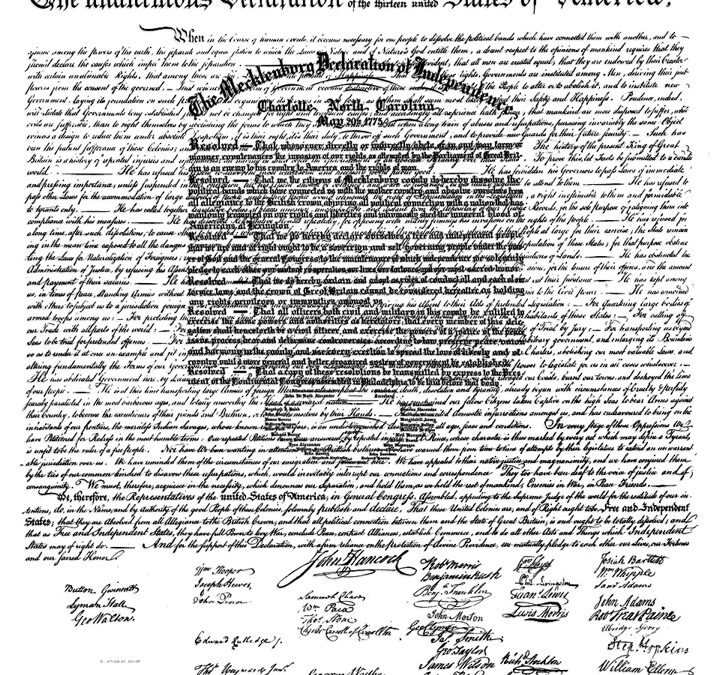
The image pictured below page is a composite of sorts, depicting what Americans know as the Declaration of Independence signed on July 4, 1776 overlaid with a somewhat questionable document. Some might even call it “fake” (the word is used a lot these days, isn’t it?). Note: Click the image to view the full image if you wish.
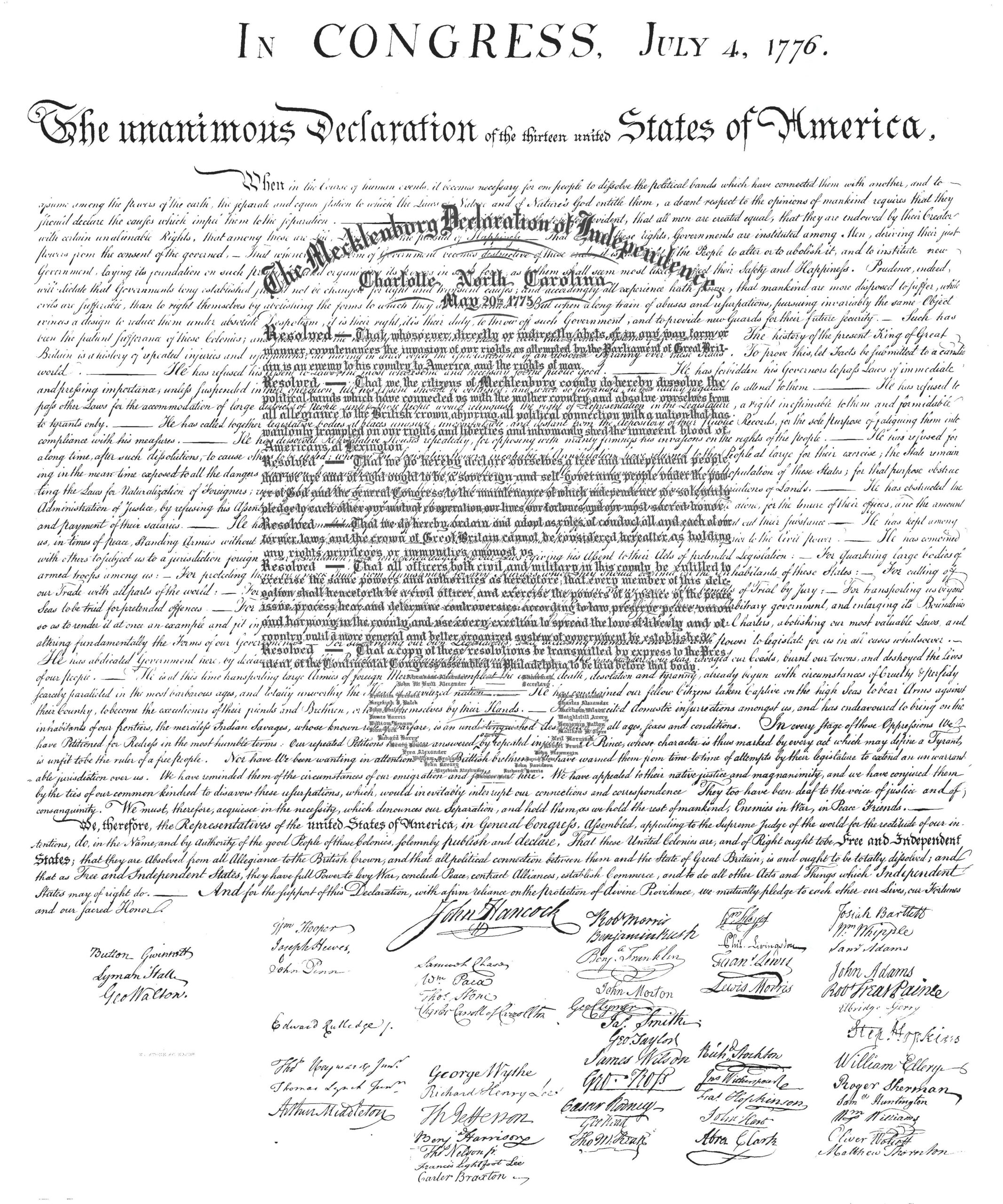
Indeed, many historians past and present insist the whole document, the so-called Mecklenburg Declaration of Independence, and its premise are fake, even preposterous. I confess to not having ever heard of the Mecklenburg Declaration of Independence until I was researching family history for a client and discovered her ancestor, John Davidson, was one of the signers of the document. Having no prior knowledge of the document (or the controversy), my inquiring mind wanted to know more. I found some answers and thoughtful insights after reading an excellent book entitled, The First American Declaration of Independence?, by Scott Syfert.
Since we’re approaching “Independence Month” let’s take a trip back in time and put ourselves in the place of our forbears who were growing increasingly agitated with distant and unrepresentative British governance. In May of 1775 news of an event which had occurred, quite shockingly the month before, in Lexington, Massachusetts, finally reached Mecklenburg County, North Carolina. Historians would later refer to this seminal event as “the shot heard ‘round the world”.
The night before several riders, including Paul Revere, had ridden through the countryside warning of approaching British troops. Just past sunup on April 19 the first shots rang out and eight militiamen were felled. The engagement wasn’t a battle, per se, as it’s since been romanticized – more of a skirmish. Nonetheless, eight Americans lost their lives and the fuse had been lit. News at that time traveled at the speed of an express rider, and about a month later word reached the North Carolina backwoods.
The meeting called in Mecklenburg County wasn’t necessarily extraordinary for the times. News of alarming incidents had triggered meetings, pamphlets, essays and newspaper diatribes for some time. In 1774 Rowan County (next to Mecklenburg) stood with Bostonians after the unceremonious tea-dumping incident in December 1773. If Boston was under duress and oppression, then so was Rowan County and the rest of America. One resolution put it rather succinctly: “the Cause of the Town of Boston is the common Cause of the American Colonies.”1
The pot was beginning to boil in Mecklenburg County as well. A summons was sent to the captain of each militia company throughout the county to appoint two persons to send to Charlotte with enough authority to put in action a plan to deal with increasing encroachment on their rights and liberty. At the time Charlotte wasn’t much more than a small village, but it was the county seat and location of the Mecklenburg County court house.
Although records of the meeting were lost in a fire at John McKnitt Alexander’s home in the early 1800s, the oft-repeated story has remained unchanged in North Carolina historical records.
The committee of men met, debated and drafted a set of resolutions, later called the Mecklenburg Declaration of Independence (or “MecDec” for short). Less than a page long, MecDec proclaimed the citizenry of Mecklenburg County “a free and independent People”2 who ought to be free to govern themselves. Furthermore, they proposed to “dissolve the political bands which have connected us to the Mother Country” and solemnly pledged “to each other our mutual cooperation, our lives, our fortunes, and our most sacred honor.”3
About 2:00 on the morning of May 20 all resolutions passed unanimously. One of the delegates, Captain James Jack, was recruited to express the committee’s declaration to Congress in Philadelphia. By mid-June Captain Jack had delivered his package and returning home carried a circular, or open letter, signed by North Carolina’s congressional delegates: Richard Caswell, William Hooper and Joseph Hughes.
Acknowledging alarming concerns of their constituents, the three congressmen urged citizens to prepare as other colonies were doing the same:
We conjure you by the Ties of Religion Virtue and Love of your Country to follow the Example of your sister Colonies and to form yourselves into a Militia. The Election of the officers and the Arrangement of the men must depend upon yourselves. Study the Art of Military with the utmost attention; view it as the Science upon which your future security depends.4
They spoke of readiness, watchfulness and resisting tyranny, then with this seemingly misplaced ending, wrote:
. . . look to the reigning Monarch of Britain as your rightful and lawful sovereign, dare every danger and difficulty in support of his person crown and dignity and consider every man as a Traitor to his King who infringing the Rights of his American Subjects attempts to invade these glorious Revolution principles which placed him on the Throne and must preserve him there.55
Huh? The final sentence seemed totally out of place with the preceding words. Why the hesitancy and caution in the ending? In actuality, while Congress was well aware of growing unrest of American colonists, they were still hoping to find a way to compromise with the Crown and avoid armed conflict. On July 5, 1775, just days following Captain Jack’s departure, Congress adopted the so-called “Olive Branch Petition”.
Clearly, Congress was tip-toeing around this delicate issue:
Your Majesty’s Ministers, persevering in their measures, and proceeding to open hostilities for enforcing them, have compelled us to arm in our own defence, and have engaged us in a controversy so peculiarly abhorrent to the affections of your still faithful Colonists, that when we consider whom we must oppose in this contest, and if it continues, what may be the consequences, our own particular misfortunes are accounted by us only as parts of our distress.6
They were displeased with the state of affairs in America, yet proceeded ever so delicately so as not to outright blame the King – merely his magisterial authorities. Congress needn’t have bothered to broach the subject so delicately as King George refused to even read the document. This was when Congress and all Americans realized war was inevitable. Thomas Paine’s pamphlet, Common Sense, was published in January 1776. On July 4, the Declaration of Independence was signed in Philadelphia. The history seems clear for all the above-described events. Thus, it begs the question as to why and when the Mecklenburg document became such a controversial piece of history. Good question.
MecDec became controversial years later, long after the Revolutionary War was fought and won, when an article submitted by “J. McKnitt” was published in the April 30, 1819 edition of the Weekly Raleigh Register. Dr. Joseph McKnitt Alexander
signed his name just as his father John had.
Dr. Alexander provided details of the Mecklenburg event, noting that Abraham Alexander was elected chairman and his own father elected clerk of the proceedings. He recorded each Resolve in the article and added that “bye-laws” had been added. The resolutions “were all passed, sanctioned and decreed unanimously, about 2’clock, A.M. May 20.”7
Dr. Alexander further wrote that Captain James Jack was sent to Philadelphia to deliver a copy of the Mecklenburg proceedings. He noted that the Captain, upon returning to Charlotte, informed his fellow committee members that while Congress individually agreed with the declaration’s sentiments, they deemed it premature to proceed further at the time. The joint letter sent back and signed by North Carolina’s delegation confirms as such. Again, what was controversial since it seemed to mesh with what one might refer to as “facts already in evidence”.
Perhaps it was how Dr. Alexander ended his article:
The foregoing is a true copy of the papers on the above subject, left in my hands by John McKnitt Alexander, dec’d. I find it mentioned on file that the original book was burned April, 1800. That a copy of the proceedings was sent to Hugh Williamson in New York, then writing a History of North Carolina, and that a copy was sent to Gen. W.B. Davie.8
While his father had maintained custody of all original papers, Dr. Alexander admitted most of them were destroyed in the 1800 fire. From whence came the resolutions published in the 1819 article? John McKnitt apparently attempted to reconstruct what he could from what remained. When he completed the task he sent at least one copy to General Davie, someone John had served with during the war. Historians refer to it as the “Davie Copy”.
It’s doubtful John McKnitt Alexander was concerned with what future historians would think of what he did to preserve an important part of history. In the ensuing years he would always claim it was the correct version of what transpired in May 1775. This was all well and good while residents of the area who recalled those events were still around to verify his claims, but when he and others began dying off it was harder to make those claims. As the Register’s editor pointed out in 1819, there may have been those in the community who were not aware of what had transpired in ‘75.
Stay tuned for Part 2 of this article next week.
 Thanks for stopping by! For more stories like this one, consider subscribing to Digging History Magazine. Purchasing a subscription entitles you to subscriber benefits (20% off all services, including custom-designed family history charts) AND a chance to win your very own custom-designed family history chart! Details here (or click the ad below).

Footnotes:
- Documenting the American South: Colonial and State Records of North Carolina, “Resolutions by inhabitants of Rowan County concerning resistance to Parliamentary taxation and the Provincial Congress of North Carolina”, Volume 9, pp. 1024-1026, accessed at http://docsouth.unc.edu/csr/index.html/document/csr09-0293 on May 26, 2026.
- William Henry Hoyt, The Mecklenburg Declaration of Independence: A Study of Evidence
Showing that the Alleged Early Declaration of Independence by Mecklenburg County, North Carolina, on May 20th, 1775, is Spurious (New York: G.P. Putnam’s Sons, 1907), 5 (accessed at https://www.loc.gov/item/07015929/ on May 26, 2026). - Ibid.
- The Colonial Records of North Carolina, Volume X: 1775-1776 (Raleigh: Josephus Daniels, Printer to the State, 1890), 22 (accessed on May 26, 2026 at https://babel.hathitrust.org/cgi/pt?id=wu.89067595553;view=1up;seq=71).
- The Colonial Records of North Carolina, 23.
- History.com (This Day in History), “Congress Adopts Olive Branch Petition”, accessed June 26,
2018 at https://www.history.com/this-day-in-history/congress-adopts-olive-branch-petition. - Weekly Raleigh Register, April 30, 1819, accessed at www.newspapers.com on May 26, 2026, 1.
- Ibid.