
American humorist Evan Esar once said, “a signature always reveals a man’s character – and sometimes even his name”.1 In the case of those highlighted in this article, their names more likely spoke volumes about the political leanings of the family they were born into.
I came across these years ago when I was writing “Tombstone Tuesday” articles for the Digging History blog. The more I researched the more of them I found. It was simply amazing to discover how many men were named “States Rights” and it appears that most, if not all, were born in Confederate or former Confederate states…hmm.
Many were born around the time of the Civil War. Some carried the name into the twentieth century. South Carolina seemed to have been a hotbed of states rights fervor – Union County in particular – before, during and long after the Civil War. Here are a few examples:
States Rights Aycock
He was born on July 29, 1933, son of Edmund and Lula Aycock. His great grandfather Jasper Aycock had a son named States Rights, born on December 23, 1860, three days after South Carolina seceded from the Union.
States Rights Crawford
He was born in March 1860, according to the 1900 census, to Benjamin Franklin and Emily Crawford. He died suddenly and unexpectedly on March 19, 1904. His obituary stated the town of Union was shocked by his death. He had been away on business in Atlanta, returned home a day after feeling a carbuncle (boil) coming on. He went to bed, “blood poisoning at once set in and after suffering intensely Mr. Crawford passed away.”2
States Rights Gregory
He was born in Union County, South Carolina on July 14, 1859 to William and Evaline Gregory. In 1860 and 1870 his full name was recorded and thereafter he would be enumerated as “States R.” or “States”.
States Rights Gist
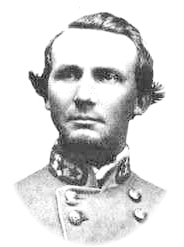 He was born in Union County, South Carolina on September 3, 1831 to parents Nathaniel and Elizabeth Gist, his name owing to his father’s “nullification politics”3 His family was wealthy, with roots dating back to early Maryland settlements.
After graduating from South Carolina College (later University of South Carolina) in 1852 he attended Harvard Law School for one year. States, as he was known to his family, returned home to South Carolina and was admitted to the bar in 1853.
Not long after his return States joined a local volunteer militia as captain, quickly advancing to aide-de-camp to the governor and promoted to brigadier general at the young age of twenty-four. His cousin, Governor William Henry Gist, appointed States as his special aide-de-camp, bringing him to Columbia to live in the governor’s residence. In April of 1860 States resigned his military position and worked full-time for his cousin.
With it appearing Republican Abraham Lincoln would win the election, the governor sent States to visit six other southern governors to gauge their support in advance of a likely secession convention. When Governor Gist left office in December 1860 the new governor, Francis Pickens, appointed States as his adjutant and inspector general, beginning in January 1861. South Carolina was the first state to secede on December 20.
States’ job was now a challenging one as he was tasked with overseeing the mobilization of military forces and keeping an eye on operations in Charleston. Fort Sumter fell into Confederate hands, and on April 14, 1861 he accompanied the Governor and General Beauregard to the fort to raise the Confederate flag.
While continuing to recruit troops for the Confederate Army he paid a visit to Richmond and was introduced to President Jefferson Davis and General Joseph E. Johnston. The General sent States as a volunteer aide-de-camp to General Barnard E. Bee at Bull Run on July 20.
When General Bee and one of his officers, Colonel Jones, were killed, States assisted Beauregard in commanding the regiment. Upon his return to Charleston he continued recruitment and by March 1862 had been commissioned as a brigadier general in the provisional Confederate Army. From May 1862 to May 1863 he would be in charge of defending the Carolina coastline.
Along with General William H.T. Walker of Georgia he would lead two brigades from South Carolina to join forces with General Johnston in Mississippi. They would participate in the Vicksburg and Jackson campaigns in July 1863. Walker’s division was sent to Chattanooga to merge with General Bragg’s Army of Tennessee in late August 1863. A few weeks later, as preparations were underway for Chickamauga, States was summoned for duty in the main army.
The brigade he led was just under one thousand infantryman and upon arrival he found himself being appointed acting commander of Walker’s division, Walker having been promoted to temporary corps commander. His brigade went right into the thick of things by plugging a hole in Breckinridge’s division. In the short span of forty-five minutes he would lose more than 170 men. He took charge again during the Battle of Chattanooga.
During the Atlanta campaign of 1864 he served again with Walker’s division. Walker was killed on July 22 and States suffered a hand wound. His brigade was again reassigned, back to Tennessee. On November 30, 1864 States Rights Gist was killed while leading his brigade on foot after his horse had been killed. He was buried near the battlefield; his remains were re-interred in Columbia, South Carolina in 1866.
Despite his lack of formal military training, his service was exemplary. “He was a strict disciplinarian and his brigade was deemed by superiors and peers to be one of the finest in the Army of Tennessee in appearance as well as in conduct. States Rights Gist was the model of a civilian gentleman turned solider.”4 No doubt, his father would have been proud.
States Rights Gist Finley
States Rights Gist Finley was the son of David Edward and Elizabeth (Gist) Finley and born on August 30, 1898 in York County, South Carolina, “on the day of the first primary election, while his papa was being nominated for congress.” David Finley served as a Untied States Congressman from March 1899 until his death on January 26, 1917.
Interestingly, States Rights Gist Finley had a brother named “Gist Finley”, but he would be known as either “States R.” or just “States” Finley. While States Rights Gist did not have any children (he had married in May of 1863), perhaps members of his extended family chose to later honor him by passing on his name.
States Rights Compere Fowler
He was born on June 9, 1860 in Yell County, Arkansas. His father, Coleman, had been born in Union County, South Carolina. In census records he was enumerated as “States R.C. Fowler” or “S.R.C. Fowler”. He died on February 17, 1937 in Yell County.
States Rights Sartor
He was born August 1862 to parents Joseph and Elizabeth Sartor in Monroe County, Mississippi. He is enumerated as “States R.” in 1880. He died in 1896 and his grave stone reads “Steven R. Sartor”. Perhaps he tired of his birth name?
States Wright Jolly
States Wright Jolly, as he signed his World War I draft registration in 1918, was enumerated both as “States W.” and “States R.” The Social Security Death Index referred to him only as “States Jolly”. He was another South Carolinian.
Not that it wasn’t common practice at the time, but it’s interesting to note many of them simply went by their initials “S.R.” One can imagine how someone might have wanted to conceal (or change) their real name following the South’s defeat, but most seem to have proudly borne it, and in some cases continued passing the name down through the family line.
It’s conceivable that female names were also influenced by the volatile time around the Civil War, as evidenced by a baby girl named Shellanna Marvilla (or Marviller) Holt. Born during the Atlanta Campaign in Jonesboro on August 30, 1864, family researchers claim she was named by Union General John “Blackjack” Logan. The bullets (shells) they were surely a-flying!
War time baby names popped up during World War II as well. In the days leading up to D-Day the world was on edge. Americans waited anxiously to hear word and many towns and cities across the country made plans to sound sirens when word came the invasion had begun. California’s war council, however, decided to forego the sirens because, according to Governor Earl Warren, it would “be bad to celebrate until we’ve won something.”5
Woodall Rodgers, Mayor of Dallas, Texas received a letter from the National Noise Abatement Council criticizing plans to sound sirens across the nation because it would create “unnecessary and needless noise.”6 Rodgers ignored the criticism and emphasized the city of Dallas would herald the nation’s push into western Europe.
 Those sirens began to sound in Texas between 2:00 and 2:30 a.m. on the morning of June 6, 1944. In Houston most retail stores were planning to close and more than four hundred churches opened their doors early that day for twenty-four hours of special prayer for peace and early victory.
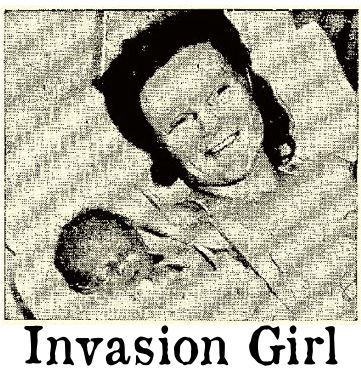
As sirens sounded in Dallas, a doctor arrived at the home of Mr. and Mrs. Lester Renfrow to delivered their baby girl. In honor of the faraway invasion, her mother proclaimed she would name her Invasia – Invasia Mae Renfrow.
News of her birth appeared in newspapers across the country, tucked in amongst war headlines. One newspaper displayed a picture of Invasia and her mother Willie Mae, surrounded by soldiers at war around the world – she was “Invasion Girl.”
The Renfrows weren’t the only family to patriotically name their newborn in honor of the day. In Norfolk, Virginia, parents Randolph and Alice Edwards named their daughter “Dee Day”. Patrolman L.B. Hoedling made it public after driving a member of the King’s Daughters staff to their home to deliver her.
The King’s Daughters started out as a small group of women in Norfolk, Virginia, all members of the Granby Street Methodist Church, who set out to make a difference in their community. These women from privileged families had never known hardship, yet they determined to care for the less fortunate. What they started in the late nineteenth century is now known as Children’s Hospital of The King’s Daughters.
Invasia Mae and Dee Day weren’t the only children born around that time with patriotically- themed names. Another baby had been christened SteVen, the “V” capitalized for victory. It appears to have been common at the time, as noted in a column by William J. Conway published in several newspapers in April 1950.
He was musing about that year’s census and the challenges faced by the census takers. “Enumerators the last time out came up with some unique combinations indeed. Such as Carbon Petroleum Dubbs, Early Christmas Bennett and States Rights Finley.”7 Conway reminded readers of the names which made headlines six years earlier and wondered if any changes had been made in those war-time names.
One baby born that day doesn’t appear to have made any headlines in 1944, but on June 6, 1964 it was observed, by obtaining a marriage license in Bozeman, Montana, that Earl D-Day Samuel Campbell had also been named in honor of the invasion.
The 1950 census records were released in 2022. Might there have been lots of kids named Ike, Winston, Franklin, Douglas or perhaps Patton? One thing’s for sure . . . it’s not likely we’ll find many (if any) named Adolph!
 Thanks for stopping by! For more stories like this one, consider subscribing to Digging History Magazine. Purchasing a subscription entitles you to subscriber benefits (20% off all services, including custom-designed family history charts) AND a chance to win your very own custom-designed family history chart! Details here (or click the ad below).

Footnotes:
- “Evan Esar Quotes”, accessed at https://www.brainyquote.com/quotes/evan_esar_105993 on April 27, 2026.
- Edgefield Advertiser, March 30, 1904, accessed at www.newspapers.com on April 27, 2026, 4.
- David S. Heidler and Jeanne T. Heidler, Editors, Encyclopedia of the American Civil War: A Political, Social, and Military History (New York: W.W. Norton, 2002), 843.
- Heidler, 844.
- San Bernardino County Sun, June 3, 1944, accessed at www.newspapers.com on April 27, 2026, 1.
- Dallas Morning News, May 29, 1944, accessed at www.genealogybank.com on April 27, 2026, 1.
- Greeley Daily Tribune, April 14, 1850, accessed at www.newspapers.com on April 27, 2026, 12.