
If you regularly research family history, you’ve probably come across occupations which you don’t recognize. Technology has steadily replaced, and made obsolete, many common jobs our ancestors performed. Even things which we find quite common today, weren’t at all common back then (if they even existed at all). For instance, not everyone in eighteenth century England had a clock or watch. This Industrial Revolution era (and beyond) occupation is indeed curious, or as Americans called it – “a queer English custom”.
 Once upon a time everyday working folks paid someone to “knock them up”. This, of course, elicits winks and giggles amongst us 21st century denizens as “knocked up” often refers to what Merriam-Webster calls “sometimes vulgar: to make pregnant”.1 There was nothing vulgar intended or implied as this quaint and curious English and Irish custom, begun during the Industrial Revolution and carried forward into the early twentieth century (and beyond for some locales), was an honorable occupation. Before alarm clocks were available and affordable, “getting knocked up” was essential to ensure working men and women avoided fines for arriving late to work.
It may have been a curious custom, but it was honest work for anyone willing to arise before anyone else in the neighborhood, and rain or shine, walk around tapping on their clients’ windows, or should I say “knocking them up”. They would advertise themselves as a “knocker-up” or “window tickler” and were paid perhaps two to three pence per week to make sure their client rolled out of bed on time.
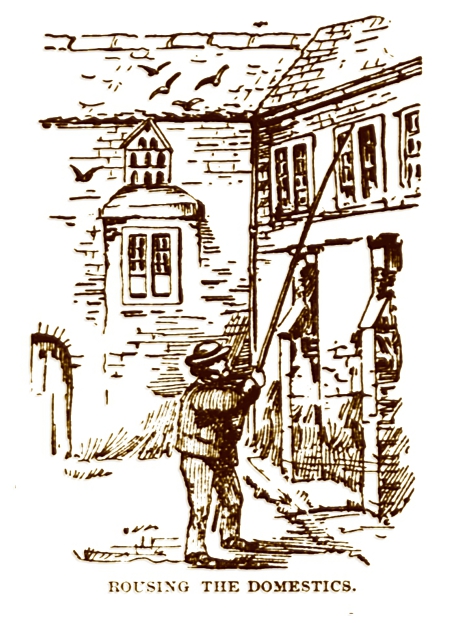
The work of knocking up the neighborhood was necessity on one side of the world, while on the other side Americans found it a “Queer English Custom”.2 For some it wasn’t a neighborhood job, but rather a part of their duties as caretakers at prominent residences. At Fullham Palace, the bishop of London’s residence, the lodgekeeper began working up servants around 5:30 a.m.
The palace knocker-up used a fifteen-foot pole known as a “rousing stave” to wake up the servants, knocking until the “wakee” gave “a more or less grateful answer in reply.” Although similar, there was a difference between the pole used in rousing the help and the one used during church services “directly upon the persons of inattentive or dozing members of the congregation.” The church rod was meant to bring slumbering congregants “a proper sense of their position.”3
During the era before alarm clocks were more readily available in the United Kingdom, one might see a card in the window of the general store: “Workmen called early in the morning. Terms moderate.” The Washington Post, musing about knockers-up in England, opined:
The “knocker-up” would have a much harder job in America than he has in England, for there he is favored by purely local condition. In the first place, the houses in the industrial sections are closely packed together in long rows, like the buildings in the business sections of American cities, and are very seldom more than two stories high. Thus the “knocker up” is able to quickly arouse an entire street of workers, the rattle and roar of his stick bringing the men and women promptly from their beds. And his work is expedited by the fact that many of the sleepers hear him while he is a dozen hoses away, and are out of bed and rapping on their windows in reply by the time he reaches them.4
In other words, a knocker-up would have a harder time making a living in America since buildings in larger cities were built so close together. Why pay for a knocker-up when the rap on your neighbor’s window is sufficient to arouse you? Perhaps the equivalent today would be people who “borrow” a neighbor’s Wi-Fi signal instead of paying for their own Internet service?
Not everyone appreciated their neighbors’ knocker-up at such an early hour, especially actors and actresses who tended to “sleep in” after arriving home late the night before. One London actress, a Miss Hay, was just dropping off to sleep when she heard a “weird sound against her window.” Startled, she rushed to the window and threw the curtains aside, and heard “Coom on, Joe,” shouted a voice. “Are you no gettin’ oop to-day?” The knocker-up had forgotten his regular client was away.5
Not only did the knocker-up arouse his clients, he even saved a few it appears. The London Evening News reported two women saved themselves from a burning house by sliding down sheets to the street. The fire was just below their living area and a knocker-up had sounded the alarm when it was apparent escape by the stairs would be impossible. The building was gutted, but the occupants were saved thanks to their neighborhood knocker-up.6
As well known as their services were in certain parts of England, one journalist was startled out of a sound sleep one morning after relocating to Lancashire. He also received quite an education about “knocking up” in the process:
TEN MINUTES WITH A “KNOCKER-UP”. When the present writer first settled in Lancashire, he took up his residence in one of a row of new houses – the landlord called them “villas,” but that is a detail. Early on the following morning he was rudely awakened by a sound at the window which can only be likened to the rattle of peas, though they seemed to be propelled by steam power through a “shooter” about fifty times the usual size. Jumping out of bed, he rushed to the window and pulled aside the extemporised blind, whereupon a cry, which sounded like “fire” came from below, followed immediately by the retreating clatter of clogs. This was puzzling, but in no way alarming, for the house, exuding moisture as it did from every pore, was as safe as a freezing chamber. Later the same day the mystery was cleared up. The supposed man with the pea-shooter practised the little-known industry of the “knocker-up,” and roused people at any time they liked by rattling wires, fastened to a long stick, against their window-panes; and, not being then accustomed to the new hours, he woke up the wrong man. “I was always a good getter-up,” said a knocker-up to the writer recently, “and some of the mean at the mill used to ask me to give them a call. I did, and for nothing, except, perhaps, a drink now and then; but when they got too many – I had to go to work myself – I charged them 2d. a week. I kept at my work until I was getting a bit done, and then, as I had got a pretty good connection, I started knocking-up for a living. I get up a four; sometimes earlier, especially in Whit week and holiday times, when people go off on trips; them I’m at it pretty nearly all through the night. But, as a rule, it’s four, and I’m done about six – yes, done for the day. It’s not so easy as you think. You see there’s a man in the next street here that wants calling at four, and another right over yonder at a quarter-past four. It’s a good walk. Well, then I have to come back here; and so I go on. There’s so much dodging about, arrange things how you like. I’ve above two hundred to knock up every morning, and they pay me 2d. a week; it takes me best part of Saturday afternoon to draw the money. Some knockers-up have a good many more than that, particularly the old widow women, but their sons or daughters help them, or, perhaps, an old couple manage it between them. How many knockers-up in Lancashire? I don’t know; I don’t think anybody does. Thousands, I should think. You see nearly everybody among working folk has a knocker-up, because they’re on the safe side then. If they get a few minutes late, they’re ‘baited’ (fined) or lose a quarter. Yes; I should hear about it if I stopped in bed till seven some morning. But sometimes I oversleep myself a bit, and then I have to tell them to look sharp, as I am late. Oh, yes; I have known knockers-up to miss a morning altogether; but they mustn’t do that very often, I can tell you. If they won’t do it right, somebody else will.” Thus the knocker-up. It may be added that in some places the charge for the service he does is 3d. a week, and that his industry is a favourite refuge for men when they become too old to follow their trade.7
Such was the life of one knocker-up who admittedly himself didn’t always “rise to the occasion” on time himself. One humorist mused a veritable tongue-twister about a knocker-up’s dilemma:
Tommy Jones was always late for work, so his employer approached him one morning and inquired what had made him so late.
“Well,” replied Tommy, “it’s this way. You see our knocker-up has a knocker-up that knocks our knocker-up every morning at four o’clock. Well, our knocker-up’s knocker-up didn’t come to knock our knocker-up up, so our knocker-up didn’t come to knock us up.”8
While the job normally provided steady income, a knocker-up was out of luck when worker strikes occurred from time to time. One such person ended up in court after he’d stolen a pair of boots, “pleading that because of the cotton lockout nobody wanted his services and that he was starving.”9
One knocker-up in particular was adversely affected during the same cotton lockout. He had been calling on clients every morning for forty years, his only occupation and sole means of support. Suddenly, two hundred clients didn’t need his services or perhaps couldn’t afford them during the lockout. In 1912 clients still preferred their reliable knocker-up to alarm clocks.10
One of Oldham’s best knocker-ups was a deaf and dumb man. Why was that? As one client explained, “He’s the best caller-up I could have,” because he can’t hear me when I should all right. I have to get out of bed and go down and push him away from the door.”11
Unfortunately, there were no knocker-up trade unions either to protect their livelihood in the event of work stoppages. In one town, however, knockers-up combined their efforts and began demanding advance payment.
For many years the profession was strictly male-oriented, but in the early twentieth century women began to pursue careers as knockers-up – an oddity for sure. Still it must have taken a special kind of person to arouse themselves before heading out to arouse others. Such was the case of Henry Wood, who years before had been nursed back to health by Florence Nightingale.
Despite the challenges of his chosen occupation, Henry seemed well suited for the task:
Leaving his bed every morning at four o’clock he is soon afterwards in the streets. He meets nobody but the friendly policeman as he goes from house to house and taps with a long stick at the bedroom windows of cotton-workers who pay him a few pence a week to do so. “Owd Harry” has to face many bitter and wretched mornings in the course of a year, yet he is hale and hearty and likely to go on rousing people to the duties of the day for a long time to come.12
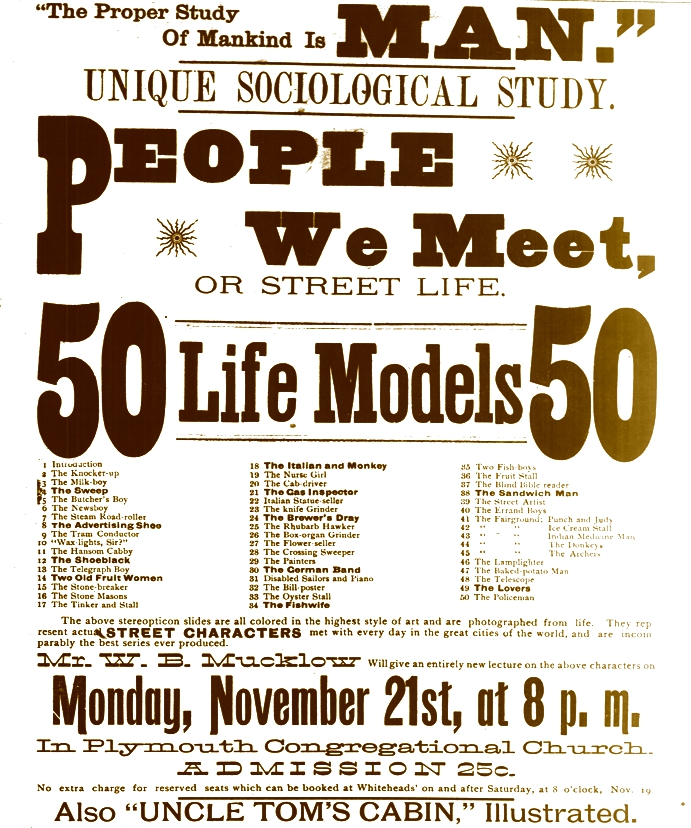 Despite occasionally over-slumbering themselves most knocker-ups were reliable. Indeed, it was true, according to Mr. W.B. Mucklow who produced a stereopticon slide show in 1892 – a sort of “man-on-the-street” exposé. Mucklow had met with every day “street characters” in the great cities of the world. At the top of his “50 Life Models” was none other than a knocker-up, followed by the milk boy. Other life models included “two old fruit women”, “the Italian and monkey”, “the blind Bible reader” and last of all “the policeman”.13
The profession eventually experienced a setback of sorts, as evidenced by a news blurb entitled “Persons Not Insurable”. In 1913 certain provisions of British law forbade the following men from obtaining insurance: “men who volunteer, or are asked, in a market, to put burrs under the wheels of vehicles, cover the horses, and adjust their nose-bags, while the drivers are in a shop, no payment for these services being promised; a ‘knocker-up’, engaged by various people to wake them daily for a fixed weekly payment.”14 Brits did have some unusual occupations, didn’t they?
When World War I broke out, knocker-up services were in even higher demand in Lancashire especially as workers went to work in military-related industries. It turned out to be a boon for a knocker-up who might normally receive up to three pence a week per client. Now that the war effort had kicked in, they could demand four pence as extra war pay.15
It appears the practice wasn’t going away even though the rest of the modern world had long since adapted to waking up to alarm clocks. During World War II certain areas of England still employed their friendly neighborhood knocker-up. Men were off to war and women took up the profession “in English mill towns, making the rounds and knocking on houses to waken workers in time to get to work.”16 Scotland adopted the practice briefly in 1941 when a shortage of alarm clocks for factory workers was noted.17
Alarm clock shortages aside, the reliable knocker-up was sorely missed in some communities. London’s Guardian held a poetry contest, offering “a first prize of two guineas and a second prize of one guinea…for Lines on the Alarm Clock’s Summons.” First prize was a clever acrostic:
A voice to all the houses crises: “Sleep no more!
Laggards and lie-abeds, awaken!
Abandon now the sonorous snore;
Rise up and get you read for
Munching your matutinal bacon!”
Cursing, I scramble out of bed; half-blind,
Look for the place I put my socks in.
Oh! what a bane this bell I find!
Cannot some keen, ingenious mind
Kindly invent an anti-tocsin?
Second prize was a short homage to bygone days:
The knocker-up with rattling canes
Rapped against the window-panes.
Nor did he cease his strident knocking
Until you “showed a leg” – or stocking.
Buy nowadays our chanticleer
Crows lustily beneath our ear.
Often from the bedside locker
We receive our morning shocker.
Do not ignore thus siren’s warning,
Or blitzed will be your busy morning.18
In the early 1950s there were still a few knockers-up awakening railway workers in Derby, England. However, in 1951 it was announced that English railroads had ended the “ancient job” of knocker-up:
Britain’s most unique jobholder – the “knocker-up” – had been declared extinct by a ruling of the nation’s socialized railways. Ever since trains began running in Britain, “knockers-up” have plodded before dawn through snow, fog and rain to awaken engineers and firemen in the big railway towns.
They knocked on doors until sleepy heads emerged from windows above and assured that the men behind the throttle would get to work on time.
But the railway management decided it could save about $840,000 yearly by asking the trainmen to wake themselves.
Today, 1000 former “knockers-up” were looking for new jobs. They predicted, however, that the muddle caused by their absence would convince the railway management to revoke its order before the month was out.19
Alas, it appears this was the end of the knocker-up. After years of indispensable service to mankind they were suddenly quite the opposite – “dispensable”.
******************
Postscript: Being a knocker-up wasn’t the only “curious profession” of the nineteenth century, however. Others included: “artificial ear and nose makers, prayer-makers, leg stretchers, saladmakers, knockers up and fourteenth men.”20
The “fourteenth man” was much in demand in Paris where, to avoid the awkwardness of having thirteen guests at a dinner, the “lucky man” always ready at a moment’s notice. This is, of course, in contrast to the Thirteen Club whose express purpose was to challenge the notion of the number thirteen being unlucky.
 Thanks for stopping by! For more stories like this one, consider subscribing to Digging History Magazine. Purchasing a subscription entitles you to subscriber benefits (20% off all services, including custom-designed family history charts) AND a chance to win your very own custom-designed family history chart! Details here (or click the ad below).

Footnotes:
- “Knocked Up”, as defined by Merriam-Webster, accessed on January 14, 2020 at https://www.merriam-webster.com/dictionary/knock-up.
- The Kansas City Gazette, March 1, 1892, accessed at www.newspapers.com on January 14, 2020, 4.
- Ibid.
- The Washington Post, May 19, 1912, accessed at www.newspapers.com on January 16, 2020, 3.
- London Evening News, February 11, 1915, accessed at www.newspaperarchive.com on January 16, 2020, 5.
- London Evening News, August 26, 1912, accessed at www.newspaperarchive.com on January 16, 2020, 3.
- London Middlesex Gazette, February 27, 1892, accessed at www.newspaperarchive.com on January 17, 2020, 6.
- The Gnowangerup Star (Australia), November 20, 1920, accessed at www.newspaperarchive.com on January 17, 2020, 1.
- London Evening News, January 16, 1912, accessed at www.newspaperarchive.com on January 17, 2020, 5.
- London Evening News, January 1, 1912, , accessed at www.newspaperarchive.com on January 17, 2020, 4.
- Ibid.
- London Evening News, December 7, 1903, accessed at www.newspaperarchive.com on January 17, 2020, 1.
- Salina Daily Republican, November 19, 1892, accessed at www.newspapers.com on January 17, 2020, 4.
- London Standard, July 5, 1913, accessed at www.newspaperarchive.com on January 17, 2020, 8.
- Vancouver Daily World, February 16, 1916, accessed at www.newspapers.com on January 17, 2020, 12.
- The Evening News (Harrisburg, Pennsylvania), March 12, 1942, accessed at www.newspapers.com on January 17, 2020, 22.
- Sioux City Journal, October 4, 1941, accessed at www.newspapers.com on January 17, 2020, 3.
- The Guardian (London), April 2, 1941, accessed at www.newspapers.com on January 17, 2020, 3.
- The Baytown Sun, August 4, 1951, accessed at www.newspapers.com on January 17, 2020, 2.
- Abilene Weekly Reflector (Kansas), January 15, 1891, accessed at www.newspapers.com on January 17, 2020, 6.