

 As genealogists we have all come across terms which are unfamiliar for one reason or another. Many times the word or terminology is obsolete, or it might mean something altogether different in the twenty-first century. Such was the case as I was recently researching maternal ancestors, investigating possible French ancestry after coming across my third great grandmother’s Widow’s Pension Application.
My seventh great grandfather, Henry Chadeayne, was born in France in 1678 and in 1740 was chosen as one of his town’s officers. In New Rochelle, New York Henry was appointed a “sessor”. The word is part of a common word used today, “assessor”, as in one who assesses or collects taxes. It was, however, some of the other offices which caught my attention. Uncertain of what the terms meant, I (as I am prone to do) set off on a little adventure to see what I could learn.
I should also mention I was intrigued by some of the meeting agenda items. Apparently, the question of where sheep were allowed to pasture was of great concern as a “Majority of Voices” voted “that Sheep shall be no commoners.”1 Since the term “commoner” today generally means someone who is of lower social status, I wasn’t sure what the word meant in this context. It appears the term refers to “commonage” which means the use of something, like a pasture, in common with others. But, I’ve digressed – back to civic duty.
Some of the offices were more familiar like “town clerk”, “constable” and “overseer of highways”. Pretty obvious what these positions entailed. However, what exactly was a “fence viewer”? Or, for that matter, what were the duties of a “pounder”? Along the way I ran across a few more.
Pounder
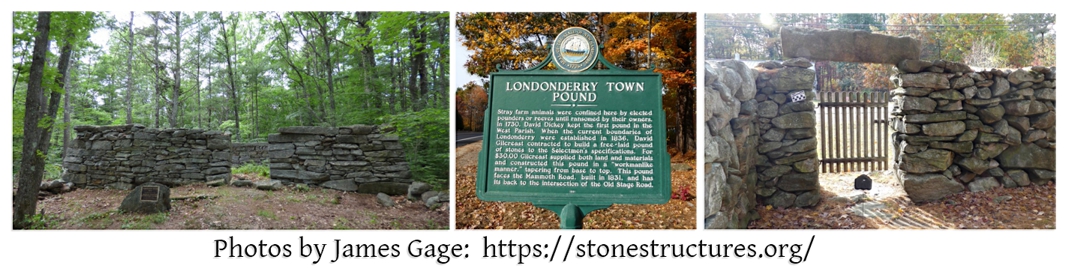
Ever hear the saying, “he couldn’t get elected dogcatcher”? In early America the job of pounder (or key-keeper) may have been similar to that of “dogcatcher”, but it wouldn’t have been referred to derisively, as in a low-level political appointment. A pounder was responsible for herding a variety of animals, whether stray or wild, into an enclosure of some sort (a pound) and often located on his own property.
As local customs and conditions necessitated, a town might pass ordinances regulating just how free animals were to roam throughout city limits. In the early 1800s these Connecticut towns were apparently needing to address the issue. In the case of Farmington, it seems just about anyone with a means to corral wandering animals could be a key-keeper or pounder – and apparently profit from it:
Be it enacted by the inhabitants of the town of Farmington . . . that no horses, cattle, asses or mules shall be allowed to go at large on the highways, commons, or uninclosed lands in said town; and it shall be lawful for any proprietor or holder of lands in said town, or any other person by his or her order, to impound any horse, cattle, ass, or mule, found or suffered to go at large as aforesaid, in a pound within said town nearest to the place where taken; and the owner or owners of such horse, cattle, ass, or mule, as impounded shall pay for each the sum of sixteen cents to the key-keeper, before the same shall be released from said pound, three-fourths for the use of the impounder and one-fourth for the use of the key-keeper.2
In 1800 a “bye-law, for restraining Geese and Swine, from going at large within the limits of the City of Norwich”3 was passed. While geese and swine wandering within the city limits faced imminent impoundment, the new ordinance only stipulated enforcement for precisely a period of one year and one month, enacted on (no kidding) April 1, 1800.
While animals may have been allowed to previously roam freely throughout a settlement, as small towns and townships grew into cities the citizenry wanted containment, preventing animals from “going at large”. I suppose “going at large” could be interpreted more than one way, couldn’t it? As far as being a pounder in days of old, it might have been a “dirty job” but someone had to do it.
Hog Reeve
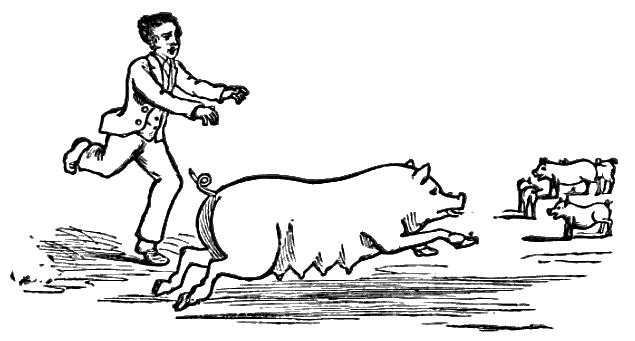
Much like a pounder, a hog reeve wrangled stray animals of the porcine variety. This particular civic office was common throughout New England, and an important one since hogs were seen as a menace by reason of their propensity to root around in local fields and gardens. Whereas a cow might eat the tops off a potato, a hog would dig it up.
By law all swine were required to be yoked and have nose rings. Part of a hog reeve’s duty was to outfit ring-less hogs, and charge its owner for neglect of the law.
 New Hampshire is an example of a state which still elects hog reeves, even if done so primarily in jest. In 1988 a young lawyer, newly-married, decided to run for hog reeve of Cornish, New Hampshire. Why?
Tradition dictates it, according to a 1989 Boston Globe article. Why the task would often fall to younger men may be somewhat debatable, however. The Globe suggested a reeve “may have been chosen from the town’s recently married men because they would be the most vigorous.”4 One genealogical resource suggests that “young men were adept at putting rings on young ladies’ fingers.”5
It was a vitally important issue early in New Hampshire’s history, as evidence by a law already on the books and in apparent need of further legislation in 1767:
AN ACT IN ADDITION TO THE LAWS OF THIS PROVINCE FOR REGULATING THE MANAGEMENT OF SWINE
Although lengthy and full of “legalese” the act points out the importance of preventing swine from “going at large un-ringed” since pigs were prone to root up soil, “destroying the meadow and pasture land, and the fruit growing on tilled land”. Since owners were often “careless of injuring their neighbours”:
Be it therefore Enacted by the Governor, Council and Assembly:
That no Swine of any kind shall be suffered to go at large, or be out of the inclosure of the owner thereof – And if the owner of any swine of any sort or kind shall suffer them he owns, or is possessed of, so to be, and go at large out of his or her inclosure, he or she shall forfeit and pay the sum of six shillings for the first offence, and twelve shillings for the second . . .6
Thus, while some New England towns passed local ordinances addressing such issues, in New Hampshire it was state law. Like many other towns throughout New England, New Hampshire also needed a fence viewer.
Fence Viewer
This civic position still exists today, although not exclusively in the New England area (some places in the Midwest still elect or appoint fence viewers). For example, someone serving as trustee of a small town or township or a county commissioner might have fence viewer responsibilities.
In early America, however, this civic position carried weight in terms of local governance. By the way, if your ancestor served as a fence viewer during the Revolutionary War (and you can prove it), you qualify to join either Daughters of the American Revolution (DAR) or Sons of the American Revolution (SAR) as a patriot descendant.
The Massachusetts Colony made provisions for fences in 1647 “For the better preserving of Corn from damage, by all kinde of Cattle, and that all Fences of Corn-fields, may from time to time be sufficiently upheld and maintained.”7 The job of fence oversight at that time fell to the selectmen of all towns:
for the repairing of all Fences both general and particular, within their several townships, excepting Fences belonging to Farms of one hundred Acres or above and have power to impose upon all Delinquents, twenty shillings for one offence; and if any Select men shall neglect to make Orders as aforesaid, they shall forfeit five Pounds to the use of the Town, and so for every Months default from time to time.8
Thus, so important was the job of fence viewer that if a selectman failed in his duties he would be required to pay the town for dereliction of duty. In order to prevent such dereliction, however, selectmen could appoint up to two additional persons per year to “view the Common fences, of all their Corn-fields, to the end, to take due notice of the real defects and insufficiency thereof.”9 Furthermore, any perceived defects or insufficiencies required proof provided by two or three witnesses.
A town’s fence viewer would take his job seriously, regularly walking through the town to “see that the fence be sett in good repaire, or else complain of it”.10 It was, of course, to an owner’s advantage to keep his fence in good repair. If he didn’t, and an animal broke through it, he would be liable for any damages. If the fence remained un-repaired the fine might be doubled and paid to the person who eventually performed the repair, often the fence viewer cum fence repairer.
Fence laws set requirements for sound construction as well as height limitations. In early America a “sufficient fence” would have been required to be at least four to five feet high. In New Jersey a sufficient fence would measure “Four Foot and Four Inches High.”11
Whether a fence viewer actually measured a fence’s height or just “eyeballed” it, one anecdotal account in Vermont newspapers in 1868 pokes a bit of fun (perhaps that state’s fence viewers took their work a little too seriously sometimes?):
FENCES AND FENCE VIEWERS IN MORRISTOWN:
Fence Viewers – E.M. Irish, weight 300 lbs; Leonard Wood, height 6 feet 8 inches, and “Banty” Terrill, size of a tame cherry!
Voted, That all fences upon which Irish could sit, that Wood couldn’t straddler, nor Banty crawl through, should be deemed legal fences!12
In addition to regularly inspecting a town’s fences, a fence viewer might be required to walk the town’s boundaries with its selectmen, an annual tradition meant to ensure a nearby town wasn’t encroaching upon their own:
“Beating the bounds” was a specially important duty in the colonies where land surveys were imperfect, land grants irregular, and the boundaries of each man’s farm or plantation at first very uncertain. In Virginia this beating the bounds was called “processioning.” Landmarks were renewed that were becoming obliterated; blazes on a tree would be somewhat grown over – they were deeply recut; piles of great stones containing a certain number for designation were sometimes scattered – the original number would be restored. Special trees would be planted, usually pear trees, as they were long-lived. Disputed boundaries were decided upon and announced to all the persons present, some of whom at the next “processioning” would be living and be able to testify as to the correct line. This processioning took place between Easter and Whitsuntide, that lovely season of the year in Virginia; and must have proved a pleasant reunion of neighbors, a May-party. In New England this was called “perambulating the bounds,” and the surveyors who took charge were called “perambulators” or “boundsgoers.”13
Fence viewers arbitrated boundary disputes as well. While New England and parts of the Midwest may have required the services of fence viewers, Westerners – Texans in particular – have at times mildly mocked the tradition:
A Connecticut editor has been elected fence viewer, and now calls upon all persons having fences to be viewed to bring them to his office.14
Three clergymen have been chosen fence viewers in Charlotte, Vt. They were given to railling [sic].15
Every state has fence laws, even Texas, although I couldn’t locate a record of the need for fence viewers in the Lone Star State. After all, who would have needed them when you had barbed wire?
 Thanks for stopping by! For more stories like this one, consider subscribing to Digging History Magazine. Purchasing a subscription entitles you to subscriber benefits (20% off all services, including custom-designed family history charts) AND a chance to win your very own custom-designed family history chart! Details here (or click the ad below).

Footnotes:
- Jeanne A. Forbes, Records of the Town of New Rochelle: 1699-1828 (New Rochelle, New York: The Paragraph Press, 1916), 238.
- Hartford Courant, January 28, 1823, accessed at www.newspapers.com on February 18, 2019, 3.
- Norwich Packet, March 27, 1800, accessed at www.genealogybank.com on February 18, 2019, 4.
- The Boston Globe, March 13, 1989, accessed at www.newspapers.com on February 18, 2019, 2.
- Barbara Jean Evans, A to Zax: A Comprehensive Dictionary for Genealogist and Historians
(Midlothian, Virginia: Hearthside Press, 1995 [Third Edition]), 136. - Acts and Laws of His Majesty’s Province of New Hampshire, in New England. With Sundry
Acts of Parliament, accessed on February 18, 2019 at https://books.google.com/books - Edward Rawson (Secretary), The general laws and liberties of the Massachusetts colony: revised & re-printed, by order of the General Court holden at Boston. May 15th. 1672, accessed on February 18, 2019 at https://quod.lib.umich.edu/cgi/t/text/text-idx?c=evans;cc=evans;view=text;idno=N00114.00
01.001;rgn=div2;node=N00114.0001.001:2.28. - Ibid.
- Ibid.
- Susan Allport, Sermons in Stone: The Stone Walls of New England and New York (New York: W.W. Norton & Company, 1990), 44.
- Allport, 47.
- The Burlington Free Press, March 17, 1868, accessed at www.newspapers.com on February 19,
2019, 4. - Alice Morse Earle, Child Life in Colonial Days (New York: The Macmillan Company, 1899),
314. - North Texas Enterprise (Bonham, Texas), May 17, 1873, accessed on February 18, 2019 at
https://texashistory.unt.edu/ark, 4. - The Dallas Daily Herald, March 23, 1876, accessed at www.newspapers.com on February 18, 2019, 1.
One of my husband’s ancestors was listed in a early census as being an “ostler” which, as it turns out, is someone who looks after the horses at an inn … a stable hand, if you will. I’m not gonna lie, I had to look it up!
Norma, good to hear from you! That’s a term I’ve never heard. I’ll have to file that one away for a future article 🙂