

Thomas Jefferson Roach and His “Sister Wives”
I don’t mean to imply “Sister Wives” (as in the TLC reality show of the same name) meant Thomas Jefferson (“T.J.”) Roach was a polygamist. Quite the contrary, since according to family history Thomas was of the Baptist faith. He does, however, have a unique story.
Thomas Jefferson Roach was born on August 25, 1825 in Orange County, Virginia to parents William and Tincey (Row) Roach. On January 27, 1845 T.J. married Alice Farish in Caroline County, Virginia. Census records indicate their first child, Eugenia, was born around 1849.
By 1860 the family had migrated from Virginia to Cherokee County, Texas. Their oldest son, George W., was nine years old that year and had been born in Virginia. The next child, John, was six years old and had been born in Texas. Presumably the family migrated sometime between 1851 and 1854. Two more children, Robert (4) and Mary K. (six months old) were also enumerated in 1860.
According to Cherokee County history T.J. owned and operated a sawmill on Tail’s Creek in Pine Town (now Maydelle). From November of 1856 to April of 1860 he was Postmaster of Pine Town, this in addition to farming. Thomas was a deacon and one of the charter members of The Pleasant Grove Missionary Baptist Church, organized on September 16, 1854.1 In 1855 he had been named a squire which meant he could perform wedding ceremonies.
There is no official record of Alice’s death, although family historians believe she died around 1861 en route to Virginia, perhaps to visit her mother, Clementine, who had been widowed in 1845 when her husband, George Buckner Farish, passed away. It is presumed Alice was buried along the way in an unmarked grave, perhaps in Louisiana or Mississippi. One source, The Tracings, indicates Alice appears on a Mortality Schedule with a death date of April 1860.2 This is curious, however, since she was enumerated on July 23 in Cherokee County for the 1860 census. If true, it seems more likely the family departed sometime after the census date, especially if she died in 1861.
Alice was decidedly unhappy with life in Texas. T.J., like so many others, had come to Texas to seek his fortune, but Alice longed to go home to Virginia. In letters back home she wrote of her contempt for the life T.J. had chosen for his family:
I would rather be poor in Virginia than rich in Texas. . . Texas is a poor man’s country. You have no idea how many poor people there are in Texas. It takes all they have to bring them here and many of them would leave but they have not the means to leave with. They are moving constantly from one portion of the State to another. You rarely see a family but that they are willing to move . . . Texas is a rough country to live in. We have a plenty coarse diet, but I can tell you that dainties are a rarity. Mrs. Herndon says she had to eat so much corn bread that it scratches her throat. She likes Texas as bad as I do. They use the great-quantity of coffee, tobacco and snuff. You seldom meet with a lady young or old but that they use snuff and tobacco. Mr. Roach married a couple last Thursday and he said there as 150 persons and nearly every lady after supper had a pipe in her mouth. Would you not think they were well smoked?3
Perhaps the journey, which would cost $700 round-trip, was a compromise of sorts between the reluctant wife and her fortune-seeking husband.
Although no official records appear to exist, family historians estimate T.J. married Sallie, his first “sister wife” in 1862. Sallie was Alice’s younger sister. In 1860, Sallie was still single and living with Clementine in Caroline County, Virginia. Sallie was available and Thomas needed a wife to raise his children. The couple returned to Texas, although it’s unclear when that occurred. Of note, Alice and T.J.’s youngest child Mary (Mollie) was left with family in Virginia, never to be reunited with her father and siblings in Texas. Mollie apparently never married either.
Sallie died not long after their return from Virginia. Thomas served during the Civil War, joining the Texas 35th Cavalry, Company F, in September 1863. As a 1st Sergeant he served under the command of Captain John T. Wiggins of Rusk. Where the children lived and were cared for during this period of time is unknown, although some records indicate that other members of the Farish family had at some point migrated to Texas.
On February 14, 1865, T.J. married his third wife, Mary Josephine Broome, in Cherokee County. The Tracings notes two children born early in their marriage did not survive. Around 1869 their son Eugene was born and in 1871 another son, Gus Wallace, was born.
Thomas also operated a steam-powered sawmill south of Pine Town. When the county decided to build their own transportation company (a horse-drawn tramway) after being by-passed the Houston and Great Northern Railroad Company. In exchange for company stock, Thomas agreed to provide crossties and narrow wooden rails. It was, without a doubt, a rather risky investment.4
While the railroad met with much excitement in Rusk at its opening on April 29, 1875, it had been constructed on a shoestring budget, utilizing prison labor from the Texas State Penitentiary, and already on shaky ground financially. T.J.’s contributions didn’t fare well, either, as it soon became apparent his rails proved woefully inadequate. Without infusions of stockholder capital, it all went bust in 1879 when the railroad was auctioned off for the grand total of $90.50. T.J. was never paid for the lumber provided.
Nevertheless, T.J. continued to lumber area forests, perhaps supplying wood to his father-in-law Cicero Broome, Josephine’s father. Cicero, born in North Carolina, left Alabama for Texas in 1848. For some time Cicero had been either a “gin maker” (1850 census) or in the milling business. He also owned a furniture factory, manufacturing “primitive wooden cotton gins and mill wheels”.5
While there is no official record of Josephine’s death, on March 23, 1876 T.J. was wed a fourth time to Elizabeth Bobbitt. Family historians report Elizabeth and her twins died in childbirth, presumably in 1877.
On November 14, 1877 T.J. married his second “sister wife”, Kate Bobbitt, who was Elizabeth’s half-sister by their father Anthony T.S. Bobbitt. According to census records, Kate would have been at least twenty-five years younger than T.J. By the time they were married most of Thomas’ children were grown – only Eugene and Wallace, children from his marriage to Josephine, remained with their father. To their family, T.J. and Kate added three more children: Nannie (November 1880), Thomas Jefferson (December 1884) and James (December 1886). T.J. continued to farm in Cherokee County and in 1881 took on the additional duties of Notary Public, which according to Cherokee County History, Texas Governor Oran M. Roberts had appointed him to that office.
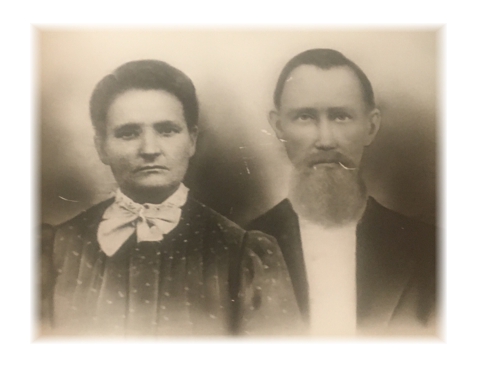 Although it isn’t known for sure which wife this is, given the number of short-lived marriages, this may be a picture of T.J. and Kate.
Thomas Jefferson Roach died on February 14, 1891 in Maydelle, Cherokee County, Texas. He was buried in what is today known as the Roach Cemetery in Maydelle. His sons Eugene and Gus Wallace are buried there, as are their wives and two of his grandchildren. Kate, the only one of Thomas’ wives to outlive him, married John T. Jones on December 17, 1900 and died in Rusk in 1919.
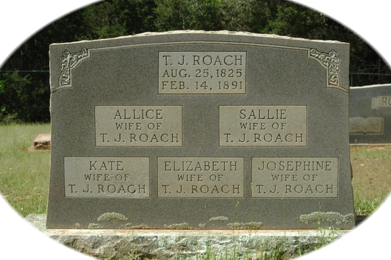
The life and times of Thomas Jefferson Roach and his wives demonstrate quite clearly the dangers faced by pioneers who left the comfort of their settled homes in places like Virginia, the Carolinas, Alabama, and Mississippi and joined hundreds of others who had “gone to Texas” during the great migration which took place in the nineteenth century.
With very few doctors to tend the sick and mothers in childbirth, many deaths occurred, leaving widows and widowers and motherless, fatherless children behind. And, with all the siblings, half-siblings, cousin marriages and the like, it’s easy to see why serious genealogical research is not for the faint of heart!
 Thanks for stopping by! For more stories like this one, consider subscribing to Digging History Magazine. Purchasing a subscription entitles you to subscriber benefits (20% off all services, including custom-designed family history charts) AND a chance to win your very own custom-designed family history chart! Details here (or click the ad below).

Footnotes:
- The Cherokeean, September 11, 1986, accessed at https://texashistory.unt.edu on March 12, 2026, 8.
- Anderson County Genealogical Society. The Tracings, Volume 14, Number 02, July 1995, periodical, June 1995; Palestine, Texas. (texashistory.unt.edu/ark:/67531/metapth37956/: accessed March 12, 2026), University of North Texas Libraries, The Portal to Texas History, texashistory.unt.edu; crediting Anderson County Genealogical Society.
- Cherokee County Historical Commission (Tex.). Cherokee County History, book, 2001; Jacksonville, Texas, page 479. (texashistory.unt.edu/ark:/67531/metapth354360/: accessed March 12, 2026), University of North Texas Libraries, The Portal to Texas History, texashistory.unt.edu; crediting Cherokee County Historical Commission.
- Idem, 11.
- Idem, 17.